Safety / Tips and Tricks / Rope access and confined space
Activity 01 · Rope access
Using PPE for Material Handling: Ground-Level Loads and Rope Access Work
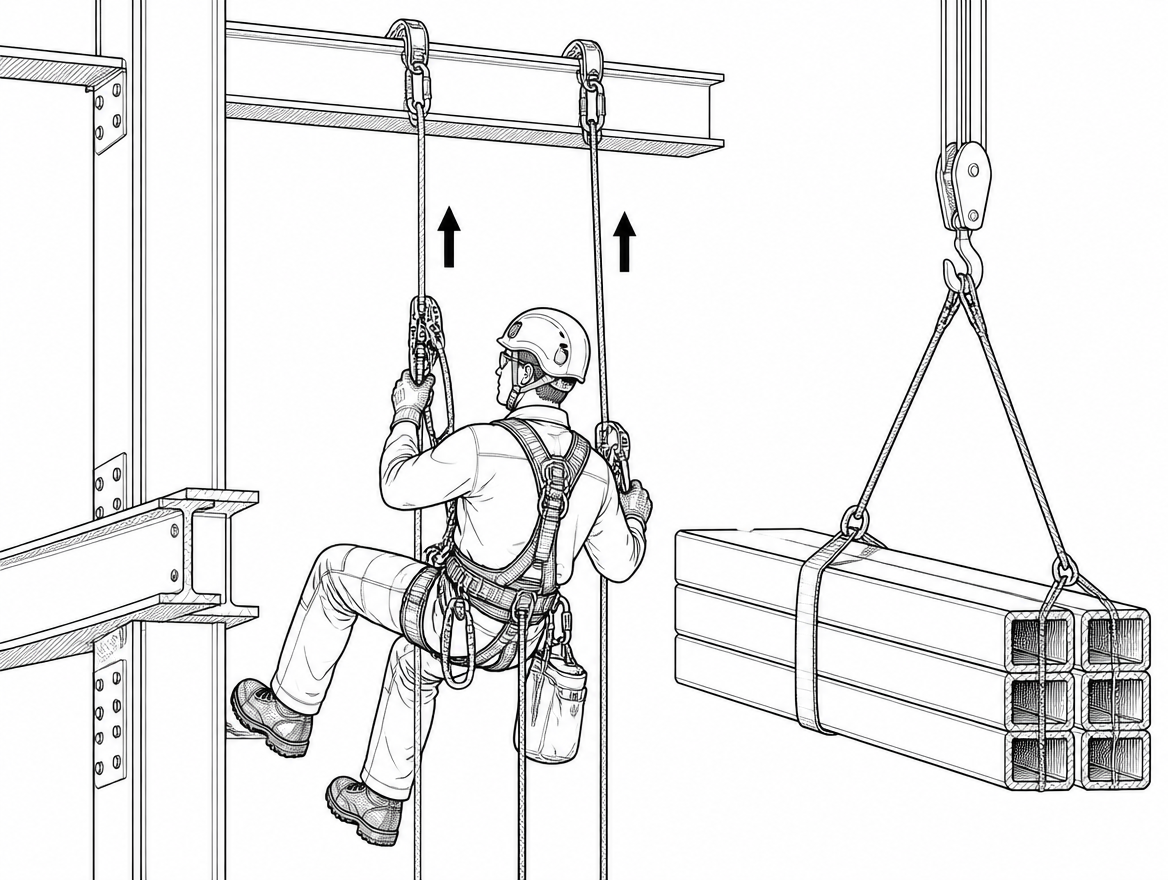
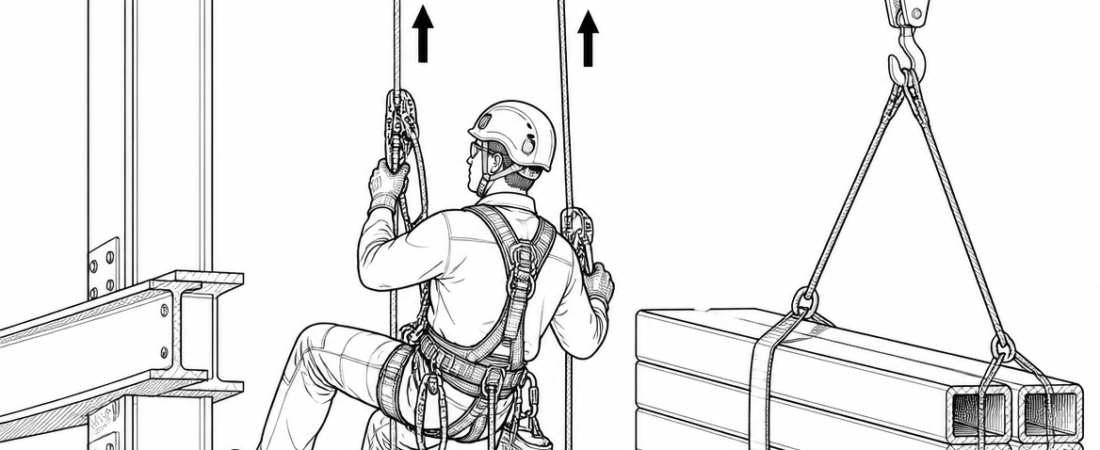
Material handling is where most of a site's PPE gets used and where most of it gets chosen badly. A glove that survives a week of moving steel sections may be the wrong glove for stripping banding; a boot rated for impact says nothing about the puncture risk of a stripped-out pallet; and a harness that is perfectly adequate for suspension becomes a hazard the moment someone clips a tool bag to the same attachment point they are hanging from. This article covers the PPE that matters when loads are moved by hand, and then the more specific question of PPE for material handling in rope access work, where the load and the worker share the same vertical space.
Two points frame everything that follows. First, PPE sits last in the control hierarchy: Directive 89/656/EEC requires PPE to be used where risks cannot be avoided or sufficiently limited by other means, and Directive 90/269/EEC on the manual handling of loads sets no EU-wide maximum weight — the obligation is to assess and reduce the risk, not to issue gloves and move on. Second, all PPE placed on the EU market must meet Regulation (EU) 2016/425; fall-protection equipment falls under Category III, which carries both type examination and ongoing production surveillance requirements. Category III equipment also brings a training and periodic-examination obligation with it.
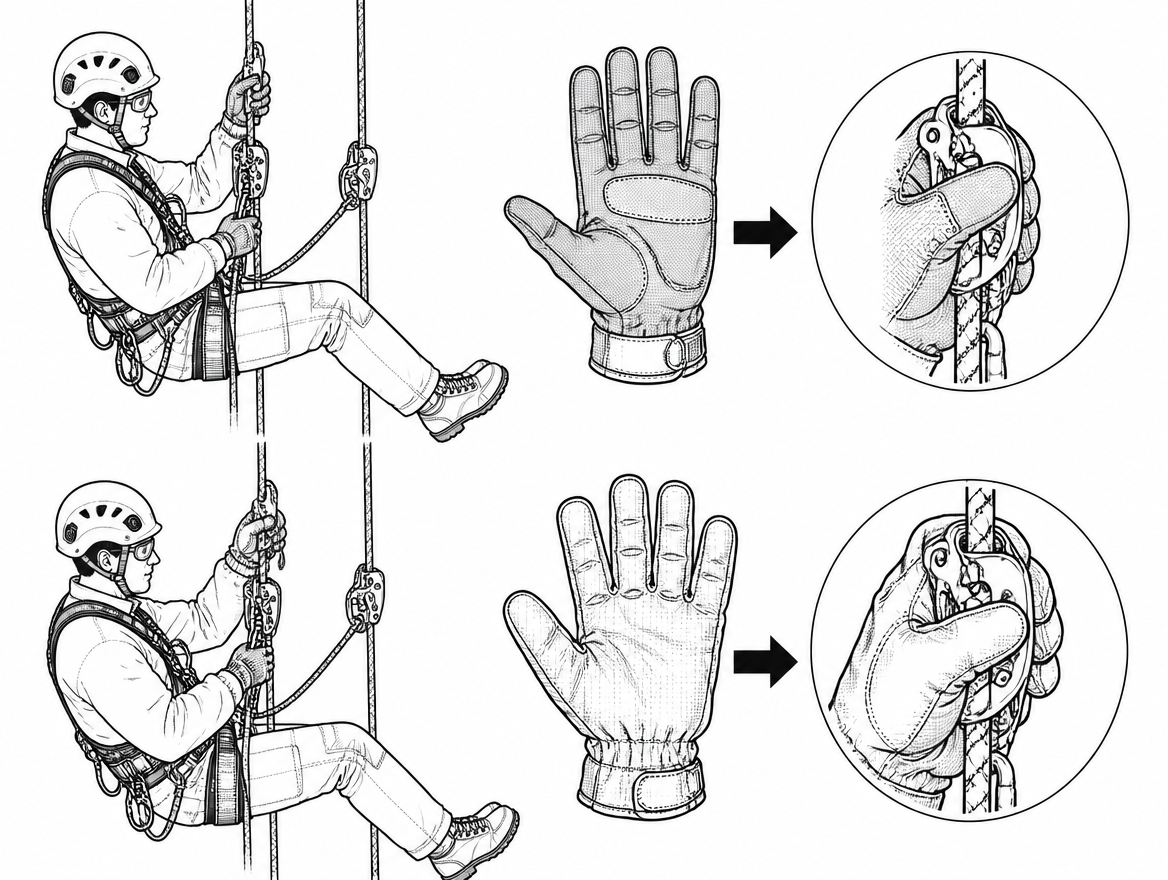
Hand protection: matching EN 388 performance to the actual load
EN 388:2016+A1:2018 reports mechanical performance in a fixed order: abrasion (1–4), coup-test cut resistance (1–5), tear (1–4), puncture (1–4), then TDM cut resistance to ISO 13997 on an A–F scale, with an optional impact designation. The A–F value is the meaningful one for sheet metal, glass and strapping, because the coup test loses reliability against materials that blunt the blade.
Common mismatches in material handling:
- Sheet metal, glass, cut band steel: select on the ISO 13997 letter grade, not the coup-test number, and check that the cut protection extends to the palm side of the fingers and thumb crotch where the edge actually runs.
- Blockwork, kerbs, timber: abrasion and tear performance, plus impact protection across the back of the hand where loads are set down.
- Hot or cold loads: EN 388 says nothing about thermal risk — that is EN 407 (thermal hazards) or EN 511 (cold).
- Rotating or in-running nip points: gloves may need to be removed rather than upgraded. A glove that catches is worse than a bare hand.
Fit is a performance characteristic, not a comfort preference. An oversized glove reduces grip force and pinch precision, which increases both drop risk and the load on the forearm. Where handling alternates with operating rope access devices, gloves must not prevent the user from confirming that a cam has engaged or a connector gate has closed.
Foot protection: EN ISO 20345 designations that matter under a load
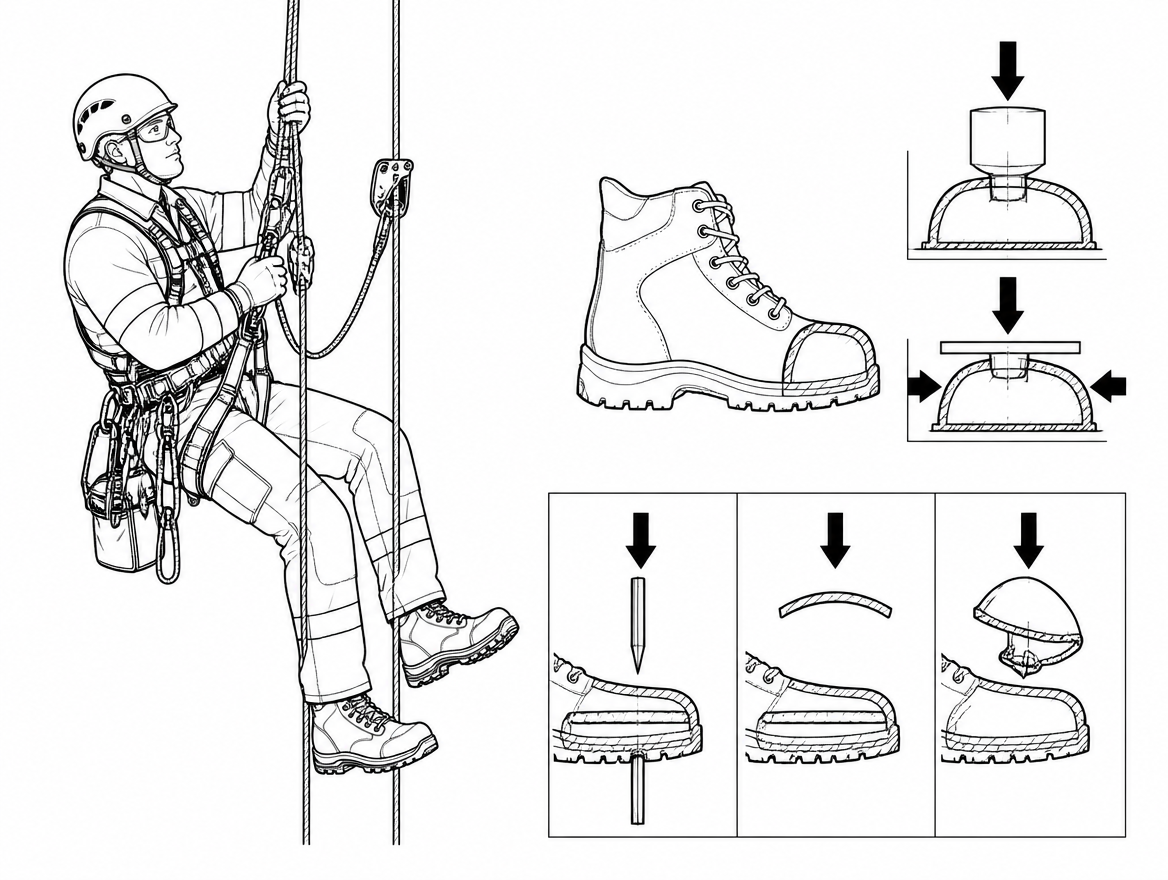
Safety footwear to EN ISO 20345 has a toecap tested to 200 J impact and 15 kN compression. That is the baseline; the rest of the designation carries the site-specific information:
- Penetration resistance — a metal insert (P) or a non-metallic textile insert (PL or PS in EN ISO 20345:2022, tested with different nail diameters). Non-metallic inserts cover a smaller area of the sole than steel plates, which matters on nail-strewn strip-out areas.
- Water resistance — S2 and S3 classes for handling in wet yards and concrete pours.
- Slip resistance — the SR designation, tested on ceramic tile with detergent under the 2021 edition. Carrying a load shifts the centre of mass forward and reduces the ability to correct a slip.
- Metatarsal protection (M) — relevant where loads are set down by hand rather than lowered mechanically; a 200 J toecap protects only the toes.
Head, eye and hearing protection during handling operations
EN 397 industrial helmets and EN 12492 helmets differ in a way that decides which one belongs on a rope access job. An EN 397 chinstrap anchorage is designed to release between 150 N and 250 N so the helmet cannot strangle a wearer whose helmet is snagged. An EN 12492 retention system must not release below 500 N, so the helmet stays on the head during a fall or an inverted position. For work in suspension, the retention behaviour of EN 12492 is the reason it is the usual choice; for ground-level handling under a crane path, EN 397 with its resistance to top impact from falling objects is the conventional selection. Some helmets are certified to both.
Eye protection to EN 166 uses impact symbols that correspond to test velocities: F (45 m/s), B (120 m/s) and A (190 m/s). Releasing steel strapping and cutting banding are low-mass, high-velocity events where F-rated spectacles are the minimum and a face shield is often better. Hearing protection to EN 352-1 (earmuffs), EN 352-2 (earplugs) or EN 352-3 (helmet-mounted) is a handling consideration wherever loads are dropped into steel skips or bins. For handling bagged cement, silica-bearing aggregate or dusty insulation, filtering facepieces to EN 149 (FFP2/FFP3) belong in the same assessment. Where handling takes place in vehicle or plant movement areas, high-visibility clothing to EN ISO 20471 is selected by class, with class 3 providing the greatest area of visible material.
One item deserves a direct statement: back-support belts are not PPE against a mechanical risk in the sense of Regulation (EU) 2016/425, and they are not a substitute for reducing load weight, carry distance or reach. Where they appear in a manual handling risk assessment, they should not be the only control listed.
PPE for material handling in rope access: the load never shares the worker’s system
Rope access work in the EU is governed by the temporary work at height provisions introduced by Directive 2001/45/EC (now consolidated in Directive 2009/104/EC). The core requirement is that the rope access system comprises at least two separately anchored lines — a working line for access, descent and support, and a safety line as backup — with the user connected to both.
The equipment set that implements this is specific:
- Rope: low-stretch kernmantle to EN 1891, normally Type A for rope access.
- Harness: a full body harness to EN 361 for fall arrest, with a sit harness to EN 813 providing the low ventral attachment used for suspension, and EN 358 attachment points where work positioning is needed.
- Rope adjustment devices: EN 12841 Type A (backup device on the safety line), Type B (ascender on the working line) and Type C (descender on the working line). The type letter is not interchangeable — a Type C descender is not a backup device.
- Connectors: EN 362, with locking gates. Mountaineering connectors to EN 12275 are a different specification and a different intended use.
- Anchors: EN 795, types A to E, each with its own installation conditions. Anchor selection is a structural question and belongs to the person who verified the anchorage, not to the technician clipping into it.
- Pulleys and hauling hardware: pulleys to EN 12278, with rated working load and rope diameter range confirmed against the rope in use.
The organising principle for material handling in this environment is that the load travels on its own system. A tool bag, a replacement panel or a bucket of sealant is rigged to an anchor line of its own, hauled or lowered on its own rope, and never introduced into the working line or safety line of a suspended person. That separation preserves two things at once: the redundancy of the two-line system, and the ability to release the load without affecting the technician.
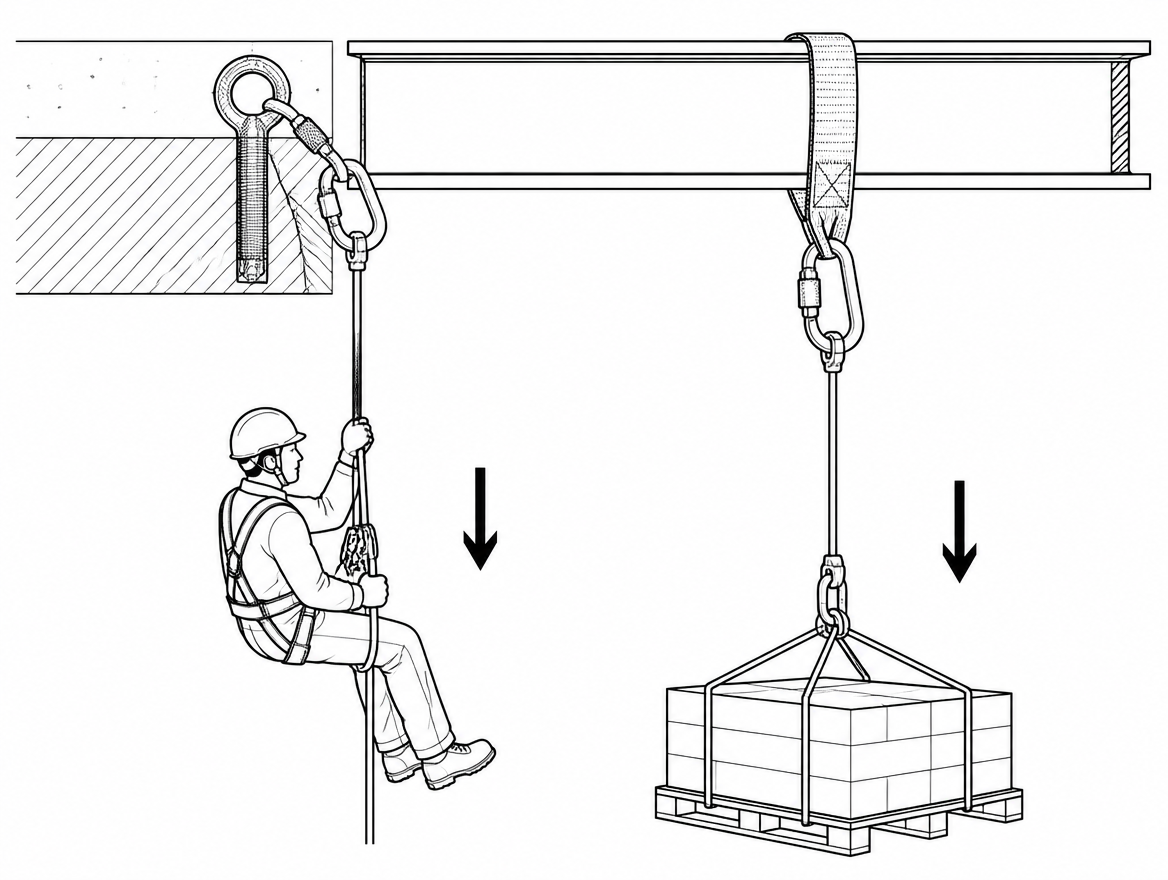
Load added to a suspended worker
Where small items must be carried on the person, three limits apply and all three come from documentation rather than judgement:
- Harness maximum rated load. Manufacturers state a maximum rated load that includes the user plus clothing, tools and equipment. Use the figure in the instructions for the specific model rather than an assumed 100 kg.
- Descender and backup device rated load. EN 12841 devices are marked with a maximum rated load and a rope diameter range; adding a heavy tool bag to the technician can move the total outside the tested range.
- Equipment loops are not attachment points. Gear loops on a sit harness are for carrying light equipment and are not rated for suspending loads or any part of the fall-protection system. Only the marked structural attachment points carry load.
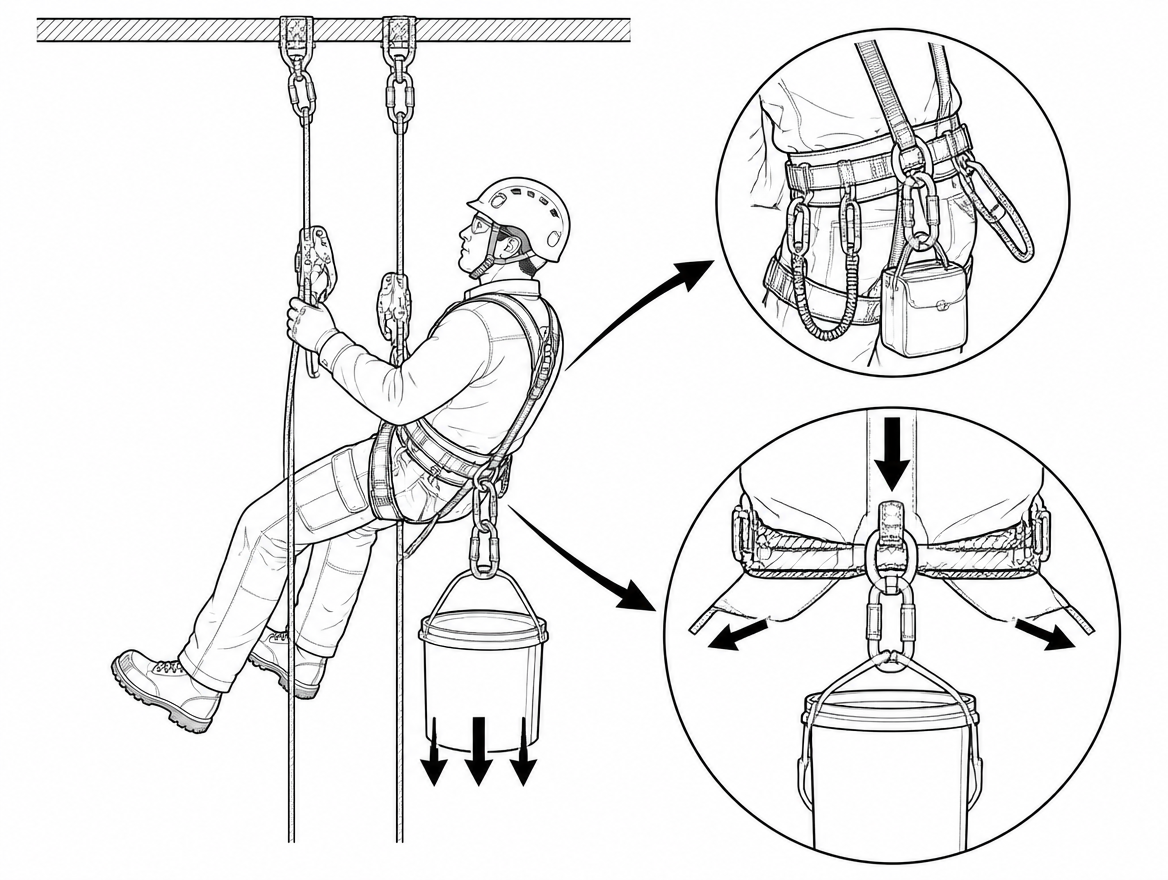
Dropped objects and the zone below
The person below the work is exposed to a hazard the technician’s PPE does nothing about. Controls are procedural and physical: an exclusion zone that accounts for wind deflection and bounce, closed tool bags rather than open buckets, and tool tethers on anything handled in suspension.
It is worth being precise about tethers: there is currently no harmonised EN standard for dropped-object tool tethers equivalent to the EN standards covering fall protection for people. They are selected on the manufacturer’s stated capacity for the specific tool mass, on the attachment method to the tool, and on the anchor point used — which should be a dedicated tether point, not the harness attachment used for suspension. Tethering a heavy tool to a harness attachment point converts a dropped-object event into a shock load on the user.
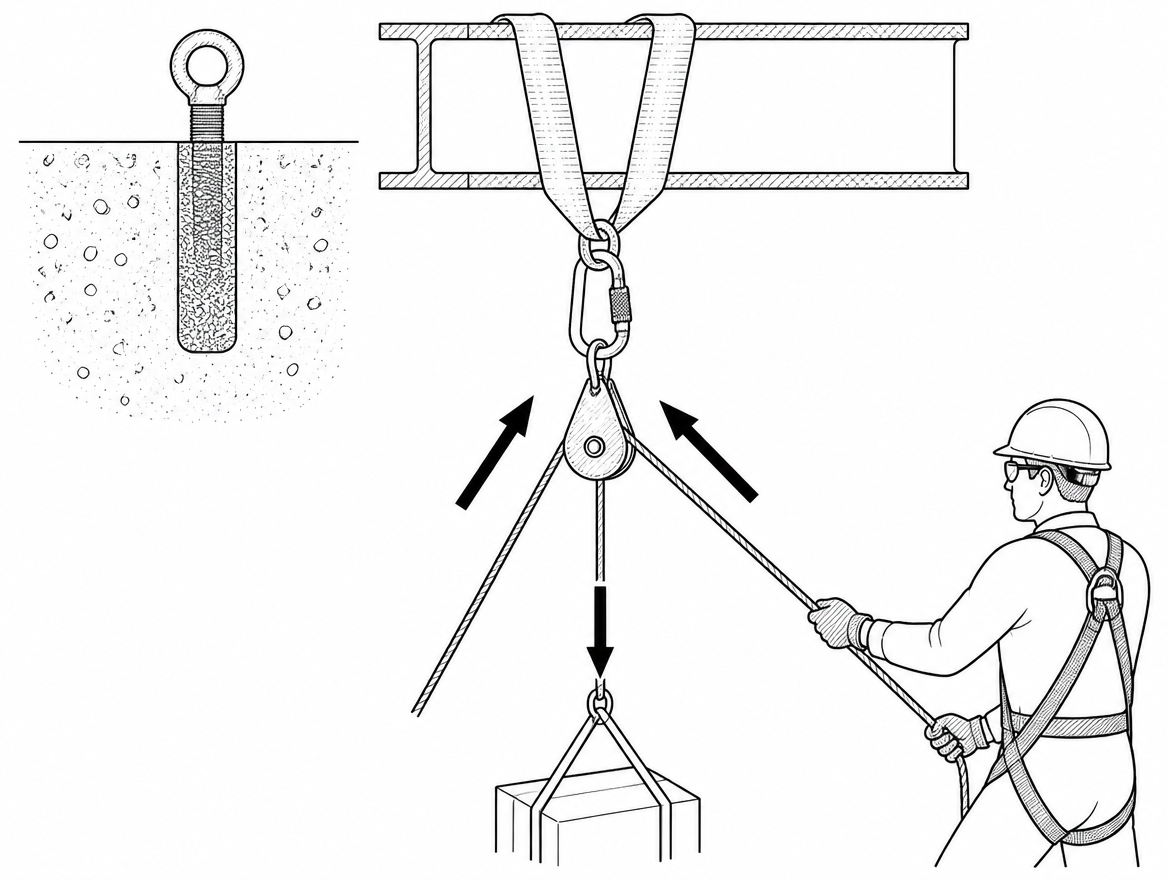
Hauling systems
Where loads are hauled rather than carried, the hauling system is lifting equipment and is assessed as such: anchor capacity for the resultant force (which, in a redirect, can exceed the load weight), pulley working load limit and rope compatibility, a progress-capture device suited to the rope diameter, and edge protection wherever the rope passes over a parapet or coping. Rope protectors and edge rollers are not PPE, but a haul rope abraded through at a coping edge produces the same outcome as a PPE failure.
Inspection, records and shelf life
EN 365 sets out the general requirements for instructions for use, maintenance, periodic examination, repair, marking and packaging of PPE against falls from height. Two intervals sit alongside each other:
- Pre-use check by the user, every time, before the equipment is loaded: rope sheath condition along the working length, harness webbing and stitching at load-bearing points, connector gate and locking function, device cams, springs and side plates, and legibility of the equipment’s own markings. Markings that can no longer be read make traceability impossible and are themselves a reason to withdraw an item.
- Periodic examination by a competent person at the interval given in the manufacturer’s instructions and at least every 12 months, recorded on the equipment record. For textile items used intensively — ropes, slings, harnesses — manufacturers commonly specify shorter intervals and a maximum service life from first use as well as from date of manufacture.
Chemical exposure is the failure mode most often missed on material handling jobs. Contact with cement slurry, solvents, battery acid or hydraulic fluid can degrade polyamide and polyester without visible damage. Contaminated textile equipment is quarantined and referred for examination rather than washed and returned to the rack.
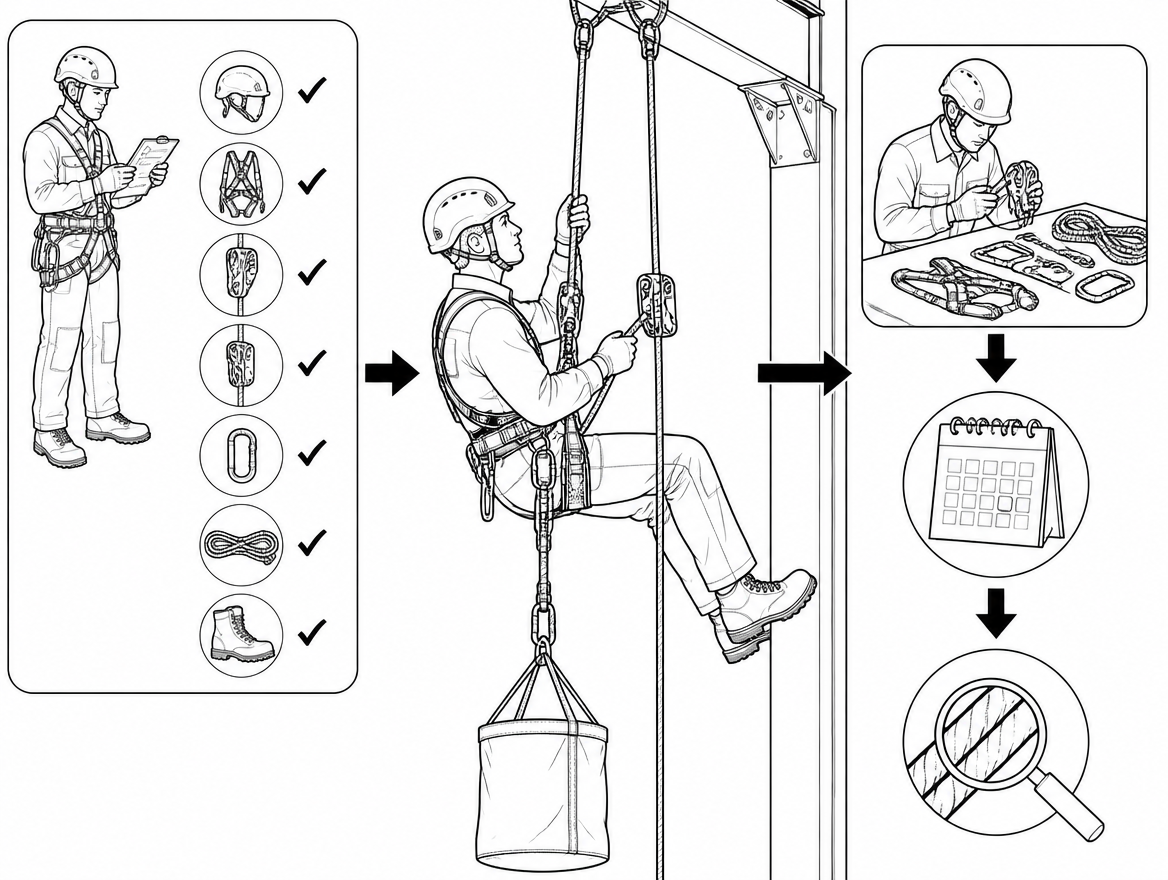
Where this sits in the management system
For organisations running ISO 45001:2018, the relevant hooks are clause 6.1.2 (hazard identification and assessment of risks), clause 8.1.2 (eliminating hazards and reducing OH&S risks, which sets the control hierarchy with PPE at the bottom) and clause 7.2 (competence). Clause 7.2 is the one that most often exposes a gap in material handling: PPE selection records exist, but there is no evidence that the person choosing between an ISO 13997 grade C and grade E glove, or between an EN 12841 Type A and Type C device, was competent to make that choice.
A practical next step is to take one live task where loads are handled in suspension and trace it end to end: the anchor verification for both the two-line system and the haul line, the maximum rated load on the specific harness and descender in use, the tether capacity for each tool going up, the exclusion zone below, and the current periodic examination record for every Category III item involved. Any point in that chain that rests on assumption rather than a document is where the next investigation will start. For the underlying requirements, the primary references are EN 365 for examination and documentation, EN 1891 and EN 12841 for the rope and devices, EN 361, EN 813 and EN 358 for the harness, and EN 795 for the anchors.
Frequently asked questions
Which EN 388 cut result should I use when handling sheet metal, glass or steel strapping?
Use the ISO 13997 TDM letter grade (A–F) rather than the coup-test number, because the coup test loses reliability against materials that blunt the blade. Also check that the cut protection extends to the palm side of the fingers and the thumb crotch, where the edge actually runs.
Does EN 388 cover hot or cold loads?
No. EN 388 says nothing about thermal risk. Heat and flame hazards are covered by EN 407 and cold by EN 511.
What does an EN ISO 20345 toecap actually protect against, and what is separate?
The toecap is tested to 200 J impact and 15 kN compression, and it protects only the toes. Sole penetration resistance (a metal insert marked P, or non-metallic textile inserts marked PL or PS in EN ISO 20345:2022) and metatarsal protection (M) are separate designations, as are water resistance (S2, S3) and slip resistance (SR).
Why is an EN 12492 helmet usually chosen for rope access instead of EN 397?
An EN 397 chinstrap anchorage is designed to release between 150 N and 250 N so the helmet cannot strangle a snagged wearer, whereas an EN 12492 retention system must not release below 500 N, so the helmet stays on the head during a fall or in an inverted position. EN 397 remains the conventional choice for ground-level handling under a crane path because of its resistance to top impact from falling objects. Some helmets are certified to both.
Are back-support belts considered PPE for manual handling?
No. Back-support belts are not PPE against a mechanical risk in the sense of Regulation (EU) 2016/425, and they are not a substitute for reducing load weight, carry distance or reach. If they appear in a manual handling risk assessment they should not be the only control listed.
Need this as a document you can issue? The template library gives you the risk assessments, permits and inspection logs in editable form — and employer plans cover a whole team with completion records.