Safety / Tips and Tricks / Rope access and confined space
Activity 01 · Rope access
Temperature and Chemical Limits for Textiles: What Ropes, Slings and Harnesses Tolerate Before They Lose Strength
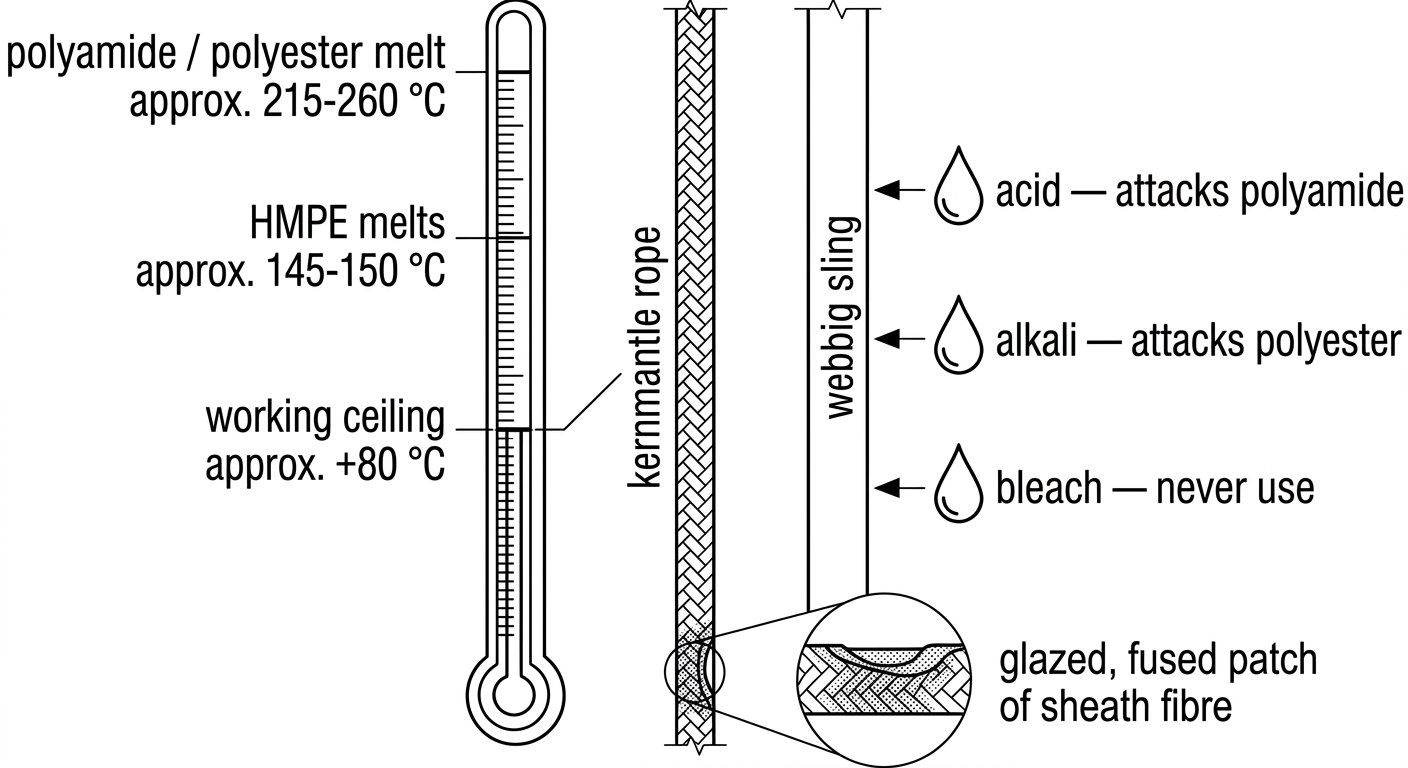
A rope, a sling or a harness webbing has no fuse and no warning light. It fails its temperature and chemical limits quietly: the fibre loses strength first, and the visible evidence — glazing, stiffening, discolouration — arrives late, or sometimes not at all. That is the practical problem with temperature and chemical limits for textiles in rope access and confined space work. The exposures that matter most are the ones a team walks past without registering them: a rope resting against a steam-traced line, a sling looped near a grinding job, a harness stored in a battery room, a descender run hot on a long fast lower.
This note covers what the common synthetic fibres actually tolerate, which chemicals attack which polymer, how to recognise heat and chemical damage on kit, and what to do when you suspect an exposure but cannot prove it.
What a manufacturer’s temperature range actually tells you
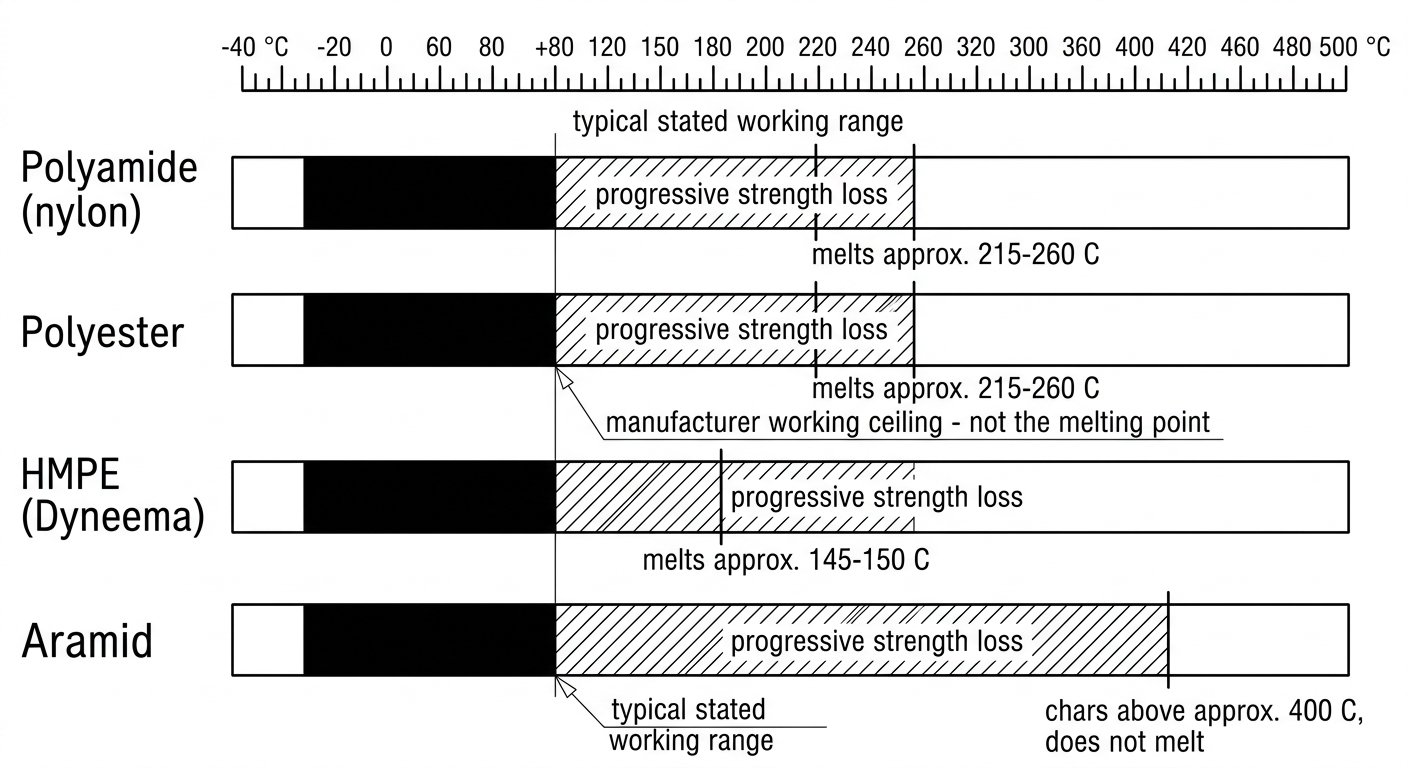
Most rope access textiles carry a stated working temperature range in the instructions for use — commonly something in the region of −30 °C or −40 °C at the cold end up to around +80 °C at the hot end for polyamide and polyester products. That upper figure is nowhere near the melting point of the fibre. It is a conservative continuous-use limit that keeps the material well clear of the region where strength starts falling away.
Two things follow from that:
- Melting temperature is not a design limit. A polyamide rope does not become safe at 200 °C simply because it has not melted yet. Meaningful strength loss begins long before the fibre visibly changes state, and some of that loss is permanent once the material has cooled again.
- Heat plus load is worse than heat alone. A hot fibre under tension creeps and deforms in a way that the same fibre unloaded on a shelf does not. Temperature limits assume the equipment may be loaded.
Fibre by fibre: what melts, what chars, what creeps
Polyamide (nylon)
The most common fibre in kernmantle rope cores and in much harness webbing. It melts in roughly the 215–260 °C band depending on the polymer type, softening measurably before that. It absorbs water, and a wet polyamide rope typically shows a modest temporary strength reduction — commonly quoted in the region of ten to fifteen percent — which is recovered when it dries. Its critical weakness is chemical, not thermal: polyamide is strongly attacked by acids.
Polyester
Common in slings, anchor strops, harness webbing and low-stretch rope sheaths. Melting behaviour is broadly similar to polyamide, in the same general region. Polyester absorbs very little water, holds up better under UV, and resists acids well — but it is vulnerable to strong alkalis, which is the mirror image of polyamide’s weakness.
HMPE (Dyneema, Spectra) and other high-modulus fibres
Very strong for their diameter and extremely resistant to most chemicals, but the melting point is far lower than the other fibres in the toolbox — in the region of 145–150 °C — and HMPE creeps under sustained load, with creep rate rising sharply as temperature rises. A thin HMPE sling in a friction-generating position is a genuinely poor choice, and one left tensioned in a hot environment can elongate permanently without ever looking damaged.
Aramid (Kevlar, Technora)
Does not melt; it chars at high temperature, generally somewhere above 400 °C, which is why aramid appears in heat-resistant slings and protective sleeves. The trade-offs are poor UV resistance, poor resistance to strong acids and alkalis, and low abrasion tolerance in some constructions. Aramid solves a heat problem; it does not produce an all-round better sling.
Heat you generate yourself
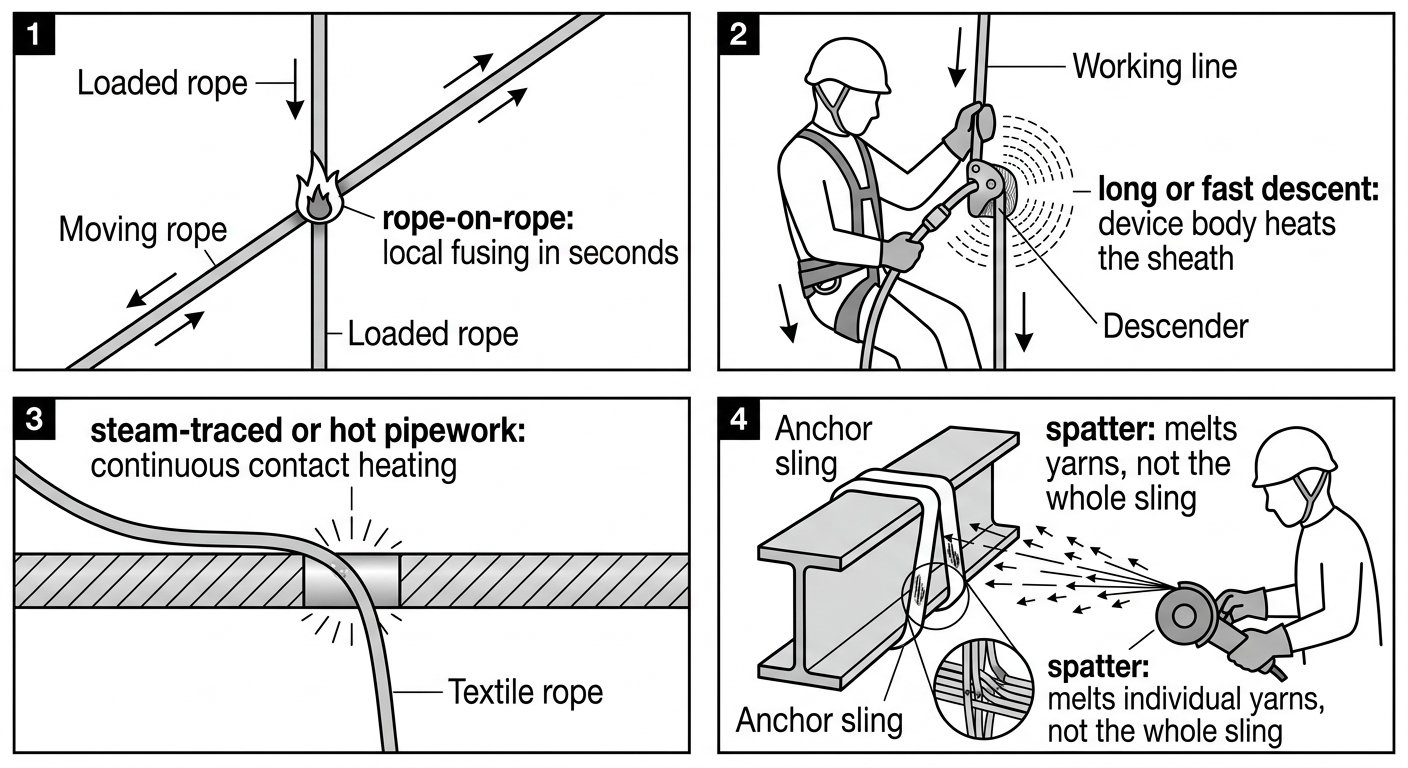
Environmental heat is usually obvious. Frictional heat is not, and it is the more common cause of textile heat damage in rope work.
- Rope running over rope. Synthetic against synthetic under load produces very high local temperatures very quickly. A moving rope crossing a static one can glaze or fuse the static rope’s sheath in seconds. This is the classic cause of a rope being destroyed by heat with no external heat source present at all.
- Descenders on long or fast descents. Metal bodies absorb the energy of the descent and can reach temperatures that will mark a sheath, and that will certainly burn a hand. Descents that are long, fast, or repeated back-to-back without cooling time are where this bites. Working within the device’s stated rope diameter range and loading limits, as covered in the note on descender specifications and working loads, keeps the friction in the range the device was designed to dissipate.
- Hot structure. Steam lines, traced pipework, uninsulated exhaust runs, freshly welded steel, furnace casings and process vessels that have not been fully cooled. A rope or sling in contact with any of these is being heated continuously, not briefly.
- Sparks and spatter. Grinding sparks and welding spatter are individually tiny but arrive far above any synthetic fibre’s melting point. They do not heat the whole textile; they punch individual holes through load-bearing yarns. Textile anchor slings near hot work should be replaced with wire strops, protected with aramid or leather sleeving, or the rigging moved.
Cold, wet and frozen
Low temperature is generally less destructive than high temperature for the common fibres, but it changes handling in ways that affect the system:
- Wet rope that freezes becomes stiff and its diameter effectively changes as ice forms in and on the sheath. Descenders and rope grabs may feed, grip and slip differently than they do on dry rope.
- Ice crystals inside a loaded rope are abrasive against the fibres.
- Cold hands and gloves change how reliably a team operates gates and cams — a separate but linked problem.
Where cold-weather work is routine, treat a frozen rope as behaving like a different rope, and test device function on it before committing to the descent.
Chemical limits: what attacks what
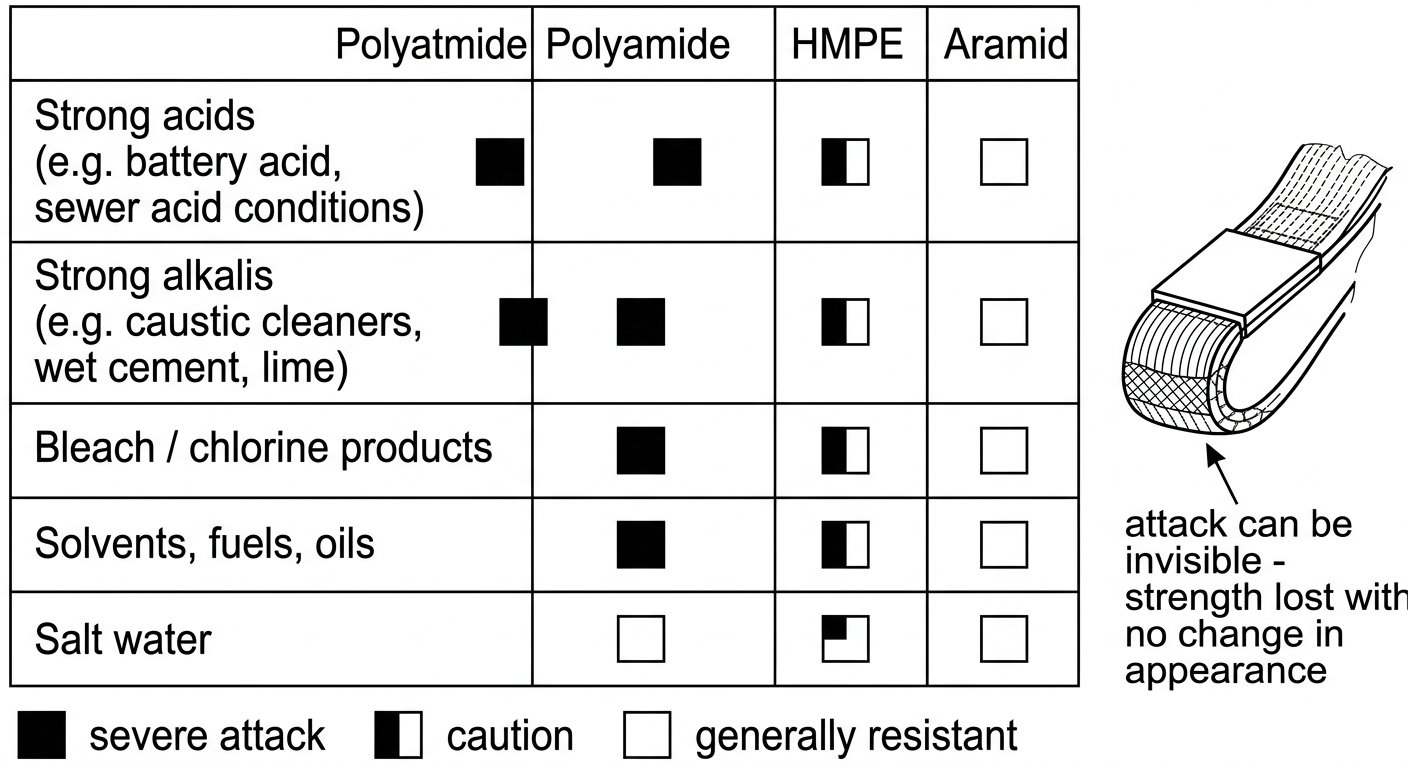
The single most useful rule to carry on site is the acid/alkali split:
- Acids attack polyamide. Sulphuric acid from battery banks is the textbook case; so is the acid environment that develops in sewers and wastewater structures where hydrogen sulphide oxidises on damp surfaces.
- Strong alkalis attack polyester. Caustic cleaning solutions, wet cement and concrete slurry, lime and some degreasers all sit on this side.
- Bleach and chlorine-based products degrade polyamide and should never be used to clean rope access textiles.
- Solvents, fuels and oils are less chemically aggressive to the fibres themselves in most cases, but they carry dissolved contaminants deep into the core, attract grit, and make the equipment impossible to assess honestly.
Two operational points matter more than the chemistry list. First, chemical attack is frequently invisible. A sling that has absorbed dilute acid can look, feel and flex normally while having lost a large fraction of its breaking strength. There is no field test that recovers that information. Second, the exposure is often to vapour or residue rather than to a puddle. Storing harnesses in a battery charging room, or lowering rope into a vessel that has held a corrosive product, is an exposure even if nothing was ever visibly splashed.
Exposures that are easy to miss
- Kit bags left on a floor where a chemical has been spilled or washed down.
- Ropes bagged wet with process residue on them and left closed overnight.
- Marker pens, paints, adhesives and solvent-based tapes applied to webbing. Only manufacturer-approved marking methods should touch load-bearing textiles.
- Salt water, which is not a strong chemical attack in itself but leaves abrasive crystals in the fibres once dry.
- Chemical protective clothing worn over a harness. A suit certified to EN 14605 for chemical protective clothing protects the wearer; it says nothing about the harness underneath it, and it can hide contamination that has run in at the cuffs, collar or attachment-point apertures. Kit worn under chemical PPE needs its own inspection after the job.
- Residues inside the space itself. The atmospheric testing sequence before entry tells you what is in the air; it does not tell you what is coating the walls, the sludge line or the floor that your rope will drag through.
Recognising heat and chemical damage on kit
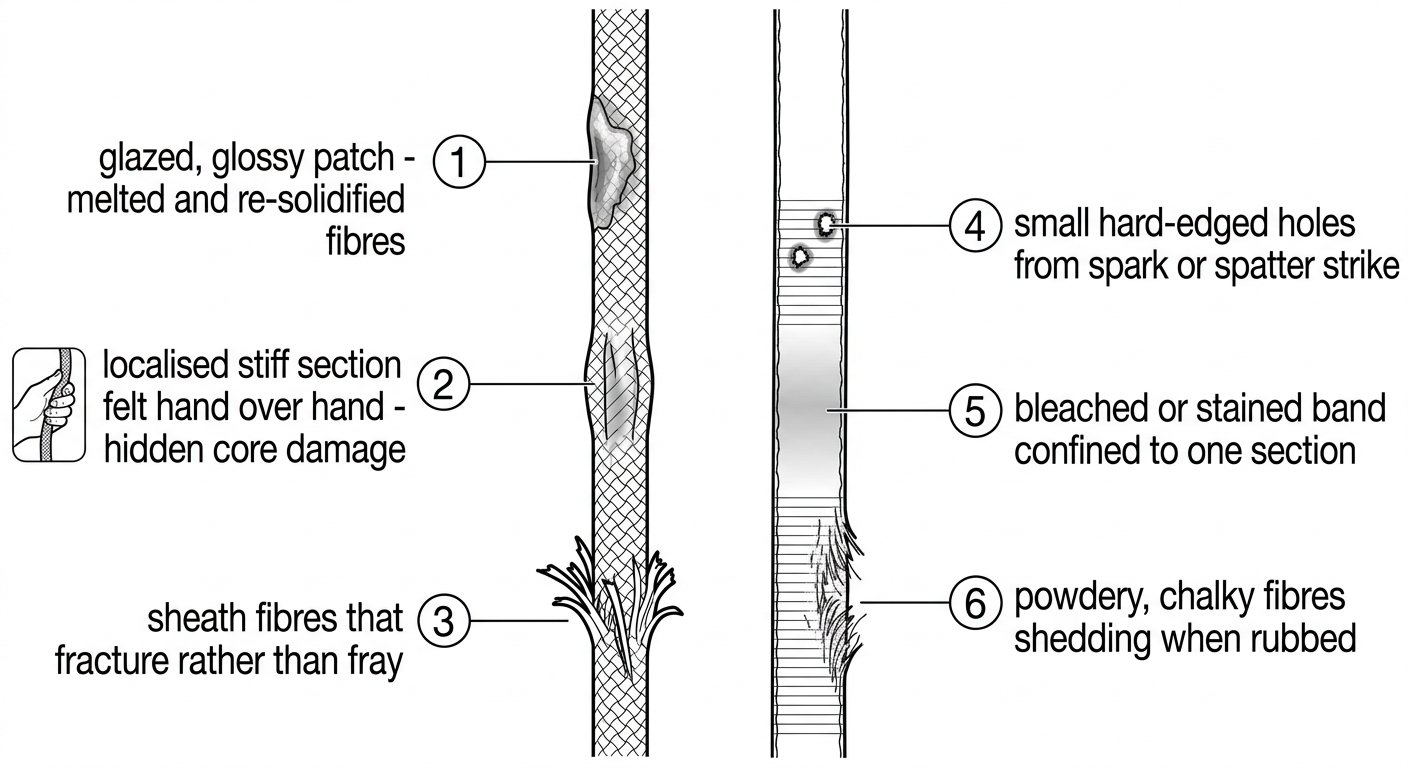
Inspection cannot detect everything, but the following signs are reliable grounds to retire an item immediately:
- Glazing or gloss on a sheath or webbing surface — fibres that have melted and re-solidified.
- Fused, hardened or shiny patches that do not flex with the rest of the material.
- Small hard-edged holes consistent with spark or spatter strikes.
- Localised stiffness in a rope, felt by running it hand over hand — often the only sign that the core has been heat- or chemically affected under an intact sheath.
- Discolouration, bleaching or staining that was not there before, particularly if it is confined to one section.
- Powdery, chalky or brittle fibres that break or shed when rubbed.
- Sheath fibres that fracture rather than fray when picked at.
These sit alongside the wider condition criteria set out in the note on service life and retirement criteria for textiles. Heat and chemical damage differ from ordinary wear in one important respect: ordinary wear is progressive and visible, while these two can be sudden and hidden.
What to do after a suspected exposure
- Take the item out of service at the point of suspicion, not at the next scheduled inspection. Segregate it physically so it cannot be picked up by the next shift.
- Rinse thoroughly with clean water if the exposure was to a corrosive or salt. Rinsing stops further attack; it does not restore strength already lost, and it does not clear the item for reuse.
- Do not use solvents, bleach, degreasers or hot water. Cleaning should use clean water and, where the manufacturer permits it, a mild soap at a low water temperature — the same approach described in the note on washing a low-stretch rope before first use. Dry away from direct heat sources and out of sunlight.
- Refer it to the competent person for documented inspection, with a written description of what the exposure was, how long it lasted and what part of the item was affected.
- If the exposure cannot be identified or bounded, retire the item and destroy it. Cut the sling, cut the rope, cut the harness webbing. An unverifiable chemical exposure is not a judgement call that inspection can resolve.
Storage and selection decisions that prevent the problem
- Store textiles dry, out of direct sunlight, and in a space with no chemical storage, no battery charging and no fuel or solvent containers.
- Transport kit in closed bags, and do not put contaminated hardware or tools into the same bag as clean textiles.
- Where a job involves known hot work or known corrosive residue, plan the anchor and rigging materials for it at the selection stage — wire strops, aramid sleeving, edge and heat protection, or repositioning the anchor entirely.
- Keep dedicated sets for known dirty environments rather than cycling the general pool through them.
- Record exposures in the equipment log. An item that has seen three borderline events is a different item from one that has seen none, even if both pass inspection today.
The short version
Assume a working ceiling in the region of +80 °C for ordinary polyamide and polyester kit, and treat anything hotter as a design problem to be engineered around rather than tolerated. Remember that HMPE’s ceiling is much lower. Keep acids away from polyamide and strong alkalis away from polyester. And treat any suspected chemical exposure as terminal unless a competent person can positively establish otherwise, because the fibre will not tell you.
Further technique notes on equipment selection, inspection and rigging are collected on the rope access and confined space hub page.
Frequently asked questions
What is the maximum temperature a rope access rope or harness can be used at?
Manufacturers of polyamide and polyester rope access textiles commonly state a working range with an upper limit in the region of +80 °C. That figure is a conservative continuous-use ceiling, not the melting point, and it assumes the equipment may be loaded. Always check the specific instructions for use, because the stated range varies between products.
Can a rope be damaged by heat without any external heat source?
Yes. A loaded rope moving across a static rope generates very high local temperatures at the contact point and can glaze or fuse the static rope's sheath in seconds. Descender bodies also heat significantly on long or fast descents. Rigging should be planned so that no rope runs across another under load.
Which chemicals are most dangerous to rope access textiles?
Strong acids attack polyamide, which is the fibre in most rope cores and much harness webbing; strong alkalis such as caustic cleaners, lime and wet cement attack polyester. Bleach and chlorine-based products degrade polyamide and should never be used for cleaning. Battery acid, sewer environments and caustic wash-down are the common real-world sources.
Can chemical damage be detected by inspection?
Often not. Textiles can absorb a corrosive substance and lose a substantial part of their breaking strength while still looking, feeling and flexing normally. There is no reliable field test, which is why an unbounded or unidentified chemical exposure is grounds for retirement rather than for a judgement call.
Is Dyneema (HMPE) a good choice near heat?
No. HMPE melts at a far lower temperature than polyamide, polyester or aramid — in the region of 145–150 °C — and it creeps under sustained load, with the creep rate increasing as temperature rises. It is excellent for chemical resistance and strength-to-diameter, but it is the wrong material for any position exposed to friction or hot structure.
What should be done with a sling exposed to an unknown chemical?
Take it out of service immediately and segregate it so it cannot be reused. Rinse with clean water if the exposure was corrosive, but understand that rinsing stops further attack rather than restoring lost strength. Refer it to the competent person with a written description of the exposure, and if the exposure cannot be identified and bounded, destroy the item.
Need this as a document you can issue? The template library gives you the risk assessments, permits and inspection logs in editable form — and employer plans cover a whole team with completion records.