Safety / Tips and Tricks / Explosive Atmosphere
Activity 08 · Explosive Atmosphere
Static Electricity as an Ignition Source
The energy needed to ignite many flammable gases is remarkably small — far below what a person can feel as a static shock — which means a discharge that goes completely unnoticed by the person who generated it can be more than sufficient to ignite an explosive atmosphere.
How charge separation happens
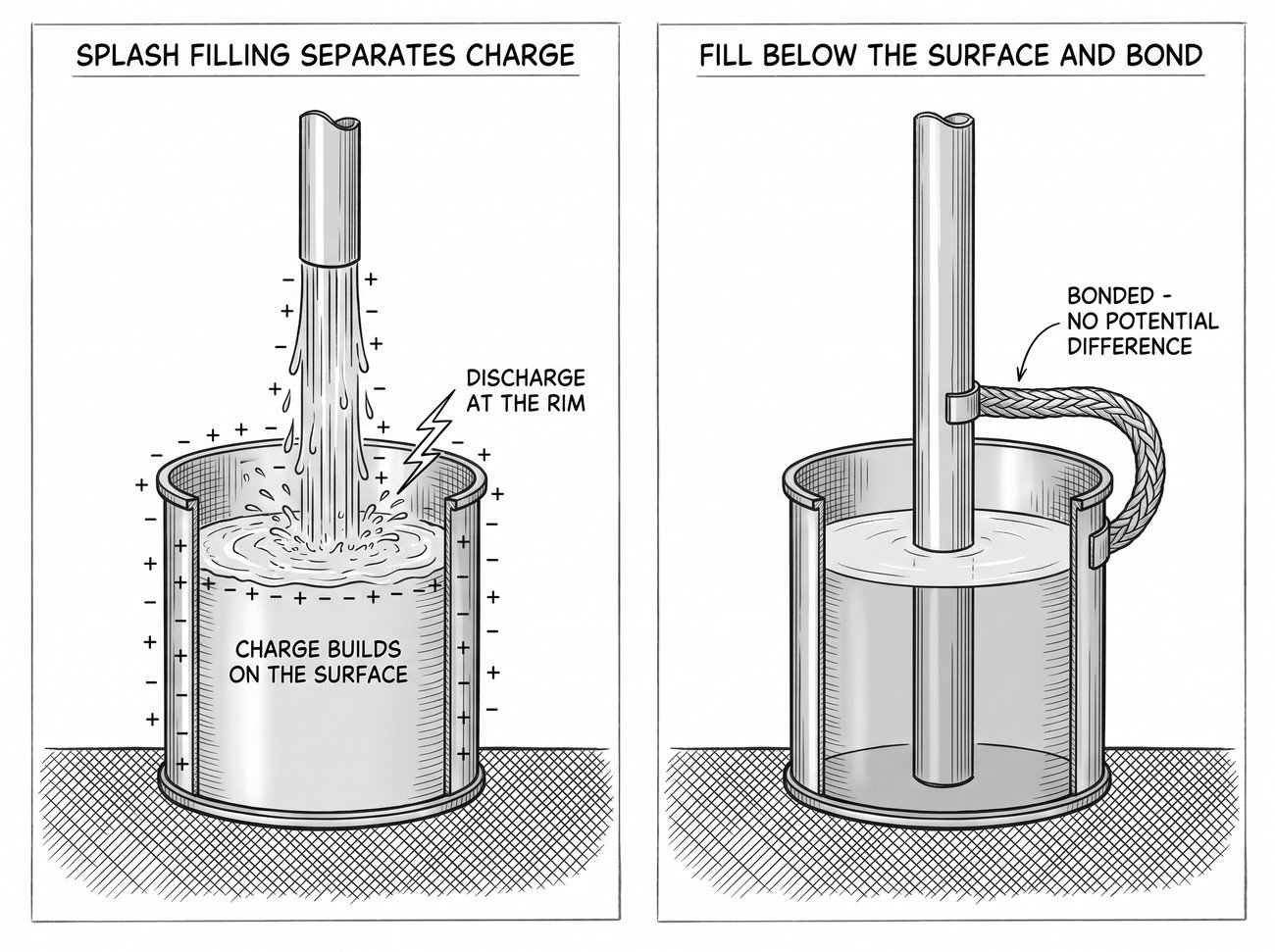
Static charge builds through charge separation, where two materials in contact and then separated leave one with a surplus and the other with a deficit of electrons, and this happens constantly in industrial settings: liquid flowing through pipe, powder moving through a chute or being poured, a person walking across a floor, plastic sheeting being unrolled, or clothing rubbing against itself during ordinary movement. None of these activities look like they involve electricity at all, which is exactly why static as an ignition source is easy to overlook compared to more obvious sources like electrical equipment or open flame.
Minimum ignition energy
Different flammable materials require different amounts of energy to ignite, expressed as minimum ignition energy, and many common flammable gases and vapours have a minimum ignition energy well below the energy in a static discharge a person would perceive as a mild shock. Fine combustible dusts generally require more energy than gases, but the most easily ignited dusts still fall within the range a static discharge can readily produce, which is why static control applies to dust handling operations as much as to flammable liquid work.
Non-conductive materials as charge accumulators
Non-conductive materials — plastic containers, plastic sheeting, non-conductive hose and pipe, insulating floor coatings — are particularly problematic because they can hold accumulated charge without any path for it to dissipate safely, releasing it later as a single discharge rather than bleeding it away continuously. Substituting a plastic container for a metal one, or laying down a plastic sheet in a hazardous area for a practical reason unrelated to electrical concerns, can inadvertently introduce a charge accumulator into an environment specifically designed to avoid them.
Humidity and its effect
Low humidity increases both charge accumulation and retention, since moisture in the air normally provides some path for charge to dissipate, and this means dry conditions represent a period of elevated static risk that is not always recognized as a changing condition worth accounting for. Facilities in dry climates, or during dry seasons, or in artificially dried indoor environments, carry a higher baseline static risk than the same operation in humid conditions.
Human body as a charge carrier
A person walking across an insulating floor can accumulate a body charge sufficient to produce an incendiary discharge on touching a grounded object, which is the mechanism antistatic clothing and footwear exist to prevent, and this risk exists regardless of what equipment or process is running nearby — it is generated purely by the person’s own movement through the space.
For the bonding and grounding controls that address this risk directly, see grounding and bonding for fixed equipment and structures.
Related standards
The standards below set the test methods and performance levels behind the equipment referenced in this note.
- EN 1149 — Electrostatic properties of protective clothing
- EN ISO 20345 — Safety footwear
- EN ISO 13688 — General requirements for protective clothing
Common errors
1Assuming a static discharge too small to feel is too small to ignite a flammable atmosphere.
2Treating static control as relevant to flammable liquids only, overlooking combustible dust operations.
3Introducing non-conductive plastic containers, sheeting or hose into an area designed to avoid charge accumulators.
4Not accounting for dry conditions as a period of genuinely elevated static risk.
Frequently asked questions
Can a static discharge too small to feel still ignite a flammable atmosphere?
Yes, many common flammable gases have a minimum ignition energy well below the energy in a discharge a person would perceive as a mild shock.
Does static control apply to combustible dust as well as flammable liquids?
Yes, while dusts generally require more energy than gases, the most easily ignited dusts still fall within the range a static discharge can readily produce.
Why are non-conductive materials particularly problematic for static?
They can hold accumulated charge with no path to dissipate safely, releasing it later as a single discharge rather than bleeding it away continuously.
How does humidity affect static risk?
Low humidity increases both charge accumulation and retention, since moisture in the air normally provides some dissipation path, making dry conditions a period of elevated risk.
Can a person generate an ignition-capable charge just by walking?
Yes, walking across an insulating floor can accumulate a body charge sufficient to produce an incendiary discharge on touching a grounded object, which is what antistatic clothing and footwear exist to prevent.
Need this as a document you can issue? The template library gives you the risk assessments, permits and inspection logs in editable form — and employer plans cover a whole team with completion records.