Safety / Tips and Tricks / Welding and hot work
Activity 05 · Welding
Spark and Slag Control: Housekeeping for Hot Work
Most hot work fires do not start at the point of welding itself — they start where a spark or piece of hot slag landed on something combustible some distance away, which makes housekeeping around the work area as important to fire prevention as any PPE the welder is wearing.
How far sparks actually travel
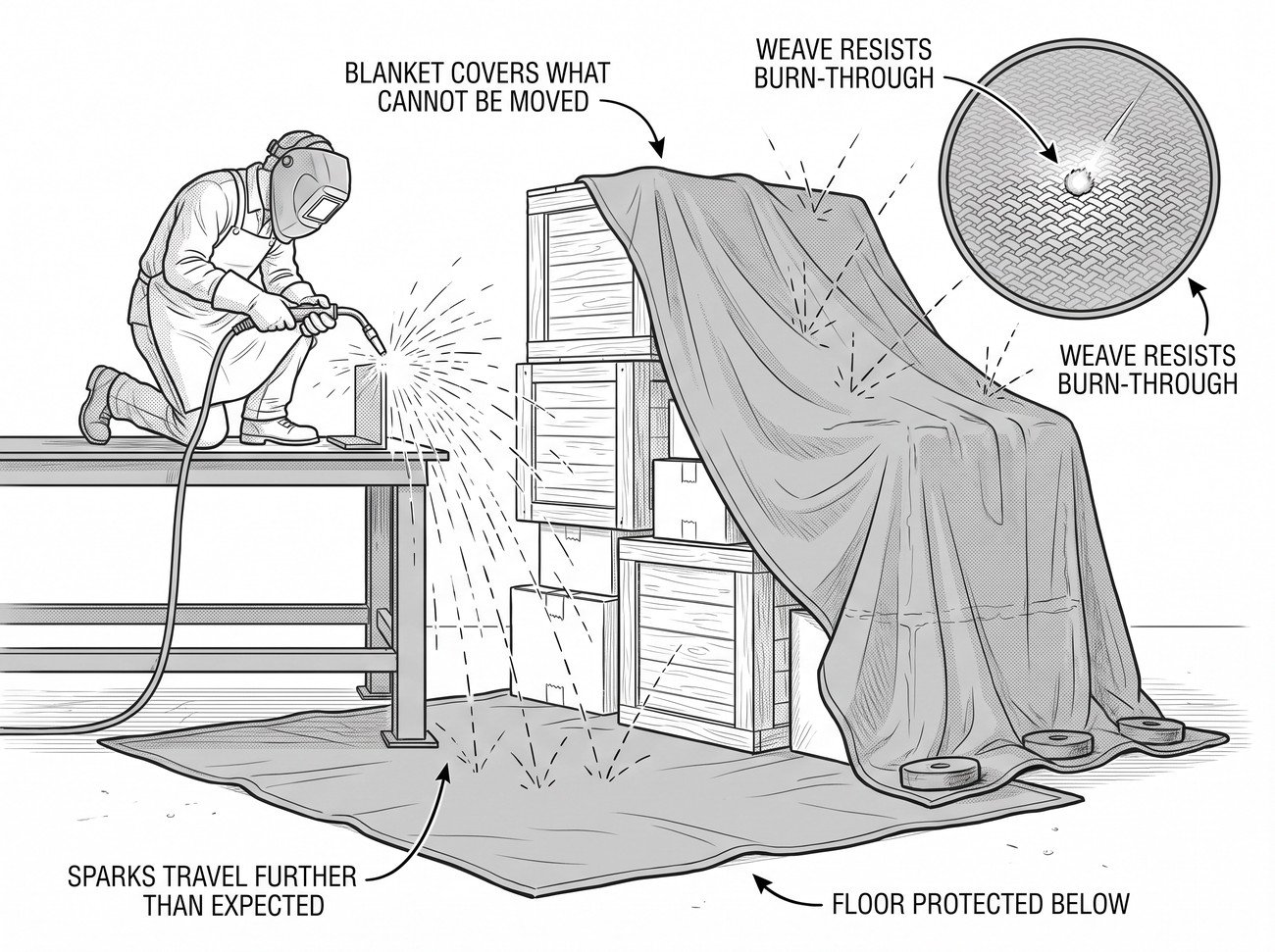
Sparks and slag from welding, cutting and grinding can travel considerably further than they appear to from the work position, particularly horizontally along a floor or when falling from an elevated work area, and it is a common and consequential mistake to judge the clearance area based on where sparks are visibly landing at eye level rather than accounting for their full travel distance and bounce. Treating the clearance area as significantly larger than the work itself, especially for elevated work, reflects how these fires actually start.
Clearing combustible material before starting
Wood shavings, paper, cardboard, oily rags, and general accumulated debris on or near the floor around a hot work area should be removed before work starts, not swept toward the edges of the immediate work zone where they remain within spark range. Where combustible material cannot be removed — a fixed structure, stored material that cannot be relocated — covering it with a welding blanket or fire-resistant curtain provides an alternative control the permit process should specifically confirm is in place.
Floor openings and gaps
Drains, expansion joints, gaps around pipe penetrations, and cracks in flooring all give sparks and hot slag a route into a space that is not visible from the work area, and covering these openings before starting closes a route that a purely visual check of the surrounding floor would miss. This overlaps directly with the area checks a hot work permit is meant to confirm, but is worth treating as its own explicit housekeeping step rather than assuming the permit process alone will catch it.
Slag disposal
Hot slag placed in an ordinary waste bin, even one that appears to contain only non-combustible scrap, can retain enough heat to ignite other material added to the same bin later or smolder for an extended period without being noticed, a genuine and recurring cause of fires discovered well after the original work finished. Slag should go into a dedicated metal container kept clear of combustible waste, and that container itself should not be positioned against a combustible wall or stored surface.
Post-work monitoring
Housekeeping controls need to remain in place through the post-work fire watch period covered under permit requirements, not just during the active welding or cutting itself — a covered drain or blanket removed the moment the torch is switched off defeats the purpose of the post-work watch that follows. Checking the area again at the end of the fire watch period, not just at the end of active work, closes this gap.
For the permit and fire watch process these housekeeping steps support, see hot work permits and fire watch.
Related standards
The standards below set the test methods and performance levels behind the equipment referenced in this note.
- EN ISO 11612 — Heat and flame protective clothing
- EN ISO 20345 — Safety footwear
- EN 407 — Thermal risk gloves
Common errors
1Judging spark clearance distance from where sparks are visibly landing rather than their full travel and bounce distance.
2Sweeping combustible debris to the edge of the immediate work zone instead of removing it or covering it.
3Placing hot slag in ordinary waste containers instead of a dedicated metal container.
4Removing housekeeping controls like covers and blankets as soon as active welding stops, rather than maintaining them through the fire watch period.
Frequently asked questions
Why is judging spark clearance by where sparks land at eye level a mistake?
Sparks and slag travel considerably further than they appear to, particularly horizontally along a floor or falling from height, so the clearance area needs to be judged on full travel and bounce distance, not visible landing points.
What should be done with combustible material that cannot be removed from a hot work area?
It should be covered with a welding blanket or fire-resistant curtain, and the permit process should specifically confirm this control is in place.
Why are floor openings and gaps a specific housekeeping concern for hot work?
Drains, expansion joints and gaps around pipe penetrations give sparks and slag a route into spaces that are not visible from the work area, so they need to be covered before work starts.
Why is hot slag disposal treated as its own housekeeping step?
Slag placed in an ordinary waste bin can retain enough heat to ignite other material or smolder unnoticed for an extended period, so it needs a dedicated metal container kept clear of combustible waste.
Should housekeeping controls be removed as soon as active welding stops?
No, they need to remain in place through the post-work fire watch period, since removing a cover or blanket immediately when the torch stops defeats the purpose of that later watch.
Need this as a document you can issue? The template library gives you the risk assessments, permits and inspection logs in editable form — and employer plans cover a whole team with completion records.