Safety / Tips and Tricks / Agriculture and livestock
Activity 13 · Agriculture
Slurry Gases and Confined Spaces on Farms
Slurry produces a gas that can kill in a single breath, and it produces most of it at the moment the slurry is disturbed — which is exactly when people are standing over it.
Four gases, one that dominates
Decomposing slurry produces methane, carbon dioxide, ammonia and hydrogen sulphide. The last is the killer. It is heavier than air so it collects in pits and low spaces, it is rapidly fatal at concentrations reached routinely during mixing, and at high concentration it destroys the sense of smell almost immediately — so the characteristic smell disappearing is a warning that conditions have got worse, not better. Relying on smell as a detector is relying on something that switches off first.
Mixing is the dangerous operation
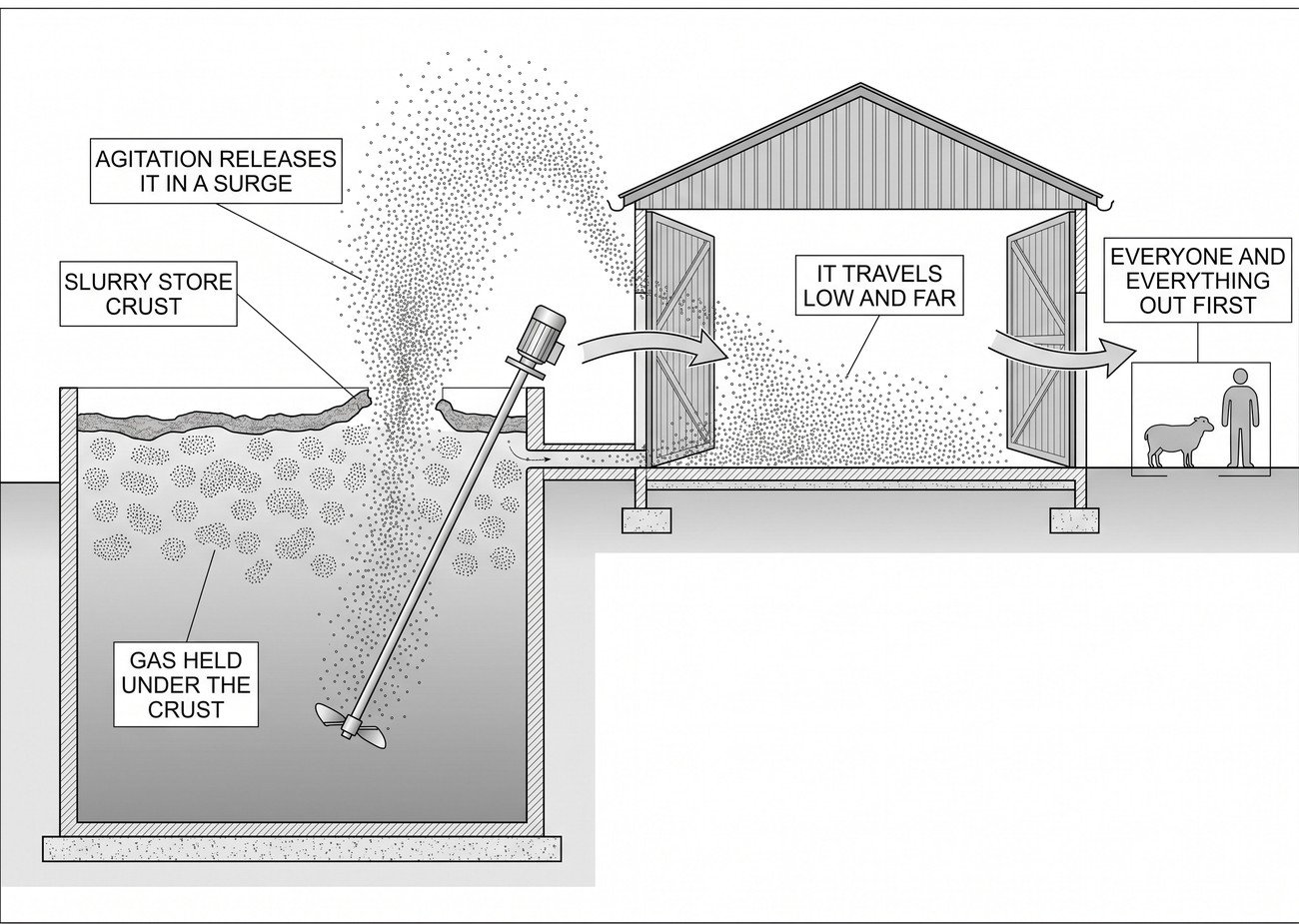
Slurry sits with a crust over it, and the gas builds beneath. Agitating releases it in a surge rather than gradually, producing lethal concentrations within seconds and well beyond the tank. The rules that follow are specific: everyone and every animal out of the building before mixing starts, maximum ventilation with doors and outlets open, nobody re-entering for a substantial period afterwards, and nobody working alone anywhere near the operation.
Never enter the space
A slurry tank, a reception pit, a channel under slats: none of these are places to enter to retrieve something, free a pump, or check a blockage. Entry requires the full confined space arrangement — atmospheric testing, forced ventilation, breathing apparatus, a rescue plan with equipment on site and people trained to use it. Nothing that has fallen in is worth the entry, and the most common fatal pattern is exactly that: someone goes in for a tool or an animal, is overcome, and two or three more follow to help.
The rescuers are the second and third victims
Multiple-fatality farm incidents are overwhelmingly slurry incidents, and they follow the same sequence every time. Somebody collapses, somebody else goes in, and the same atmosphere overcomes them within seconds. The only useful response from outside is to raise the alarm, ventilate, keep others out, and wait for people with breathing apparatus. That is enormously difficult when it is a family member below, which is why the decision has to be made in advance rather than in the moment.
Openings, covers and the fall in
Separately from the gas, people and animals drown in slurry after falling through an unguarded opening, a rotten cover, or a gap left after removing a slat. Fixed covers, guarded openings and fencing around lagoons deal with the drowning risk, and they matter most for the people who are not thinking about slurry at all — children, visitors and contractors.
For the general confined space principles, see confined space chemical hazards. For getting help to a remote location, see emergency response when remote.
Related standards
The standards below set the safety requirements, classification and test methods behind the machinery and equipment referenced in this note.
Common errors
1Using smell as a warning, when high concentrations remove the sense of smell first.
2Mixing with animals or people still in the building, or with ventilation closed.
3Entering a tank, pit or channel to retrieve something or free a blockage.
4Going in after someone who has collapsed, without breathing apparatus.
5Leaving openings, covers and lagoon edges unguarded.
Frequently asked questions
Which slurry gas is the killer?
Hydrogen sulphide. It is heavier than air so it collects in pits and low spaces, it is rapidly fatal at concentrations reached routinely during mixing, and at high concentration it destroys the sense of smell.
Why is mixing the dangerous operation?
Gas builds under the crust and agitation releases it in a surge rather than gradually, producing lethal concentrations within seconds and well beyond the tank itself.
What are the rules for mixing?
Everyone and every animal out of the building first, maximum ventilation with doors and outlets open, nobody re-entering for a substantial period, and nobody working alone near the operation.
Can you enter a slurry tank to free a blockage?
Not without the full confined space arrangement: testing, forced ventilation, breathing apparatus and a rescue plan with equipment and trained people on site. Nothing that has fallen in is worth the entry.
Why do slurry incidents kill several people?
Because someone collapses and others go in to help, and the same atmosphere overcomes them within seconds. From outside the only useful response is to raise the alarm, ventilate and keep people out.
Need this as a document you can issue? The template library gives you the risk assessments, permits and inspection logs in editable form — and employer plans cover a whole team with completion records.