Safety / Tips and Tricks / Agriculture and livestock
Activity 13 · Agriculture
Emergency Response on a Remote Holding
On most sites the emergency plan is about what to do in the first minutes. On a farm it is about surviving the twenty or more before anyone arrives.
Distance changes everything
Response times to a remote holding are long, the address may not lead anywhere useful, and the incident is frequently in a field with no name that a stranger would recognise. That is not a reason to do less planning but to do a different kind: the effort goes into being found quickly and into what can be done in the meantime, rather than into a rapid handover to professionals.
Being found is the bottleneck
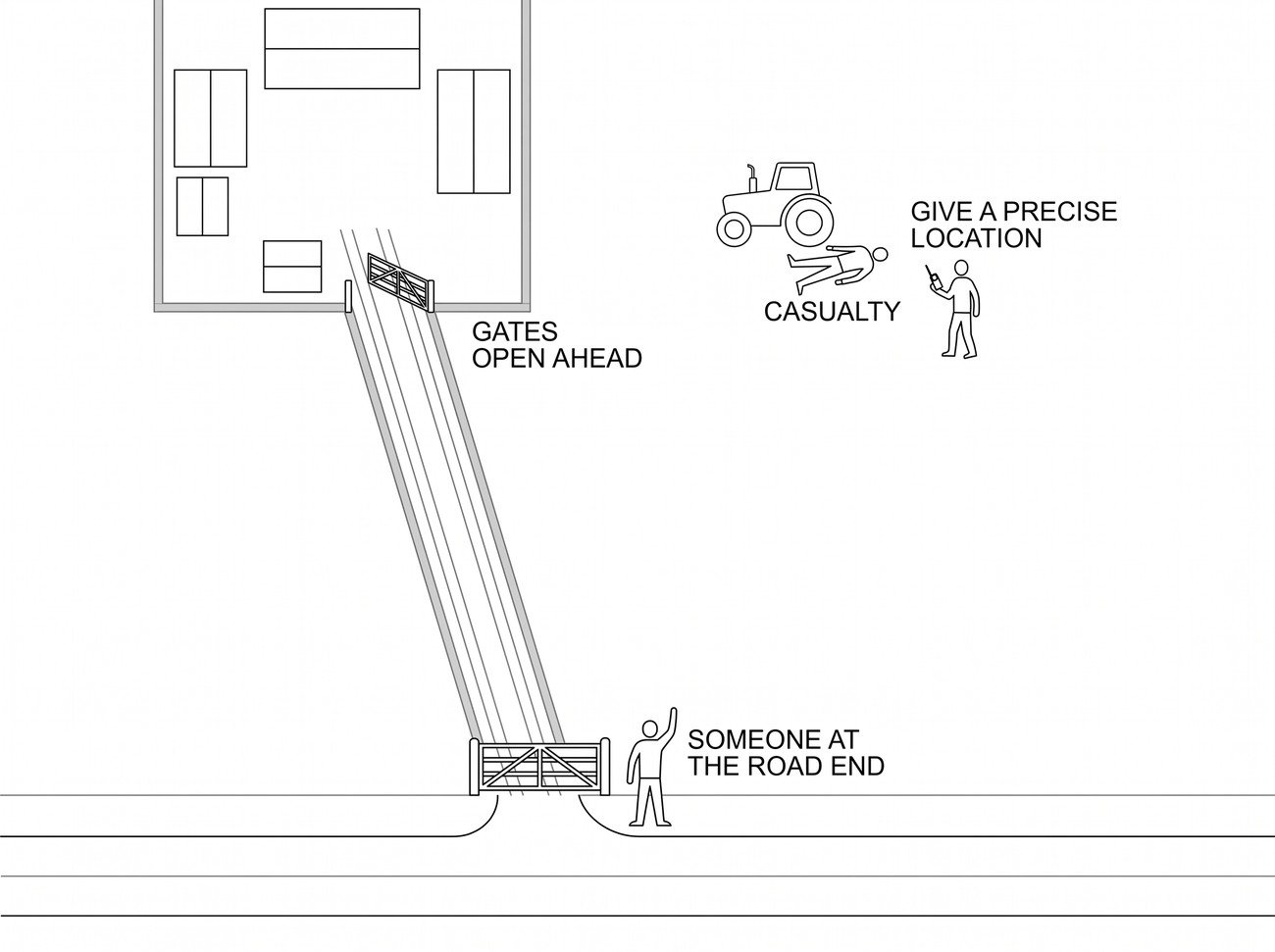
A postal address gets an ambulance to the farmhouse, which may be a long way from a person lying in a field. What actually helps is a location reference that can be read out precisely, a named person meeting the vehicle at the road end, and gates unlocked ahead of them. Deciding in advance which entrance a large vehicle can use, and whether it can reach each part of the holding at all, is worth doing on a wet afternoon rather than during an incident.
What has to be survivable alone
Severe bleeding is the injury most likely to be survivable with immediate action and fatal without it, and it is common in farm incidents. Training in controlling catastrophic bleeding, and equipment kept where the work happens rather than in the house, addresses the gap that distance creates. A kit in a vehicle that goes to the field is more use than a better kit in a cupboard.
Do not become the second casualty
The reflex to go to someone is strongest when it is family, and on a farm it usually is. Slurry gas, an unstable load, a machine that has not been isolated, an animal still loose — all of these are still present when the first person arrives. Stopping to isolate the machine, ventilate, or secure the animal takes seconds and is what prevents the second and third casualty that farm incidents so often produce.
The people who are not there
An emergency plan on a farm has to work when the person who knows everything is the casualty. Someone else needs to know where the isolators are, which fields have stock, where the first aid kit lives, and how to describe the location. Writing that down in one place, and telling family and regular contractors where it is, is what turns individual knowledge into something the holding actually has.
For raising the alarm at all, see lone working on a farm. For the incident type that most often produces multiple casualties, see slurry gases and confined spaces.
Related standards
The standards below set the safety requirements, classification and test methods behind the machinery and equipment referenced in this note.
Common errors
1Giving a postal address for an incident that is not at the farmhouse.
2Having nobody at the road end to meet the vehicle and open gates.
3Keeping the first aid kit in the house rather than where the work happens.
4Going straight to a casualty without isolating the machine or securing the animal.
5Holding all the knowledge in one person, who may be the casualty.
Frequently asked questions
How does distance change the plan?
The effort moves from a rapid handover to professionals towards being found quickly and managing the injury in the meantime, because response times to a remote holding are long.
What actually helps responders find you?
A precise location reference read out on the call, a named person meeting the vehicle at the road end, and gates unlocked ahead of them. A postal address only reaches the farmhouse.
Which injury most needs immediate action?
Severe bleeding: it is common in farm incidents, survivable with immediate action, and fatal without it. Training and kit kept where the work happens address the gap distance creates.
Why do farm incidents produce multiple casualties?
Because the reflex to go to someone is strongest when it is family, and the hazard is still present: slurry gas, an unstable load, an unisolated machine or a loose animal.
What has to be true of the plan?
It has to work when the person who knows everything is the casualty. Someone else must know where the isolators are, which fields have stock, where the kit is, and how to describe the location.
Need this as a document you can issue? The template library gives you the risk assessments, permits and inspection logs in editable form — and employer plans cover a whole team with completion records.