Safety / Tips and Tricks / Agriculture and livestock
Activity 13 · Agriculture
Grain Stores and Flowing Grain Entrapment
Grain behaves like a fluid when it moves and like a solid when it stops, and a person standing on it when it starts to flow has a few seconds before they cannot get out.
Flowing grain pulls you under
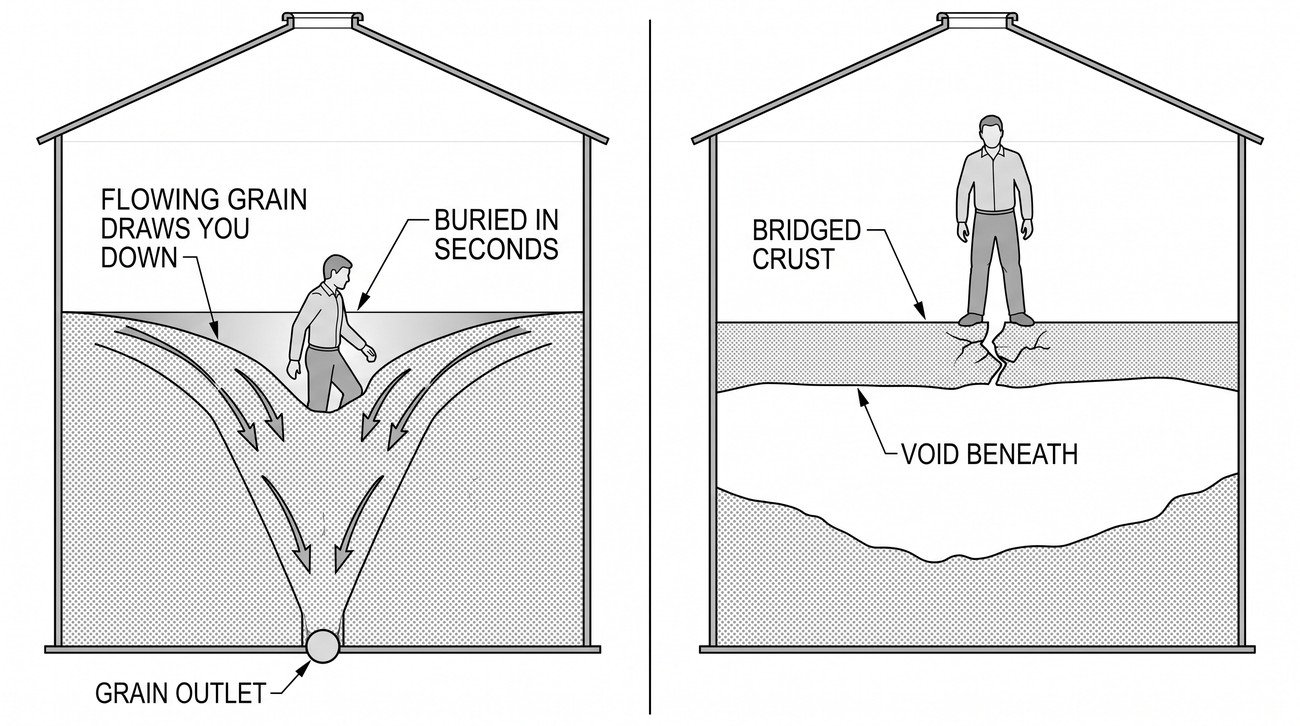
When grain is being discharged from below, the surface moves down in a funnel towards the outlet. A person standing on it is drawn towards the centre and downward, and the rate is far faster than most people expect: buried to the knees in seconds, and to the waist shortly after. Once buried past the waist, the grain locks around the body with enough force that a person cannot be pulled free, and above the chest the pressure prevents breathing.
Nobody walks on grain while it is moving
That is the whole of the primary control. Discharge is stopped and the equipment isolated and locked before anyone enters, because a person on the surface has no warning that flow has started until they are already sinking. The other absolute is not entering to break up a blockage from above — which is the specific action behind most of these deaths.
Bridging and the void underneath
Damp or spoiled grain forms a crust that holds its shape after the grain beneath has been discharged, leaving a void that is invisible from above. The surface looks solid and level, and it collapses when someone stands on it, dropping them into a space they cannot climb out of and burying them. Any grain that has been in store a long time, or that is known to be damp, should be assumed to be bridged and probed from outside rather than tested by walking on it.
Vertical faces collapse
Grain that has crusted can also stand as a vertical or overhanging face after material is taken from below. That face can release as a single mass, burying anyone at the base. Working from above with a pole, from outside the bin, or bringing the face down remotely are the ways to deal with it; standing at the bottom and digging into it is not.
If entry is unavoidable
Entry needs the same discipline as any confined space: equipment isolated and locked off, a harness with a lifeline anchored above, a trained attendant outside who does not enter, and atmospheric testing where spoiled grain may have produced gas or depleted oxygen. Dust is its own hazard, both to the lungs and as an explosion risk where it is disturbed near an ignition source.
For the dust exposure, see respiratory protection on the farm. For rescue distance, see emergency response when remote.
Related standards
The standards below set the safety requirements, classification and test methods behind the machinery and equipment referenced in this note.
- EN 149 — Filtering Half Masks (FFP1/FFP2/FFP3)
- EN 143 — Particle Filters
- EN ISO 4254 — Safety of Agricultural Machinery
Common errors
1Walking on grain while discharge is running.
2Entering to break up a blockage from above.
3Assuming a level surface is solid when the grain may have bridged.
4Digging into a vertical crusted face from below.
5Entering without isolation, a lifeline and an attendant who stays outside.
Frequently asked questions
How fast does flowing grain bury someone?
Buried to the knees in seconds and to the waist shortly after. Past the waist the grain locks around the body so a person cannot be pulled free, and above the chest the pressure prevents breathing.
What is the primary control?
Nobody walks on grain while it is moving. Discharge is stopped and the equipment isolated and locked before anyone enters, because a person on the surface gets no warning that flow has started.
What is bridging?
Damp or spoiled grain forms a crust that holds its shape after the grain beneath is discharged, leaving an invisible void. The surface looks solid and collapses when stood on.
Why are vertical grain faces dangerous?
Crusted grain can stand as a vertical or overhanging face after material is removed from below, and it can release as a single mass burying anyone at the base.
What does entry require if it cannot be avoided?
Equipment isolated and locked, a harness and lifeline anchored above, a trained attendant outside who does not enter, and atmospheric testing where spoiled grain may have produced gas.
Need this as a document you can issue? The template library gives you the risk assessments, permits and inspection logs in editable form — and employer plans cover a whole team with completion records.