Safety / Tips and Tricks / Construction and demolition
Activity 09 · Construction
Scaffold Handover, Tagging and Who May Alter a Scaffold
Most scaffold incidents involving an altered structure share a single feature: the person who removed the component was not the person who designed the structure, and nobody recorded that it had gone.
What a handover actually transfers
Handover is the point at which responsibility for a completed structure passes from the erector to the user. It is a statement that the scaffold has been built to the agreed design, that it has been inspected, and that it is fit for the duty class it was specified for. It also fixes the boundary of what was handed over: a handover covers a defined structure at a defined date, and anything added later — an extra lift, a loading bay, a sheeted face — is outside it until it is handed over in turn.
The tag system and what each state means
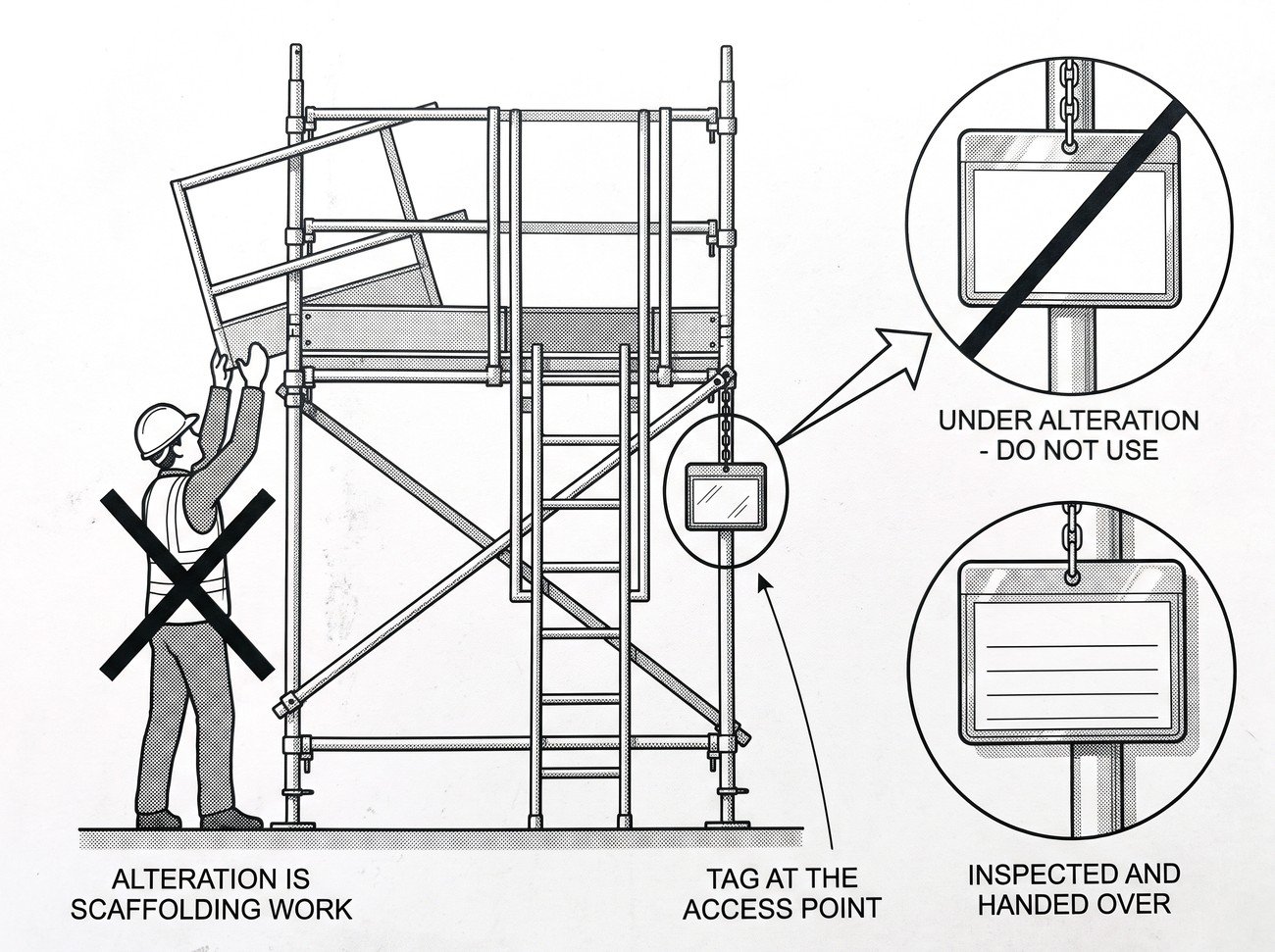
A tag at the access point is the mechanism that makes the handover visible to people who were not present for it. A scaffold under construction or alteration carries a prohibition state, and nobody outside the scaffolding crew may use it in that condition. A completed and inspected scaffold carries a permitted state naming the date and the inspector. The system only works if the tag is changed the moment the structure changes, which is precisely the discipline that lapses when a crew is under time pressure.
Who may alter a scaffold, and who may not
Alteration is scaffolding work, and it belongs to the scaffolding crew regardless of how small the change appears. Removing a guardrail to land material, lifting a board to drop a cable, taking out a tie to fit a window, moving a brace to get a plant machine past — each of these changes the load path of a structure designed as a whole. The person doing the work is rarely in a position to know what the removed component was carrying, which is exactly why the rule is absolute rather than proportionate to the apparent size of the change.
If you find an altered scaffold
The correct response is to stop using it, prevent others from using it, and get it inspected before it goes back into service. That means physically restricting the access point rather than relying on telling people, because the next trade on site did not hear the conversation. An altered scaffold that is still tagged as inspected is more dangerous than an obviously incomplete one, because it carries an active signal that it is safe.
Recording it so the next person knows
Inspections have to be recorded, and the record has to be accessible on site rather than filed in an office. The value of the record is not the compliance evidence; it is that the next inspector can see what was reported last time and check whether it was resolved. A recurring note about the same missing tie across three inspections is a much stronger signal than any single entry, and that pattern is only visible if the records live together.
Use the scaffold handover certificate to record the transfer, and see scaffold inspection before you step on it for the pre-use check.
Related standards
The standards below set the test methods and performance levels behind the protective equipment used for this work.
- EN 361 — Full Body Harnesses
- EN 362 — Connectors for Fall Protection
- EN 795:2012 — Anchor Devices for Fall Protection
Common errors
1Treating a handover as covering later additions such as an extra lift or a sheeted face.
2Leaving a permitted tag in place while the structure is being altered.
3Removing a guardrail, board or tie because the change looks too small to matter.
4Reporting an altered scaffold verbally instead of physically restricting access to it.
5Filing inspection records off site, so nobody can see a fault recurring across inspections.
Frequently asked questions
What does a scaffold handover transfer?
Responsibility for a completed structure from the erector to the user, confirming it was built to the agreed design, inspected, and is fit for its duty class. It covers a defined structure at a defined date and nothing added later.
What do the two tag states mean?
A prohibition state means the scaffold is under construction or alteration and may not be used by anyone outside the scaffolding crew. A permitted state names the date and inspector and means it has been completed and inspected.
Who is allowed to alter a scaffold?
The scaffolding crew, regardless of how small the change looks. Removing a guardrail, board, tie or brace changes the load path of a structure designed as a whole.
Why is an altered but still-tagged scaffold especially dangerous?
Because it carries an active signal that it is safe. An obviously incomplete scaffold warns people; an altered one that still reads as inspected does not.
Why do inspection records need to be kept on site?
So the next inspector can see what was reported last time and whether it was resolved. A fault recurring across three inspections is a far stronger signal than any single entry.
Need this as a document you can issue? The template library gives you the risk assessments, permits and inspection logs in editable form — and employer plans cover a whole team with completion records.