Safety / Tips and Tricks / Agriculture and livestock
Activity 13 · Agriculture
Safe Stop: The Routine Before You Leave the Cab
A great many farm deaths involve a machine that moved when nobody expected it to, and almost all of them would have been prevented by the same four actions carried out in the same order every time.
The four actions
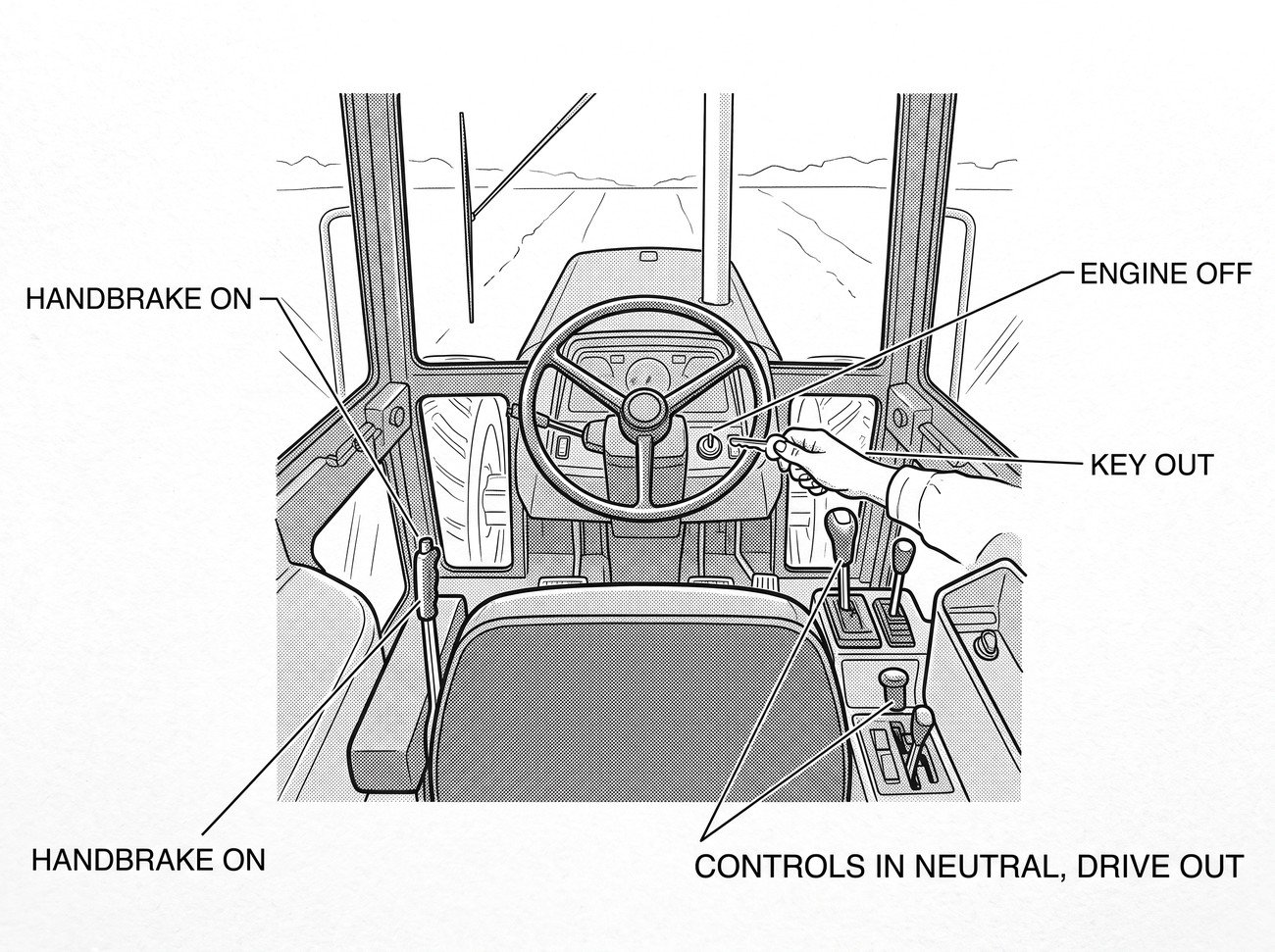
Handbrake on. Controls in neutral, with the power take-off disengaged. Engine off. Key removed. Each one addresses a different failure: the brake stops the machine rolling, neutral stops it driving away or a mounted implement starting, engine off removes the power, and the key removes the possibility of someone else starting it while you are underneath. Doing three of the four leaves a specific route by which the machine can still hurt you.
Why the order matters
The sequence is arranged so that each step is safe to perform after the one before it. Taking the key out while the machine is in gear on a slope leaves it held by nothing. Switching off before the brake is applied means the machine is briefly relying on a transmission that is no longer driven. Working through the same order every time also makes it possible to notice when a step has been missed, which a random order does not.
The habit is the control
Safe stop is not a procedure people forget because they do not know it. It is skipped because the task is brief: adjusting a linkage, clearing a bit of trash, checking a bearing, reaching to free something. The exposure is measured in seconds and the consequence is measured in a lifetime, and the only reliable defence is that the routine is automatic rather than a decision made each time.
Leaving a machine unattended
The same four actions apply when walking away from a machine, and one thing is added: any raised implement or loader is lowered to the ground. A hydraulic ram holds a load by fluid pressure and a seal, both of which can fail, and a loader left up in a yard is a load suspended over anywhere a child, a visitor or an animal might walk. Lowering it costs a few seconds and removes the hazard entirely.
Keys are a control, not a convenience
A key left in a machine is an invitation, and on a farm the person who accepts it is often a child, a visitor or someone who has never operated that machine. Keys kept in a known place indoors rather than in the ignition is one of the very few farm controls that costs nothing, and it addresses several different incident types at once.
For the machinery this protects you from, see PTO shafts and entanglement and baling and unblocking. For who else is in the yard, see children and visitors.
Related standards
The standards below set the safety requirements, classification and test methods behind the machinery and equipment referenced in this note.
Common errors
1Carrying out three of the four actions and treating that as safe stop.
2Skipping the routine because the task will only take a moment.
3Leaving a loader or implement raised when walking away from the machine.
4Removing the key before securing the machine against rolling.
5Leaving keys in machines standing in the yard.
Frequently asked questions
What are the four safe stop actions?
Handbrake on, controls in neutral with the power take-off disengaged, engine off, key removed. Each closes a different route by which the machine can still move or be started.
Why does the order matter?
Each step is safe to perform after the one before it. Taking the key out while the machine is in gear on a slope leaves it held by nothing, and a fixed order makes a missed step noticeable.
Why is safe stop skipped?
Not through ignorance but because the task is brief: adjusting a linkage, clearing trash, checking a bearing. The exposure is seconds and the consequence is permanent, so the routine has to be automatic.
What is added when leaving a machine unattended?
Lowering any raised implement or loader to the ground. A hydraulic ram holds a load by fluid pressure and a seal, and a raised loader in a yard is a suspended load over anywhere a person might walk.
Why do keys matter so much on a farm?
A key left in a machine is an invitation, and the person who accepts it is often a child, a visitor or someone who has never operated that machine.
Need this as a document you can issue? The template library gives you the risk assessments, permits and inspection logs in editable form — and employer plans cover a whole team with completion records.