Safety / Tips and Tricks / Agriculture and livestock
Activity 13 · Agriculture
PTO Shafts: Guarding and Entanglement
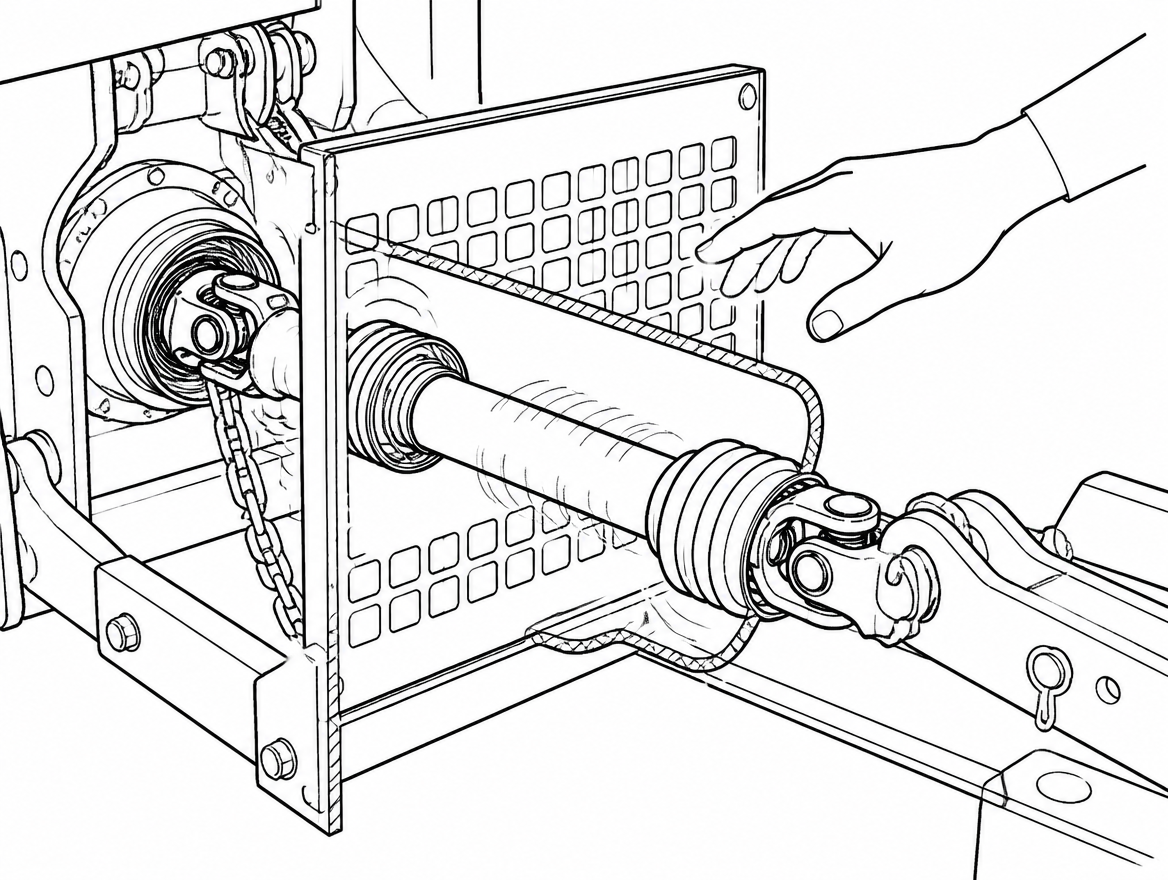
A power take-off shaft turns fast enough to wrap a person around it several times before they can react, and it is the single most consistently lethal piece of equipment on a farm.
Why the PTO is different
The shaft is at waist height, it runs the length of the gap between tractor and implement, and it carries enough power to drive a machine. Anything that touches it — a coat, a sleeve, a bootlace, a trouser leg, hair — is wound around it in a fraction of a second, and the shaft does not stop. Unlike most machinery hazards there is no partial contact and no minor version of the injury.
The guard is a three-part system
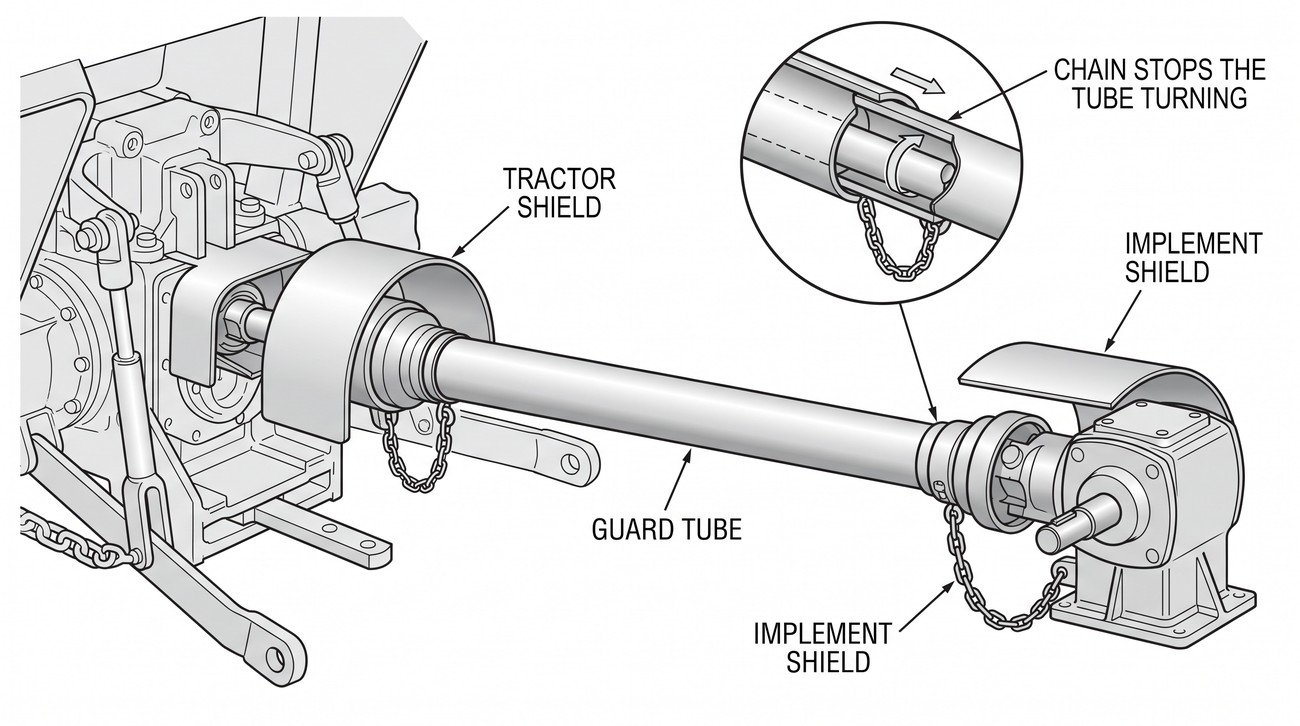
Protection comes from three components that only work together: the shield on the tractor covering the stub, the guard tube covering the shaft itself, and the shield on the implement covering the input connection. A missing or broken section leaves an exposed length exactly where the person walking past it will be, and the fact that the other two are present provides nothing. The guard tube must also turn freely on its bearings and be held from rotating by its restraint chains at both ends.
The chain is not decoration
If the guard tube is free to spin with the shaft, it is no longer a guard — it is a rotating tube that will catch clothing exactly as the shaft would. The restraint chains hold the tube stationary while the shaft turns inside it, and a broken or unattached chain converts a functioning guard into a hazard that looks like a guard. Chains are quick to lose and are rarely the first thing anyone looks at.
Damaged guards get removed rather than repaired
A cracked or seized guard tube is awkward, catches on the hitch and gets in the way, so it gets taken off. That decision is usually made once and never revisited, and the machine then runs unguarded for years. Replacement guard components are inexpensive relative to any other part of the operation, and a machine with a missing guard is not a machine that is temporarily unsafe — it is one that has been made permanently so.
Nobody steps over a running shaft
Crossing a turning PTO to reach the other side of the machine is common and is the specific action behind many of these deaths. There is no safe way to do it and no clothing that makes it acceptable. The alternatives are walking round the machine, or carrying out safe stop first — and if the layout makes walking round genuinely impractical, that is a reason to change the layout rather than to accept the crossing.
For the routine that removes the power first, see safe stop. For the standard behind agricultural machinery guarding, see EN ISO 4254.
Related standards
The standards below set the safety requirements, classification and test methods behind the machinery and equipment referenced in this note.
Common errors
1Treating a guard as adequate when one of the three components is missing.
2Leaving the restraint chains broken or unattached, so the guard tube spins with the shaft.
3Removing a damaged guard rather than replacing it.
4Stepping over a turning shaft to reach the other side of the machine.
5Approaching an implement to look at something with the PTO still engaged.
Frequently asked questions
Why is a PTO shaft so dangerous?
It sits at waist height, runs between tractor and implement, and carries enough power to drive a machine. Anything touching it is wound around in a fraction of a second, and there is no minor version of the injury.
What are the three parts of PTO guarding?
The shield on the tractor covering the stub, the guard tube covering the shaft, and the shield on the implement covering the input connection. All three are required; two of three protects nobody.
What do the restraint chains do?
They hold the guard tube stationary while the shaft turns inside it. Without them the tube spins with the shaft and becomes a rotating hazard that looks like a guard.
Why do damaged guards get removed rather than replaced?
Because a cracked or seized tube catches and gets in the way, so it comes off once and is never refitted. Replacement components are inexpensive relative to everything else on the machine.
Is there a safe way to cross a running PTO?
No. Walking round the machine or carrying out safe stop first are the only options, and if the layout makes walking round impractical the layout is what needs changing.
Need this as a document you can issue? The template library gives you the risk assessments, permits and inspection logs in editable form — and employer plans cover a whole team with completion records.