Safety / Tips and Tricks / Rope access and confined space
Activity 01 · Rope access
Retrievable Rope Rigging: How to Set Up a Pull-Down System Without Losing Control of It
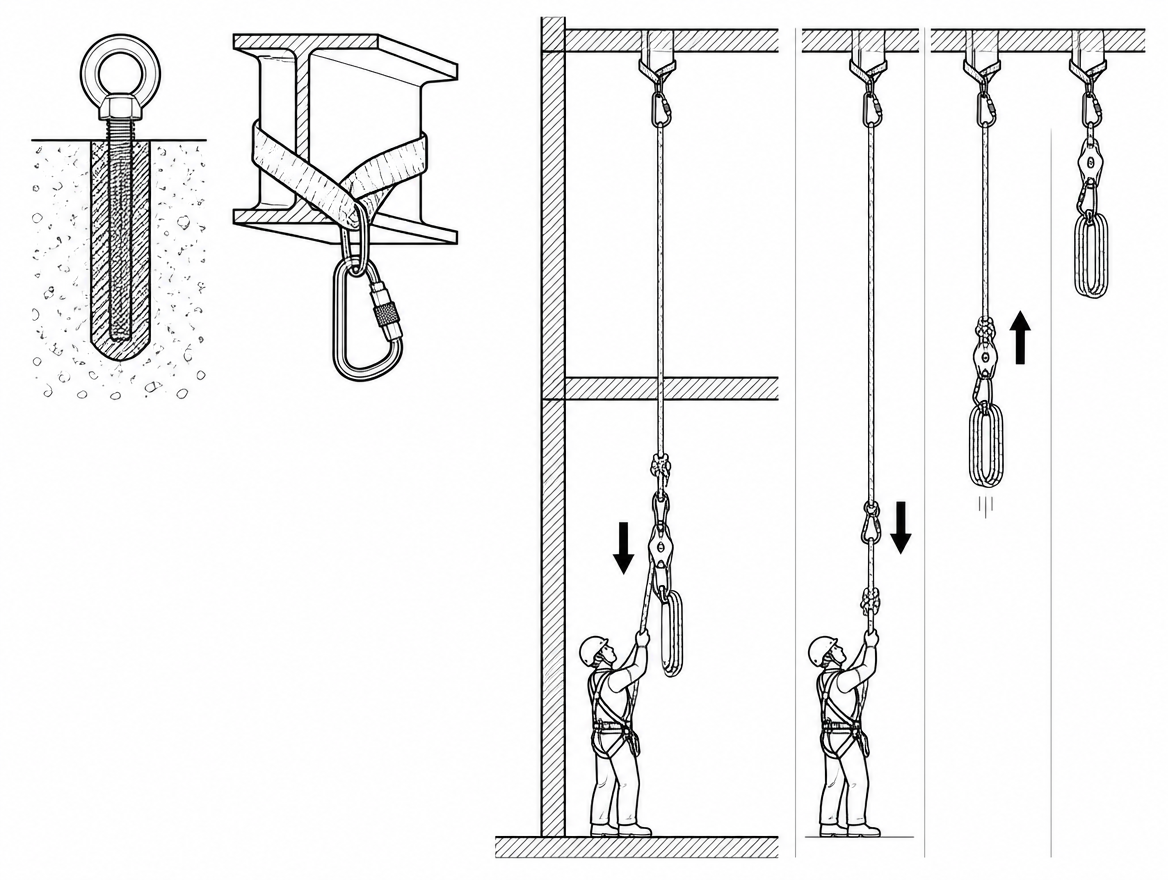
A retrievable rope is one that comes down with the team. Nobody stays at the anchor to release it, and nobody climbs back up to recover it — the rope is rigged so that a pull from the bottom brings the whole system down. That convenience is also the hazard: the moment the last person leaves the anchor, the ability to correct a rigging error disappears. If the rope jams, the team has no line back up. If the retrieval strand is pulled from the wrong position, the descending rope, the connectors and anything the rope dislodges land on the person pulling.
Retrievable rope rigging appears in tree work, confined-space and shaft access, wind and telecoms structures, canyon and cave rescue, and any situation where the anchor is not reachable a second time. This article covers the two standard configurations, the anchor and hardware decisions that determine whether retrieval works, the sequence for rigging and testing it, and the EU regulatory limits on using a single line for work.
Retrievable is not the same as releasable
Two terms get used interchangeably on site and mean different things:
- Retrievable: the rope can be recovered from the bottom after everyone is down. It is a one-way system — once retrieved, the anchor is no longer usable.
- Releasable (contingency) rigging: the rope is rigged so that a person at the anchor can convert a fixed line into a lower, usually through a descender in the anchor system. It requires someone to stay at the top and it does not, by itself, retrieve anything.
A system can be both, but the two functions are rigged differently and solve different problems. Confusing them produces a rope that cannot be lowered in an emergency and cannot be pulled down at the end.
Where a single retrievable line is permitted for work at height
The temporary work at height provisions consolidated in Directive 2009/104/EC (Annex II, point 4.3) require rope access and positioning systems to comprise at least two separately anchored lines — a working line with a means of ascent and descent, and a safety line with a fall arrest back-up device. A single line is permitted only in exceptional circumstances where the risk assessment shows that using a second line would make the work more dangerous, and where appropriate compensating measures are in place. National implementations differ in how narrowly this is read, so the governing text is the national transposition, not the Directive alone.
This matters directly for retrievable rigging, because many retrievable set-ups are single-line by design. A retrievable arrangement does not create an exemption. Where two lines are required, both the working line and the safety line have to be retrievable and independently anchored — which roughly doubles the rigging, the anchor demand and the retrieval complexity, and is the point at which many teams reconsider whether the descent needs to be retrievable at all.
Under ISO 45001, the decision to work on a retrievable system is a documented control decision: it belongs in the risk assessment, the method statement and the rescue plan, not in the descending technician’s judgement at the edge.
Configuration 1: doubled rope through a fixed retrieval point
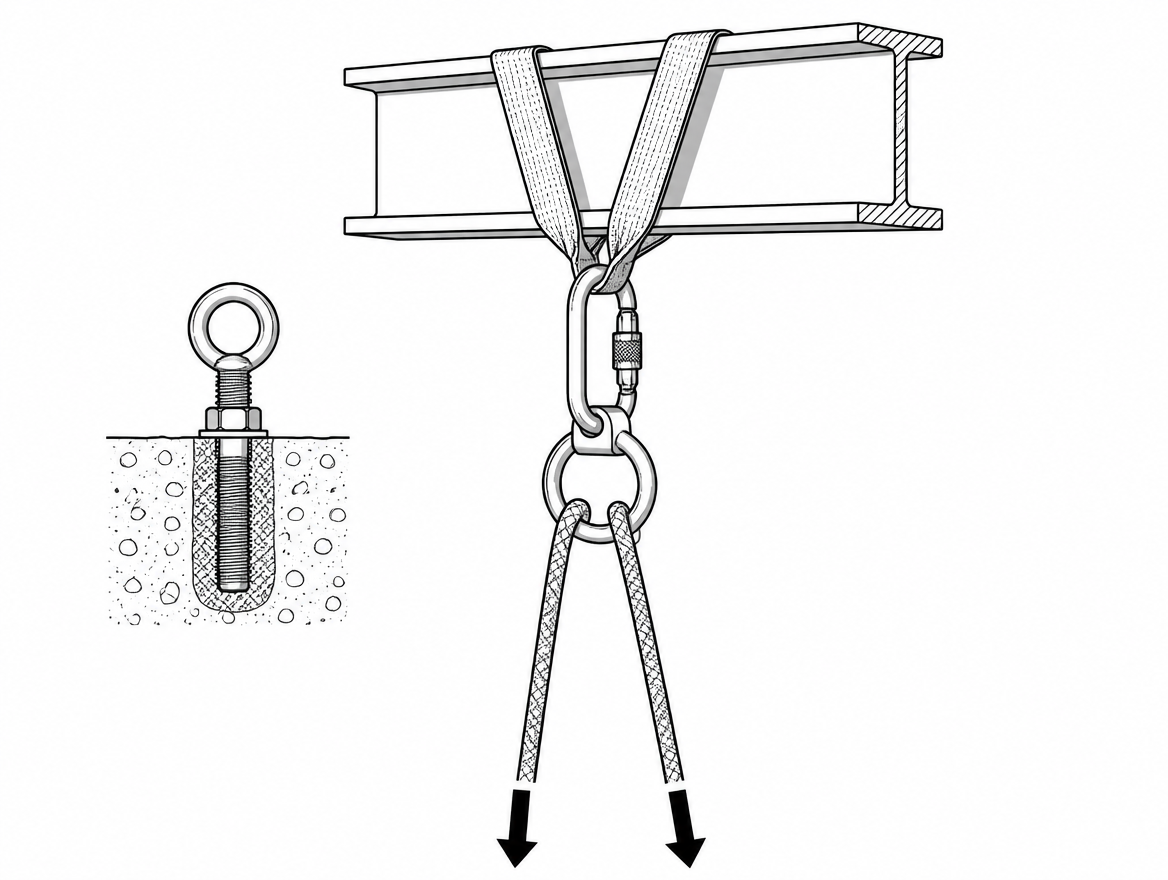
The rope is passed through a metal ring or screwlink at the anchor and both strands are run to the ground. The descent is made on both strands together or on one strand of the doubled system, depending on device and technique, and retrieval is a straight pull on one side.
Key points for this configuration:
- The rope must run on metal, not textile. A loaded rope moving across a webbing sling generates enough friction heat to cut the sling. Use a ring or a screwlink connector to EN 362 Class Q, fully closed with the sleeve tightened down against the shoulder.
- Load distribution changes with technique. Hanging on both strands, each strand carries roughly half the mass; hanging on one strand of a system blocked at the anchor, that strand carries all of it, and the anchor sees the full load plus friction at the ring.
- Doubled ropes twist. Two strands running through a descender will wrap around each other over a long descent. Flake both strands separately at the bottom before the next person descends, and keep them separated at the top.
- Rope-on-rope contact is a stop condition. A moving strand bearing on a static strand under load will glaze and then melt the sheath. Rig so the strands are separated at the ring and at every edge.
What the rope runs over at the anchor
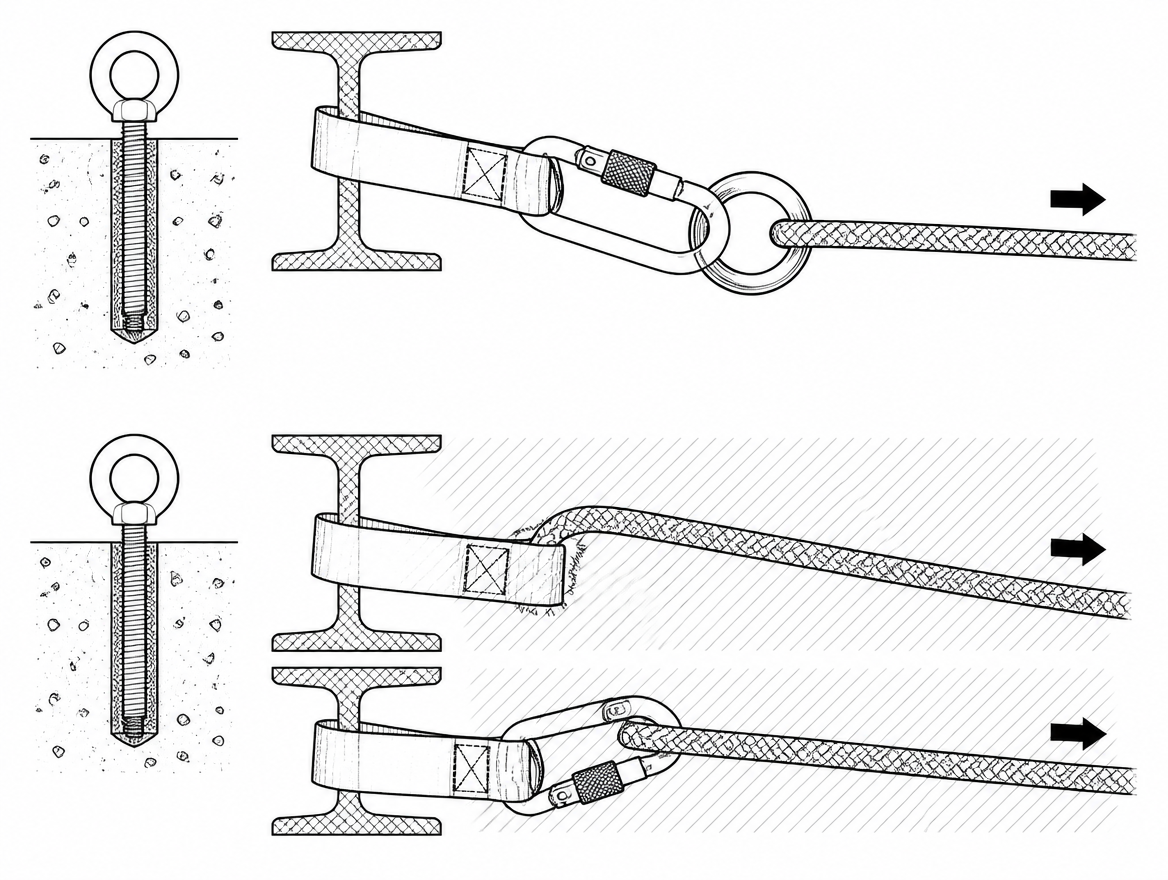
Retrieval failures cluster at the anchor. A rope routed through a carabiner can shift onto the gate and load it across its minor axis; a rope routed around a structural member instead of through a ring binds under load and will not run when pulled. A dedicated smooth-radius ring or a Class Q screwlink, hanging free enough to align with the pull direction, is what makes retrieval predictable.
Configuration 2: single rope with a separate retrieval line
Here the working rope is blocked at the anchor — typically with a knot or block held against a ring or a toggle — so that the full descent happens on a single strand. A separate light retrieval cord runs to the ground. Pulling the cord releases the block and the rope falls.
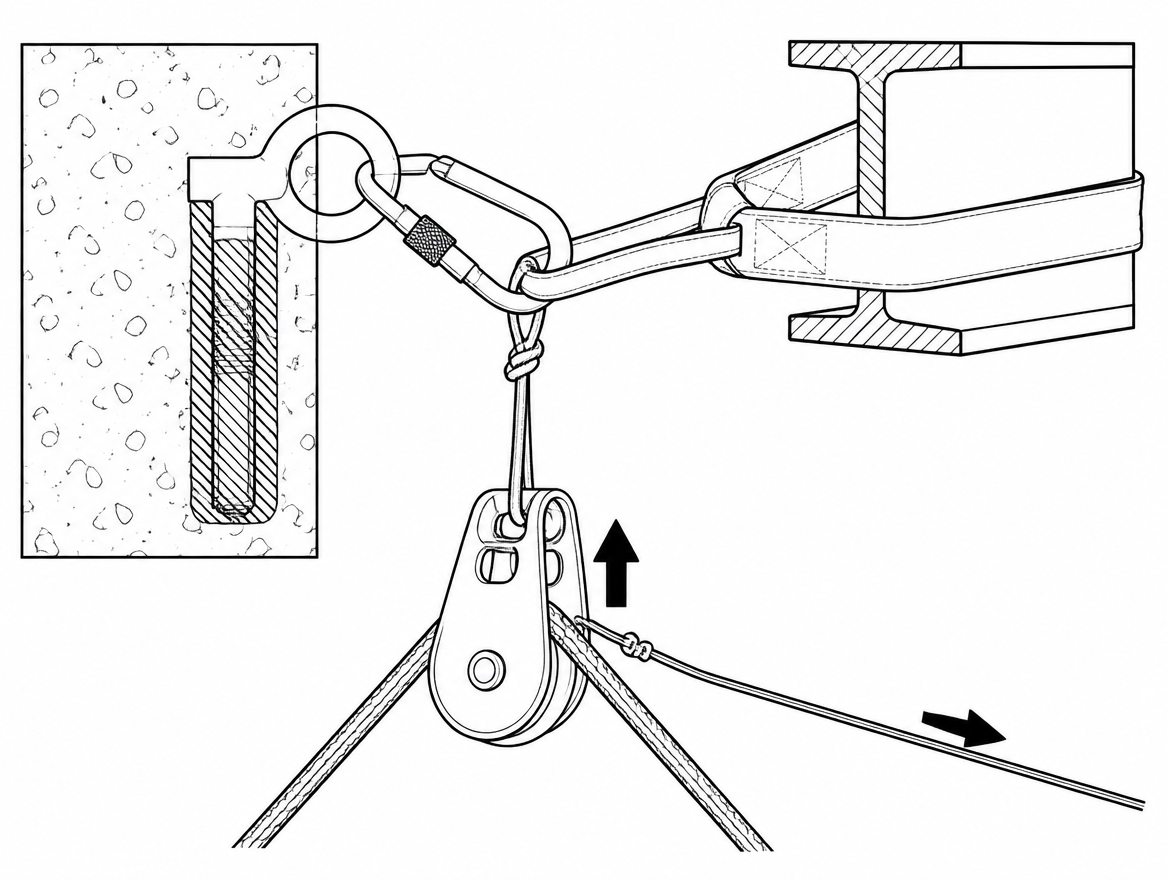
The advantages are a single-strand descent with no twist, less rope in play, and a device set-up identical to normal single-rope technique. The trade-offs are specific and worth stating plainly:
- The retrieval cord is not a life-support line. It is not rated, not inspected as PPE and not connected to anyone. Nothing about the system should ever depend on it holding a person.
- The release must be positive and unambiguous. A toggle or block that can be released by rope movement, wind or a snagging cord is a release mechanism that can act while somebody is on the rope. Only use arrangements the manufacturer specifies for that purpose, or established rigging whose release geometry has been verified unloaded and under load at ground level.
- Cord management dominates the failure modes. The retrieval cord tangles with the working line, wraps the descender, catches on structure and gets stood on. It needs to be bagged, run clear of the working line and managed by the descending technician, not left to hang loose.
In arboriculture, the same principle appears in retrievable rope guides and friction savers, where the retrieval line recovers the anchor hardware after a base-anchored descent. The rigging detail differs; the discipline around cord management does not.
Rope, connectors and anchors
- Rope: low stretch kernmantle rope to EN 1891, Type A for general access and rescue work. Type B has lower performance requirements and a lower test mass and is not the default choice for a system that has to be recoverable and abrasion-tolerant. Descenders certified to EN 12841 Type C and rescue descenders to EN 341 are certified against a stated diameter range — the rope has to be inside that range for the certification to mean anything.
- Anchors: where a transportable temporary anchor device is used, EN 795 Type B applies; EN 795 covers single-user devices, and CEN/TS 16415 covers anchor devices used by more than one person at a time. Structural anchor points that are not products under EN 795 need a documented strength assessment by a competent person.
- Connectors: EN 362, self-locking where the connector can be loaded during the descent. Screwlinks used as retrieval rings are Class Q and must be fully tightened; a partially closed screwlink loses most of its rated strength.
- PPE status: ropes, harnesses, connectors and descenders in this system are Category III PPE under Regulation (EU) 2016/425. EN 365 sets the framework for instructions, records and periodic examination — examination by a competent person at least every 12 months where the manufacturer requires it, with the record kept for the individual item.
Rigging sequence
- Confirm the descent length. For a doubled-rope pull-down, the usable descent is roughly half the rope, less what the anchor consumes. Measure or verify from a drawing rather than estimating from the edge.
- Build the anchor and set the retrieval point. Position the ring or screwlink so it hangs clear and can align with the eventual pull direction from below.
- Protect every edge and contact point. Edge protectors, rollers or padding at each place the loaded rope bears on structure, secured so they stay in place while the rope moves under them.
- Close the system. Stopper knots in both ends, or the ends secured at the base. An open end on a retrievable system is the classic descend-off-the-end scenario, because the length available is not the length of the rope.
- Position the joining knot, if two ropes are used. Joining ropes in a retrievable descent adds a knot that has to pass a device or sit at a specific side of the anchor. Where it is unavoidable, place the knot on the strand that is not pulled, keep the knot clear of the ring, and confirm every person on the team knows which strand is which before the descent starts.
- Test the pull before the last person leaves the anchor. A short test pull on the retrieval strand from the ground, while someone is still at the top to correct a fouled rope or a misaligned ring, is the single most effective control in the whole procedure.
- Last person down re-checks the anchor. Ring alignment, screwlink fully closed, edge protection in place, strands separated, retrieval cord running free.
Edge protection is a retrieval issue, not only a wear issue
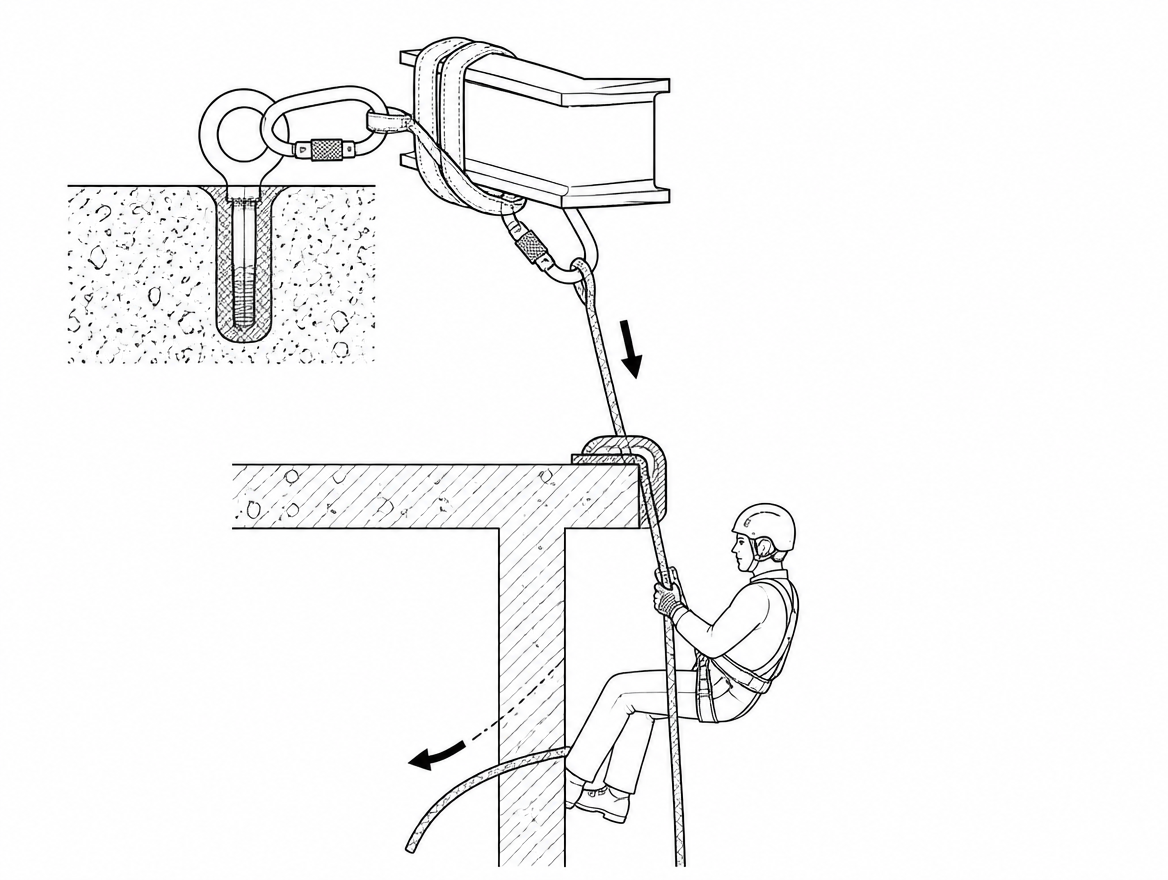
Abrasion on descent is the obvious concern. The less obvious one is that an unprotected edge with any lip or rough surface will grip the rope during retrieval, when the rope is being pulled sideways across the edge with no weight on it to help it run. A rope that ran perfectly well on descent can bind completely on the way down. Edge protection that stays fixed — not a pad that shifts as soon as the load comes off — addresses both.
Pulling the rope down
Retrieval is the point of highest exposure to falling objects, and the person doing it is standing directly under the anchor by default.
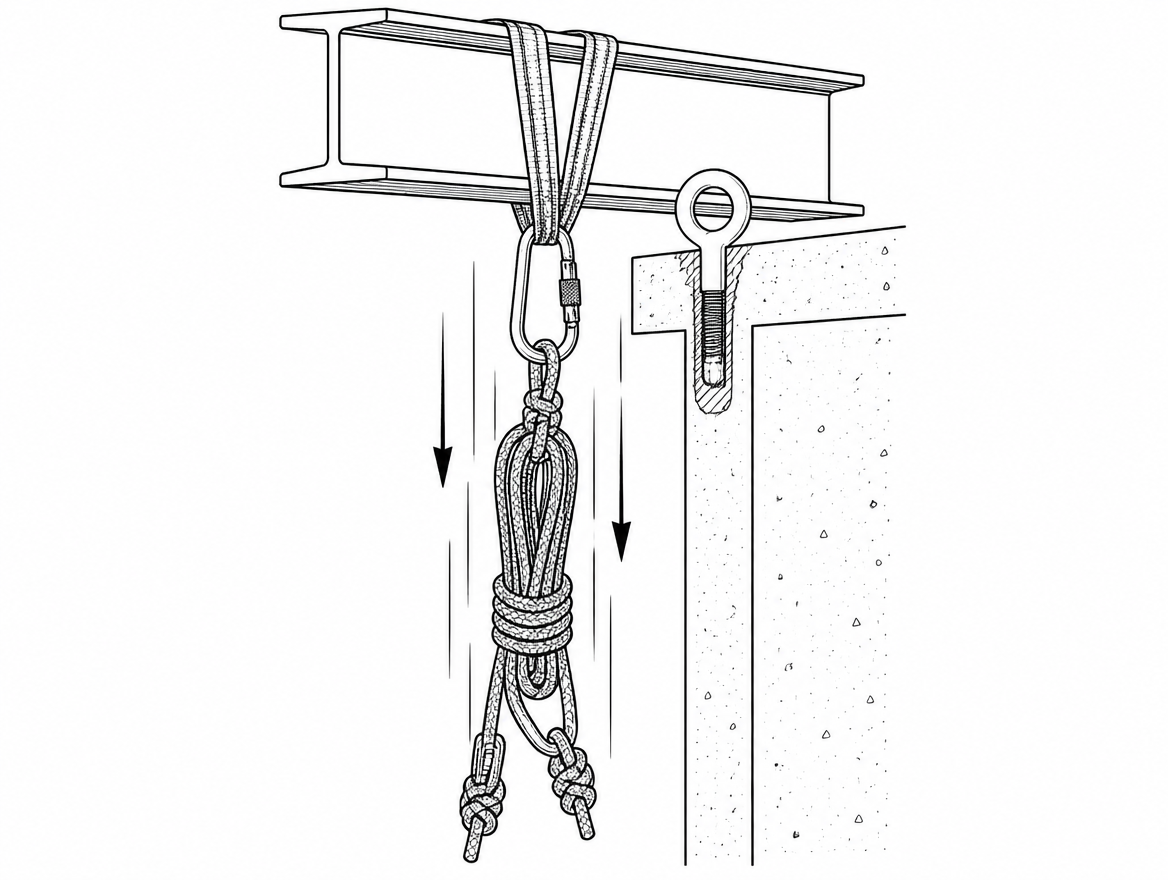
- Move out of the fall line before pulling. A pull taken from an offset position keeps the descending rope, the connectors and any dislodged material away from the person on the cord.
- Confirm the drop zone is clear and that nobody is working below or on the structure the rope will sweep across.
- Pull steadily and evenly. Jerking the strand shakes the rope into structure and is a common cause of snagging.
- Keep helmets on until the rope, both ends and all anchor hardware are on the ground and accounted for. Screwlinks and rings arrive at terminal velocity.
- If the rope binds, stop. Repeated hard pulls on a jammed rope either damage it or free it suddenly. The response is the recovery method set out in the rescue plan — re-ascending on the fixed strand where that is possible and safe, or an alternative access route — not more force.
Plan the jam before it happens
Every retrievable descent needs a documented answer to two questions: what happens if the rope jams with the team at the bottom, and what happens if a technician needs assistance while on a system that cannot be lowered from the anchor. Both belong in the rescue plan, with the equipment for the chosen response present on site rather than in the van.
A retrievable system that jams is not an emergency in itself — the team is down and safe, and the rope is a recoverable asset. It becomes an emergency when the plan for that outcome was to improvise.
Before the next retrievable descent
Three checks separate a controlled retrievable rig from a hopeful one: the rope runs on metal at the anchor with a smooth radius and free alignment; every edge is protected in a way that survives the load coming off; and the pull is tested from the ground while someone is still at the top. Everything else in this article supports those three.
For the surrounding controls — anchor selection and documentation, PPE inspection intervals under EN 365, and rescue planning for single-line work — see the related articles on temporary anchor devices to EN 795 and on building a work-at-height rescue plan that matches the access method actually used.
Frequently asked questions
What is the difference between a retrievable and a releasable rope system?
A retrievable rope can be recovered from the bottom after everyone is down — it is a one-way system, and once retrieved the anchor is no longer usable. Releasable (contingency) rigging lets a person at the anchor convert a fixed line into a lower, usually through a descender in the anchor system; it requires someone to stay at the top and does not, by itself, retrieve anything. A system can be both, but the two functions are rigged differently and solve different problems.
Does rigging a rope to be retrievable exempt the job from the two-line requirement?
No. The temporary work at height provisions consolidated in Directive 2009/104/EC (Annex II, point 4.3) require rope access and positioning systems to comprise at least two separately anchored lines — a working line with a means of ascent and descent and a safety line with a fall arrest back-up device. A single line is permitted only in exceptional circumstances where the risk assessment shows a second line would make the work more dangerous and compensating measures are in place. A retrievable arrangement creates no exemption: where two lines are required, both must be retrievable and independently anchored, which roughly doubles the rigging, anchor demand and retrieval complexity. National transposition, not the Directive alone, is the governing text.
Why must the rope run on metal at the anchor rather than on a sling?
A loaded rope moving across a webbing sling generates enough friction heat to cut the sling. The rope should run through a smooth metal ring or a screwlink connector to EN 362 Class Q, fully closed with the sleeve tightened down against the shoulder. A rope routed through a carabiner can shift onto the gate and be loaded across its minor axis, and a rope routed around a structural member instead of through a ring binds under load and will not run when pulled.
What problems does a doubled-rope pull-down configuration introduce?
Load distribution changes with technique: hanging on both strands, each strand carries roughly half the mass, while hanging on one strand of a system blocked at the anchor means that strand carries all of it and the anchor sees the full load plus friction at the ring. Doubled ropes also twist — two strands through a descender wrap around each other over a long descent, so both strands should be flaked separately at the bottom before the next person descends and kept separated at the top. Rope-on-rope contact is a stop condition: a moving strand bearing on a static strand under load will glaze and then melt the sheath.
Can the retrieval cord in a single-line set-up be used to support a person?
No. The retrieval cord is not a life-support line: it is not rated, not inspected as PPE and not connected to anyone. It carries no person, must be bagged and kept clear of the working line, and nothing about the system should depend on it beyond releasing the block so the rope falls.
Need this as a document you can issue? The template library gives you the risk assessments, permits and inspection logs in editable form — and employer plans cover a whole team with completion records.