Safety / Tips and Tricks / Energy and networks
Activity 03 · Energy
Rescue Planning for an Electrical Contact Incident
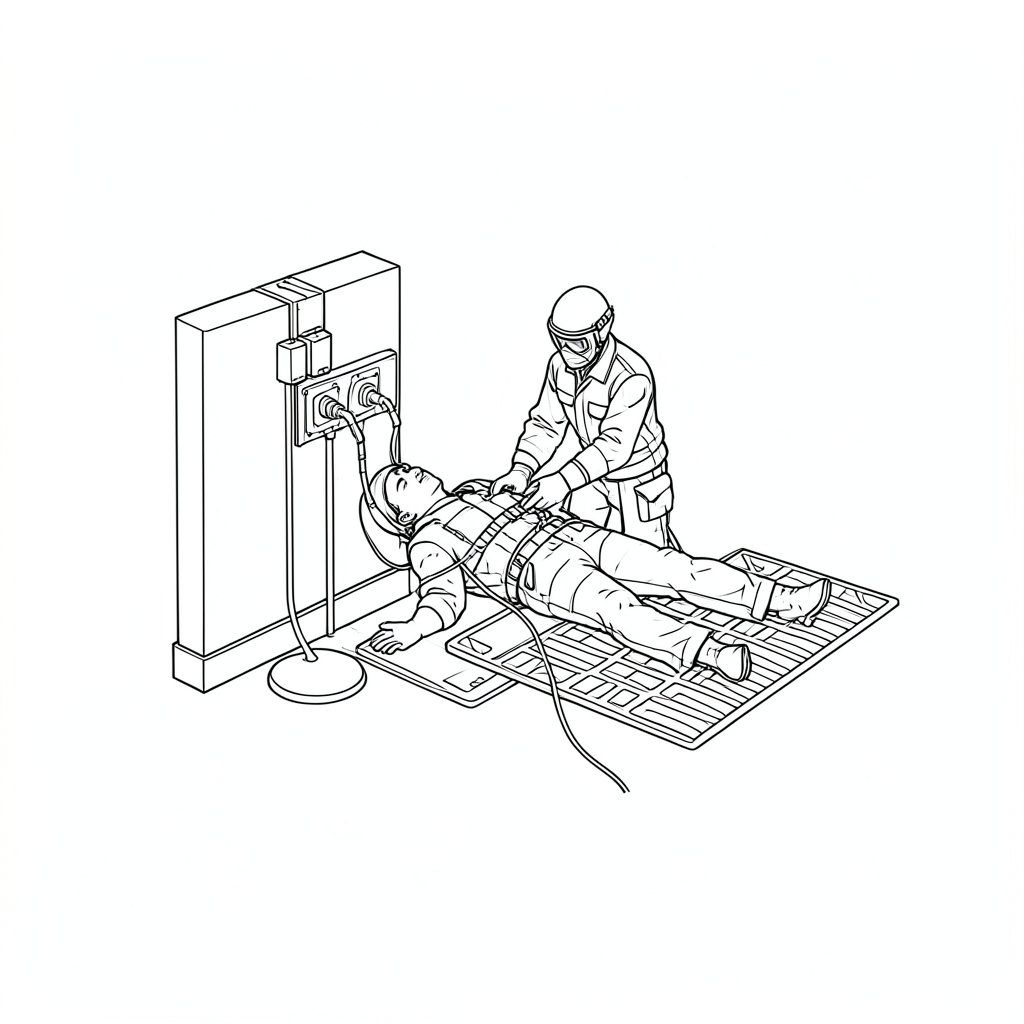
An electrical contact incident often leaves the casualty still connected to the source of current, which makes the rescuer's first action — approach or hold back — the single most consequential decision in the entire response, and it has to be made correctly under real time pressure.
Why the first instinct can be the wrong one
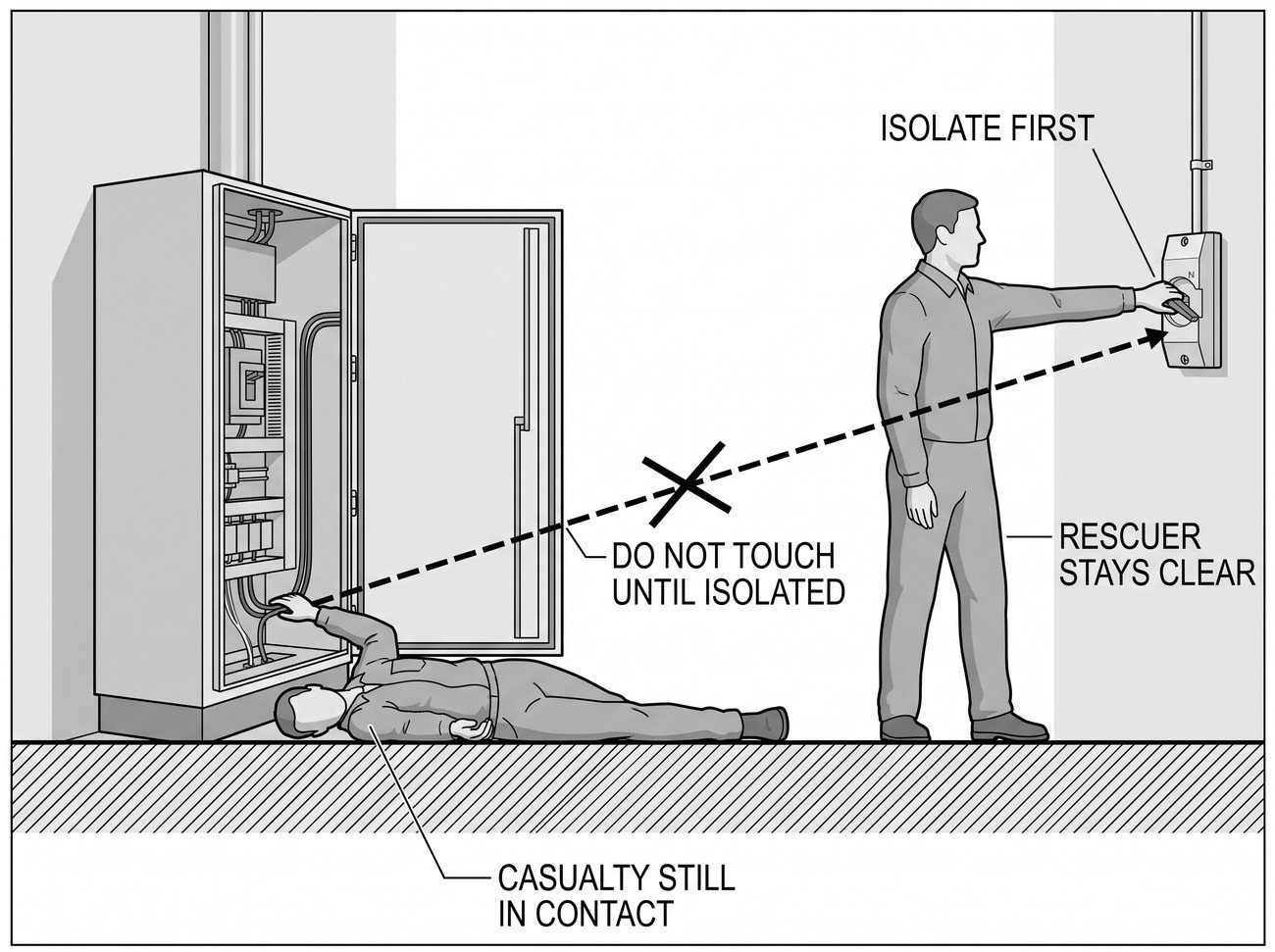
The instinctive response to seeing someone in contact with electricity is to reach in and pull them away, but touching a casualty who is still part of a live circuit can make the rescuer a second casualty through the same current path. The first action in any electrical contact rescue is to remove the source of danger, not the casualty, wherever this can be done safely and quickly.
Removing the source of danger
Where the supply can be isolated quickly — a nearby switch, breaker or emergency stop — this should be the first action. Where isolation is not immediately available, non-conductive material can sometimes be used to separate the casualty from the source, but only by someone who understands the risk and only with genuinely non-conductive equipment, since a rescuer’s own judgement about what counts as non-conductive under pressure is not always reliable. Where neither option is safely and immediately available, the priority is to prevent further casualties by keeping others back and calling for help, rather than a well-intentioned but under-informed rescue attempt.
After the source is removed
Once the casualty is confirmed clear of the electrical source, standard first aid and emergency response applies, but electrical contact carries specific additional considerations: internal injury and cardiac effects are not always visible externally, so any electrical contact incident warrants medical assessment even where the casualty appears unharmed, and burns from an electrical contact often extend deeper than they first appear at the skin surface.
Why this needs to be planned before it happens
A rescue plan for electrical work should identify, before the task starts, how the specific circuit or equipment can be isolated quickly if needed, who is responsible for that isolation in an emergency, and what emergency contact and first aid resources are available on site. This is directly analogous to the rescue planning required for fall-arrest work at height — a plan improvised after the incident has already started is far less reliable than one prepared in advance.
Training and drills
Personnel working on or near electrical hazards should be trained in this specific rescue sequence, not just general first aid, since the counter-intuitive first step of removing the source before approaching the casualty is exactly the kind of instruction that is easy to forget under the stress of a real incident without prior practice.
For the isolation this rescue plan depends on being able to act on quickly, see lockout-tagout for electrical isolation.
Common errors
1Reaching directly for a casualty still in contact with a live source before removing the danger.
2Attempting to use improvised, uncertain materials to separate a casualty from a live source.
3Treating an electrical contact casualty who appears uninjured as not needing medical assessment.
4Not identifying the isolation point and rescue plan for a task before work begins.
Frequently asked questions
Why shouldn't a rescuer immediately pull a casualty away from an electrical contact?
Touching a casualty who is still part of a live circuit can make the rescuer a second casualty through the same current path, so the first action should be removing the source of danger, not the casualty.
What is the first action in an electrical contact rescue?
Removing the source of danger where this can be done safely and quickly, such as isolating a nearby switch, breaker or emergency stop, before approaching the casualty at all.
Can non-conductive material be used to separate a casualty from a live source?
Only by someone who understands the risk and only with genuinely non-conductive equipment, since a rescuer's own judgement about what counts as non-conductive under pressure is not always reliable.
Why does an electrical contact casualty need medical assessment even if they appear unharmed?
Internal injury and cardiac effects are not always visible externally, and burns from electrical contact often extend deeper than they first appear at the skin surface.
Why does electrical rescue planning need to happen before work starts, not during an incident?
A plan improvised after the incident has already started is far less reliable than one prepared in advance, identifying how the specific circuit can be isolated quickly and who is responsible for that isolation.
Need this as a document you can issue? The template library gives you the risk assessments, permits and inspection logs in editable form — and employer plans cover a whole team with completion records.