Safety / Tips and Tricks / Energy and networks
Activity 03 · Energy
Grounding and Earthing for Temporary Electrical Safety
Proving a circuit dead is not the end of the isolation process on higher-voltage systems — temporary earthing is what protects against the circuit becoming live again unexpectedly while work is in progress, whether from human error elsewhere on the system or from induced voltage on long conductors.
Why proving dead is not the final safeguard
A circuit confirmed dead at the moment of testing can still become live again: through human error at a remote switching point, through an automatic reclose function operating as designed but at the wrong moment, or through voltage induced onto a long conductor running parallel to an energised line. Temporary earths applied after proving dead protect against exactly these scenarios, by ensuring that if the circuit does become energised, the fault current flows to earth through the temporary earth rather than through anyone working on the circuit.
Where earths need to be applied
Temporary earths should be applied at, or as close as practical to, the actual work location, and on both sides of the work point where the circuit could be fed from more than one direction. Earthing only at a point remote from the actual work location leaves the section between the earth and the work point without the protection the earth is meant to provide.
Sequence and equipment
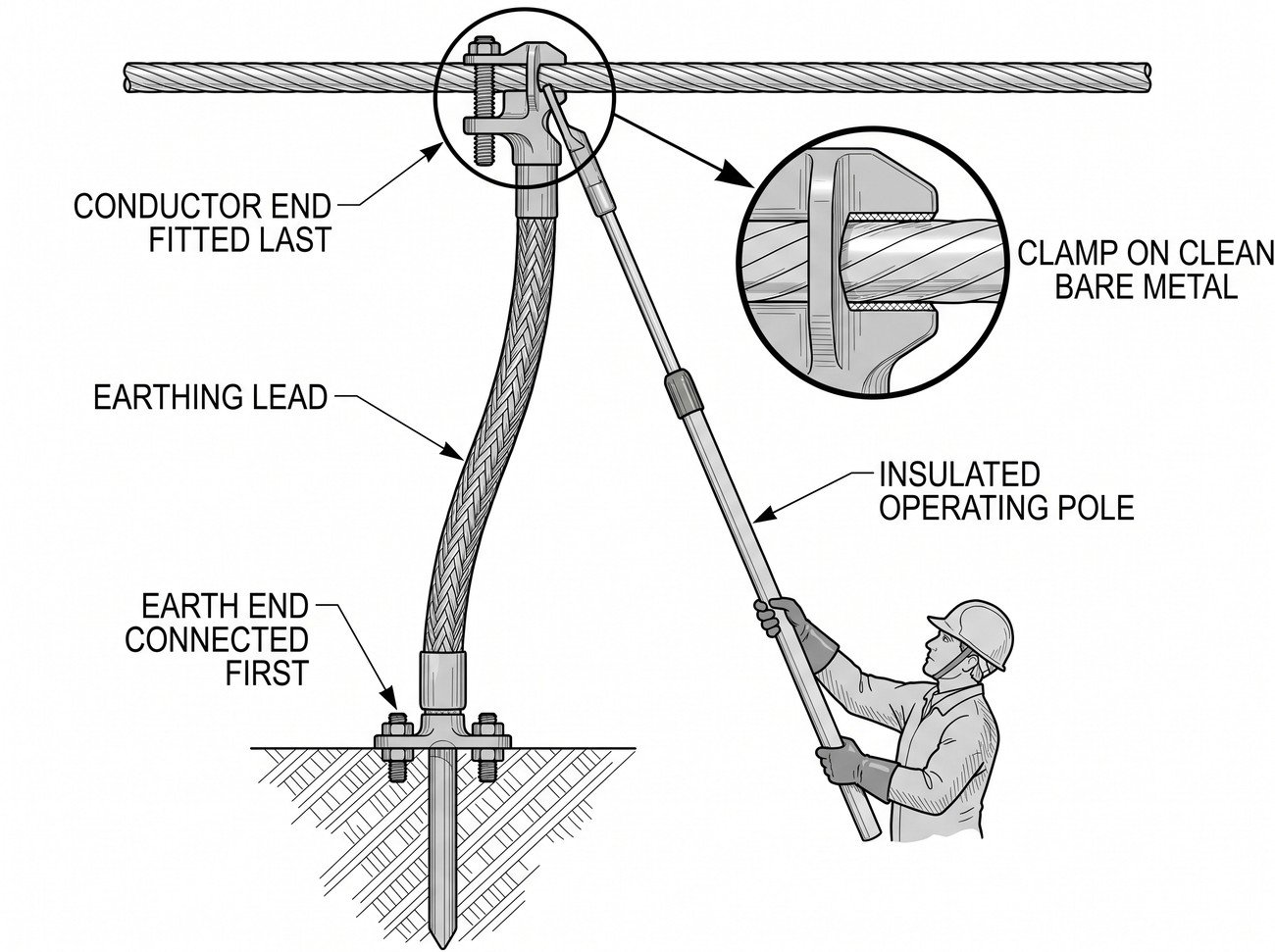
Earthing equipment is connected to the earth point first, then to the conductor, and removed in the reverse order — conductor first, then earth — which minimises the time the equipment itself could be at a raised potential during connection or disconnection. The earthing equipment’s rating needs to match the fault current the system could deliver, since undersized earthing equipment can fail during the very fault event it exists to protect against.
Testing and inspecting earthing equipment
Temporary earths and their connecting leads need visual inspection before use for damage to the clamps or conductors, and periodic testing to confirm continuity and rating are still within specification, following the same discipline as insulating gloves or insulated tools. Equipment that has previously carried a fault current should be inspected and, where the manufacturer specifies, retired or retested before reuse, since the fault event itself may have degraded it even without visible damage.
Removing earths at the end of the task
Earths should only be removed once work is complete and everyone has been accounted for, following the reverse of the connection sequence, and this step needs to be included explicitly in the permit hand-back process so that supply cannot be restored while a temporary earth is still connected to the circuit.
This step follows directly from testing for absence of voltage.
Common errors
1Applying earths only at a point remote from the actual work location rather than close to it.
2Connecting or disconnecting earthing equipment in the wrong sequence.
3Using earthing equipment rated below the system's potential fault current.
4Restoring supply without confirming all temporary earths have been removed.
Frequently asked questions
Why is a circuit proven dead still at risk of becoming live again?
Through human error at a remote switching point, an automatic reclose function operating as designed but at the wrong moment, or voltage induced onto a long conductor running parallel to an energised line.
Where should temporary earths actually be applied?
At, or as close as practical to, the actual work location, and on both sides of the work point where the circuit could be fed from more than one direction, since earthing only at a remote point leaves the work section unprotected.
What is the correct sequence for connecting temporary earthing equipment?
Connect to the earth point first, then to the conductor, and remove in reverse order – conductor first, then earth – which minimises the time the equipment could be at a raised potential during connection or removal.
Why does earthing equipment need a specific fault current rating?
Undersized earthing equipment can fail during the very fault event it exists to protect against, so its rating needs to match the fault current the system could actually deliver.
What should happen to earthing equipment after it has carried a fault current?
It should be inspected and, where the manufacturer specifies, retired or retested before reuse, since the fault event may have degraded it even without visible damage.
Need this as a document you can issue? The template library gives you the risk assessments, permits and inspection logs in editable form — and employer plans cover a whole team with completion records.