Safety / Tips and Tricks / Rope access and confined space
Activity 01 · Rope access
Pulley Efficiency: What the Numbers Mean
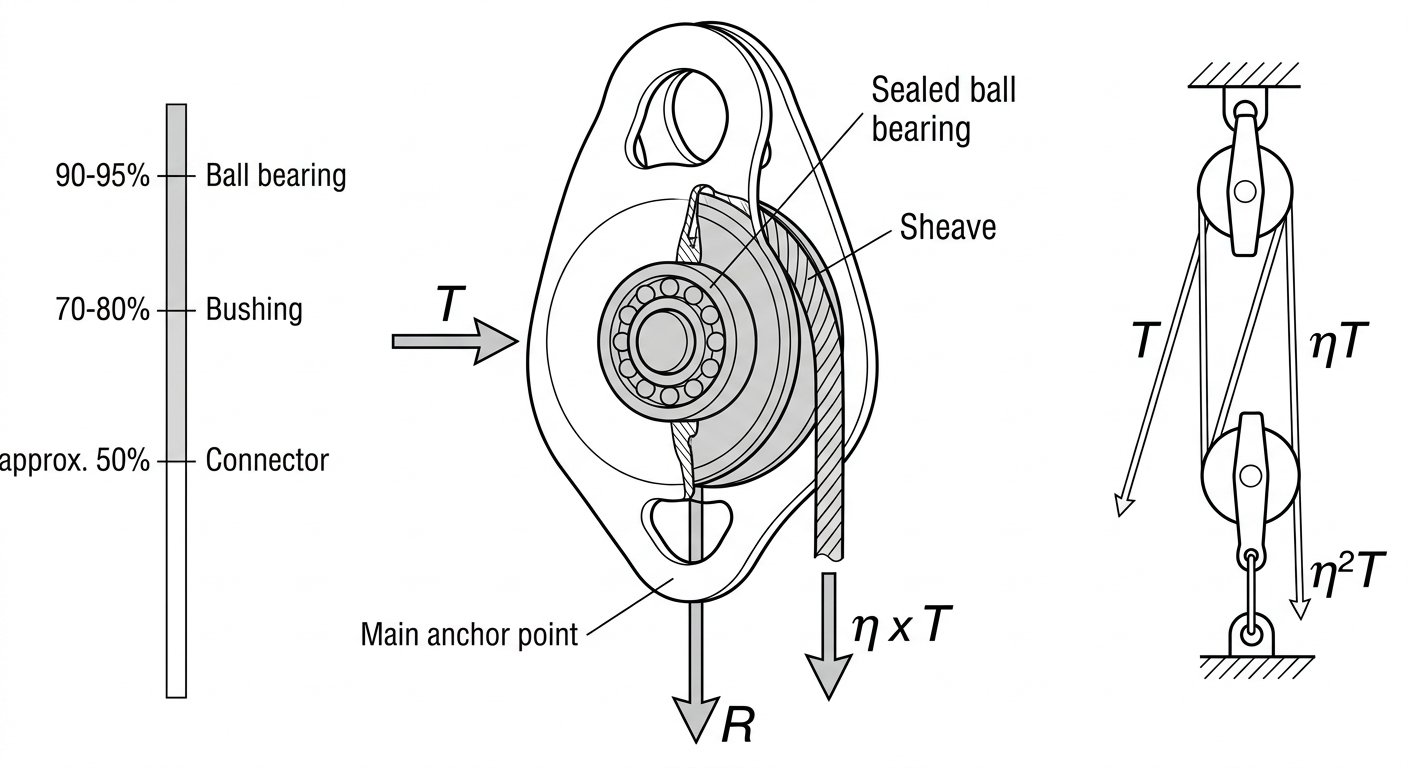
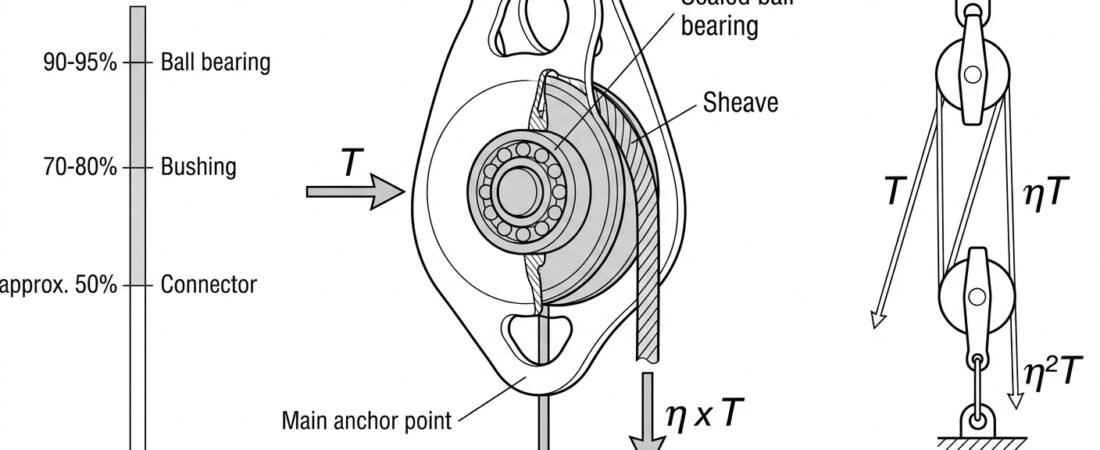
A pulley's stated efficiency is not a marketing number — it changes the force a hauling team has to produce, the load the anchor actually sees, and whether a 4:1 on paper behaves like a 4:1 on the rope. On site the practical questions are simple: how much of the hauler's effort reaches the load, and how much force is left over in the anchor. Efficiency figures answer both, provided the number is read for what it is.
What an efficiency figure actually measures
Pulley efficiency is normally expressed as the useful force delivered on the output side divided by the force applied on the input side, given as a percentage. A pulley described as 90% efficient will, under the manufacturer’s test conditions, deliver roughly 90 units of tension for every 100 pulled through it — the missing 10 units are lost to friction and to work done deforming the rope.
Two points matter when comparing figures:
- The number is tied to a test setup. Efficiency is measured with a specified rope type and diameter, a specified load, and usually a full 180° change of direction. Change the rope, the load or the wrap angle and the real figure moves.
- It is not a certification value. The European product standard for pulleys, EN 12278, deals with construction and strength characteristics; efficiency percentages published by manufacturers are performance data from their own testing rather than a harmonised, directly comparable rating. Treat cross-brand comparisons of one or two percentage points as noise.
Where the losses come from
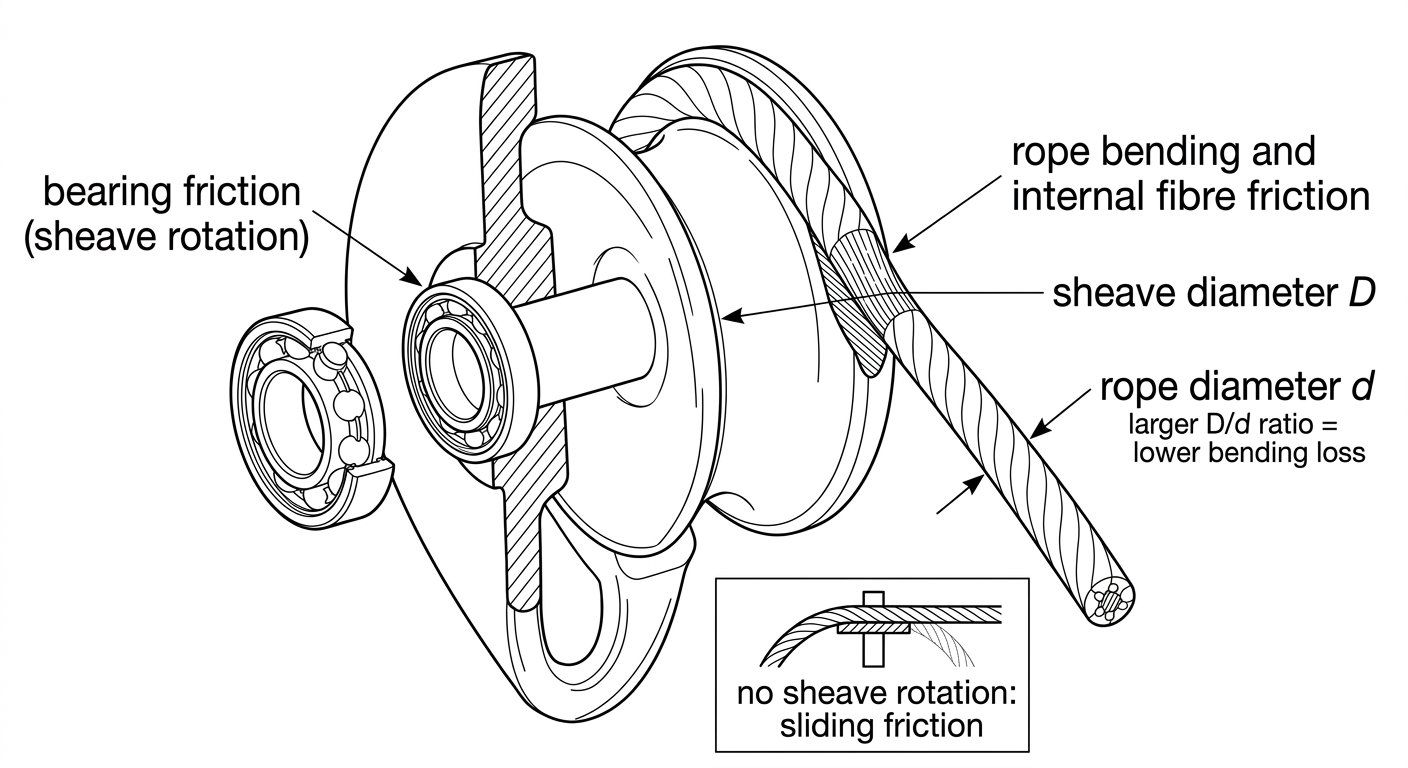
Two mechanisms account for nearly all of the loss:
- Friction in the sheave’s rotation. Sealed ball bearings turn under load with very little resistance; a plain bushing (a simple bearing surface between sheave and axle) turns with noticeably more. This is why bushing pulleys and ball-bearing pulleys of otherwise similar size do not perform alike.
- Rope bending and internal friction. Forcing a loaded rope around a curve flattens it, compresses the sheath and makes the fibres slide against one another. This loss grows as the sheave gets smaller relative to the rope, and as the rope gets stiffer — a large-diameter, low-stretch rope on a small sheave loses more than a supple rope on a generous one.
Everything else that degrades efficiency in service traces back to one of those two: grit or dried mud in the bearing, a corroded axle, a grooved or worn sheave, a rope that is wet, frozen, dirty or glazed, or strands entering the pulley at an angle so the rope rubs the side plates.
Typical figures, and what they imply
Published values vary by model and test method, but the broad picture is consistent and worth carrying in your head as orders of magnitude rather than exact constants:
- Sealed ball-bearing pulleys: typically in the region of 90–95%.
- Bushing (plain-bearing) pulleys: typically around 70–80%, depending on size and load.
- A connector used as a redirect: roughly half the input force is lost — the rope slides over a fixed, small-radius bar instead of rotating a sheave. It also abrades the rope and wears a groove in the connector.
That last figure is the reason a carabiner is a redirect of last resort in a hauling system, not a substitute for a pulley. If you are choosing hardware to sit alongside a sheave, see choosing connectors for hauling and pulleys; rope choice matters too, and matching low-stretch rope diameter to devices and loads covers the diameter and stiffness side of the same problem.
Efficiency and anchor load on a simple redirect
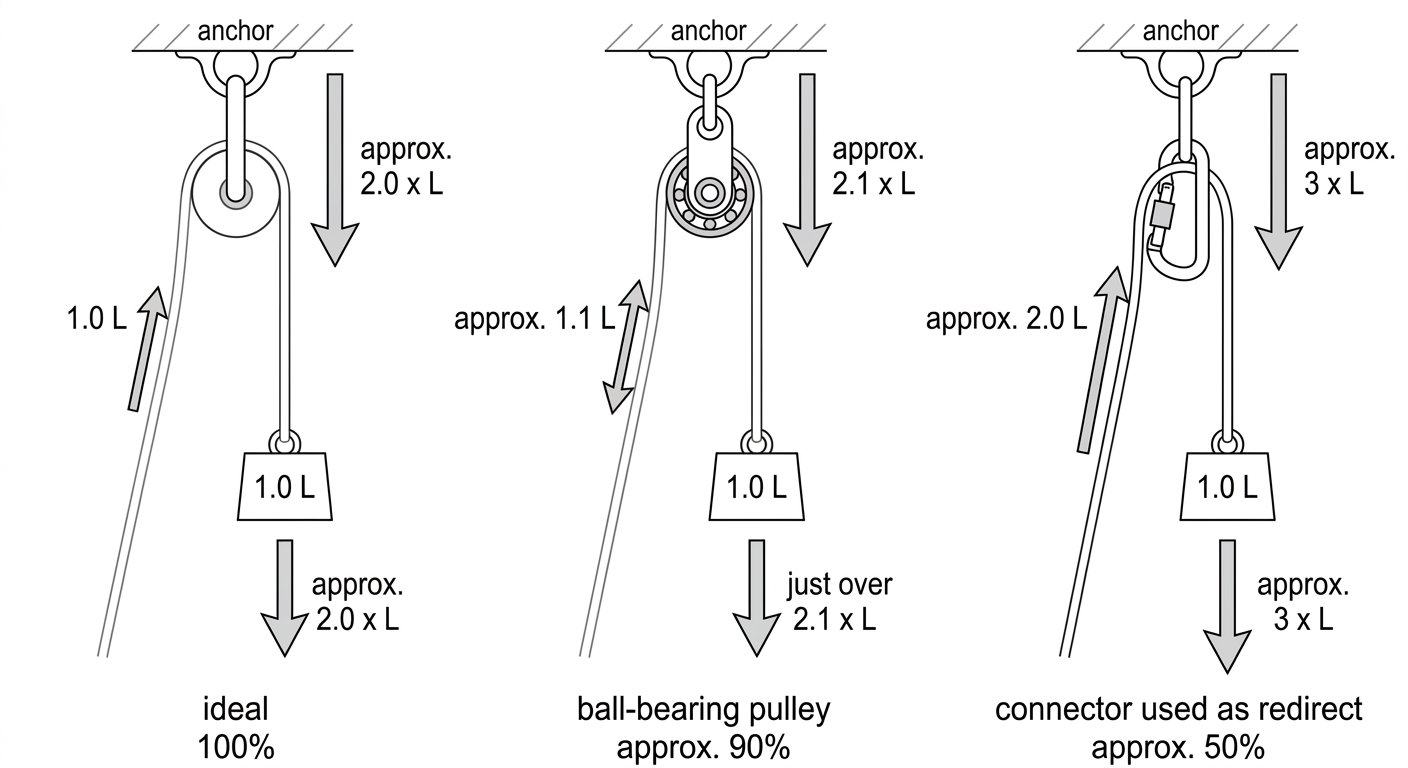
The most common place efficiency is misread is a single 180° redirect. With a hypothetical frictionless pulley, the two rope strands carry equal tension and the anchor sees twice the load. Real pulleys break that symmetry: to move a load L, the input strand must carry roughly L divided by the efficiency, so the anchor carries the sum of the two unequal tensions.
For a 100 kg load, that gives an anchor force in the region of:
- about 2.0 × the load with a theoretically perfect pulley;
- a little over 2.1 × the load at 90% efficiency;
- around 3 × the load with the rope running over a connector.
So friction does not reduce anchor load — it increases it, because the hauling side has to pull harder. Anything rigged as a top redirect or a high directional needs to be sized for that, which is one reason redirect hardware and its connectors are chosen deliberately rather than from whatever is left on the harness. The same logic drives connector selection for anchor rigging.
Why losses compound in a hauling system
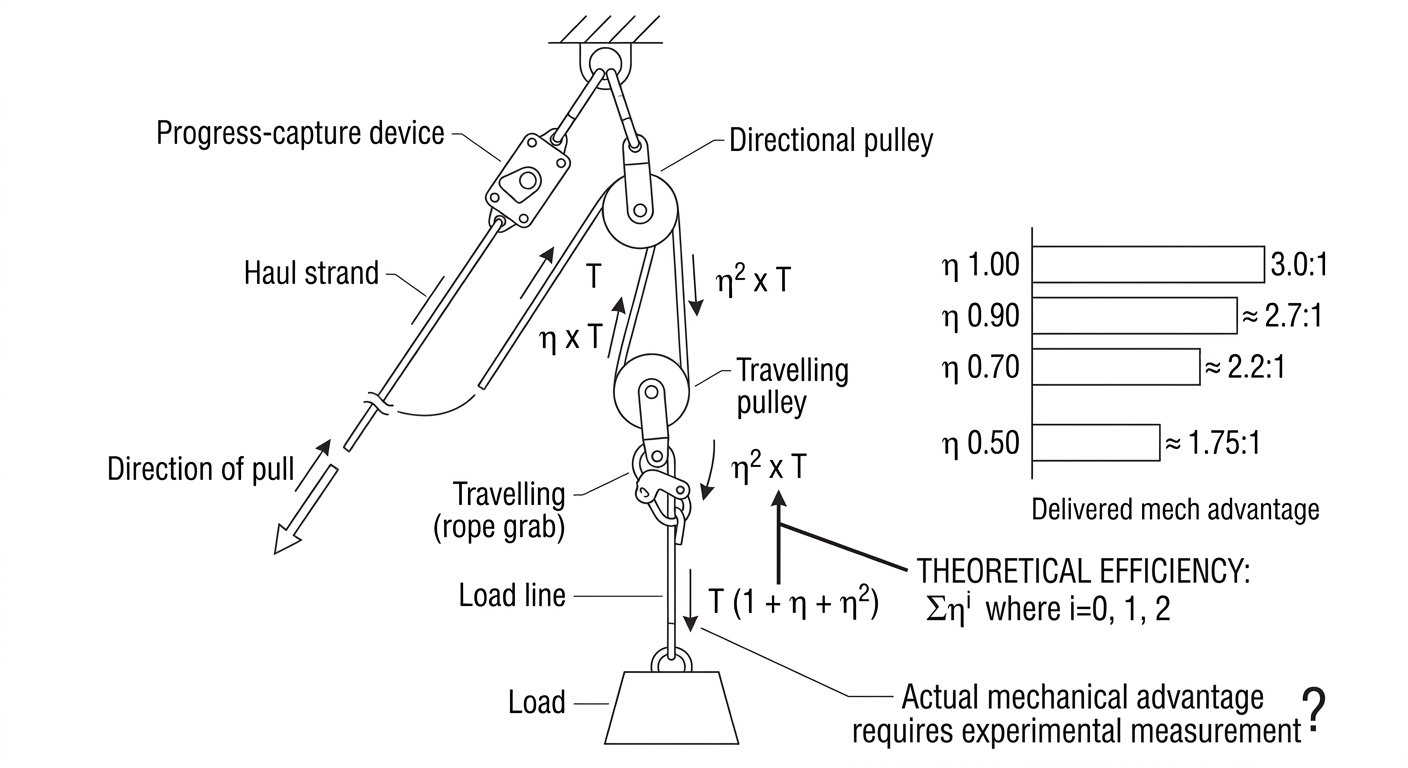
In a mechanical advantage system, each pulley the rope passes through multiplies the loss rather than adding to it. Trace the tension through a simple 3:1 with the hauler pulling with force T: after the first sheave the strand carries ηT, after the second η²T, and the force arriving at the load is the sum of the contributing strands — T + ηT + η²T.
Working that through:
- With perfect pulleys (η = 1.00): 3.0:1.
- With good ball-bearing pulleys (η = 0.90): about 2.7:1 — roughly 90% of the theoretical advantage.
- With bushing pulleys (η = 0.70): about 2.2:1 — closer to 73%.
- With connectors standing in for sheaves (η = 0.50): about 1.75:1 — barely more than half of what the rigging appears to offer.
The arithmetic gets harsher as systems get bigger. A 5:1 or a compound 9:1 has more sheaves in series, so the gap between the nominal ratio and the delivered ratio widens. Practical consequences:
- Prefer fewer, better pulleys over more, poorer ones. Adding a stage of mechanical advantage on lossy hardware can deliver less improvement than simply replacing the hardware.
- Do not size a team from the nominal ratio. If the plan assumes three haulers move a 3:1 comfortably, build in the real shortfall.
- Count all the friction, not just the sheaves. Progress-capture devices riding along the rope, edge contact, rope running over structure, and any deviation all take their share.
- Watch the reverse direction. The same friction that steals hauling force also masks the load when you release the haul and the system settles onto the capture device — the system may feel lighter than it is right up to the moment it takes the load.
Deviation angle: small deflections cost little
Efficiency figures are usually quoted for a full 180° turn, the most demanding case. A pulley used as a small deviation — pulling the rope a few degrees off line to clear an obstruction — bends the rope less, wraps less of the sheave and loses correspondingly less. The anchor force follows the same pattern: a shallow deviation is loaded only lightly, while an angle approaching 180° loads the anchor with roughly the sum of both strand tensions.
Two field consequences follow. First, when you have a choice, place directionals where the rope turns through the smallest angle that still does the job. Second, never estimate a deviation anchor’s load from the rope tension alone — it depends on the angle, and at wide angles it exceeds the load being moved.
Keeping the efficiency you paid for
A pulley’s published figure is what a clean, undamaged unit does with a suitable rope. Field checks that protect it:
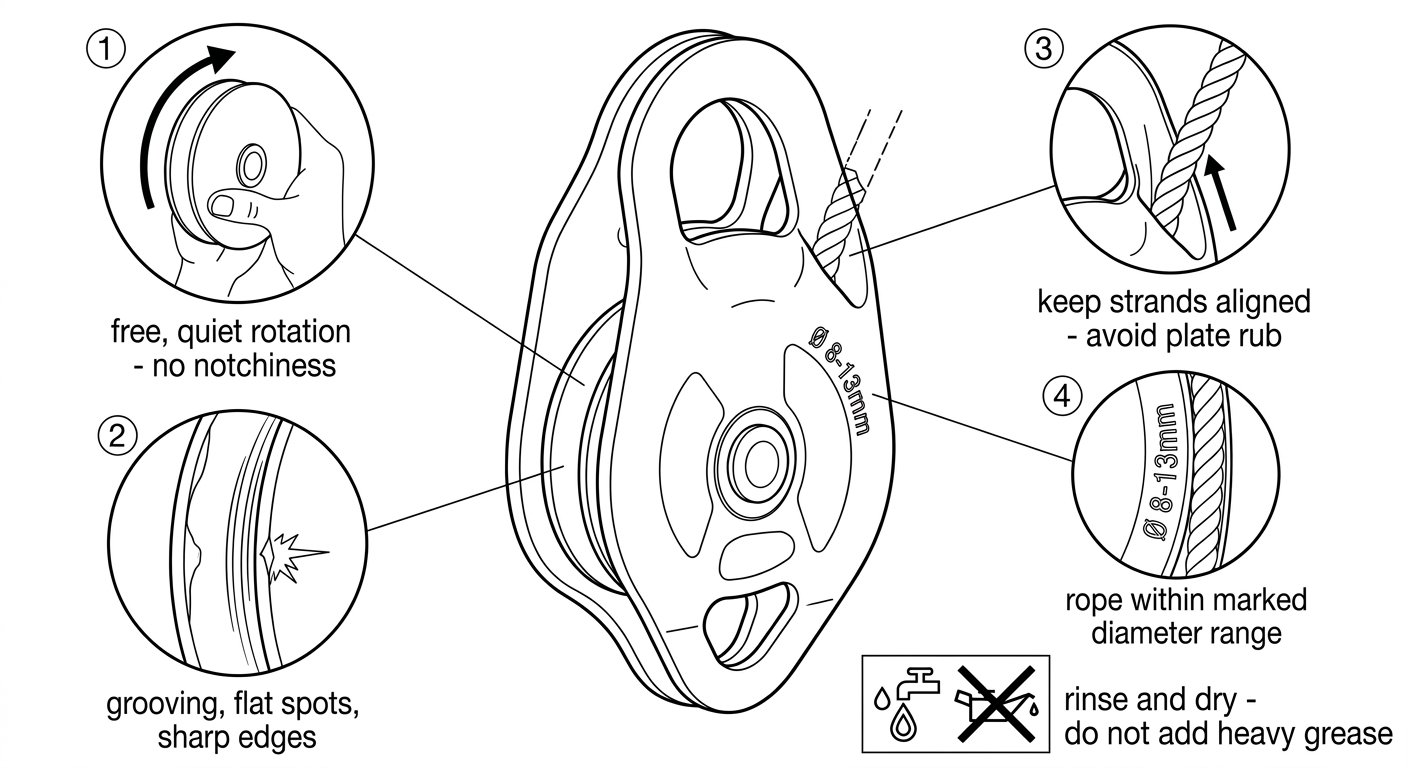
- Spin the sheave under no load. It should turn freely and quietly. Roughness, notchiness or resistance means a contaminated or damaged bearing.
- Inspect the sheave groove. Grooving, flat spots, sharp edges and burrs cut efficiency and attack the rope sheath.
- Rinse rather than lubricate. Flush grit out with clean water and dry thoroughly; heavy oils and greases on an exposed sheave collect abrasive dust. Follow the manufacturer’s instructions — sealed bearings generally need nothing added.
- Check rope-to-sheave sizing. The rope should sit in the groove without pinching against the side plates and within the diameter range marked on the pulley. Oversized or over-stiff rope on a small sheave loses more than the datasheet suggests.
- Keep strands aligned. If the incoming and outgoing rope rubs the side plates or the connector, you are paying for friction that the pulley was designed to avoid.
- Watch the rope’s condition. Wet, muddy, sandy or frozen rope runs measurably worse and wears both sheave and sheath.
Reading a datasheet without over-reading it
When comparing two pulleys, look past the headline percentage to the conditions behind it: the test load, the rope diameter and type, and the wrap angle. A figure measured at a high test load on supple rope flatters a pulley that will spend its working life at low load on stiff, dirty, larger-diameter rope. Where numbers are close, decide on the things that do not depend on the test bench — sheave diameter, bearing type and sealing, breaking strength, rope diameter range, plate design for the rigging you actually build, and whether it can be inspected and cleaned.
The single most useful habit is to treat published efficiency as an upper limit on a good day, then plan hauling systems with the real, reduced ratio in mind. For related rigging decisions in the same series, start from the rope access and confined space technique notes.
Frequently asked questions
Is a higher pulley efficiency always the better choice?
Not on its own. Efficiency matters most where forces are multiplied or repeated — hauling systems, tensioned lines, high directionals — and less on a single redirect used occasionally. Strength, sheave diameter, rope diameter range, plate design and the ability to clean and inspect the unit often decide the choice when published efficiencies are within a few percent of each other.
Can I use a carabiner instead of a pulley as a redirect?
It works, but roughly half the input force is lost because the rope slides over a fixed, small-radius bar instead of rotating a sheave. That both increases the effort needed and raises the anchor load, and it abrades the rope while wearing a groove in the connector. It is acceptable as an expedient in low-force applications, not as a substitute for a sheave in a hauling system.
Why does my 3:1 feel much harder than 3:1?
Because losses compound rather than add: each sheave the rope passes through reduces the tension delivered onward, so a nominal 3:1 typically behaves like roughly 2.7:1 on good ball-bearing pulleys and closer to 2.2:1 on bushing pulleys. Additional friction from progress-capture devices, edge contact and rope running over structure reduces it further.
Does pulley friction reduce the load on the anchor?
No — it increases it. To move a given load, the input strand must carry more tension than the load itself, and the anchor carries the resultant of both strands. On a 180-degree redirect the anchor sees a little over twice the load with a good pulley, and around three times the load if the rope runs over a connector.
Do efficiency figures depend on the rope being used?
Yes. Manufacturers measure efficiency with a specified rope and load, and a stiffer, larger-diameter, wet, dirty or frozen rope loses more energy in bending than a clean, supple one. Always keep the rope within the diameter range marked on the pulley, and treat the published figure as a best case rather than a guaranteed value.
Should I lubricate a pulley to improve its efficiency?
Generally no. Sealed bearings usually need nothing added, and heavy oil or grease on an exposed sheave collects abrasive dust that makes the problem worse. Flush grit out with clean water, dry thoroughly, and follow the manufacturer's maintenance instructions for the specific model.
Need this as a document you can issue? The template library gives you the risk assessments, permits and inspection logs in editable form — and employer plans cover a whole team with completion records.