Safety / Tips and Tricks / Rope access and confined space
Activity 01 · Rope access
Rope Diameter Limits on Descenders: Why the Marked Range Matters
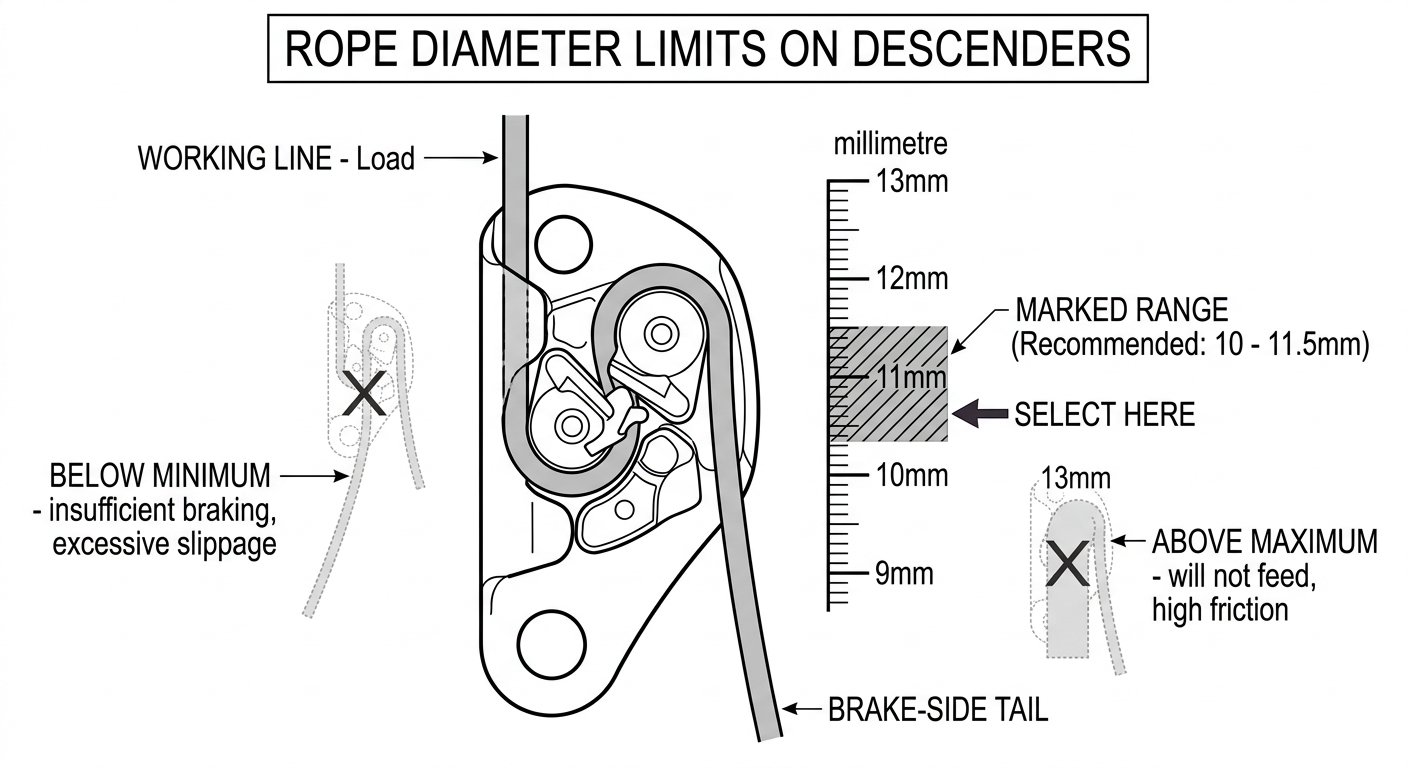
Every industrial descender carries a marked rope diameter range, and it is one of the few pieces of information on the device that directly governs whether the device will brake when a worker needs it to. Fit a rope thinner than the marked minimum and braking force drops, descent speed becomes hard to control and the hand may not be able to arrest the load. Fit a rope thicker than the marked maximum and the rope may refuse to feed, the descent becomes jerky, and the cam can be difficult to release or to modulate. Neither problem announces itself at the point of rigging — both appear once the operator is hanging on the rope. The diameter check belongs at kit selection and at the pre-use check, not halfway down a shaft.
What the marked range on a descender actually means
The diameter range stamped or engraved on a descender is a certification range, not a recommendation. It states the diameters of rope on which the device was tested and passed the requirements of the standard it is certified to — typically EN 12841 Type C for rope adjustment devices used in descent for work access, and often additionally EN 341 for descender devices used in rescue. Outside that band, the manufacturer makes no claim about braking performance, and the operator has no test data to rely on.
Two details are commonly misread:
- A device can carry more than one range. It is common for a descender to be certified over one diameter band for work access and a slightly different band — sometimes with a different maximum load or a different class — for rescue or for lowering two people. The relevant range is the one for the use you are actually putting the device to.
- The range refers to the rope’s actual diameter, not the label rounding. Low-stretch kernmantle rope is sold by nominal diameter, and the standard for the rope permits a manufacturing tolerance around that nominal figure. A rope sold as 11 mm can measure meaningfully more or less than 11 mm depending on construction and on how it has been treated.
Industrial descenders as a class sit in a fairly narrow band: most devices intended for rope access work are certified somewhere in the region of 10 mm to 11.5 mm, while some lighter or more compact devices accept thinner ropes and some older or lowering-oriented devices accept thicker. There is no universal figure. Read the device.
Why a rope that is too thin is dangerous
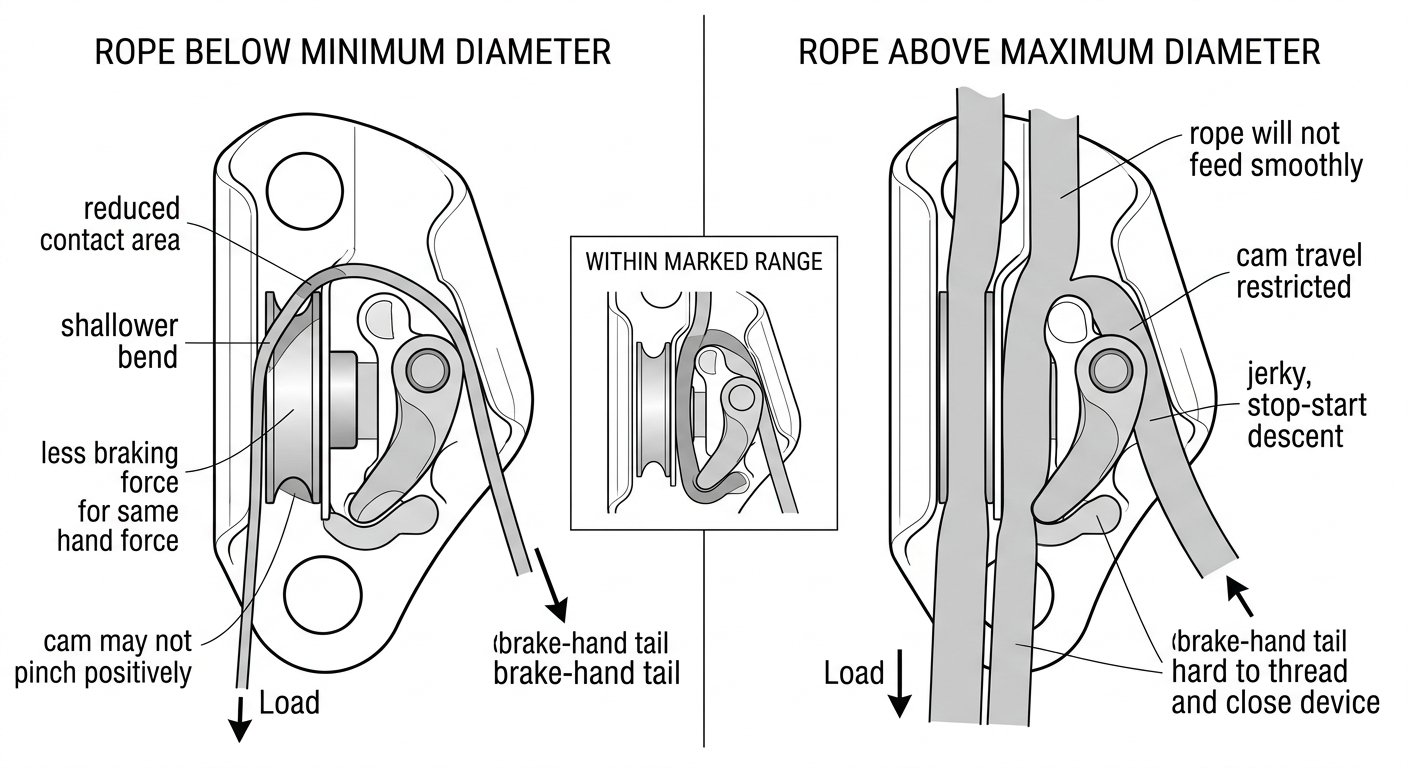
A descender generates braking force by bending the rope around a fixed geometry — a sheave, a bollard, a cam pinch point — and by the friction of the sheath against those surfaces. Reduce the diameter and you reduce both the contact area and the severity of the bend the rope has to take through the same channel. The practical consequences:
- Lower braking force for the same hand force. Descent accelerates more readily, and the margin between controlled descent and runaway narrows.
- Less reliable self-braking. On cam-type devices, a thin rope may not be pinched firmly enough to hold the load when the handle is released, particularly under a heavy load or with a slick or wet rope.
- Unpredictable anti-panic behaviour. Where a device has an anti-panic function, its engagement depends on the rope filling the mechanism as designed. A thin rope can change the point at which it engages, or how positively.
- Heat concentration. Faster descents on a smaller contact area put more thermal energy into less sheath material, which increases the risk of glazing or sheath damage.
None of this is corrected by “descending carefully”. A rope below the device’s minimum diameter is outside the certified configuration.
Why a rope that is too thick is also a problem
Excess diameter fails in the opposite direction, and it is often dismissed as a mere nuisance. It is not:
- The rope may not feed. The operator ends up fighting the device rather than controlling a descent, which produces stop-start, shock-loaded movement.
- The cam or handle can become hard to modulate. Fine speed control disappears; the descent becomes a series of releases and grabs.
- Loading and threading become awkward. A rope that is difficult to install correctly is a rope that gets installed incorrectly — back-to-front threading is a classic consequence of forcing a tight fit while working one-handed at an anchor.
- Anti-panic and self-braking functions can be impeded. A mechanism designed around a given rope volume may not travel through its full range.
The rope you rigged is not the rope you measured
Diameter in service is not a fixed number. Several ordinary factors move a rope within — or out of — a device’s range:
- Wear and fuzzing. A used rope with a raised, abraded sheath behaves as a larger effective diameter in a device channel, even though its load-bearing core is unchanged or reduced. Old ropes tend to feed worse, not better.
- Load and tension. Under a suspended load, rope necks down and runs slightly thinner through the device than it measures slack on the ground.
- Contamination and stiffness. Dust, cement, grit and dried salt stiffen a rope and change how it takes a bend. Stiff rope feeds poorly at the top of a range.
- Water and ice. A wet rope is typically slicker at the sheath and swells slightly; an iced rope may behave like a rigid bar. Both change braking behaviour.
- Newness. A brand-new sheath is often slicker than the same rope after a few weeks of use, so a new rope at the bottom of a device’s range is the worst-case friction combination.
The practical implication: do not habitually select a rope diameter that sits at the extreme edge of the device’s range. A diameter comfortably inside the band leaves room for wear, wet conditions and heavy loads without leaving the certified configuration. The trade-offs involved in that choice are covered in more detail in the note on choosing a low-stretch rope diameter to match devices, loads and wear.
Match the rope to the whole system, not just the descender
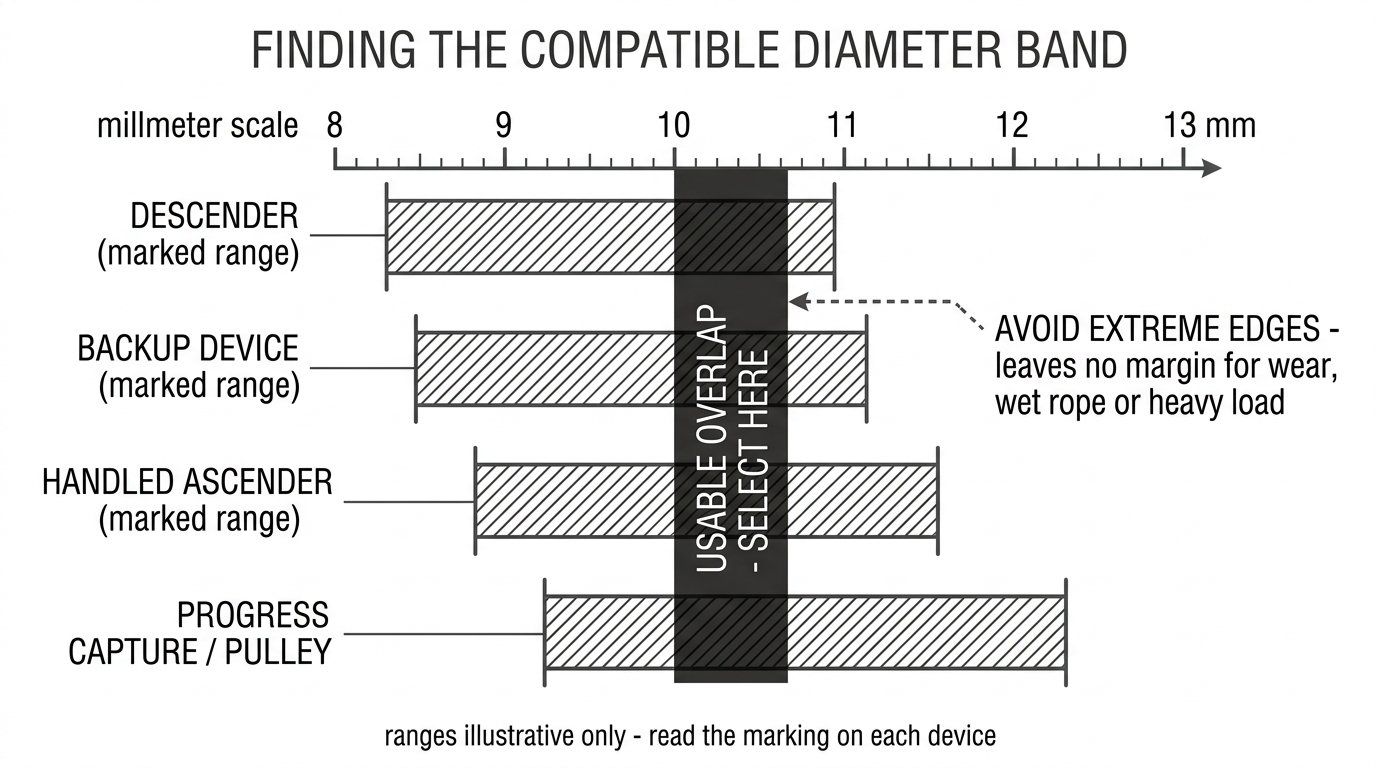
A rope access system rarely contains only one rope-dependent device. On a typical two-rope setup the rope has to pass through, or be gripped by, several items with their own marked diameter ranges:
- the descender on the working line;
- the backup device on the safety line;
- handled and chest ascenders, if changeover to ascent is possible;
- progress-capture devices, pulleys and any rescue or hauling hardware carried for the task;
- edge protection and rope-management hardware, where the fit affects wear rather than function.
The usable rope diameter for the task is the overlap of all of those ranges — not the range of whichever device happens to be the most tolerant. It is common for a backup device to have a narrower or differently centred range than the descender, and for that device to be the real constraint on the whole kit. Where working and safety lines are of different diameters, each line must suit the devices actually placed on it, and the crew must know which line is which without having to guess.
Note also that diameter influences the hardware around the rope, not only the rope-gripping devices. Connector selection for the descender attachment is a separate compatibility question, addressed in the note on choosing a connector for a descender.
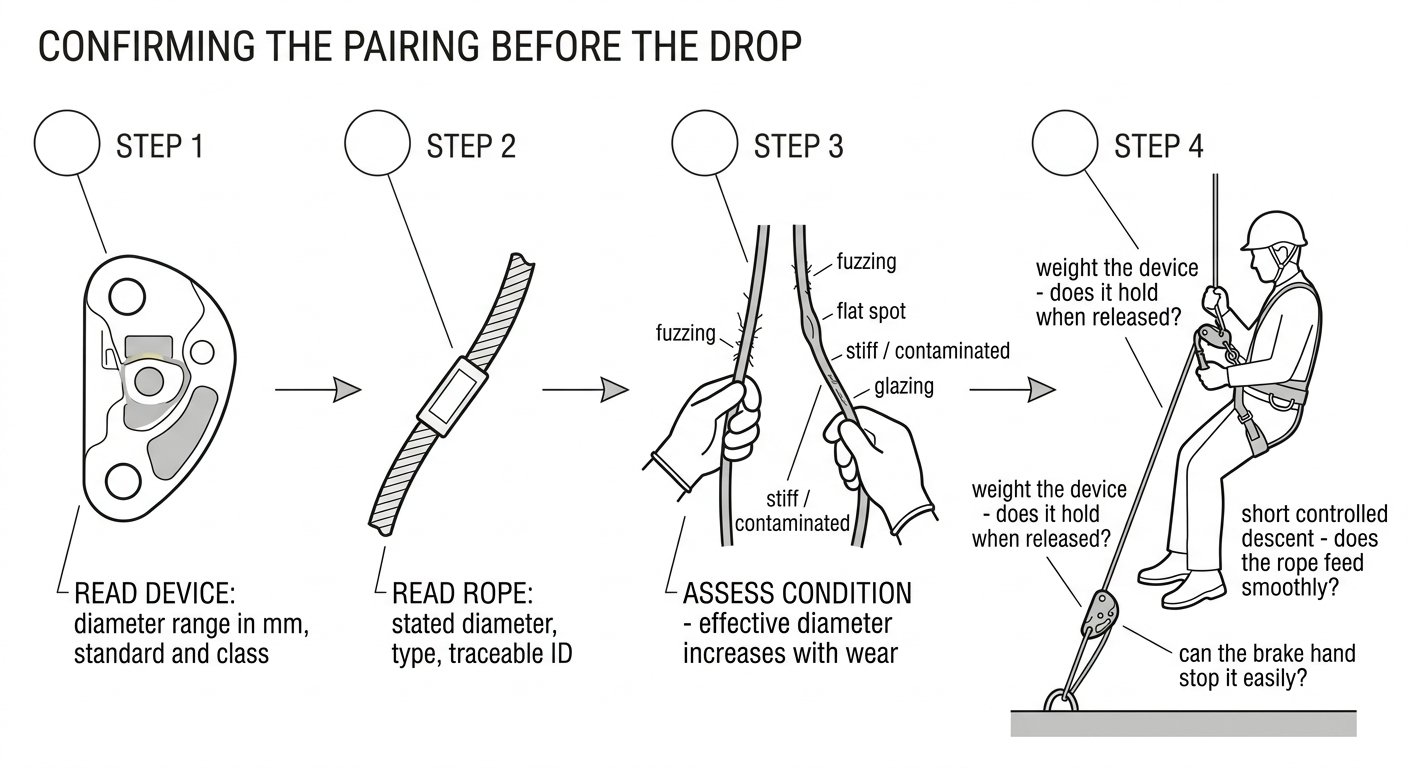
Checking compatibility before the shift
1. Read the device
Locate the diameter range marked on the descender body or side plate, along with the standard and class it is certified to. If the marking is worn to the point of being unreadable, the device’s compatibility can no longer be confirmed in the field and it should be withdrawn pending reference to the manufacturer’s documentation.
2. Read the rope
Check the rope’s identification — the end marking, tag or log entry — for the stated diameter, type and manufacturer. A rope with no traceable identification cannot be matched to a device with confidence.
3. Assess the rope’s condition, not just its label
Run the working length through the hands during the pre-use inspection. Note fuzzing, flat spots, stiffness, glazing and contamination. A visibly furred or stiffened rope should be expected to feed differently from a new one, and a rope already near the top of the device’s range should be treated with particular suspicion.
4. Function test on the actual rope, under load, close to the ground
This is the step most often skipped. With the descender installed on the rope that will actually be used, and while still within a safe position at the anchor or low above a floor:
- confirm the rope is threaded in the correct direction and the device closes fully;
- weight the device and confirm it holds when the handle or control is released;
- make a short controlled descent and check that the rope feeds smoothly and that speed responds proportionally to hand and handle input;
- confirm the brake hand can stop the descent without unusual effort.
Jerky feeding, a device that has to be forced, unusually low hand force required to move, or a device that creeps under load are all reasons to change the rope or the device before committing to the drop.
What to do about a mismatch — and what not to do
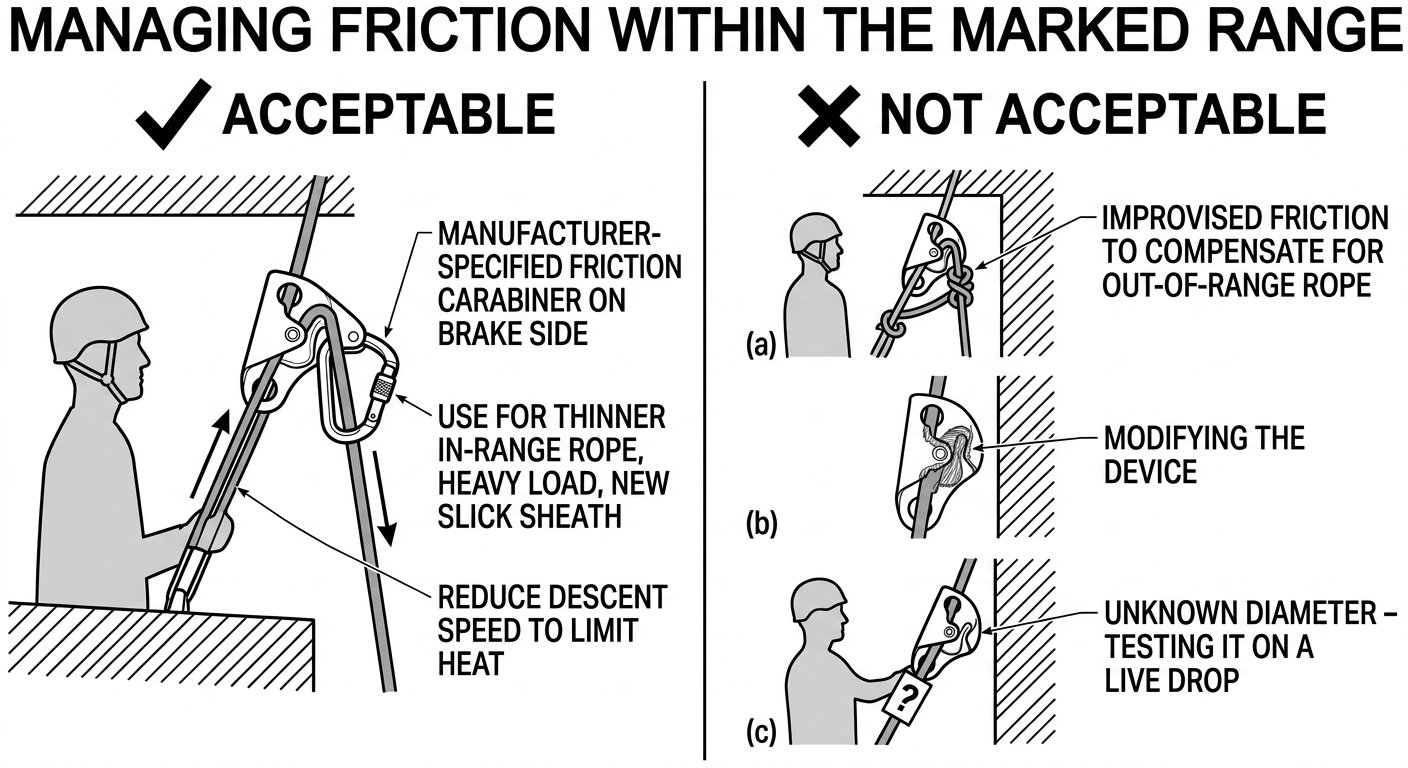
The correct response to a rope outside a device’s marked range is to change the rope or change the device. There is no technique that restores a certified configuration.
Within the certified range, however, legitimate adjustments exist for managing friction at the ends of the band:
- At the low-friction end (thinner rope in range, heavy load, long or fast descent, new slick rope): add friction where the manufacturer permits it — typically a redirect of the braking side through a dedicated friction carabiner on the device, according to the instructions for that specific descender. Reduce descent speed and manage heat.
- At the high-friction end (thicker rope in range, fuzzed sheath, light operator): expect greater hand effort and plan rope management so the tail runs cleanly; do not remove manufacturer-specified friction elements to compensate unless the instructions allow it.
What should never be done: substituting an uncertified rope diameter and compensating with an improvised wrap, hitch or extra carabiner in the brake line; grinding or modifying a device to accept a rope; or fitting a rope of unknown diameter and “seeing how it runs” on a live drop.
Recording the pairing
Where an organisation issues kits rather than individual items, the simplest control is to record the rope diameter alongside the devices in each kit and to keep incompatible diameters out of the same store, van or bag. Mixed-diameter stock is the most common origin of an on-site mismatch: a spare rope grabbed from the wrong bin is indistinguishable from the right one at arm’s length. Colour coding, labelled bags and rope logs that state diameter as well as length all reduce that failure mode considerably more effectively than a reminder at toolbox talk.
Takeaway
Treat the marked diameter range as a hard boundary and the middle of that range as the working target. Confirm the range on the device, confirm the diameter and condition of the rope, take the overlap across every rope-dependent device in the system, and prove the pairing with a loaded function test before the drop. Further technique notes in this series are collected on the rope access and confined space hub.
Frequently asked questions
Where do I find the rope diameter range for my descender?
It is marked on the device itself, usually on a side plate or frame, alongside the standard and class it is certified to, and it is repeated in the manufacturer's instructions for use. If the marking has worn away and the instructions are not available, the device's compatibility can no longer be confirmed and it should be taken out of service until the documentation is obtained.
Can I use a slightly thinner rope if I descend more slowly and add a friction carabiner?
No. Below the marked minimum, the device's braking and self-braking performance is outside anything the manufacturer has tested, and technique does not restore that. Added friction is a legitimate adjustment only for a rope that is already inside the certified range, and only in the way the manufacturer's instructions permit.
Why does an old rope feed worse than a new one of the same nominal diameter?
Abrasion raises and fuzzes the sheath, and contamination or repeated loading stiffens the rope, so it behaves as a larger, less flexible cross-section inside the device channel. A rope that was near the top of a descender's range when new can become difficult to feed after a period of use, which is one reason not to select a diameter at the extreme edge of the range.
Do the working line and the safety line have to be the same diameter?
Not necessarily, but each line must suit the devices actually placed on it, and the crew must be able to tell the lines apart without guessing. Because a backup device often has a narrower or differently centred diameter range than the descender, it is frequently the backup device rather than the descender that limits the rope choice for the whole system.
Does a wet rope change how the descender behaves?
Yes. A wet sheath is generally slicker and the rope may swell slightly, so braking and feeding characteristics both change relative to a dry rope of the same diameter. Combining a wet or brand-new slick rope with a diameter at the bottom of the device's range is the worst case for friction, so plan for slower descents and check the manufacturer's guidance on added friction.
What should I do if the descender feels stiff or jerky on the rope at the start of a descent?
Stop while still safely at the anchor or close to the ground and resolve it before committing to the drop. Confirm the rope is threaded correctly and the device is fully closed, then check the rope's diameter and condition against the device's marked range. Jerky feeding, forced installation or a device that creeps under load are all reasons to change the rope or the device rather than to continue.
Need this as a document you can issue? The template library gives you the risk assessments, permits and inspection logs in editable form — and employer plans cover a whole team with completion records.