Safety / Tips and Tricks / Explosive Atmosphere
Activity 08 · Explosive Atmosphere
Non-Sparking Tools and Intrinsically Safe Equipment
Non-sparking tools and intrinsically safe equipment are often mentioned together as if they solve the same problem, but they address two entirely separate ignition mechanisms — mechanical impact and electrical energy — and using one where the other is needed leaves the actual hazard unaddressed.
What non-sparking tools actually do
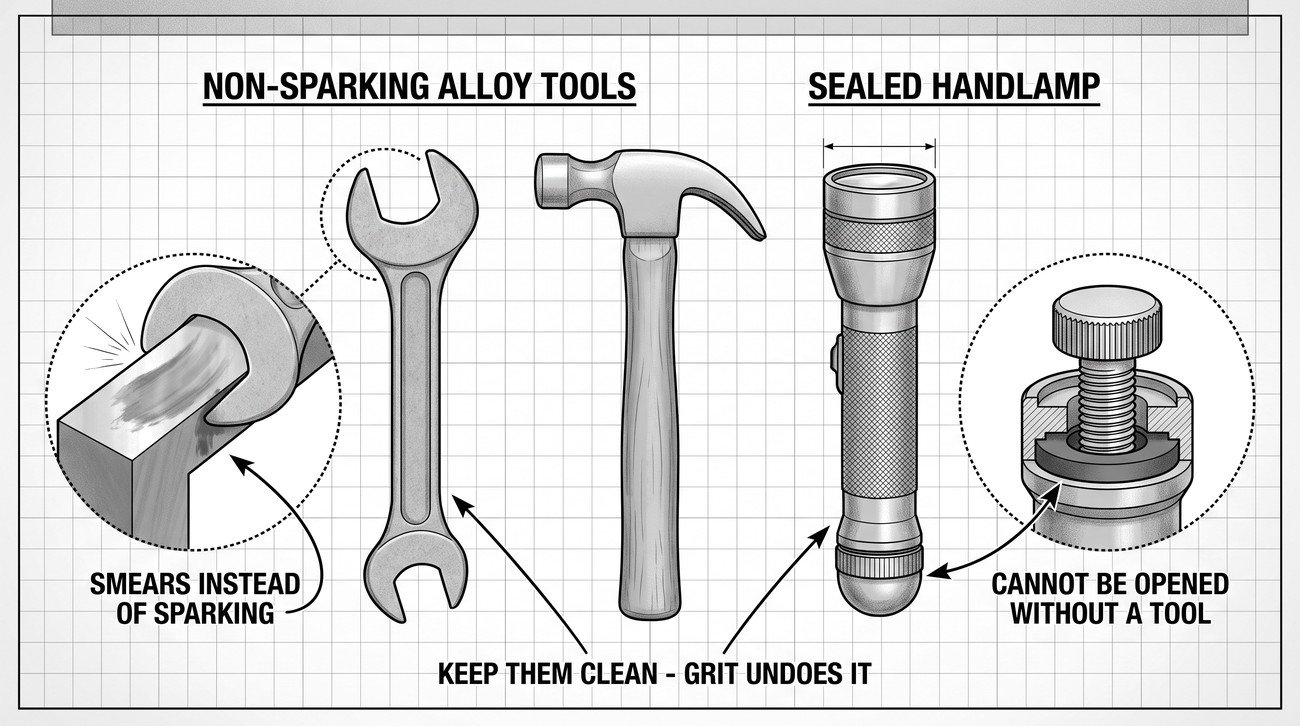
Non-sparking hand tools are made from copper-beryllium, aluminium-bronze or similar alloys that produce fewer and cooler sparks on impact or friction against steel or concrete than conventional steel tools do. This is a mechanical ignition control, addressing the risk of a dropped or struck tool producing an incendive spark, and it has nothing to do with electrical ignition sources at all.
The limits of non-sparking tools
Non-sparking is a relative rather than absolute property, and these tools can still produce sparks under sufficiently severe impact, particularly when contaminated with grit, rust particles or aluminium residue that can act as an ignition catalyst on impact. They also tend to be softer than steel equivalents, wearing faster and requiring more frequent inspection and replacement, and treating them as an absolute guarantee against mechanical ignition rather than a meaningful risk reduction overstates what they provide.
What intrinsic safety means
Intrinsically safe equipment is designed so the electrical energy available within the circuit, under both normal operation and specified fault conditions, remains below the level capable of igniting the surrounding atmosphere through either a spark or a hot surface. This is achieved through circuit design limiting current, voltage and stored energy, rather than by containing an ignition source the way a flameproof enclosure does, which is why intrinsically safe equipment can often be opened and worked on in a live hazardous area where flameproof equipment cannot.
System certification, not just component certification
An intrinsically safe circuit’s certification depends on the whole loop — the field device, the cable parameters, and the associated barrier or isolator — and substituting a component, extending cable length beyond certified parameters, or connecting a non-certified device into the loop can invalidate the intrinsic safety of the entire circuit. This makes intrinsic safety a system property rather than a per-item label, which is a frequent source of unintended non-compliance during maintenance work.
Battery and portable device considerations
Portable equipment marked intrinsically safe is certified with specific batteries, and substituting a different battery type or brand, even one that fits physically and functions normally, can invalidate the certification because the stored energy characteristics differ from what was assessed. Battery replacement should follow the manufacturer’s specified type and, where required, occur outside the hazardous area.
For maintenance work where these tools are typically used, see maintenance and permit work inside hazardous areas.
Related standards
The standards below set the test methods and performance levels behind the equipment referenced in this note.
- ISO 12100 — Safety of machinery
- EN 388 — Gloves against mechanical risks
- EN 1149 — Electrostatic properties of protective clothing
Common errors
1Treating non-sparking tools and intrinsically safe equipment as addressing the same ignition mechanism.
2Relying on non-sparking tools as an absolute guarantee rather than a risk reduction, particularly when contaminated with grit or rust.
3Substituting a component or extending cable beyond certified parameters in an intrinsically safe loop.
4Replacing batteries in intrinsically safe portable equipment with a different type than the certification specifies.
Frequently asked questions
What do non-sparking tools actually protect against?
Mechanical ignition from impact or friction sparks, using alloys like copper-beryllium or aluminium-bronze that produce fewer and cooler sparks than steel; they do not address electrical ignition at all.
Are non-sparking tools an absolute guarantee against sparks?
No, non-sparking is a relative property, and these tools can still spark under severe impact, particularly when contaminated with grit, rust particles or aluminium residue.
What does intrinsic safety mean?
The equipment is designed so electrical energy in the circuit, under normal and specified fault conditions, stays below the level capable of igniting the atmosphere through a spark or hot surface.
Why is intrinsic safety a system property rather than a per-item label?
Certification depends on the whole loop including field device, cable parameters and barrier, so substituting a component or extending cable beyond certified parameters can invalidate the entire circuit.
Can batteries be swapped in intrinsically safe portable equipment?
Only for the manufacturer-specified type, since a different battery can have different stored energy characteristics and invalidate the certification even if it fits and functions normally.
Need this as a document you can issue? The template library gives you the risk assessments, permits and inspection logs in editable form — and employer plans cover a whole team with completion records.