Safety / Tips and Tricks / Warehouse and Logistics
Activity 07 · Warehouse
Manual Handling Gloves and Cut Protection for Logistics
Cardboard edges, strapping, and packaging materials cause more cuts in logistics work than most people expect, and the everyday, low-drama nature of these hazards is exactly why glove selection for general manual handling gets less attention than higher-profile PPE, despite being one of the most frequently used pieces of equipment on a warehouse floor.
Reading the EN 388 rating
EN 388 rates gloves against mechanical risks across several categories including abrasion, cut, tear and puncture resistance, each scored on its own scale, so the specific digits relevant to logistics work — cut and puncture resistance in particular, given the prevalence of cardboard edges, strapping, and occasional sharp packaging debris — matter more than the presence of the EN 388 mark alone. A glove with strong abrasion resistance but weak cut resistance is a poor match for a role dominated by cardboard and strapping hazards, even though it still carries a valid EN 388 rating overall.
Matching glove level to the actual task mix
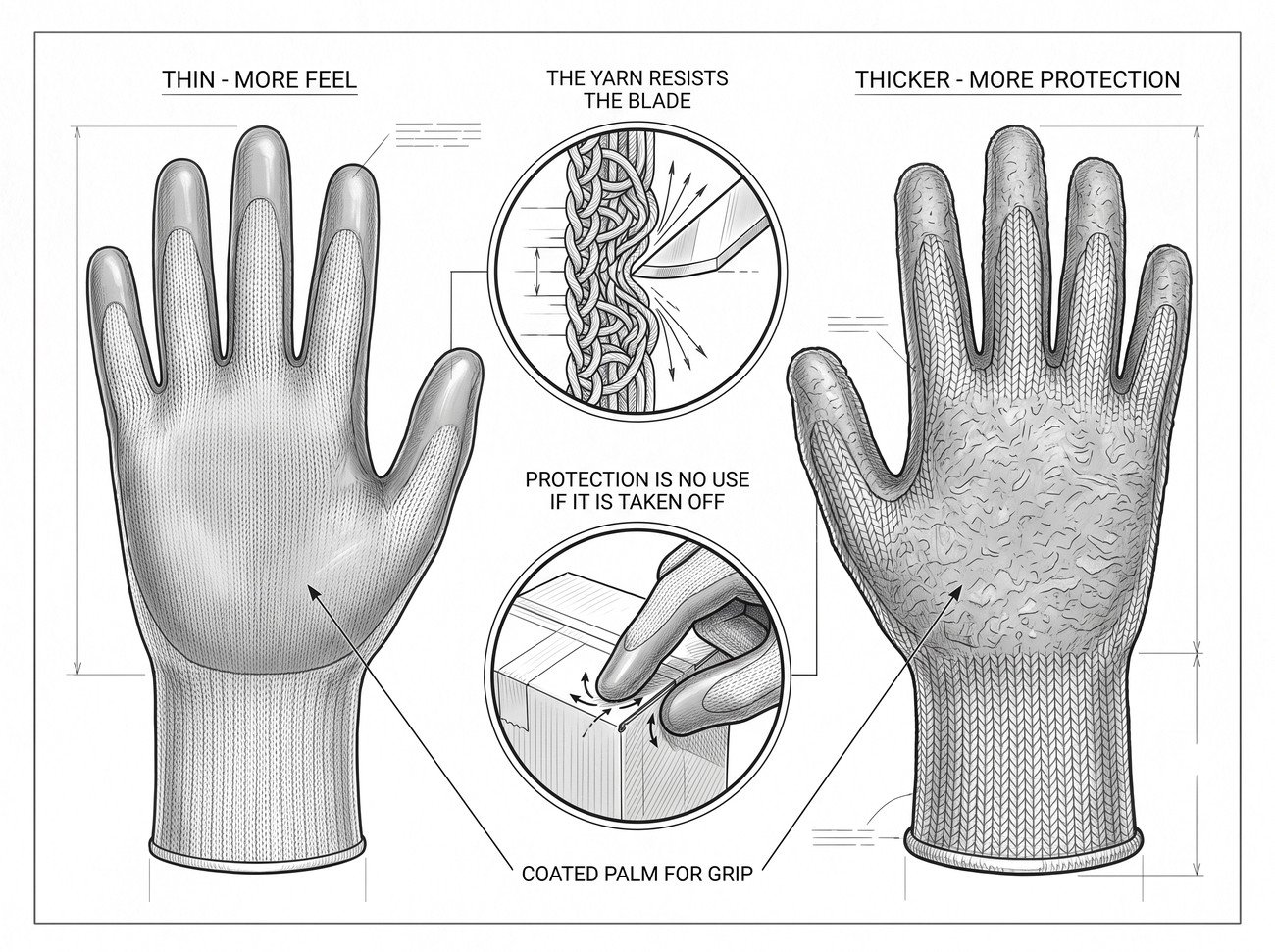
General order picking and box handling typically needs a moderate cut-resistance level combined with good grip and dexterity for repetitive handling, while tasks involving strapping removal, box cutter use, or handling damaged packaging with exposed sharp edges warrant a higher cut-resistance level even at some cost to dexterity. Issuing a single glove type across an entire warehouse workforce regardless of role tends to either under-protect higher-risk tasks or over-specify unnecessarily for the majority of lower-risk handling.
Grip and dexterity for repetitive handling
Order picking and box handling are repetitive tasks performed for extended periods, and a glove with poor grip performance increases the chance of dropped items and awkward, compensating hand positions that themselves create strain injury risk over a shift. Selecting for grip and dexterity within whatever cut-resistance level the task requires, rather than assuming any cut-resistant glove is an equivalent choice regardless of its grip characteristics, supports both the cut protection and the repetitive-motion demands of the role together.
Box cutter and strapping-specific tasks
Tasks that specifically involve cutting tools or tensioned strapping carry a different and generally higher injury severity potential than general box handling, since a box cutter slip or a strapping release under tension can cause a deeper laceration than typical cardboard-edge contact. These specific tasks warrant their own glove selection, reviewed separately from general warehouse floor handling, rather than assuming the same glove used for routine picking is adequate for them.
Replacement and condition
Cut-resistant gloves lose performance as the fibers wear, even without an obvious hole developing, and a glove that has taken a significant cut, even a minor one that did not reach skin, should be treated as compromised and replaced rather than continued in service on the assumption that a near-miss proves the glove is still performing adequately.
For manual handling technique that reduces strain injury risk alongside glove selection, see back support and safe lifting technique.
Related standards
The standards below set the test methods and performance levels behind the equipment referenced in this note.
- EN 388 — Gloves against mechanical risks
- EN 511 — Cold protection gloves
- EN ISO 13688 — General requirements for protective clothing
Common errors
1Issuing a single glove type across the whole workforce regardless of the actual task mix and cut exposure.
2Selecting gloves for maximum cut resistance without considering the grip and dexterity repetitive handling tasks actually require.
3Using general handling gloves for box cutter or tensioned strapping tasks that warrant higher, task-specific cut protection.
4Continuing to use a glove that has already sustained a significant cut, treating it as still adequately protective.
Frequently asked questions
What does the EN 388 rating actually measure on a glove?
Mechanical risks across several categories including abrasion, cut, tear and puncture resistance, each scored separately, so the specific digits relevant to the task matter more than the mark alone.
Should every warehouse role use the same glove type?
No, general order picking needs moderate cut resistance with good grip, while strapping removal or box cutter use warrants higher cut-resistance protection, so a single uniform glove tends to under- or over-protect different roles.
Why does grip performance matter as much as cut resistance for repetitive handling?
Poor grip increases dropped items and awkward, compensating hand positions that themselves create strain injury risk over a shift, so grip and cut resistance both need to be considered together.
Do box cutter and strapping tasks need their own glove selection?
Yes, these tasks carry a higher injury severity potential than general box handling and should be reviewed separately rather than assuming a general handling glove is adequate.
Should a glove that has sustained a cut but not reached skin be reused?
No, it should be treated as compromised and replaced, since a near-miss does not prove the glove is still performing at its rated level.
Need this as a document you can issue? The template library gives you the risk assessments, permits and inspection logs in editable form — and employer plans cover a whole team with completion records.