Safety / Tips and Tricks / Warehouse and Logistics
Activity 07 · Warehouse
Back Support and Safe Lifting Technique
Manual handling injuries build up gradually far more often than they happen from one dramatic lift, which is exactly why they are so often underestimated on a day-to-day basis: the lift that actually causes the injury is frequently unremarkable on its own, the culmination of accumulated strain from many similar lifts before it.
Technique fundamentals
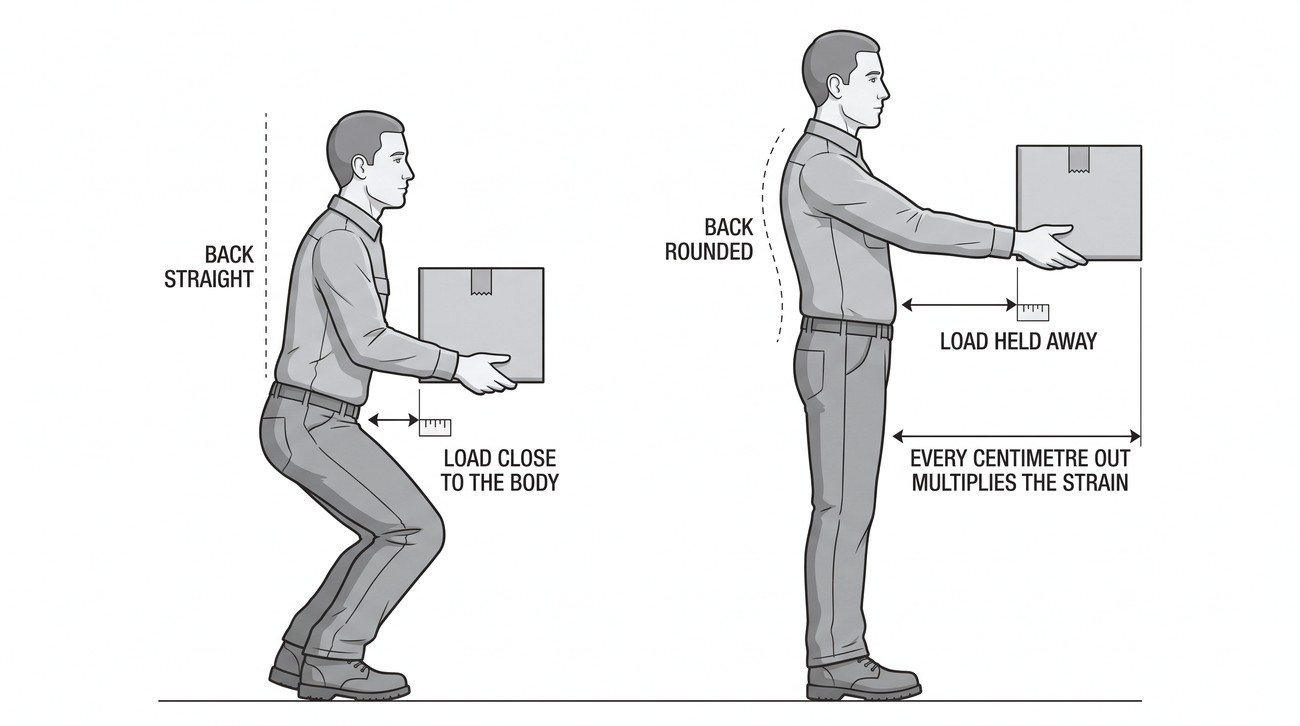
Lifting with the legs rather than the back means bending at the knees and hips while keeping the back in a neutral, reasonably upright position, letting the strong muscles of the legs do the work rather than the lower back, which is far more vulnerable to injury from repeated loaded flexion. Keeping the load close to the body throughout the lift, rather than reaching out and lifting from a distance, dramatically reduces the effective leverage and strain on the spine for the same actual weight being moved.
Assessing the load before lifting
Checking a load’s actual weight, stability, and whether its contents might shift before committing to a lift avoids the specific hazard of a lift that turns out heavier or less stable than expected partway through, when the body is already committed to the movement and less able to adjust safely. A quick test lift, or checking a label for stated weight where available, before the full lift begins is a simple habit that catches this before it becomes a problem mid-lift.
Twisting under load
Twisting the spine while carrying or setting down a load, rather than turning the whole body including the feet, is one of the more common mechanisms behind acute lower back injury, since the spine under load is far less tolerant of rotational force than of straightforward bending. Pivoting the feet to turn the whole body toward the destination, rather than rotating only the torso while the feet stay planted, removes this specific risk from an otherwise correct lift.
Team lifting and mechanical aids
Loads that are too heavy, too large, or too awkwardly shaped for one person to handle safely alone should be moved with a second person or a mechanical aid such as a pallet truck or trolley, and the decision to involve a second person or equipment should be made before attempting the lift, not partway through when it becomes clear the load is more than expected. Team lifts need coordination on timing and direction, since an uncoordinated team lift can create worse strain than either person lifting the same total weight alone in a coordinated way.
Cumulative strain and pacing
Repetitive lifting across a shift accumulates strain even when each individual lift uses correct technique, and pacing, rotating between different tasks, and taking recovery breaks between periods of repetitive lifting all reduce the cumulative load on the back over the course of a full shift, addressing a risk that correct single-lift technique alone does not fully cover.
For the gloves that support grip and control during manual handling, see manual handling gloves and cut protection.
Related standards
The standards below set the test methods and performance levels behind the equipment referenced in this note.
Common errors
1Bending and lifting primarily from the back rather than the legs.
2Reaching out to lift a load from a distance rather than keeping it close to the body.
3Twisting the spine while carrying or setting down a load instead of turning the whole body.
4Attempting a lift alone that should involve a second person or a mechanical aid, discovered only partway through the lift.
Frequently asked questions
Why is manual handling injury often gradual rather than caused by one dramatic lift?
It typically builds up from accumulated strain across many similar lifts, and the lift that finally causes injury is often unremarkable on its own rather than obviously excessive.
What is the core technique difference between lifting with the legs versus the back?
Bending at the knees and hips while keeping the back neutral lets the strong leg muscles do the work, rather than loading the lower back, which is far more vulnerable to injury from repeated flexion.
Why does keeping a load close to the body matter?
It dramatically reduces the effective leverage and strain on the spine for the same actual weight, compared to reaching out and lifting from a distance.
Why is twisting under load particularly risky for the back?
The spine under load is far less tolerant of rotational force than straightforward bending, so pivoting the whole body with the feet, rather than rotating only the torso, removes this specific injury mechanism.
Does correct single-lift technique fully address manual handling risk over a shift?
No, repetitive lifting accumulates strain even with correct technique, so pacing, task rotation and recovery breaks are needed to address cumulative load that single-lift technique alone does not cover.
Need this as a document you can issue? The template library gives you the risk assessments, permits and inspection logs in editable form — and employer plans cover a whole team with completion records.