Safety / Tips and Tricks / Roofing and work at height
Activity 02 · Roofing
Inspecting and Maintaining Roof-Mounted Anchor Points
A certified installation to EN 795 is the start of an anchor's service life, not the end of the checking that keeps it trustworthy. Roof-mounted anchors are exposed to weather, structural movement and, sometimes, work that happens near them but is not related to their use, and any of these can quietly compromise a point that was correctly installed.
Why roof anchors degrade differently from indoor equipment
An anchor exposed to weather sees corrosion risks an indoor point does not, particularly at the interface where the anchor fixing meets the roof covering, which is also often the hardest part of the installation to inspect visually without removing surrounding material. Thermal cycling — roofs heating and cooling daily, sometimes by a large margin — stresses fixings over time in a way that a stable indoor anchor never experiences. UV exposure affects any polymer or coated components. None of this means roof anchors are unreliable, but it does mean their inspection needs to account for exposure conditions an indoor anchor point does not face.
What a pre-use check should cover
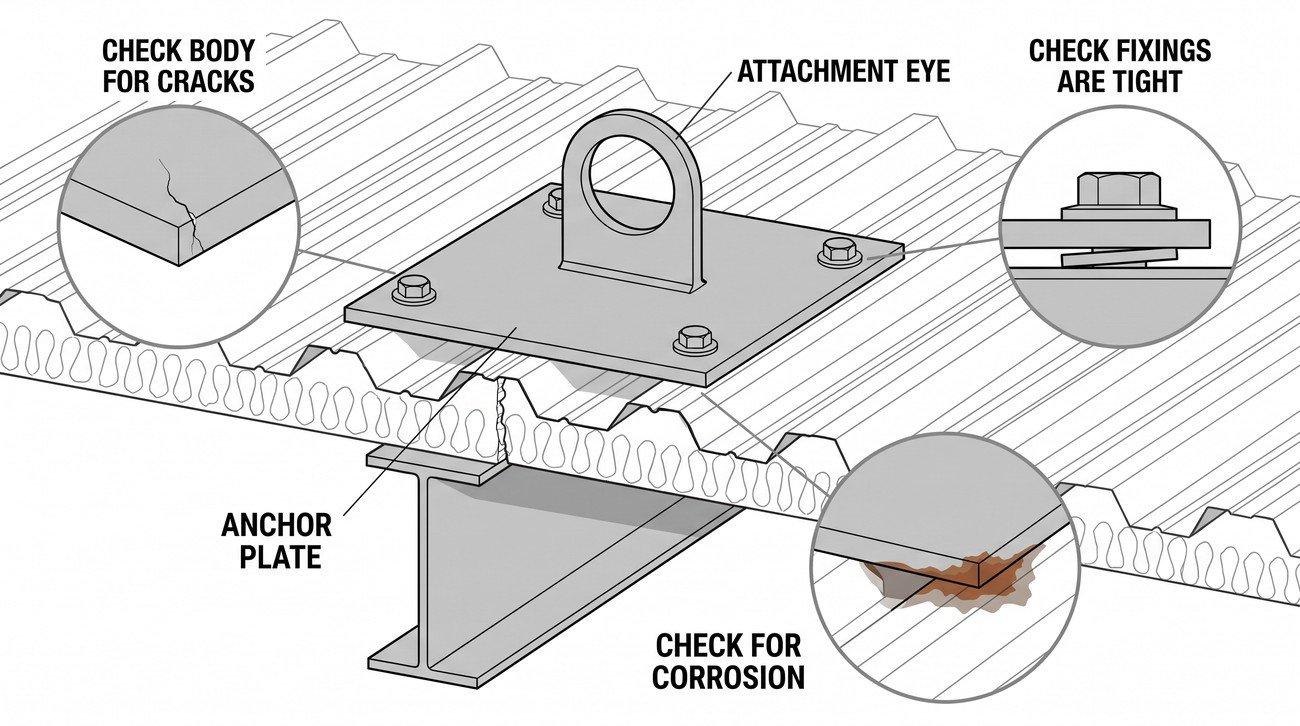
Before each use: visual inspection of the anchor body for cracks, deformation or corrosion, confirmation that all fixings are tight and the anchor has not developed play or movement, and a check of the surrounding roof covering for signs of water ingress at the fixing point, which can indicate a failing seal even before it affects the anchor’s structural performance. Any anchor showing signs of movement, corrosion beyond light surface staining, or damage to its marking or certification tag should be taken out of service until a competent person has assessed it, not used with the issue noted for later.
Periodic formal inspection
Beyond the pre-use check, a periodic formal inspection by a competent person — at an interval set by the manufacturer’s instructions or the organisation’s own risk assessment, whichever is more frequent — should assess the anchor against its original installation specification, not just its current visual condition. This is the point at which structural changes to the building, a roof covering replacement that happened without re-certifying the anchors it now surrounds, or cumulative wear not visible on any single pre-use check gets caught.
Records and traceability
Each anchor should be identifiable — a tag or marking linking it to its installation record and inspection history — so that anyone using it can confirm what it is actually rated for and when it was last checked. An anchor with no traceable record is effectively an unknown quantity regardless of how solid it looks, and should be treated with the same caution as an anchor known to have failed a check, not assumed adequate because nothing has obviously gone wrong with it.
For the different anchor types this inspection regime applies to, see selecting a roof anchor system.
Common errors
1Relying on a visual glance rather than checking fixing tightness and the surrounding roof seal.
2Continuing to use an anchor after a roof covering replacement without confirming it was re-certified for the new surface.
3Treating light surface corrosion as cosmetic rather than a signal to escalate for assessment.
4Using an anchor with no traceable installation or inspection record because it looks physically sound.
Frequently asked questions
Why do roof-mounted anchors need different inspection attention than indoor anchor points?
They are exposed to weather, corrosion risk at the roof-covering interface, thermal cycling that stresses fixings over time, and UV exposure on polymer components, none of which an indoor anchor typically experiences.
What should a pre-use anchor check actually cover?
Visual inspection of the anchor body for cracks or corrosion, confirmation that fixings are tight with no developed play, and a check of the surrounding roof covering for water ingress at the fixing point.
Why does a roof covering replacement matter for anchor safety?
If the roof covering is replaced without re-certifying the anchors it now surrounds, the anchor's original installation specification may no longer match the actual roof structure it depends on.
What should happen to an anchor that shows movement or corrosion beyond light surface staining?
It should be taken out of service until a competent person has assessed it, not used with the issue simply noted for a later review.
Why does an anchor need a traceable installation and inspection record?
Without one, there is no way to confirm what the anchor is actually rated for or when it was last properly checked, so it should be treated with the same caution as a known-faulty anchor regardless of its visual condition.
Need this as a document you can issue? The template library gives you the risk assessments, permits and inspection logs in editable form — and employer plans cover a whole team with completion records.