Safety / Tips and Tricks / Explosive Atmosphere
Activity 08 · Explosive Atmosphere
Explosion and Fire Emergency Response Planning
An explosion gives no warning and leaves no time for decision-making, which means the entire value of emergency response planning for explosive atmospheres is realized before the event — in what people already know, and in what has already been put in place.
Planning for events with no reaction time
Unlike a developing fire, where there is often time to assess and choose a response, an explosion has already happened by the time anyone is aware of it, and the plan’s function is to govern what happens in the seconds and minutes afterward: evacuation, accounting for people, isolating what feeds any continuing release, and preventing the secondary events that frequently cause more harm than the initial one.
The secondary event problem
Initial explosions frequently damage the systems intended to contain the consequences, rupturing pipework, disabling detection or shutdown systems, and creating new releases that feed a subsequent fire or a further explosion. Response plans that assume the situation after an initial event resembles the situation before it, only with damage added, tend to underestimate how quickly a second event can follow and how different the conditions may already be.
Evacuation routes and assembly points
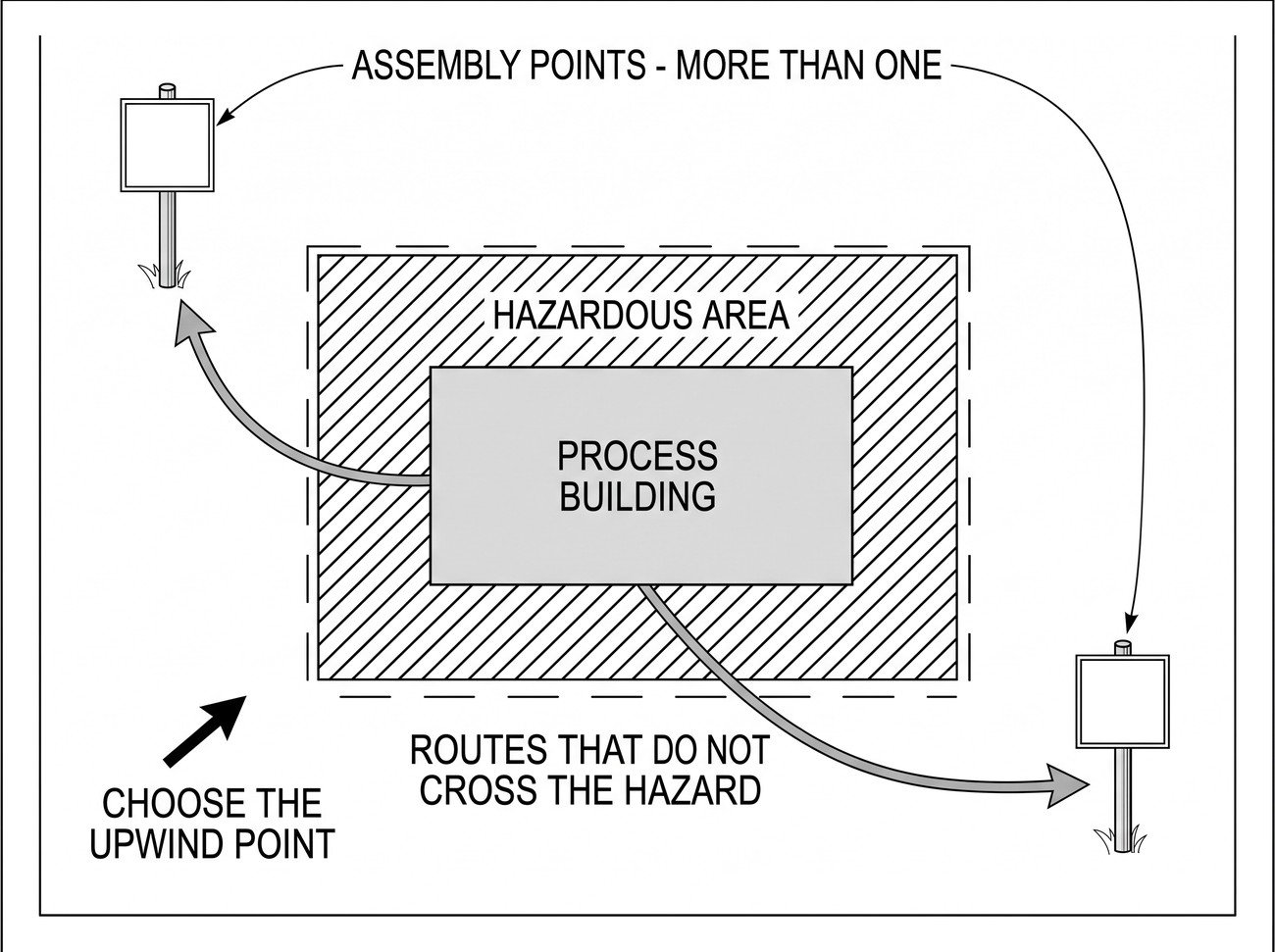
Evacuation routes need to lead away from the hazard rather than past it, and assembly points need to be far enough away and positioned so they remain usable if a subsequent event occurs, which for explosive atmosphere facilities generally means a greater distance and specific attention to prevailing wind direction than a general fire assembly point would require. An assembly point that is downwind of a continuing release, or close enough to be affected by a secondary event, moves people from one hazard into another.
Accounting for people
Knowing quickly and reliably who is on site and who is accounted for determines whether emergency responders search a damaged, still-hazardous area, and an unreliable count means either an unnecessary and dangerous search or a genuine casualty left unlocated. Systems that track contractors and visitors as reliably as permanent staff matter disproportionately here, since these are the people least likely to be missed informally.
Coordination with external responders
External emergency services arriving at a facility with explosive atmosphere hazards need to know what is stored where, what remains live, and which areas carry a continuing explosion risk, and providing this through pre-incident liaison and site familiarization is far more effective than attempting to communicate it during an active emergency. Fighting a fire at such a facility can require quite different tactics from a conventional structural fire, and that judgment depends on information the site holds.
Exercising the plan
Plans that exist only as documents perform differently from plans that have been exercised, and drills covering a plausible explosive atmosphere scenario — not just a general fire alarm evacuation — surface the specific gaps that matter: whether the assembly point is genuinely usable, whether isolation can actually be performed from a safe location, and whether the count is reliable in practice.
For the isolation systems this response depends on, see emergency isolation and shutdown systems.
Related standards
The standards below set the test methods and performance levels behind the equipment referenced in this note.
- EN ISO 11612 — Heat and flame protective clothing
- EN 1149 — Electrostatic properties of protective clothing
- EN ISO 20471 — High-visibility clothing
Common errors
1Planning as though there is reaction time, when an explosion has already happened before anyone is aware of it.
2Assuming conditions after an initial event resemble the situation before it, underestimating secondary event risk.
3Using a general fire assembly point without accounting for distance, wind direction and continuing release.
4Relying on informal knowledge of who is on site rather than a system that tracks contractors and visitors reliably.
Frequently asked questions
Why does explosion response planning differ from fire response planning?
A fire often allows time to assess and choose a response, while an explosion has already happened before anyone is aware, so the plan governs only what happens in the seconds and minutes afterward.
What is the secondary event problem?
Initial explosions frequently damage containment systems, rupturing pipework and disabling detection or shutdown, creating new releases that feed a subsequent fire or explosion often more harmful than the first.
What makes an assembly point suitable for an explosive atmosphere facility?
Sufficient distance and attention to prevailing wind direction, so it remains usable if a second event occurs and is not downwind of a continuing release.
Why does accounting for people matter so much after an explosion?
An unreliable count means either an unnecessary search of a damaged, still-hazardous area or a genuine casualty left unlocated, and contractors and visitors are the least likely to be missed informally.
What should external emergency responders know in advance?
What is stored where, what remains live, and which areas carry continuing explosion risk, since fighting a fire at such a facility can require quite different tactics from a conventional structural fire.
Need this as a document you can issue? The template library gives you the risk assessments, permits and inspection logs in editable form — and employer plans cover a whole team with completion records.