Safety / Tips and Tricks / Rope access and confined space
Activity 01 · Rope access
Choosing an Absorber for the Clearance Available
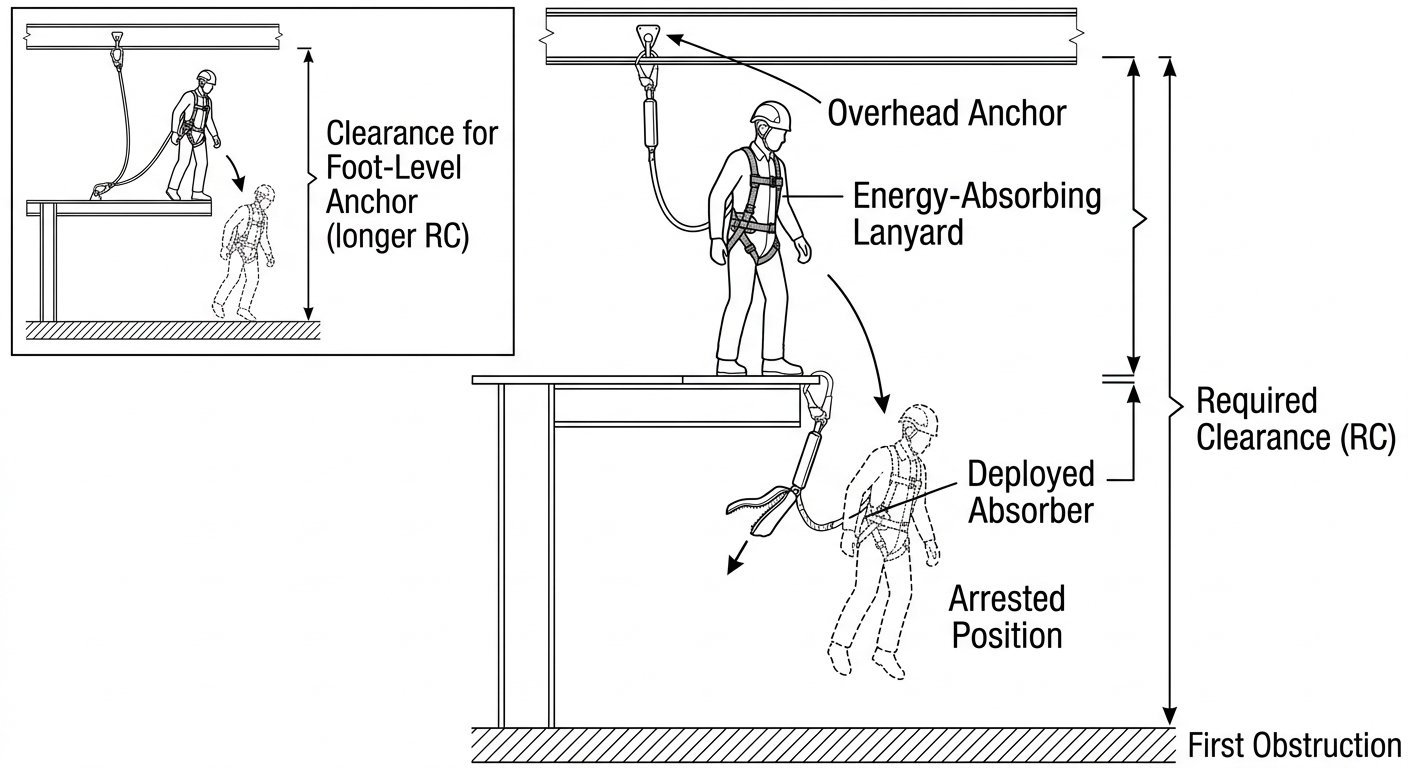
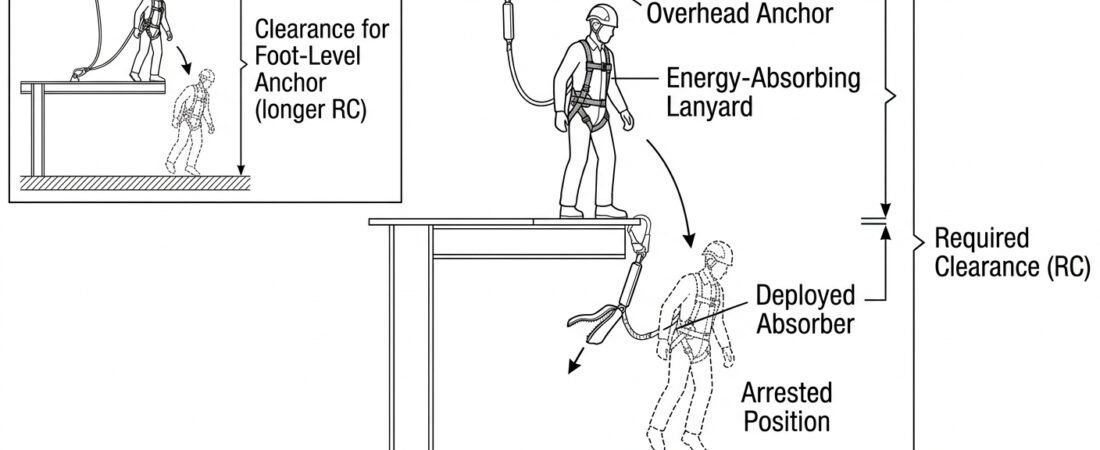
An energy absorber is only as good as the empty space underneath it. The absorber limits the force on the body during a fall arrest, but it does that by lengthening the fall — and if the structure, the plant floor or a pipe rack sits inside that lengthened distance, the worker stops against the obstruction rather than in the system. Choosing an absorber for the clearance available means measuring the space below the work position first, then selecting a lanyard length, absorber model and anchor position that fit inside it — not the other way round.
This note covers how to measure the clearance that actually exists, how to read the clearance figure in the manufacturer’s instructions, what to do when the two numbers do not agree, and which common workarounds create risk instead of space.
Clearance is measured from the feet to the first obstruction, not to the ground
The relevant distance is from the soles of the user’s boots at the work position down to the nearest thing they could hit. On a steel frame that is often a beam flange or a grating two metres below, not the slab twelve metres below. On a tank roof it may be a nozzle, a handrail or a scaffold lift. Water, live machinery and open hoppers all count as obstructions in the practical sense even where they are not solid ground.
Two further points get missed when a site survey is done from a drawing rather than in position:
- Lateral obstructions. If the anchor is off to one side, the fall becomes a swing. The arc can carry the user into structure that is not directly beneath them, and the swing itself uses up vertical clearance.
- Flexible anchors. A horizontal lifeline or a rail with any give sags under load. That sag adds directly to the fall distance and must come from the system designer’s calculation, not from a guess on site.
What makes up the required clearance
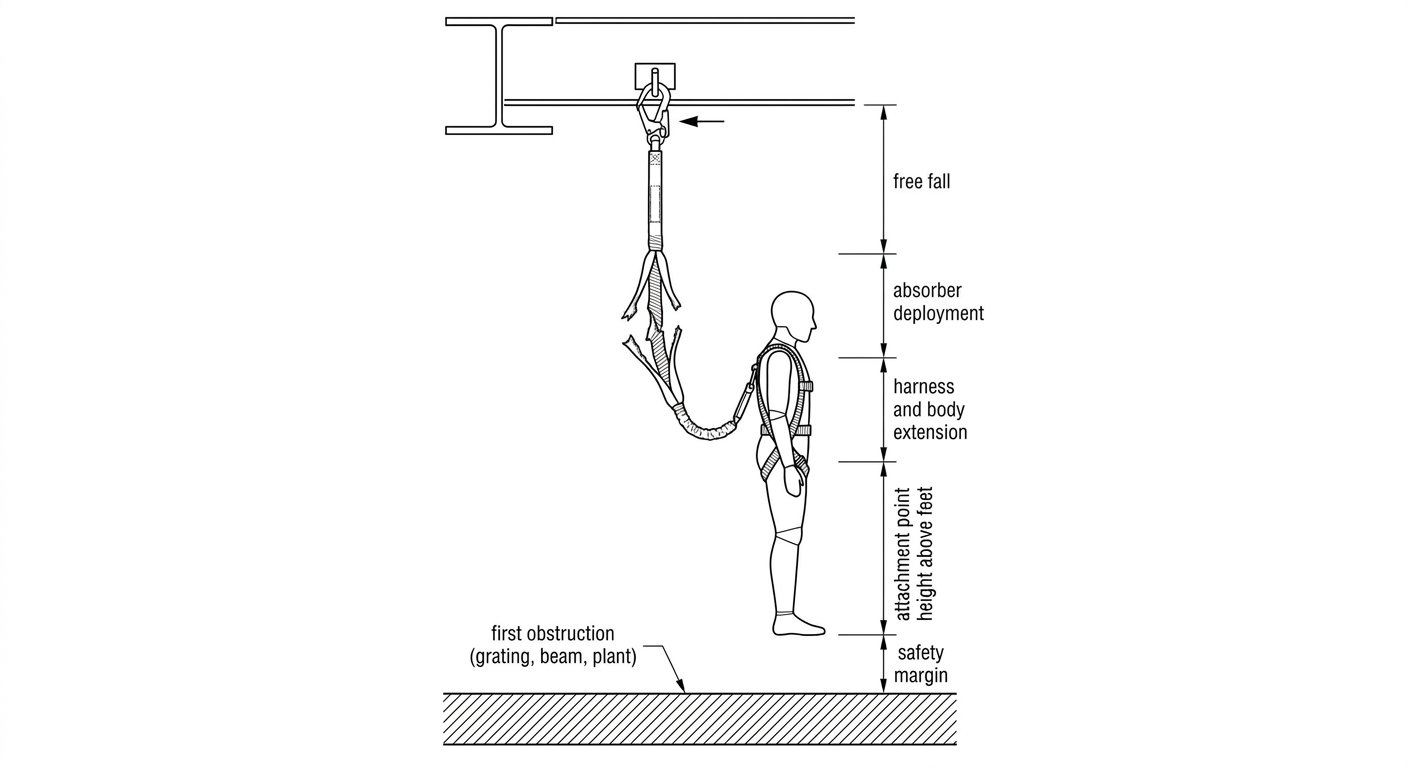
The figure printed in an absorber’s instructions is not just the tear-out length of the webbing. It is a stack of distances, each of which has to be there:
- Free fall — the distance travelled before the absorber starts to work. It depends on the lanyard length and on how far the anchor sits above or below the harness attachment point.
- Absorber deployment — the tearing or extension of the absorber itself. Manufacturers commonly quote a maximum in the region of a metre and a half for full-length energy-absorbing lanyards, with less for short or reduced-deployment models. It varies with the model, the fall energy and the user’s mass.
- Harness and body extension — stretch in the webbing plus the way the dorsal or sternal attachment shifts on the body under load. Instructions usually roll this into a fixed allowance.
- Height of the attachment point above the feet — typically taken as around one and a half metres for a standing adult, because the clearance is measured from the boots but the system holds the harness attachment.
- Safety margin — the residual gap left below the stopped user, commonly one metre in manufacturer instructions.
Under EN 361 (full body harnesses), only a marked fall-arrest attachment — dorsal or sternal — carries this load, and the point chosen affects the geometry above. A sternal attachment sits higher on the body than a dorsal one and behaves differently in a swing, which is one reason the clearance figure should be read together with the guidance on connecting a fall-arrest lanyard to the harness.
Anchor height is the biggest lever you have
Nothing else changes the required clearance as much as where the anchor sits. With the anchor overhead, the free fall is short — only the slack in the system and the drop from attachment to anchor level. With the anchor at foot level, the user falls the full length of the lanyard before the lanyard even comes tight, and then the full length again as the system loads: a factor-2 fall, the worst case the absorber is designed and tested for.
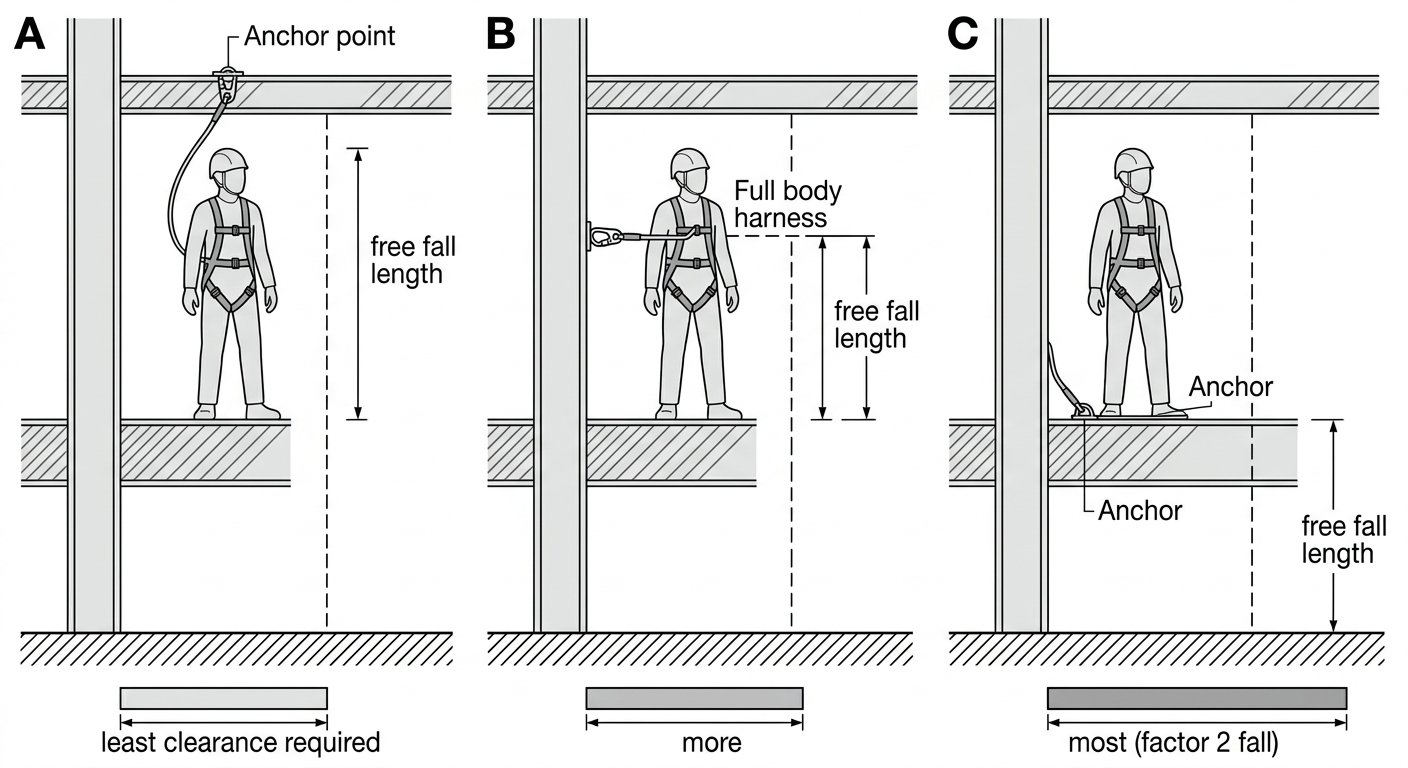
Practical consequence: if the clearance below is marginal, raising the anchor is usually cheaper and more effective than buying a different absorber. Moving a connection point from foot level to head height on the same structure can remove several metres from the clearance requirement. Where an overhead anchor genuinely cannot be provided, check that the chosen device is rated for use with the anchor at or below the attachment point — energy-absorbing lanyards to EN 355 generally are, but not every retractable device is.
Reading the manufacturer’s clearance figure properly
EN 355 caps the arrest force transmitted to the user at 6 kN and caps the total length of the assembly — lanyard, absorber and connectors together — at 2 m. That standardises the ceiling, not the clearance. The clearance requirement is model-specific and appears in the instructions for use, usually as a diagram with a figure for each lanyard length offered.
When comparing figures between models, check that you are comparing like with like:
- Which lanyard length the figure applies to. A 1 m version of the same absorber needs materially less clearance than the 2 m version. Buying the shortest length that still lets the worker reach the task is the simplest clearance saving available.
- Which anchor position is assumed. Many instructions give one figure for an overhead anchor and a larger one for an anchor at foot level. Quoting the smaller figure for a system rigged at the feet is a real and common error.
- The user mass range, including tools. Deployment and required clearance grow with total mass. Absorbers are certified for a stated mass range that includes clothing, harness and everything carried. A worker with a full tool belt and a bolt bag can sit outside the range assumed by the catalogue figure.
- Whether the figure includes the safety margin. Most do; confirm rather than assume, and never spend the margin to make a system fit.
When the available clearance is smaller than the requirement
If the measured space is less than the figure in the instructions, the energy-absorbing lanyard is the wrong choice for that position. There are several legitimate ways forward, roughly in order of preference:
- Eliminate the fall. Use restraint: a system short enough that the user physically cannot reach the fall hazard. Restraint needs no clearance at all, uses a belt or harness attachment to EN 358 (work positioning and restraint belts) or an appropriate harness point, and is covered in more detail in the note on which attachment points to use for restraint. This only works where the task itself does not require the worker to be over the edge.
- Raise the anchor. As above — the cheapest metres of clearance are usually bought with a higher connection point.
- Shorten the assembly. A shorter lanyard, or a reduced-deployment absorber designed for low-clearance use, cuts both the free fall and the tear-out length. These models exist precisely for this problem; the trade-off is reduced working radius.
- Change device type. A retractable fall arrester keeps the line taut and short, so free fall is minimal and arrest distance is much shorter than an absorbing lanyard’s. A guided type fall arrester running on a taut vertical line does the same for climbing and ladder access. Both need to be selected for the anchor geometry and the surface below.
- Change work method. Rope access on two ropes, with a descender and a backup device to EN 12841 (rope access adjustment devices), replaces a fall-arrest problem with a suspension problem and needs far less clearance because the worker is already supported. Work platforms and MEWPs do the same by removing the need to be tied off against a long fall.
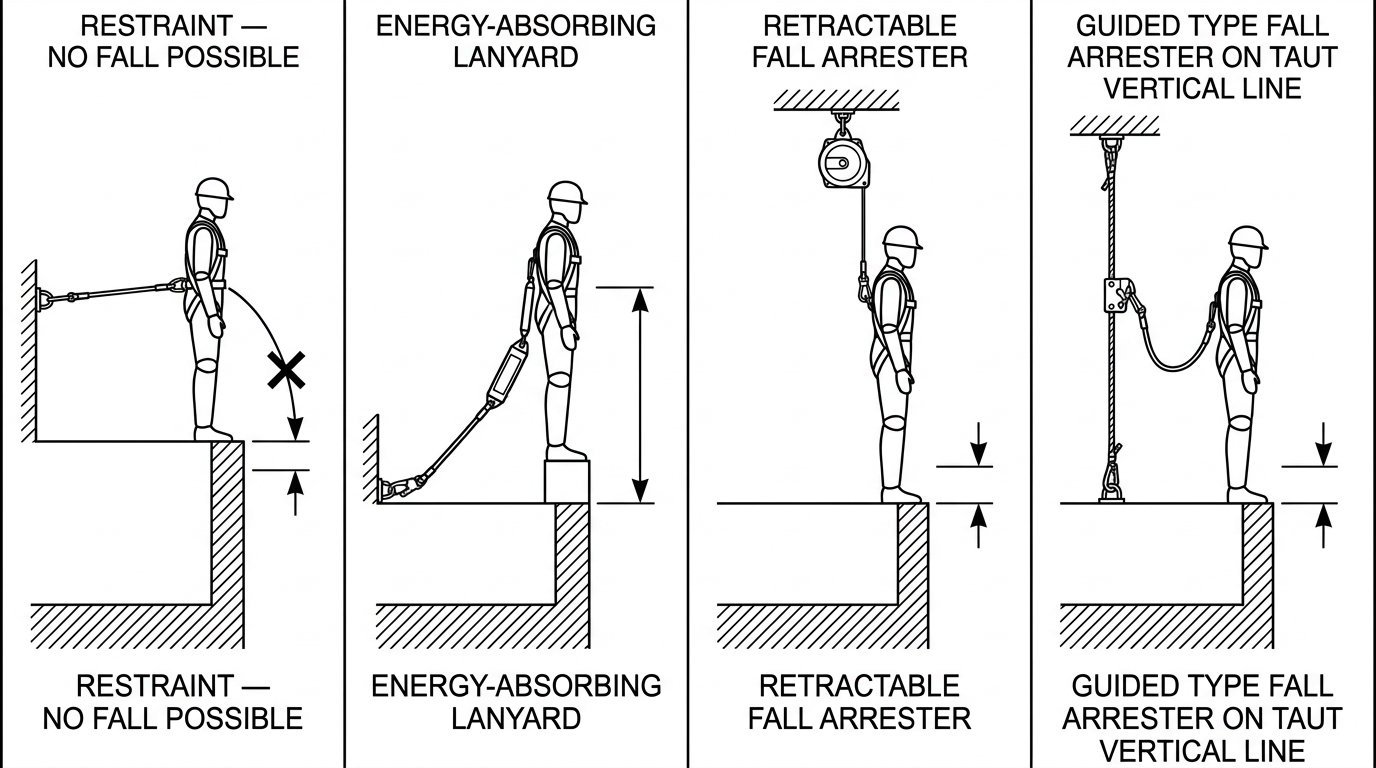
The wider selection logic between these device families is set out in the note on which type of fall-arrest lanyard to choose.
Four things that do not create clearance
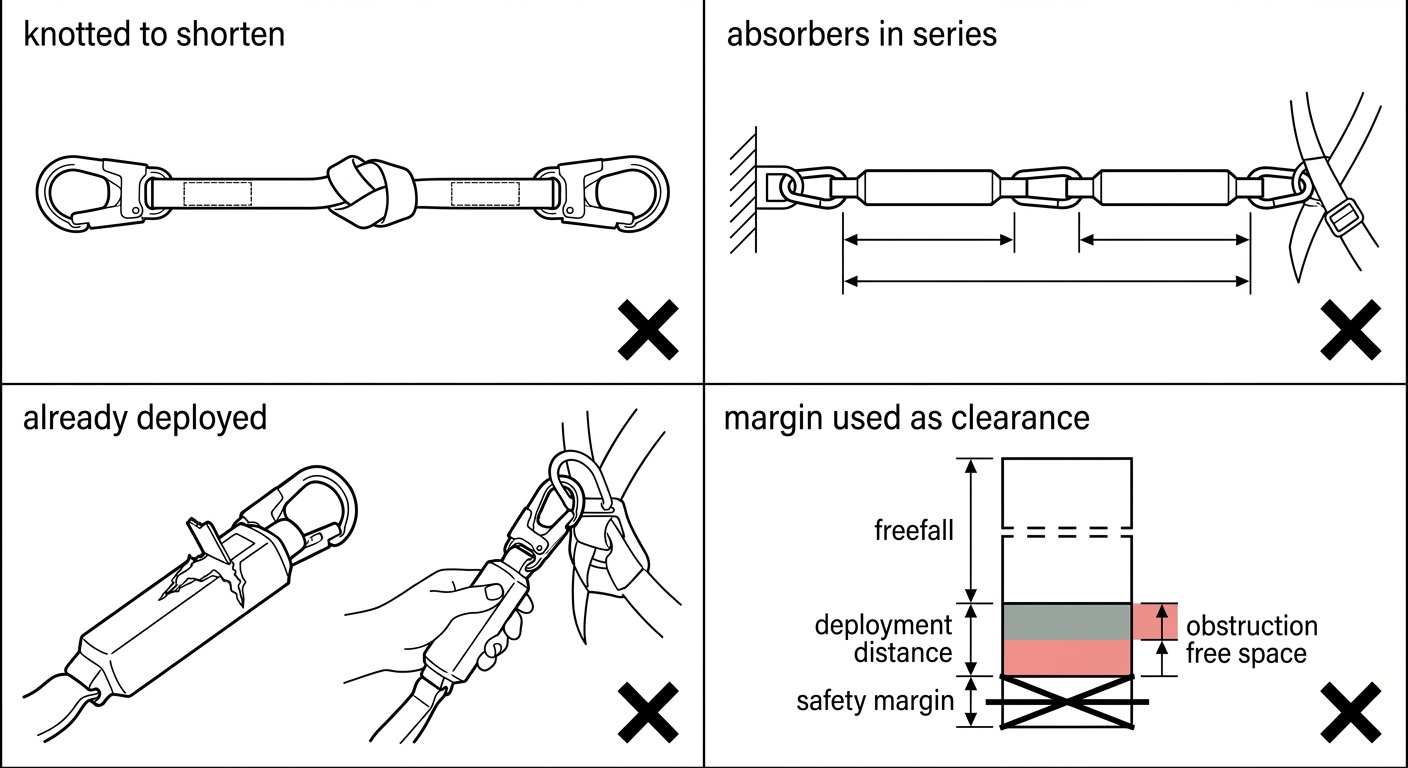
Each of these appears on site as an attempt to make a system fit a tight space. None of them works, and all of them make the outcome worse.
- Knotting or wrapping the lanyard to shorten it. A knot in a fall-arrest lanyard is not a rated adjustment; it concentrates load, cuts strength substantially and is outside the certified configuration. Buy the correct length instead.
- Adding a second absorber, or a second lanyard, in series. Two absorbers do not halve the force. They add their deployment lengths together, which increases the clearance requirement, and the assembly is no longer the tested product. The same applies to extending an absorber with an extra sling or extra connectors beyond what the instructions permit.
- Assuming a partly deployed absorber still has capacity. An absorber that has arrested a fall, or shows a broken deployment indicator, torn stitching or a split cover, is out of service. It must be withdrawn and destroyed, not returned to the rack.
- Relying on the safety margin. The final metre in the calculation is there for measurement error, body position and the difference between a test dummy and a person. It is not spare clearance.
Confined space entries usually have no clearance at all
A manhole entry into a vessel, sump or chamber frequently offers less usable clearance below the entry point than any absorbing lanyard needs. The standard solution is not a shorter absorber but a different architecture: an overhead anchor above the opening — a tripod, davit or quadpod — carrying a retractable fall arrester with rescue capability, or a two-rope system with a descender and backup. That also keeps retrieval possible, which an absorbing lanyard does not.
Clearance and retrieval should be decided together with the rest of the entry planning; see the confined space entry permit sequence and the note on selecting a rescue kit for the task.
A short field routine before the first clip-in
- Stand at the work position. Look down. Identify the first thing that could be struck and estimate the distance from your boots to it.
- Identify where the anchor will actually be, relative to your harness attachment point — overhead, level, or at your feet.
- Read the clearance figure in the instructions for that absorber, that lanyard length and that anchor position, for a user mass that includes your tools.
- Compare. If the available space is not clearly greater than the required figure, change the anchor height, the lanyard length, the device type or the work method — and re-check.
- Check the harness is adjusted so the attachment point sits where the calculation assumes it does; see adjusting a full body harness correctly.
The takeaway is a sequence, not a product: measure the space, fix the anchor height, then choose the shortest assembly that still lets the work be done. Related selection notes on lanyards, connectors, harnesses and rescue equipment are collected on the rope access and confined space technique notes hub.
Frequently asked questions
Where exactly should the available clearance be measured from?
From the soles of the user's boots at the work position down to the first thing they could strike — a beam, grating, scaffold lift, plant item or water surface — not to the ground far below. Lateral obstructions matter too, because an off-to-the-side anchor turns a fall into a swing that can carry the user into structure that is not directly underneath.
Does a shorter lanyard always reduce the clearance requirement?
Yes, in two ways: it shortens the free fall and, for models offered in several lengths, the manufacturer usually quotes a smaller total clearance figure for the shorter version. The trade-off is a reduced working radius, so the shortest length that still lets the task be done is normally the right choice.
Can two energy absorbers be used together to reduce the arrest force?
No. Absorbers in series do not halve the force; their deployment lengths add together, which increases the clearance needed, and the assembly is no longer the configuration that was tested and certified. The same applies to extending an absorbing lanyard with extra slings or connectors beyond what the instructions allow.
Why do heavier users and tool loads change the clearance figure?
Deployment length grows with the energy the absorber has to dissipate, which depends on total mass — body, clothing, harness and everything carried. Absorbers are certified for a stated user mass range, and a worker with a loaded tool belt can fall outside the range assumed by a catalogue clearance figure. Check the instructions for the mass range and use the figure that applies.
What should be used when a confined space entry offers almost no clearance below the opening?
Typically an overhead anchor above the opening — tripod, quadpod or davit — carrying a retractable fall arrester with retrieval capability, or a two-rope system with a descender and a backup device. These arrest a fall in a much shorter distance than an absorbing lanyard and, importantly, allow the casualty to be recovered.
Can an absorber that has partly deployed be reused?
No. An absorber that has arrested a fall, or that shows a broken deployment indicator, torn stitching or a split cover, must be withdrawn from service and destroyed. Its remaining capacity cannot be assessed on site, and the clearance figure in the instructions no longer applies to it.
Need this as a document you can issue? The template library gives you the risk assessments, permits and inspection logs in editable form — and employer plans cover a whole team with completion records.