
Safety / Tips and Tricks / Rope access and confined space
Activity 01 · Rope access
Which Type of Fall-Arrest Lanyard to Choose: A Selection Note
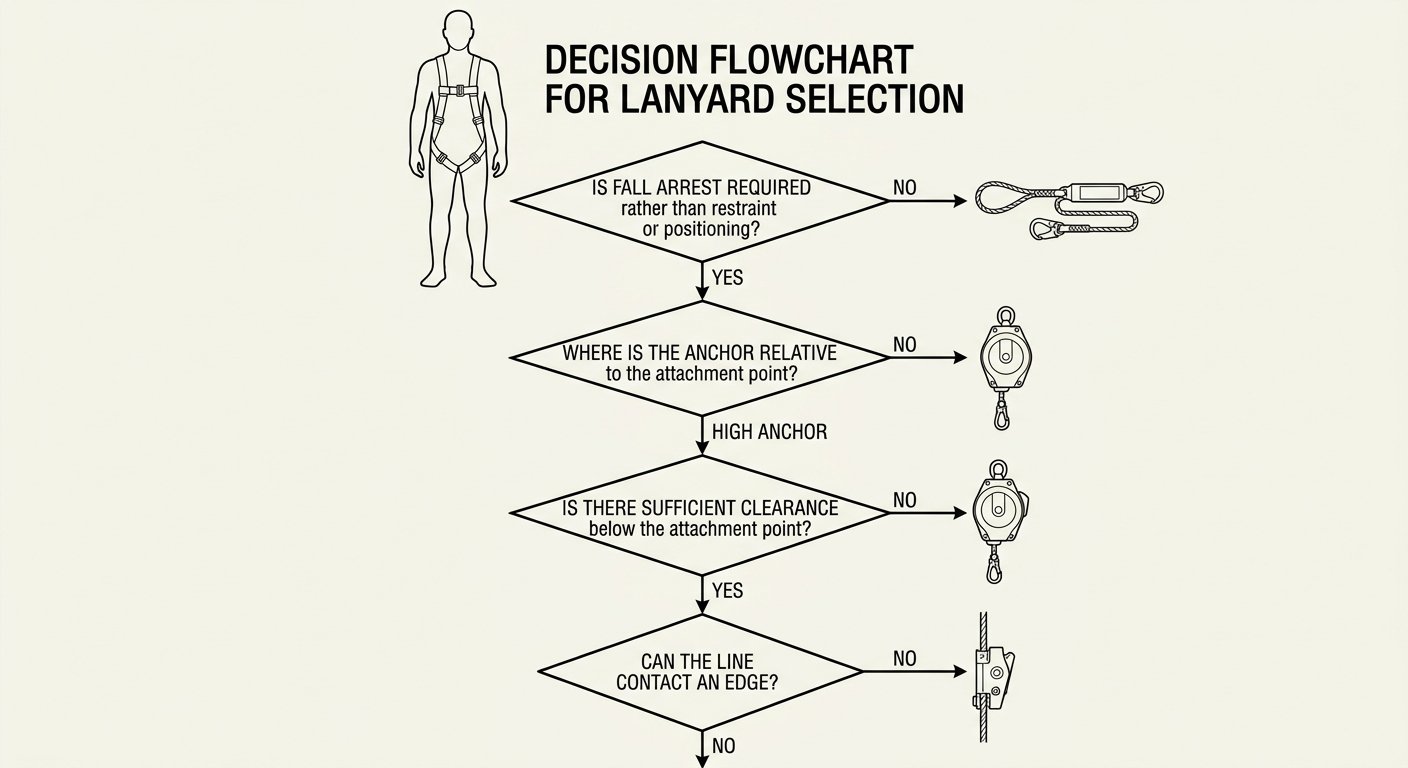
Choosing a fall-arrest lanyard is not a matter of preference or of what happens to be on the van. The choice is dictated by three site conditions that can be checked before anyone clips in: where the anchor sits relative to the harness attachment point, how much clear space there is below the worker, and whether the connecting line can be dragged across an edge. Get those three answers first, and the correct lanyard type is usually obvious. Get them wrong and a fully certified assembly can still put a worker on the floor, or arrest the fall with forces the body is not meant to take.
This note covers how to decide between an energy-absorbing lanyard, a retractable type fall arrester, and a guided type fall arrester on an anchor line, plus the specific cases — confined space entry, edge exposure, horizontal travel — where one of them is the only defensible answer.
First check: do you actually need a fall-arrest lanyard?
A large proportion of lanyard misuse comes from mixing up three different jobs.
- Restraint. The lanyard is short enough that the worker physically cannot reach the fall hazard. Nothing arrests a fall, because no fall is possible. A fixed-length lanyard or an adjustable line used purely to limit travel is appropriate here.
- Work positioning. The worker leans back into the system to work hands-free — pole work, ladder work at a fixed station. This is the domain of work positioning and restraint belts under EN 358. A positioning lanyard is not a fall-arrest lanyard: it has no energy absorption and it attaches to a belt-level attachment point that is not designed to take arrest loads. Where a fall is possible, positioning must be backed up by a separate fall-arrest system on the harness’s fall-arrest attachment.
- Fall arrest. A free fall can occur, and the system must stop it while limiting the force transmitted to the worker. This always means a fall-arrest attachment point on a full body harness certified to EN 361, never a belt, never a side D-ring, never a haul loop.
Everything below assumes you are genuinely in the third category.
The three families you are actually choosing between
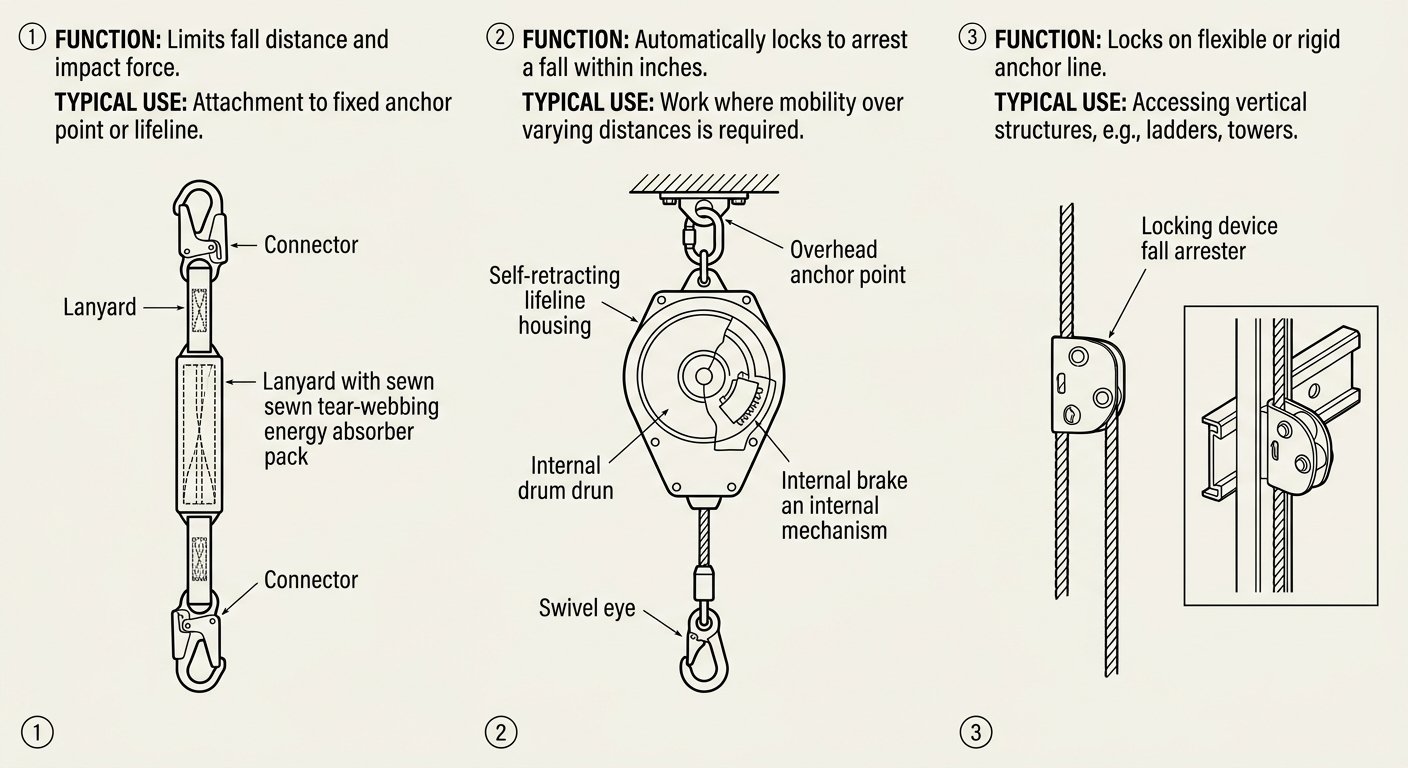
Energy-absorbing lanyard (tested to EN 355). A fixed-length webbing or rope leg with a tear-webbing or comparable energy absorber sewn into it. Simple, cheap, robust, and largely indifferent to dirt and abrasion. In European practice the complete assembly — absorber, lanyard and connectors together — is limited to two metres, and the absorber is designed to keep the arrest force on the body within the limit set by the standard (commonly quoted as 6 kN). Its weakness is clearance: the absorber has to tear to work, and that tearing distance adds to the free fall.
Retractable type fall arrester / self-retracting lifeline (tested to EN 360). A cable or webbing line on a spring-loaded drum with an inertia brake. It keeps the line short as the worker moves, so free fall distance is minimised and required clearance is usually much smaller than for an energy-absorbing lanyard. In exchange it is a mechanical device: heavier, more expensive, sensitive to how it is mounted, and — critically — most models are designed to be anchored overhead and to be loaded in line with the housing.
Guided type fall arrester on an anchor line (tested to EN 353-1 for a rigid anchor line, EN 353-2 for a flexible one). A device that travels with the worker along a fixed rail or a vertical rope and locks on the line if the worker falls. This is the correct answer for continuous vertical access — fixed ladders, masts, silo access — where neither a two-metre lanyard nor a retractable would give continuous protection over a long climb. In rope access work the equivalent function on the backup rope is served by rope adjustment devices under EN 12841, where the backup device (type A) and the working line device are distinct products with distinct roles.
Deciding factor 1: where is the anchor?
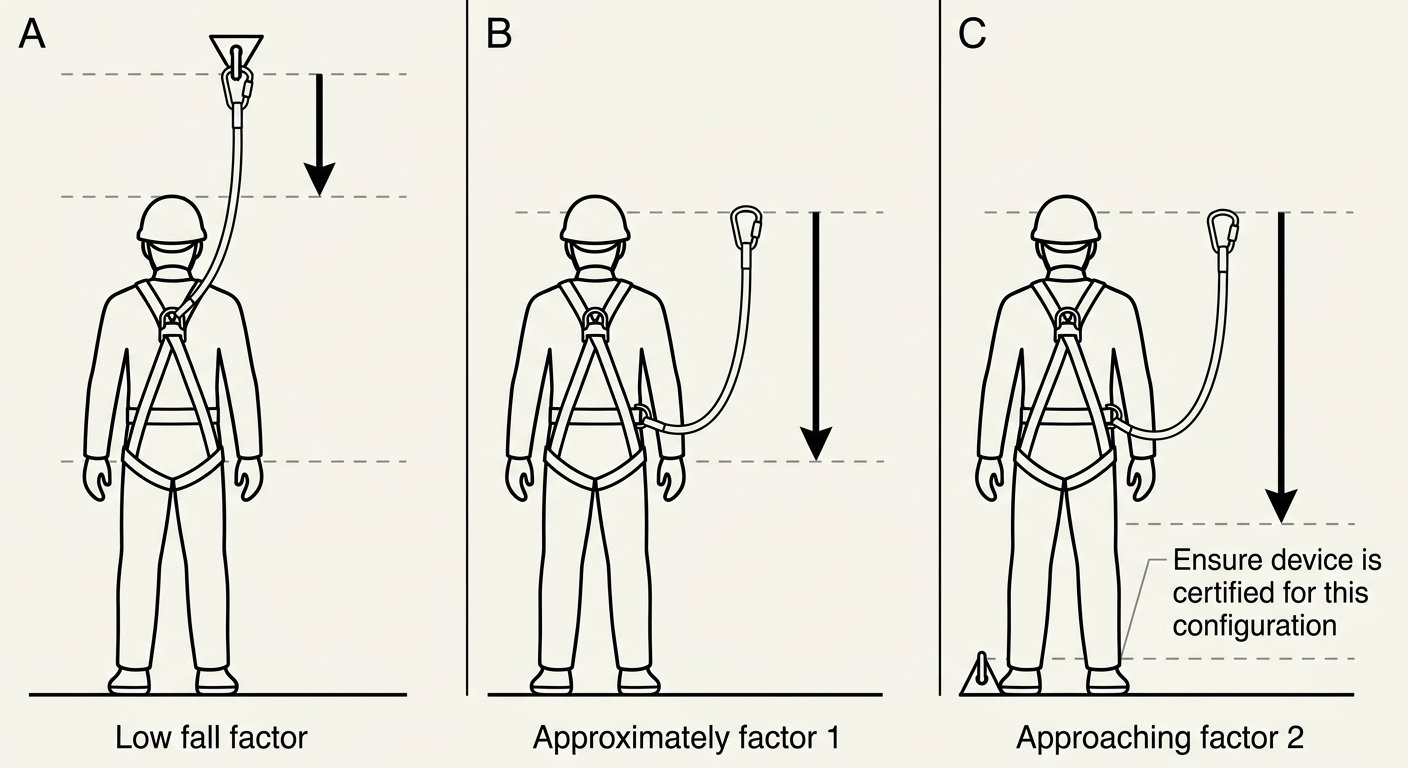
Anchor position governs the fall factor, and the fall factor governs how violent the arrest will be.
- Anchor above the attachment point (overhead, ideally near-vertically above): low fall factor, short free fall. This is the condition every lanyard type performs best in, and the condition a retractable device is designed for.
- Anchor level with the attachment point: roughly a factor 1 fall for a taut lanyard — the worker falls approximately the length of the lanyard before it begins to load.
- Anchor at or below foot level: approaching a factor 2 fall. Free fall can be roughly twice the lanyard length. Many EN 355 energy-absorbing lanyards are tested and certified for factor 2 use, but not all are, and the required clearance in that configuration is substantially greater. Standard retractable devices are generally not intended for foot-level anchorage; only models specifically qualified for it (often marketed as leading-edge or foot-level rated) may be used that way.
The practical rule: if the only available anchor is low, you must confirm in the manufacturer’s instructions that the specific device is approved for that configuration, and you must recalculate clearance for it. “It’s certified fall-arrest kit” is not an answer to a foot-level anchor.
Deciding factor 2: how much clearance is below?
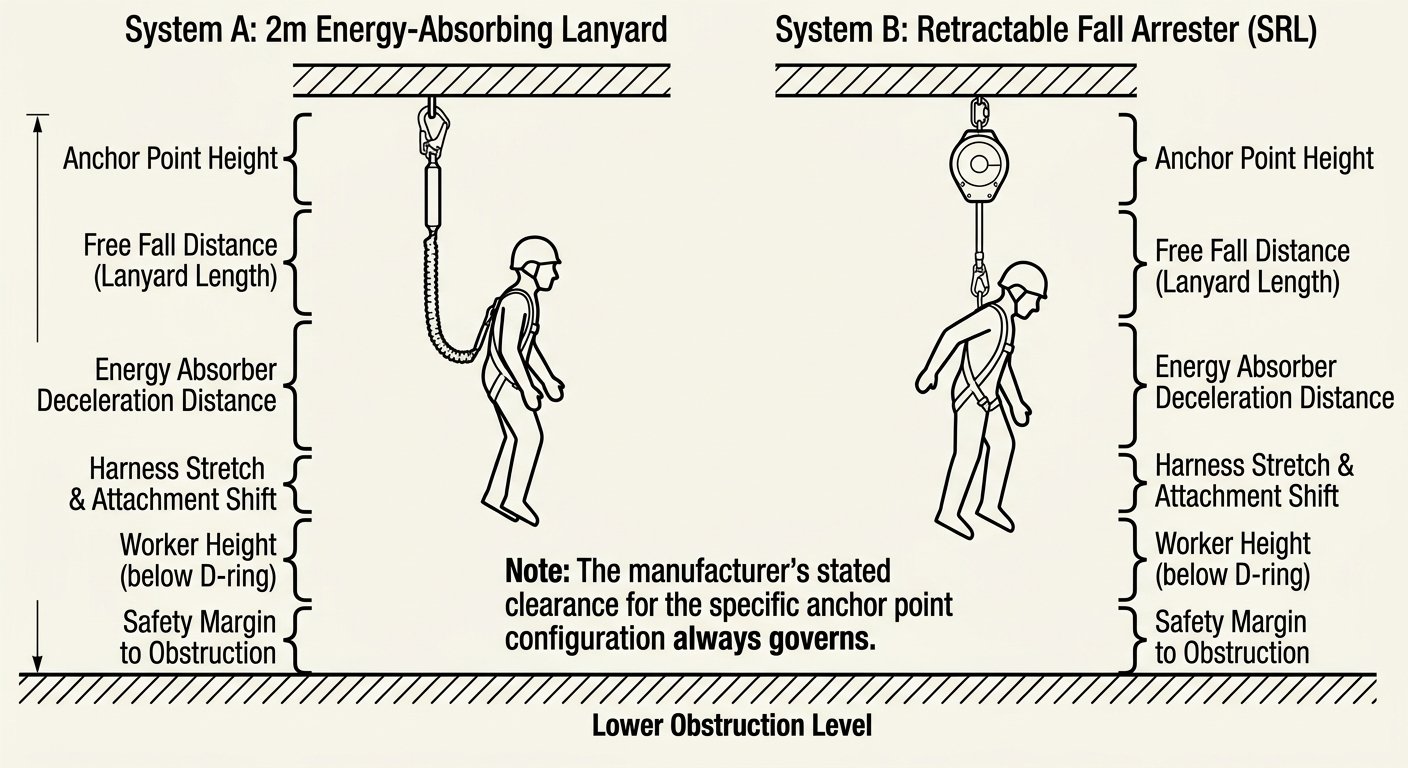
Required fall clearance is the sum of several things, and it is measured from the harness attachment point down to the nearest obstruction — not from the worker’s feet:
- free fall distance before the system starts to load (a function of lanyard length and anchor position);
- deceleration distance — absorber tear-out, or line pay-out and brake engagement on a retractable;
- harness stretch and the shift of the dorsal attachment point as the body is loaded;
- the height of the worker below the attachment point;
- a safety margin so the worker does not touch the obstruction at the lowest point of the arrest.
The number that matters is the one in the device’s own instructions, for the anchor configuration you are actually using. As a rough ranking, a two-metre energy-absorbing lanyard anchored overhead needs several metres of clear space below the attachment point; the same lanyard used from a foot-level anchor needs considerably more; a retractable device anchored overhead typically needs much less. That ranking is why clearance, more than anything else, drives the choice.
Where clearance is genuinely tight — steelwork close to a deck, work over machinery, short-fall zones — an energy-absorbing lanyard is often simply the wrong tool, and a retractable device or a guided fall arrester on a rigid rail is what makes the task survivable. Where clearance is ample but the environment is filthy and abrasive, the simple absorber lanyard is frequently the more reliable choice.
Deciding factor 3: is there an edge in the load path?
This is the failure mode most often missed at selection stage. If the worker can move away from the anchor point so that the line bears on a parapet, a deck edge, a beam flange or a cut steel edge, then in a fall that line is loaded across that edge at high speed. Steel cable retractables are particularly vulnerable here: a cable that is fine in a straight pull can be severed or badly damaged when tensioned over a sharp edge.
Two consequences for selection:
- If edge contact is possible, choose a device explicitly tested and marked for edge use (leading-edge / sharp-edge qualified), and follow its stated clearance for that configuration, which is larger than the overhead figure because of the additional swing and line deflection.
- Consider whether the anchor can simply be moved. Raising the anchor so the line clears the edge, or repositioning it so the worker stays within a narrow cone below it, removes the problem entirely and is usually cheaper than the special-rated hardware.
Edges also bring swing fall (pendulum). A worker who falls while well off to the side of the anchor swings, and can strike structure sideways before the system has finished arresting — an impact no lanyard type protects against. Limiting lateral travel, or using a horizontal lifeline or rail so the anchor tracks with the worker, is the control.
Deciding factor 4: continuous movement and 100% attachment
Where a worker must move past intermediate structure — traversing steelwork, moving between anchor points on a tower — a twin-leg (Y) energy-absorbing lanyard allows one leg to be clipped ahead before the other is released. Points that matter in practice:
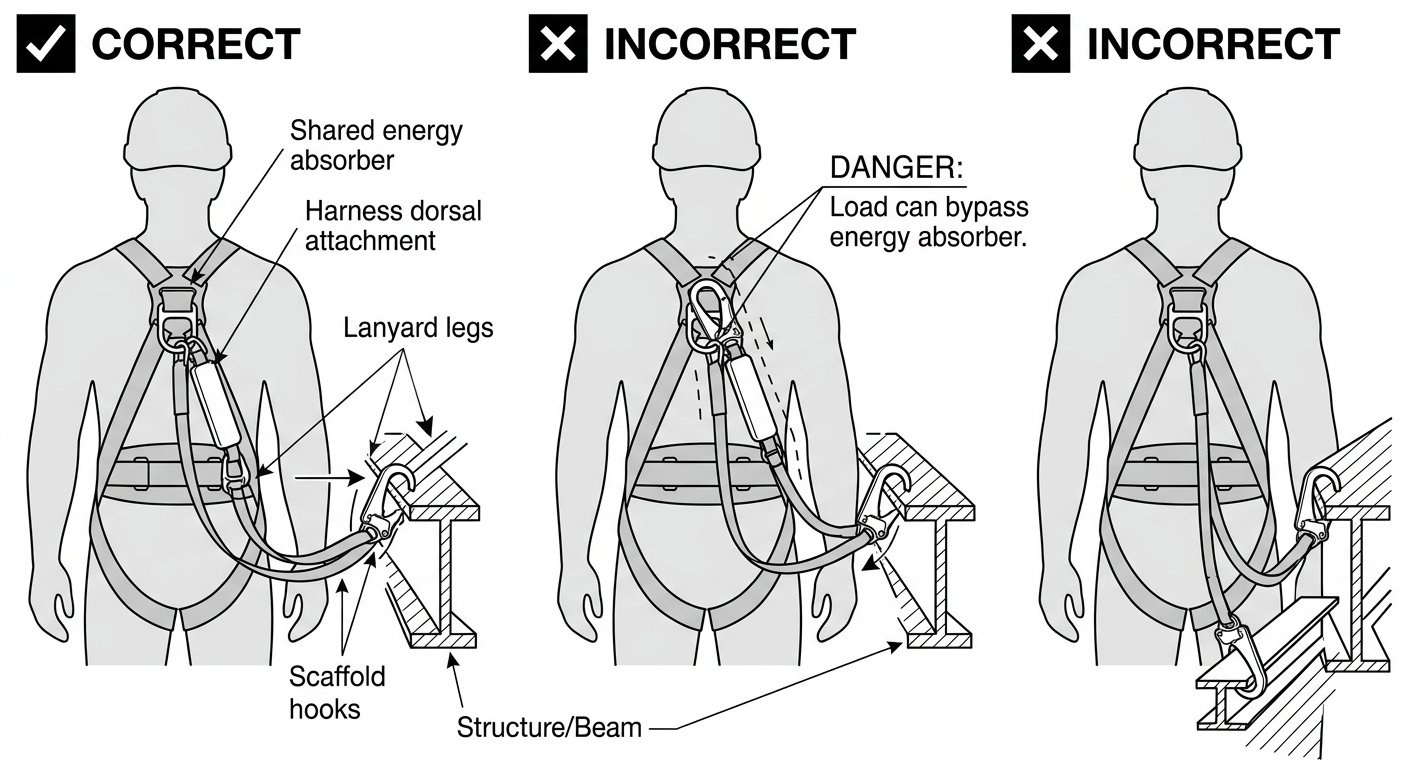
- A twin-leg assembly has one energy absorber serving both legs, and it is designed to be used with both legs originating from that single absorber at the harness attachment. Do not build a twin-leg system by connecting two independent lanyards to the same attachment point unless the manufacturer says so.
- The unused leg must be parked on the dedicated parking attachment provided on the harness or absorber — not clipped back onto the harness fall-arrest D-ring, and not left dangling where it can snag. Parking on the fall-arrest attachment can, in some configurations, transmit load through the unused leg and bypass the absorber.
- Never extend a lanyard by clipping a second lanyard, a sling or an extra connector into it. Assembly length and clearance figures are only valid for the assembly as certified.
Deciding factor 5: confined space and vertical entry
Vertical entry through a manhole or hatch is its own case. The typical arrangement is a retractable fall arrester mounted on a tripod or davit over the opening, positioned so the line runs vertically into the space and the entrant is protected from the moment they commit to the ladder. Where rescue retrieval is part of the plan, the device selected should be one with a retrieval function (a rescue winch capability), or a separate retrieval line should be rigged alongside — a plain fall arrester will hold a fallen entrant but will not raise them.
Two selection points specific to confined spaces: the device and its mounting must be compatible (retractables are not universally approved for every tripod head), and atmospheric or chemical exposure inside the space may rule out a particular line material or housing. All of this belongs in the entry permit rather than being settled at the hatch — see the walkthrough of the confined space entry permit sequence for where equipment selection sits in that process.
The parts of the choice people forget: connectors and harness fit
A lanyard is only as good as what is at each end of it.
Connectors must be certified to EN 362 for fall protection use, must be sized and shaped for what they connect to (a small connector on a wide beam anchor or a large D-ring can be cross-loaded or roll-loaded), and must have a locking mechanism appropriate to the exposure — an auto-locking gate where inadvertent opening is credible, which on a moving fall-arrest connection it usually is. The trade-offs between gate types are covered in the note on connector locking systems compared.
At the harness end, the lanyard goes to a marked fall-arrest attachment point — dorsal, or sternal where the design and the task allow it. A dorsal attachment sits at the wrong height and a sternal attachment loads awkwardly if the harness is badly adjusted, which changes both the clearance calculation and the post-fall suspension posture. Getting that right is a five-minute job covered in adjusting a full body harness correctly.
Quick selection summary
| Condition on site | Usual correct choice |
|---|---|
| Overhead anchor, generous clearance, dirty/abrasive environment | Energy-absorbing lanyard (EN 355) |
| Limited clearance below the work position | Retractable type fall arrester (EN 360), anchored overhead |
| Only low or foot-level anchorage available | Lanyard or device specifically certified for that configuration, with recalculated clearance |
| Line can bear on an edge | Edge-tested retractable, or reposition the anchor to clear the edge |
| Long fixed-ladder or mast climb | Guided type fall arrester on rigid (EN 353-1) or flexible (EN 353-2) anchor line |
| Traversing between anchor points | Twin-leg energy-absorbing lanyard, unused leg parked correctly |
| Vertical confined space entry with rescue plan | Retractable with retrieval function on tripod/davit, or separate retrieval line |
| Worker leaning back to work hands-free, fall still possible | Positioning system (EN 358) plus an independent fall-arrest system |
After selection: inspection and retirement
Whichever type is chosen, two things are non-negotiable. First, pre-use inspection every time: stitching and absorber pack intact and the tear indicator unbroken, webbing free of cuts, glazing, chemical staining and heat damage, cable free of kinks and broken strands, retractable line retracting fully and locking under a sharp pull, connector gates and locks operating cleanly. Second, any lanyard or fall arrester that has arrested a fall — or that has an activated absorber, whatever the cause — is withdrawn from service immediately and not returned to use. Periodic examination by a competent person at the interval set by the manufacturer and applicable regulation applies on top of the pre-use check.
The takeaway
Work the decision in this order: confirm you need fall arrest rather than restraint or positioning; find where the anchor is and what fall factor that gives; measure the clearance below the attachment point and compare it against the device’s stated figure for that exact configuration; then check whether an edge can enter the load path. The lanyard type falls out of those four answers. If two types both satisfy them, choose on durability and usability for the environment — that is the only stage at which preference legitimately enters.
Related selection and technique notes are collected in the rope access and confined space technique notes index.
Frequently asked questions
Can an energy-absorbing lanyard be used with an anchor at foot level?
Only if the specific product is certified for that configuration and you apply the clearance figure the manufacturer gives for it. A low anchor produces close to a factor 2 fall, roughly doubling the free fall relative to a level anchor, and the required clearance below the attachment point increases substantially. Where the instructions do not cover foot-level anchorage, the device must not be used that way.
Is a retractable fall arrester always better than a lanyard because it needs less clearance?
Not always. A retractable device usually needs far less clearance when anchored overhead, which makes it the right choice in tight fall zones, but it is a mechanical device that is heavier, more expensive and more sensitive to mounting position and to edge contact. In dirty, abrasive environments with plenty of clearance below, a simple energy-absorbing lanyard is often more robust and easier to inspect.
Can I clip a work positioning lanyard to my harness instead of a fall-arrest lanyard?
No. A positioning lanyard has no energy absorption and is used with belt-level attachment points that are not designed to arrest a fall. Where a free fall is possible, a fall-arrest system must be connected to a marked fall-arrest attachment point on a full body harness, independently of any positioning system in use.
What happens if the lanyard can be dragged over an edge?
The line is then loaded across that edge at high speed during a fall, which can cut or seriously damage it — steel cable retractables are particularly exposed to this. Either select a device specifically tested and marked for edge use and apply its larger stated clearance, or reposition the anchor so the line clears the edge entirely. Repositioning the anchor is usually the simpler control.
Where should the unused leg of a twin-leg lanyard be clipped while moving?
To the dedicated parking attachment provided on the harness or on the absorber pack. Clipping it back onto the fall-arrest D-ring can, in some configurations, allow load to pass through the unused leg and bypass the energy absorber, and leaving it dangling invites snagging. Follow the harness and lanyard manufacturer's instructions for the parking point.
Can a lanyard be reused after it has arrested a fall?
No. Any lanyard or fall arrester that has arrested a fall, and any energy absorber whose tear indicator has been activated for any reason, is withdrawn from service immediately and not returned to use. This is in addition to routine pre-use inspection and periodic examination by a competent person at the interval set by the manufacturer and applicable regulation.
Need this as a document you can issue? The template library gives you the risk assessments, permits and inspection logs in editable form — and employer plans cover a whole team with completion records.