Safety / Tips and Tricks / Rope access and confined space
Activity 01 · Rope access
Confined Space Entry: The Permit Sequence, Step by Step
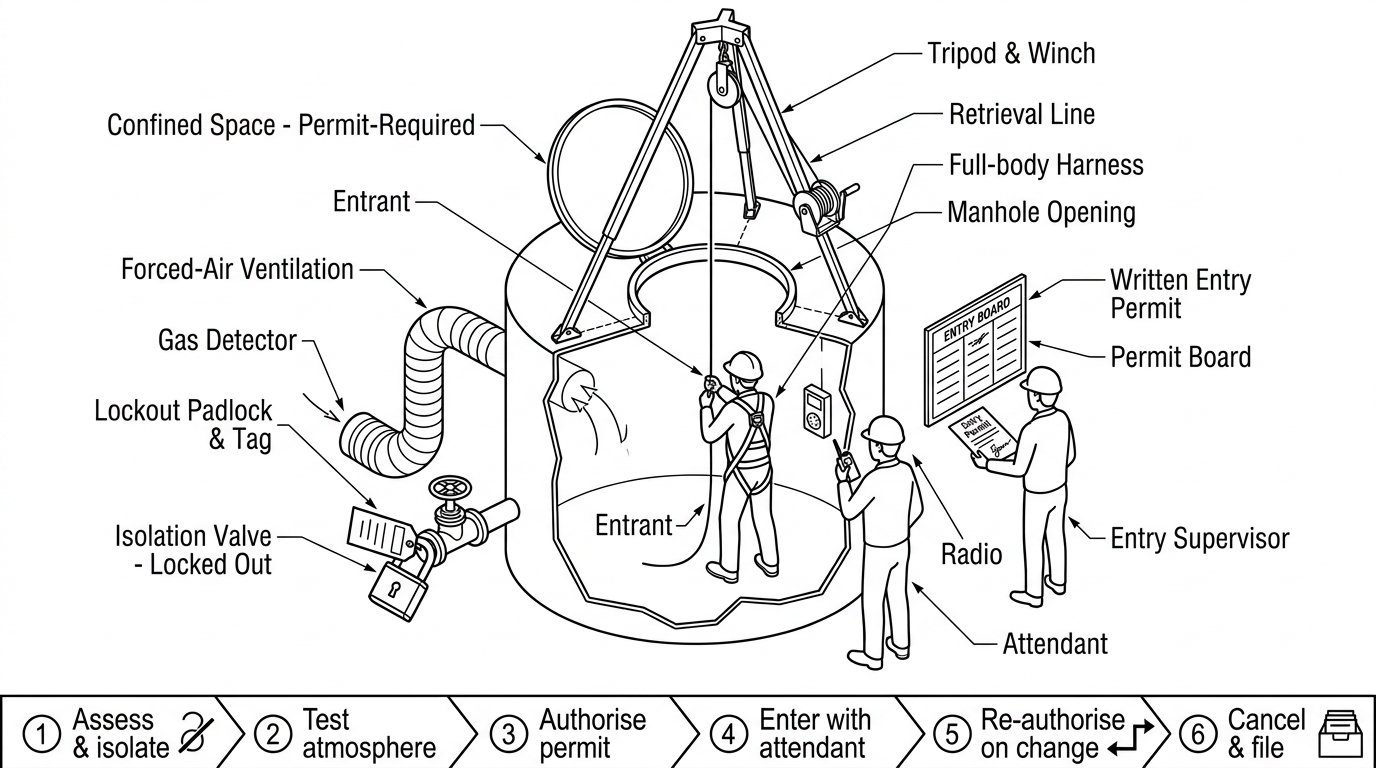
A confined space entry permit is not paperwork that happens alongside the job. It is the job's control document: a written statement that a specific space, on a specific shift, has been assessed, isolated, tested and staffed, and that a named person has authorised entry under those conditions and no others. When entries go wrong, the failure is rarely that nobody had a permit — it is that the permit was signed ahead of the conditions it described, or kept open after those conditions changed.
This article walks the permit sequence in the order it actually happens on site: hazard assessment and testing, isolation and control, authorisation, entry with a stationed attendant, re-authorisation when anything changes, and closeout. The regulatory anchors referenced throughout are OSHA 29 CFR 1910.146 (permit-required confined spaces, general industry) and 29 CFR 1926 Subpart AA (construction), with European workplaces operating under national law implementing Framework Directive 89/391/EEC and, in many organisations, an ISO 45001 management system. The specific clause numbers differ by jurisdiction; the sequence below does not.
Step 1: Confirm the space is permit-required, and what makes it so
Not every confined space needs a permit, but the decision to skip one has to be documented and defensible. A space is confined if it is large enough to enter and work in, has limited or restricted means of entry or exit, and is not designed for continuous occupancy — tanks, vessels, silos, pits, sewers, manholes, ductwork, tunnels, and the interiors of process equipment.
It becomes permit-required when it also contains, or has the potential to contain, one or more of the following:
- A hazardous atmosphere — oxygen deficiency or enrichment, flammable gas or vapour, or a toxic contaminant.
- A material with the potential to engulf an entrant, such as grain, sand, sludge or liquid.
- An internal configuration that could trap or asphyxiate — inwardly converging walls, or a floor sloping to a tapered cross-section.
- Any other recognised serious hazard: unguarded agitators, live electrical equipment, steam or process lines that can be re-energised, extreme heat, falling objects.
The phrase that matters is potential to contain. A tank that is clean and open today may still be permit-required because a valve upstream can deliver product into it. That potential is what isolation exists to remove.
Step 2: Hazard assessment and atmospheric testing before anyone enters
Testing precedes entry — not the other way round, and not with a head or arm through the opening. Testing is done from outside, using a calibrated, bump-tested multi-gas instrument with a sampling pump and probe long enough to reach the full depth of the space.
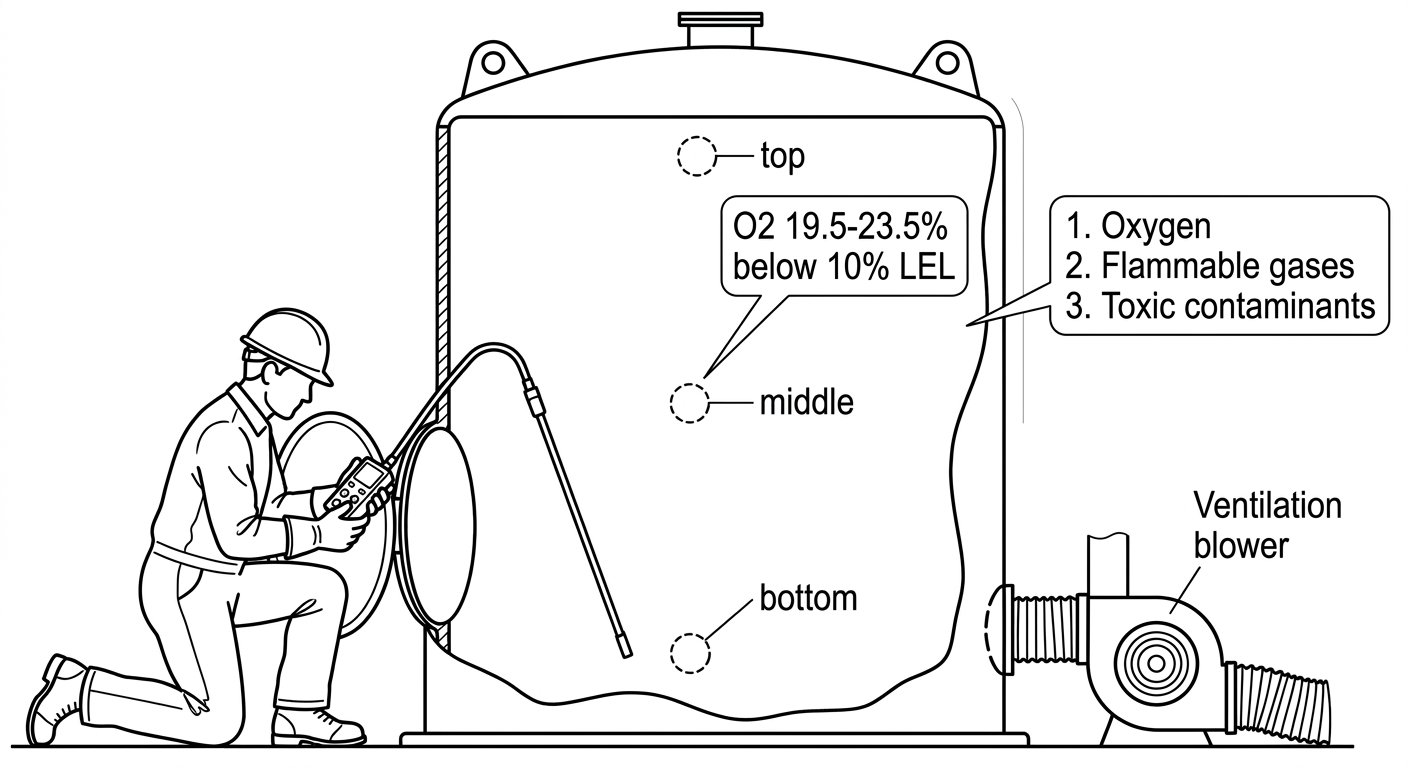
The established order of testing is oxygen first, then flammable gases and vapours, then toxic contaminants. The reason is instrument behaviour rather than convention: catalytic combustible-gas sensors need sufficient oxygen to read correctly, so an oxygen reading that falls outside the acceptable range invalidates the flammability reading taken alongside it.
Under OSHA’s criteria, an acceptable entry atmosphere means oxygen between 19.5% and 23.5%, a flammable concentration below 10% of the lower explosive limit, and no contaminant above its permissible exposure limit. Where European national limits or in-house occupational exposure limits are stricter, the stricter figure governs.
Two details are routinely missed:
- Test the space in layers. Gases stratify. Hydrogen sulphide and many solvent vapours settle low; methane and hydrogen accumulate high. Sample at the top, middle and bottom of the space, and record each reading on the permit rather than a single “pass”.
- Testing is not a one-off. Ventilation, hot work, sludge disturbance and body heat all change the atmosphere. Continuous monitoring during entry is required wherever the atmosphere can plausibly change — which, in practice, covers most permit entries.
Step 3: Isolation, lockout and ventilation — the controls the permit records
The permit is a record of controls that are already in place at the moment of signature, not a to-do list. Before authorisation, the entry supervisor should be able to physically verify:
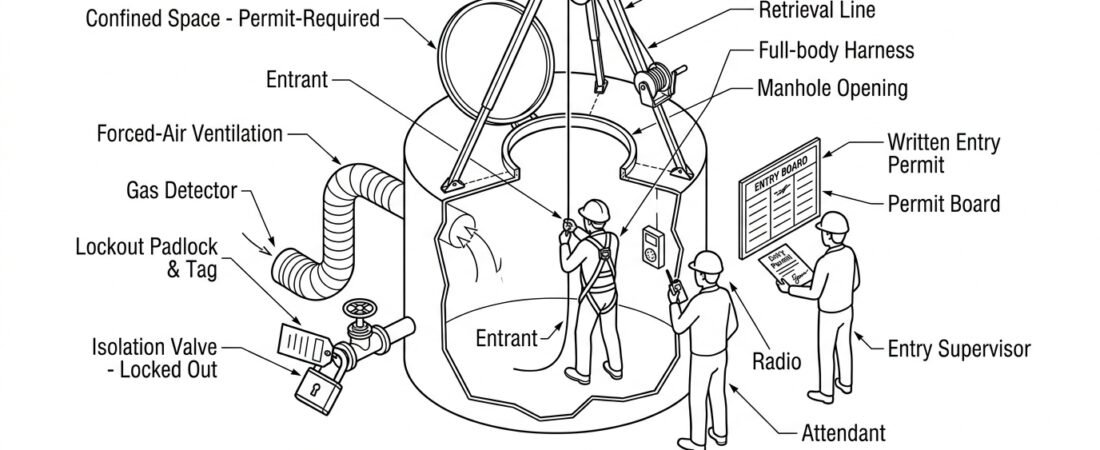
- Energy isolation. Mechanical and electrical sources locked and tagged, stored energy released, agitators and augers immobilised, verified by an attempted start where safe to do so.
- Process isolation. Lines blanked, blinded, or double-block-and-bleed isolated. Closing a valve is not isolation.
- Purging and cleaning. Residues removed or neutralised, inerting gases displaced before entry — nitrogen-purged vessels have killed entrants in atmospheres that gave no warning whatsoever.
- Ventilation. Forced-air ventilation running with a clean intake, positioned to sweep the working area rather than short-circuit at the opening.
- Access and fall protection. Openings guarded, ladders or tripod and winch rigged, entrants wearing a full-body harness (EN 361) attached to a retrieval line at an anchor rated for the load (EN 795), unless the retrieval equipment would increase the overall risk.
- Rescue arrangements. The rescue service identified, contacted and confirmed available for this entry, with a stated response method — not “call the emergency number”.
Step 4: Authorisation — who signs, and what the signature means
The entry supervisor is the person named on the permit as responsible for determining that acceptable entry conditions exist, that all required controls are in place, and that rescue services are available. That person signs the permit before entry begins and is the only person who can terminate it. Being the supervisor is a role, not a rank: a competent, trained and formally designated person holds it, and on some sites the same individual may also be a trained attendant or entrant — provided they are not attempting two roles simultaneously.
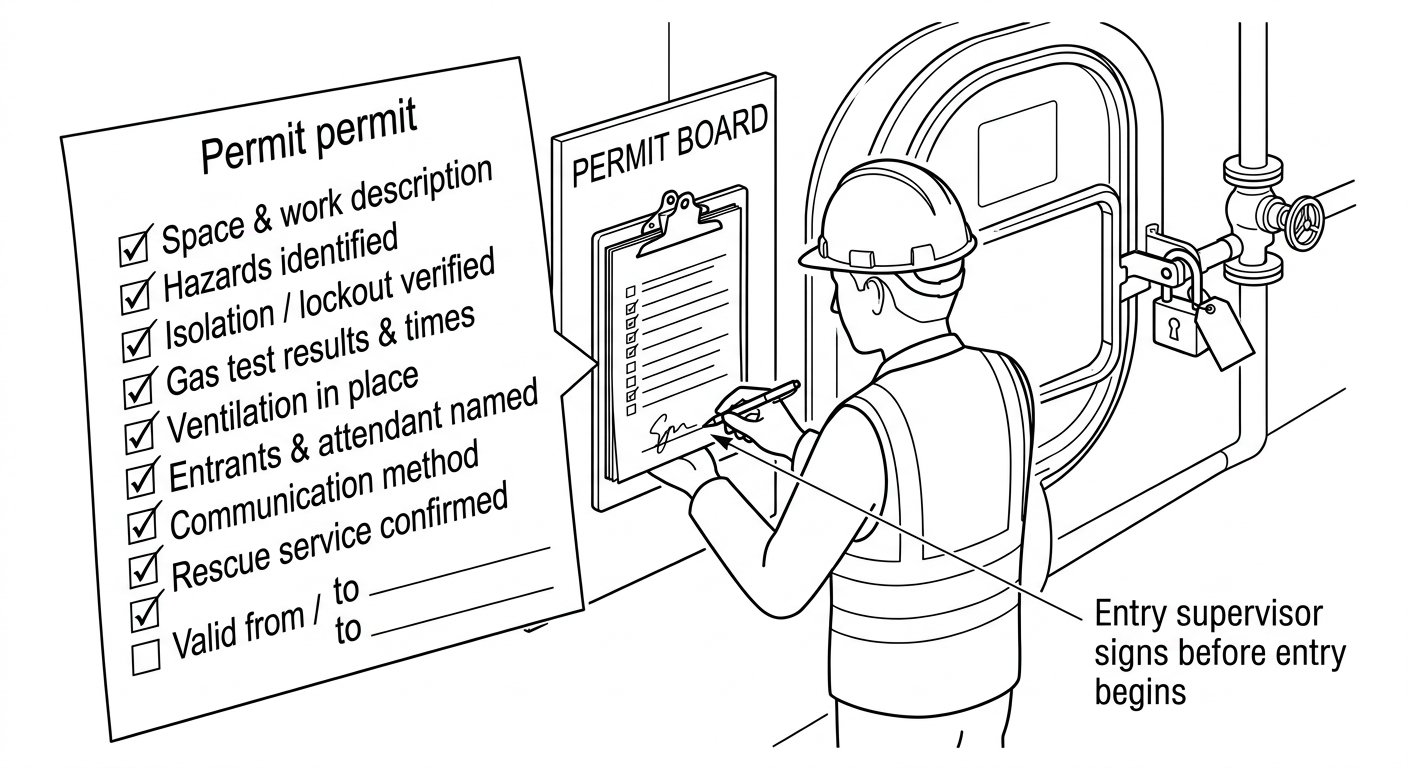
A completed permit should let a stranger reconstruct the entry. At minimum it identifies the space and the work to be done, the hazards identified, the isolation and control measures taken, the atmospheric test results with times and instrument identification, the names of authorised entrants and attendants, the communication method, the rescue arrangements, the equipment and PPE required, and the date and time window for which it is valid.
The permit is then posted at the entry point so that everyone approaching the space can read what has been authorised. A permit locked in a site office controls nothing.
Step 5: Entry, with a dedicated attendant outside
For permit-required entries, an attendant is stationed outside the space for the whole duration of the entry. This is a full-time role, not something added to a supervisor’s other duties or covered by a colleague who happens to be nearby.
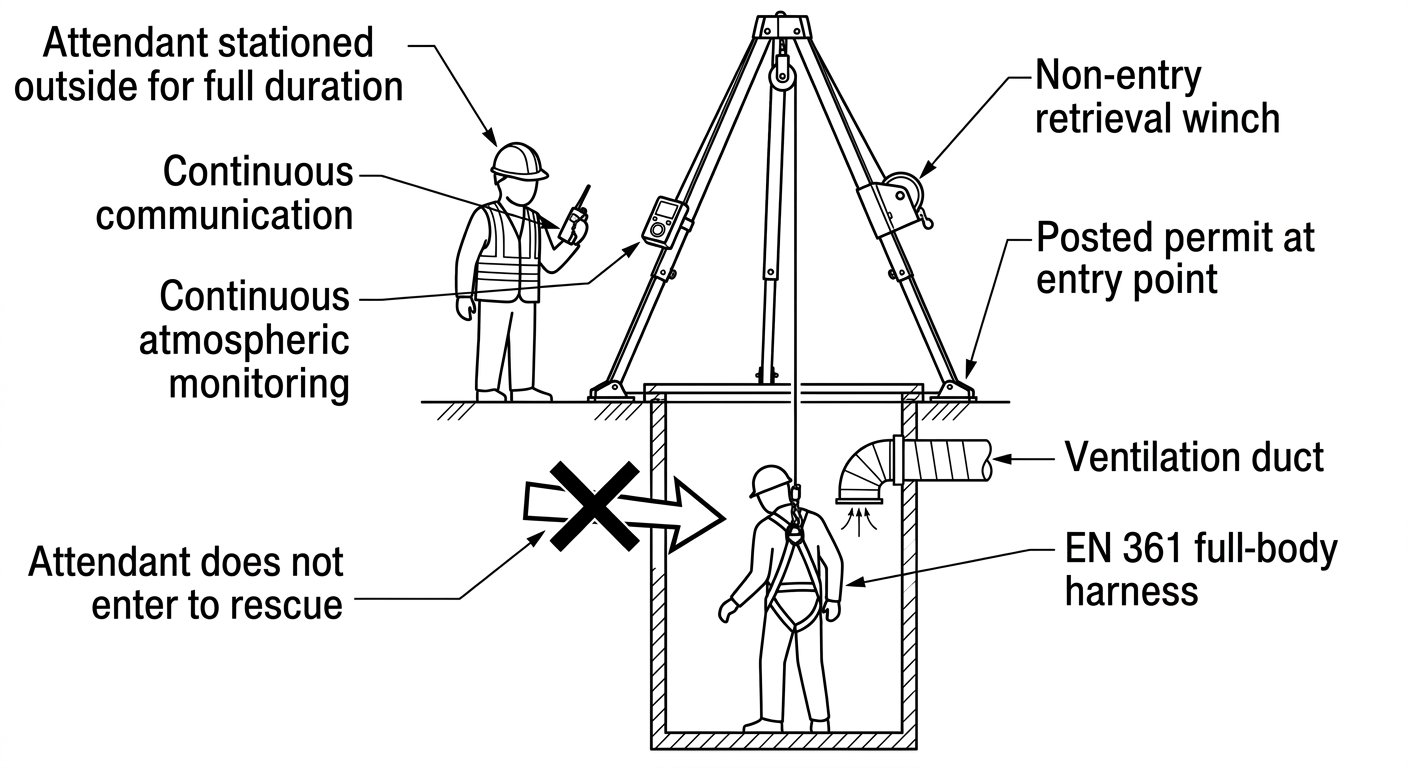
The attendant’s responsibilities during entry are specific:
- Maintain an accurate, continuous count of who is inside the space and where.
- Maintain continuous communication with entrants — by voice, radio, rope signal or another method stated on the permit — and confirm their status at defined intervals.
- Monitor conditions inside and outside the space, including the gas detector readings and any activity nearby that could introduce a hazard, such as vehicle exhaust drawn into the ventilation intake.
- Order an immediate evacuation if a prohibited condition arises, if an entrant shows signs of exposure, if a situation outside the space endangers entrants, or if the attendant can no longer perform their duties effectively.
- Summon rescue services when needed, and keep unauthorised people away from the opening.
The point that most needs stating plainly: the attendant does not enter the space to attempt a rescue. A significant share of confined-space fatalities are would-be rescuers who entered an atmosphere that had already incapacitated someone else. The attendant performs non-entry retrieval using the pre-rigged winch and retrieval line, or summons the trained rescue team identified on the permit. Entry rescue happens only by a pre-planned method, by people trained and equipped for it, wearing appropriate respiratory protection.
Step 6: When conditions change, the permit stops
A permit is valid only for the conditions and the time window written on it. If either changes, the entry stops and the permit is re-authorised or a new one is issued. There is no partial continuation.
Situations that end the validity of a permit include:
- An atmospheric reading moving outside the acceptable range, or a detector alarming for any reason including a fault.
- A change in the scope of work — particularly the introduction of hot work, coating, solvent cleaning or any process that generates fume or consumes oxygen.
- Loss of ventilation, loss of communication, or failure of lighting or retrieval equipment.
- A change in isolation status, including anyone touching a lock, blind or valve on the isolation list.
- The stated time window expiring, or a shift handover. A new shift means a new assessment and a new authorisation, even if the space appears unchanged.
- The rescue service becoming unavailable.
Re-authorisation means re-testing the atmosphere, re-verifying controls, and a fresh signature. Extending a permit by writing a later time on it, without re-testing, defeats the purpose of the document.
Step 7: Closeout — cancelling and filing the permit
The entry is not finished when the work is finished. Closeout is a defined step in the sequence and belongs to the entry supervisor.
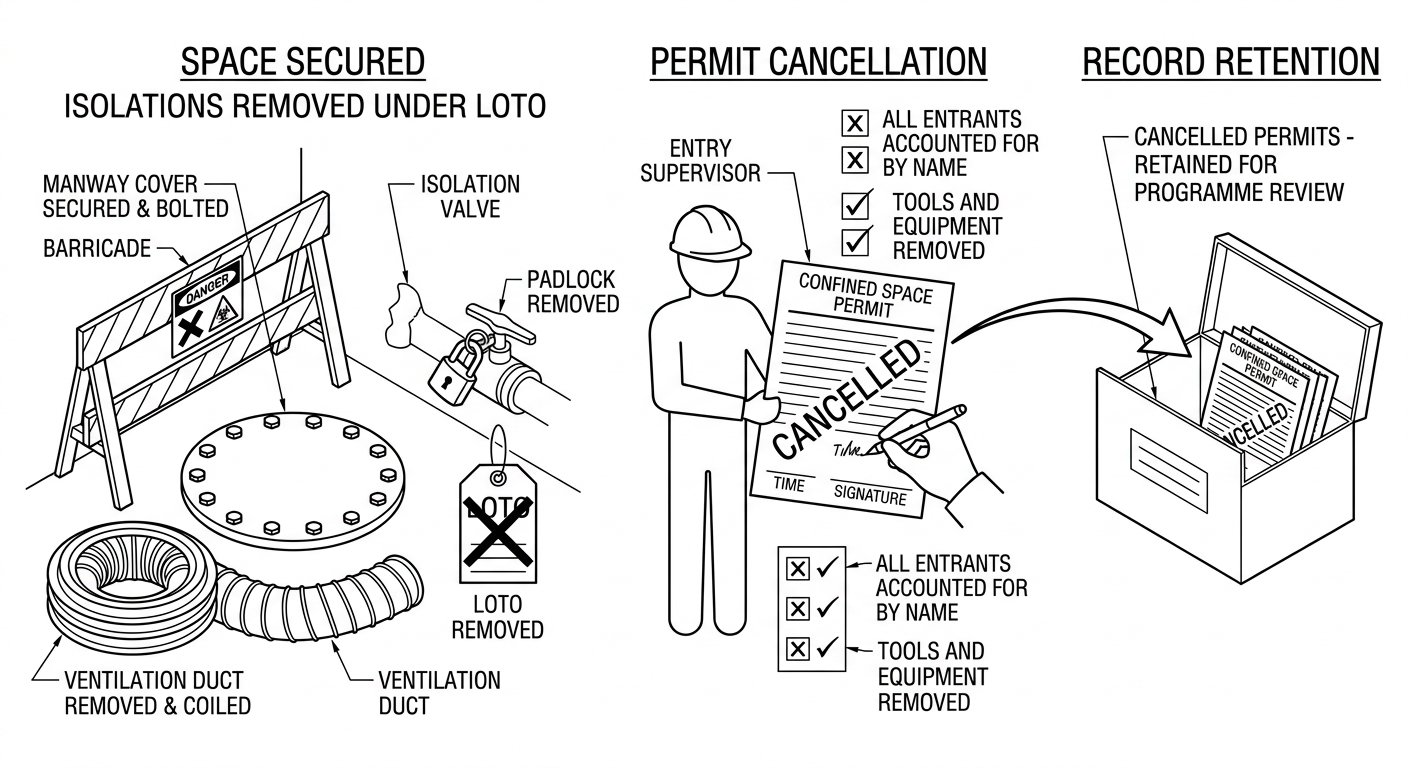
At closeout:
- All entrants are confirmed out by name, against the attendant’s count — not by a visual sweep.
- Tools, equipment and materials are removed from the space.
- The space is secured: covers replaced, openings guarded or barricaded, access restored to its normal condition.
- Isolations are removed under the site’s lockout/tagout procedure, in the correct order, and the space is returned to service.
- The entry supervisor cancels the permit, signs and times the cancellation, and the permit is retained.
Cancelled permits are worth more than their compliance value. Reviewed as a set, they show which spaces repeatedly produce marginal gas readings, where ventilation is under-specified, which tasks routinely trigger re-authorisation, and whether the programme’s hazard assessments match what crews actually find. Under OSHA 1910.146 the programme is reviewed at least annually using cancelled permits from the preceding twelve months; that review is the mechanism by which a permit system improves rather than ossifies.
The sequence in one view
- Classify the space and confirm whether a permit is required.
- Assess hazards; isolate energy and process lines; clean, purge and ventilate.
- Test the atmosphere from outside — oxygen, then flammability, then toxicity — at multiple depths, and record the readings.
- Verify rescue arrangements, retrieval equipment, PPE and communications.
- Entry supervisor completes and signs the permit; post it at the entry point.
- Attendant takes station outside; entrants enter; monitoring continues throughout.
- Any change in conditions, scope, shift or time window: evacuate, re-assess, re-authorise.
- Work complete; account for all entrants; secure the space; remove isolations; cancel, sign and file the permit.
If your site’s permit form does not currently capture the atmospheric readings by depth and time, the instrument used, the named attendant, and the rescue method, that is the most useful place to start revising it. Compare your current form against the elements listed in OSHA 29 CFR 1910.146 — or the equivalent national requirement in your jurisdiction — and against the isolation and ventilation steps in Step 3 above, before the next scheduled entry.
Frequently asked questions
Who is allowed to authorise a confined space entry permit?
The permit is authorised by the designated entry supervisor — a trained, competent person formally assigned that role for the entry. Their signature certifies that hazards have been identified, isolation and ventilation controls are in place, the atmosphere has been tested with acceptable results, and rescue arrangements are confirmed. The entry supervisor is also the person who terminates and cancels the permit.
How long does a confined space entry permit stay valid?
Only for the specific time window written on the permit and the conditions it describes. Many sites limit a permit to a single shift or a single task. It cannot be extended by writing a later time on the form; extending an entry requires re-testing the atmosphere, re-verifying controls and a fresh authorisation.
What changes require the permit to be re-authorised?
Any change to the conditions or scope the permit was written for. That includes gas readings moving outside the acceptable range, loss of ventilation or communication, a change in isolation status, the introduction of hot work or other new tasks, a shift handover, or the rescue service becoming unavailable. In each case entrants leave the space and the entry is re-assessed and re-authorised.
Can the attendant enter the space to rescue an entrant?
No — not as an improvised response. The attendant remains outside, performs non-entry retrieval using the pre-rigged retrieval line and winch, and summons the rescue service identified on the permit. Entry rescue is carried out only by trained, equipped rescuers using a pre-planned method, because an atmosphere that has incapacitated one worker will incapacitate an unprotected rescuer.
Why is the atmosphere tested in the order oxygen, flammability, then toxicity?
Because the instrument depends on it. Catalytic combustible-gas sensors need adequate oxygen to give a valid reading, so an out-of-range oxygen result makes the flammability reading unreliable. Testing oxygen first establishes whether the other readings can be trusted, and readings should be taken at the top, middle and bottom of the space because gases stratify.
Does every confined space need a written entry permit?
Not every confined space, but every permit-required one. A space becomes permit-required when it contains or could contain a hazardous atmosphere, an engulfment hazard, an entrapping internal configuration, or another recognised serious hazard. If a space is classified as not requiring a permit, that assessment should be documented and re-checked whenever the space or the surrounding process changes.
What happens to the permit after the work is finished?
The entry supervisor confirms all entrants are out by name, ensures equipment is removed and the space is secured, oversees removal of isolations, then cancels and signs the permit. Cancelled permits are retained and reviewed as a set — they reveal which spaces repeatedly produce marginal readings, where ventilation is under-specified, and whether hazard assessments match site reality.
Need this as a document you can issue? The template library gives you the risk assessments, permits and inspection logs in editable form — and employer plans cover a whole team with completion records.