Safety / Tips and Tricks / Energy and networks
Activity 03 · Energy
Arc Flash Boundaries: Limited, Restricted and Arc Flash Approach Distances
Arc flash risk is not uniform with distance from the equipment — it falls off sharply the further a worker is from the potential arc source, which is why approach distances, not just PPE category, are a core part of managing the hazard.
Why boundaries exist at all
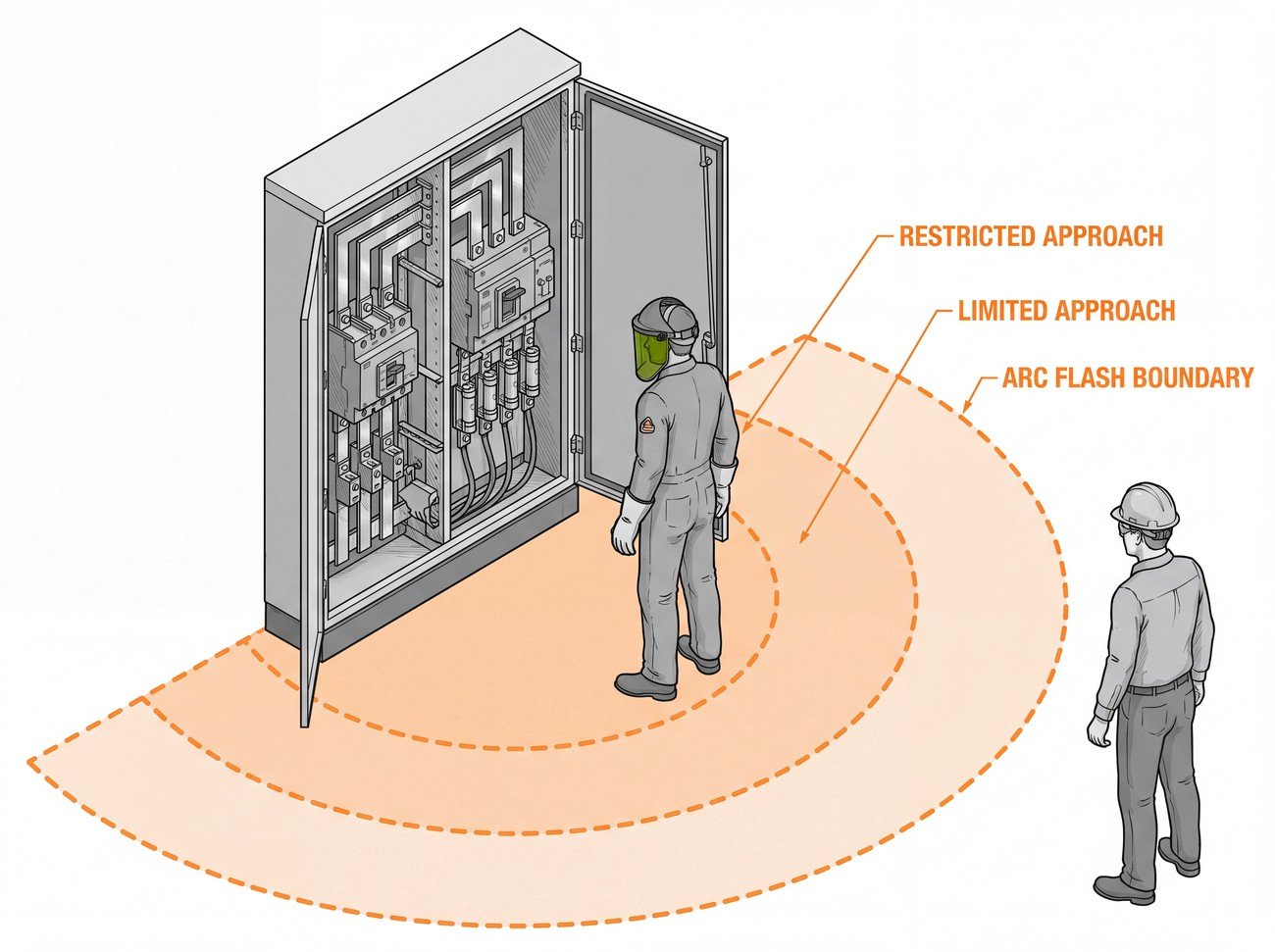
Each defined boundary marks a distance at which a specific level of risk applies, and different activities and qualification levels are permitted at different boundaries. Rather than a single “safe distance,” the boundary system recognises that different tasks need to happen at different proximities to energised equipment, and each proximity carries its own requirements for who may be there and what they must be wearing.
The arc flash boundary
The arc flash boundary marks the distance at which the incident energy from a potential arc would produce a curable second-degree burn on unprotected skin. Anyone crossing inside this boundary, regardless of task, needs to be wearing PPE meeting EN 61482 and matched to the incident energy calculated for that specific task, as covered in the arc flash risk assessment. Outside this boundary, arc-rated PPE is not required for arc flash purposes specifically, though shock protection requirements may still apply depending on proximity to exposed conductors.
The limited and restricted approach boundaries
These boundaries relate to shock hazard rather than arc flash specifically, marking distances from exposed energised conductors at which increasing qualification and precautions are required. The restricted approach boundary, closer to the conductor than the limited approach boundary, generally requires the worker to be qualified for the specific task and to use additional shock protection measures beyond what is needed further out. An unqualified person should not cross the limited approach boundary at all without being escorted by, and under the direct supervision of, a qualified person.
Why these boundaries are task- and voltage-specific
Boundary distances are not a single fixed number across all equipment — they depend on the voltage present and, for the arc flash boundary specifically, on the calculated incident energy for the task. A boundary distance appropriate for one piece of equipment does not automatically apply to another operating at a different voltage or fault current, which is why boundaries are documented per piece of equipment or per task rather than assumed generically across a site.
Marking and communicating the boundaries
Where practical, boundaries should be identified on equipment labelling or through site procedures communicated before the task begins, so that anyone approaching does not need to calculate or estimate the boundary themselves in the moment. A worker who does not know where a boundary sits cannot reliably respect it.
For how the arc flash boundary’s incident energy figure is calculated, see arc flash risk assessment.
Common errors
1Treating all approach boundaries as a single generic "safe distance" rather than distinct, task-specific figures.
2Allowing an unqualified person to cross the limited approach boundary without direct supervision by a qualified person.
3Assuming a boundary distance from one piece of equipment applies to a different one at a different voltage.
4Not communicating the calculated boundaries to workers before they approach the equipment.
Frequently asked questions
What does the arc flash boundary actually mark?
The distance at which the incident energy from a potential arc would produce a curable second-degree burn on unprotected skin – anyone crossing inside it needs PPE matched to the task's calculated incident energy.
What is the difference between the limited and restricted approach boundaries?
Both relate to shock hazard from exposed energised conductors rather than arc flash specifically; the restricted approach boundary sits closer to the conductor and generally requires the worker to be qualified with additional shock protection measures.
Can an unqualified person cross the limited approach boundary?
Only if escorted by, and under the direct supervision of, a qualified person – an unqualified person should not cross it unaccompanied.
Why are boundary distances different for different equipment?
They depend on the voltage present and, for the arc flash boundary, the calculated incident energy for the specific task, so a distance appropriate for one piece of equipment does not automatically apply to another at a different voltage or fault current.
Why should boundaries be marked or communicated in advance rather than judged on the spot?
A worker who does not know where a boundary sits cannot reliably respect it, so identifying boundaries on equipment labelling or in a pre-task briefing removes the need to estimate them in the moment.
Need this as a document you can issue? The template library gives you the risk assessments, permits and inspection logs in editable form — and employer plans cover a whole team with completion records.