Safety / Tips and Tricks / Rope access and confined space
Activity 01 · Rope access
Y-Lanyard from a Knotted Sling: Why the Improvisation Fails and What to Use Instead
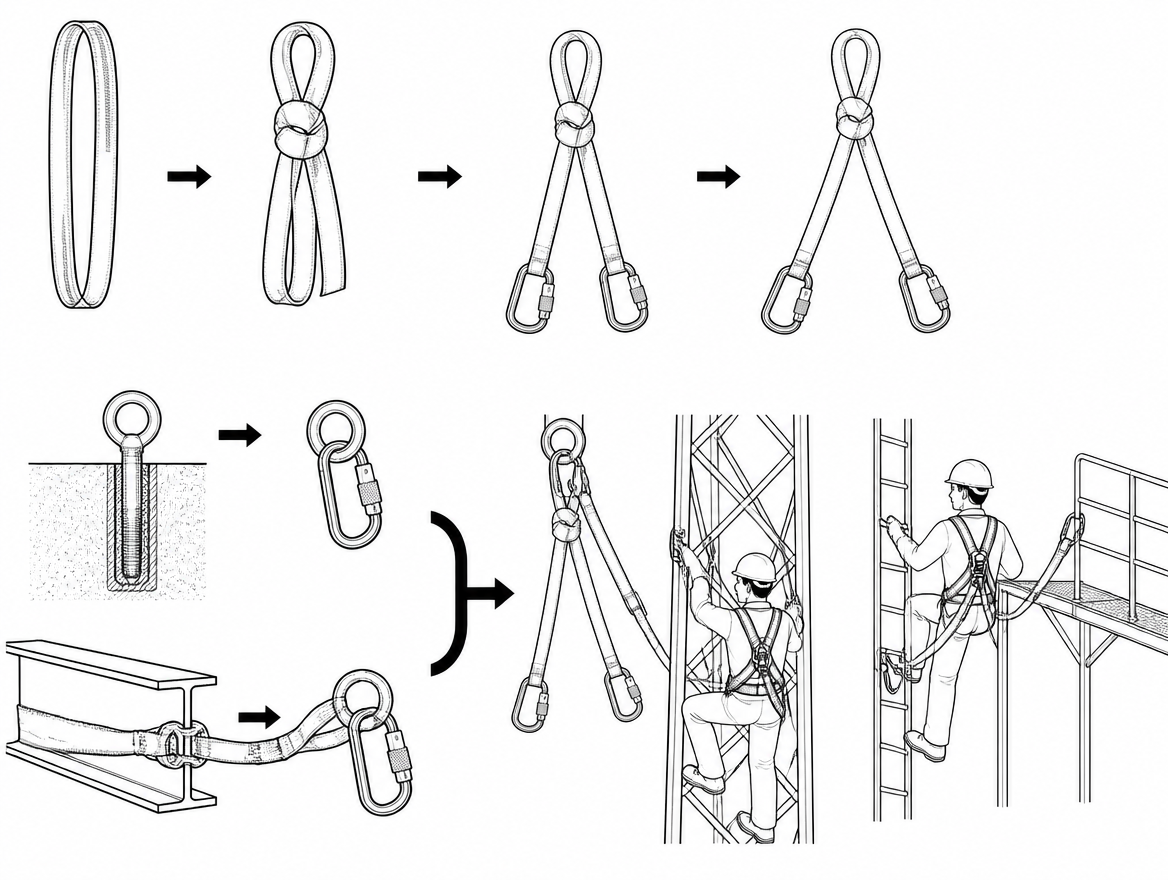
The improvisation is always the same. A worker needs continuous attachment while climbing lattice steel, moving past a scaffold node, or transferring from a ladder to a platform. The store has webbing slings and connectors but no twin-tail energy-absorbing lanyard. So a sling gets tied into a loop with an overhand or water knot, a connector goes into each resulting leg, and the assembly is clipped to the harness. It has two tails and a junction. It looks like a Y-lanyard. It is not one, and in a genuine fall it will do none of the three things a Y-lanyard is built to do.
This article sets out exactly what fails, which standards apply, and what equipment covers the job the knotted sling is being asked to cover.
What a compliant twin-tail energy-absorbing lanyard actually is
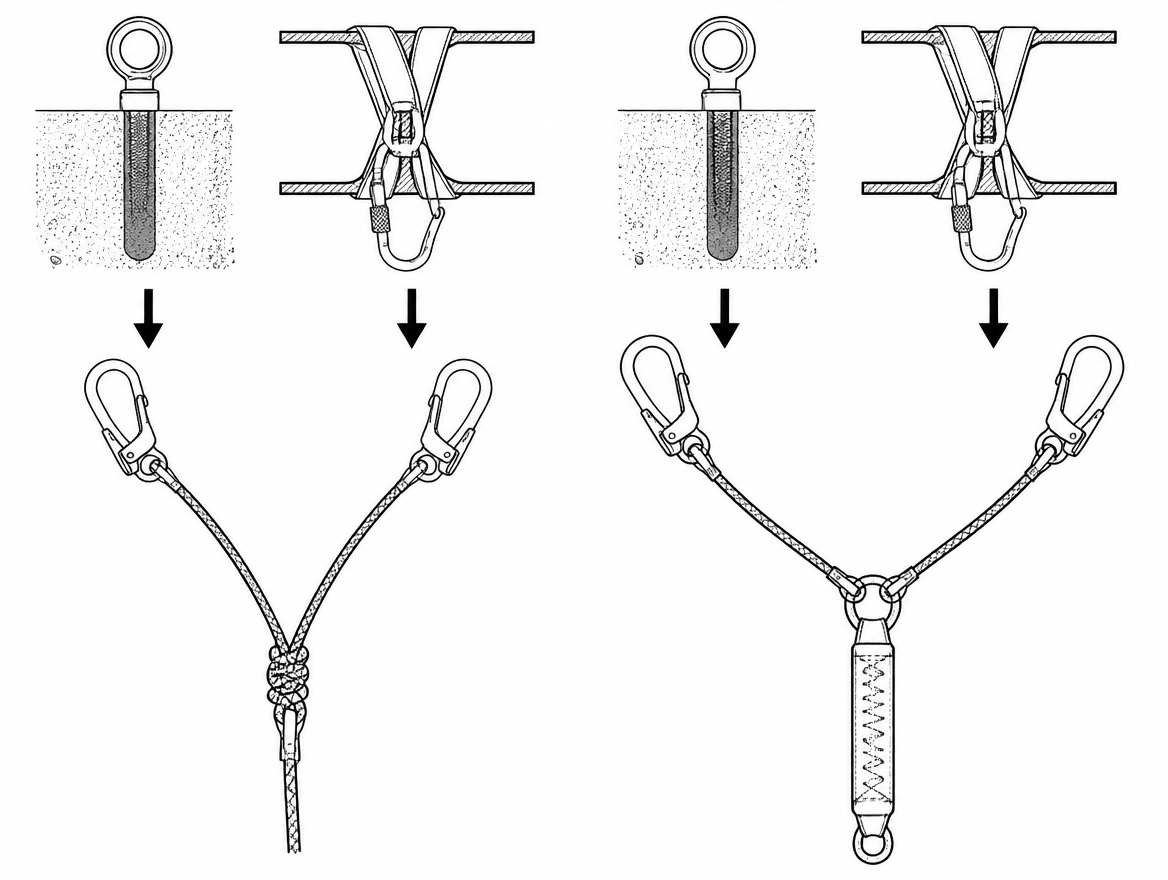
A manufactured Y-lanyard (twin-tail, or forked, energy-absorbing lanyard) is a certified assembly of several components, each covered by its own standard:
- EN 355 – the energy absorber. In the standard’s dynamic performance test the peak force transmitted to the user must not exceed 6 kN, and the total length of the assembly – absorber, lanyard and connectors together – must not exceed 2 m. The distance the absorber is allowed to deploy while arresting the fall is also limited (widely cited as 1.75 m in the test); the figure you use for clearance calculations is the deployment value printed in your own manufacturer’s instructions.
- EN 354 – the lanyard element itself, including its static strength and terminations.
- EN 362 – the connectors, with class-specific static strength and gate requirements, self-closing and self-locking, with a gate opening actually sized for the anchor being used.
- EN 361 – the full body harness the assembly attaches to, at a fall arrest attachment point (marked with the letter A, or with A/2 where two elements must be used together).
Critically, a twin-tail lanyard has one energy absorber, positioned at the harness end, downstream of the fork. Both tails share it. That single-absorber architecture is the reason the whole thing works, and it is exactly what a knot cannot reproduce.
Failure mode 1: the knot destroys strength you cannot measure
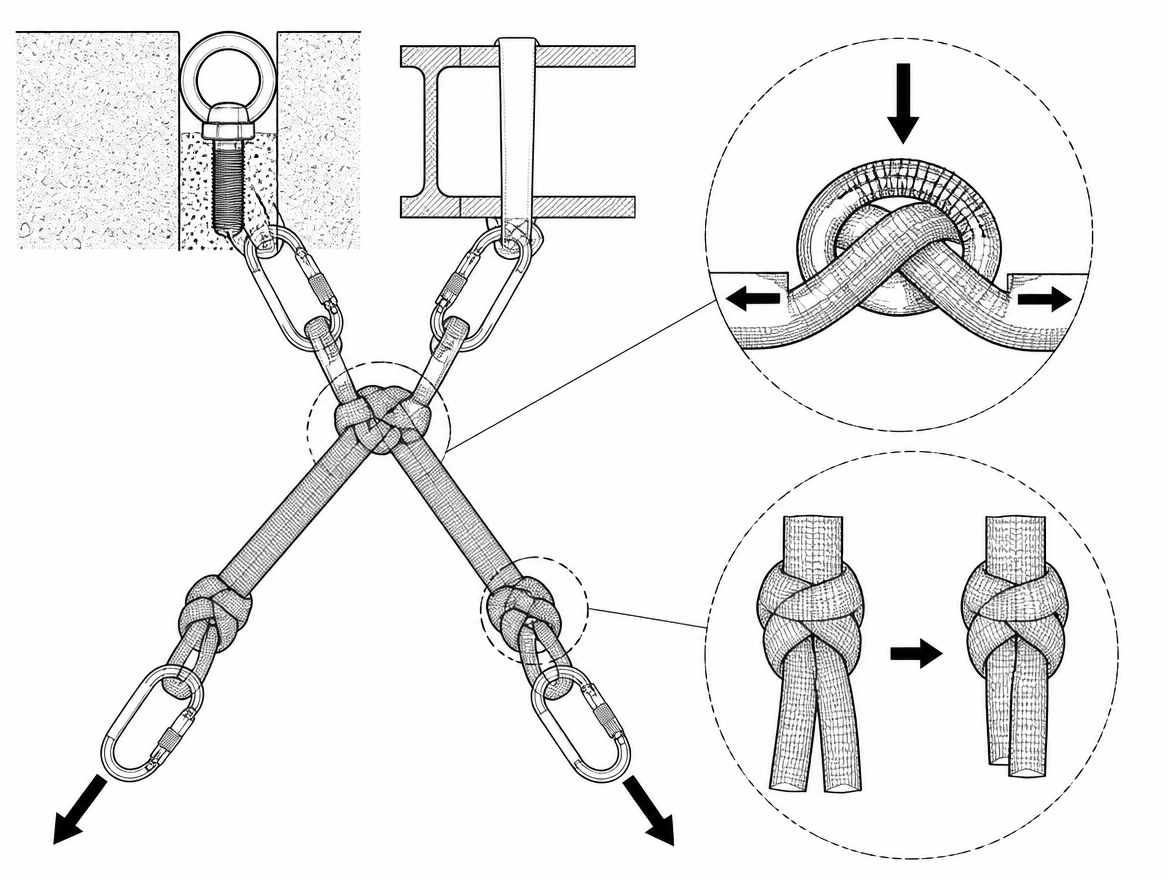
A knot is a stress concentration. The webbing or rope bends sharply around itself, the outer fibres at the bend carry a disproportionate share of the load, and failure initiates there rather than in the body of the sling. Published laboratory data on knots in ropes and webbing shows strength reductions across a broad band – roughly a fifth to a half of the rated strength, depending on the knot, the material, the sling width, edge contact and whether the assembly is wet.
The number is not the point. The point is that you cannot know which figure applies to the sling in your hand, tied by that person, on that morning, with that tail length. A 22 kN sling with a knot in it has an unknown strength, and unknown strength is not a design value.
Flat webbing knots add a second problem: they creep. Overhand and water knots in webbing are known to work their tails inward under repeated loading and slackening – precisely the load cycle a climbing worker applies all shift – until the tail pulls through and the knot capsizes. Nothing about a shift on steelwork gives anyone the opportunity to re-check tail length every few minutes.
This is also why the length of a certified lanyard is never adjusted by tying a knot in it. EN 354 and the manufacturers’ instructions issued under EN 365 are consistent on the point: a lanyard is used at its supplied length, with its supplied terminations.
Failure mode 2: no energy absorption, so the arrest force is the problem
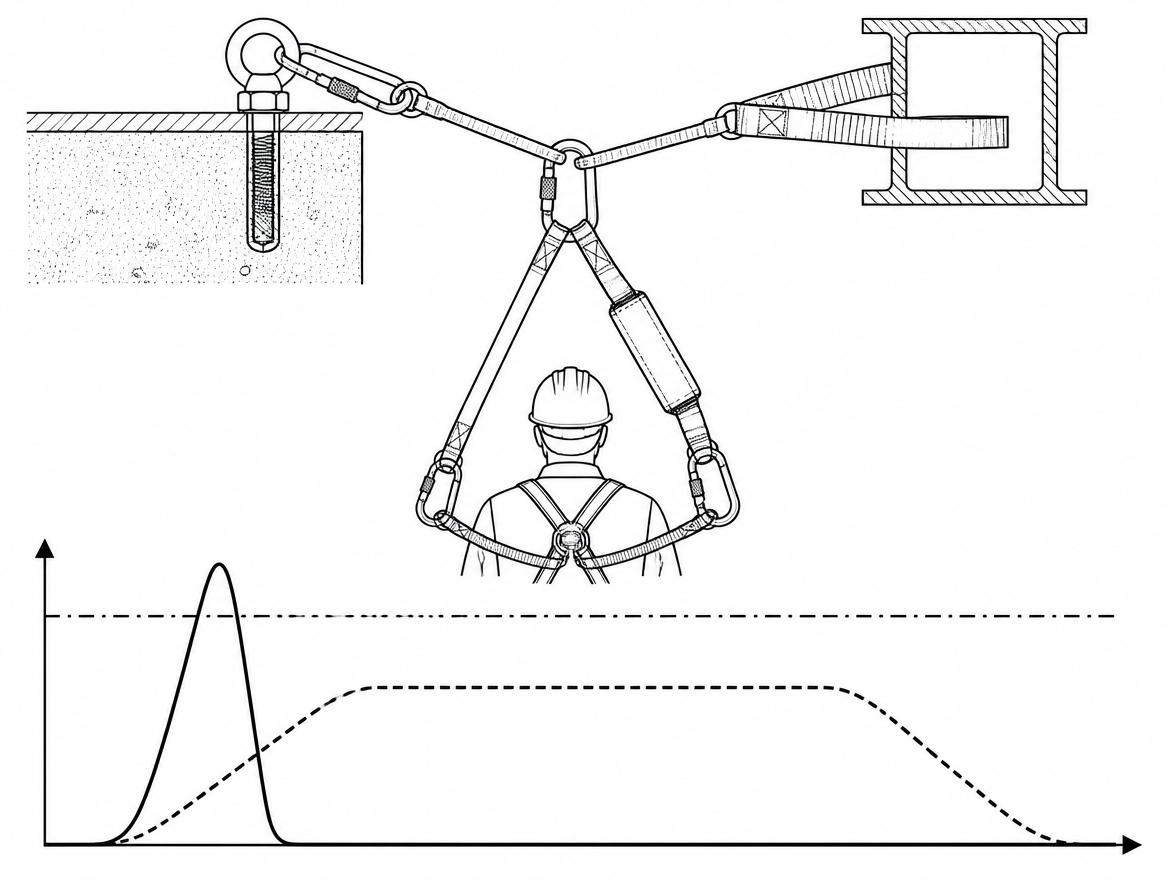
A webbing sling is a static component. It is designed to hold a static or slowly applied load, not to dissipate the kinetic energy of a falling person. In a fall arrest event the sling simply transmits the peak force straight through to the harness attachment, the worker’s body, the connector and the anchor.
The whole architecture of an EN 361 harness assumes that force has been capped at 6 kN by an EN 355 absorber before it reaches the wearer. An unabsorbed arrest on a short static element does not respect that assumption. The consequence is not “a rougher landing”: it is a load path in which the harness, the connectors, the anchor and the human spine are all being asked to accept a force the system was never dimensioned for. A 22 kN static rating on a sling tells you nothing about the arrest force it will transmit – those are different quantities answering different questions.
Failure mode 3: the geometry does what knots do, not what forks do
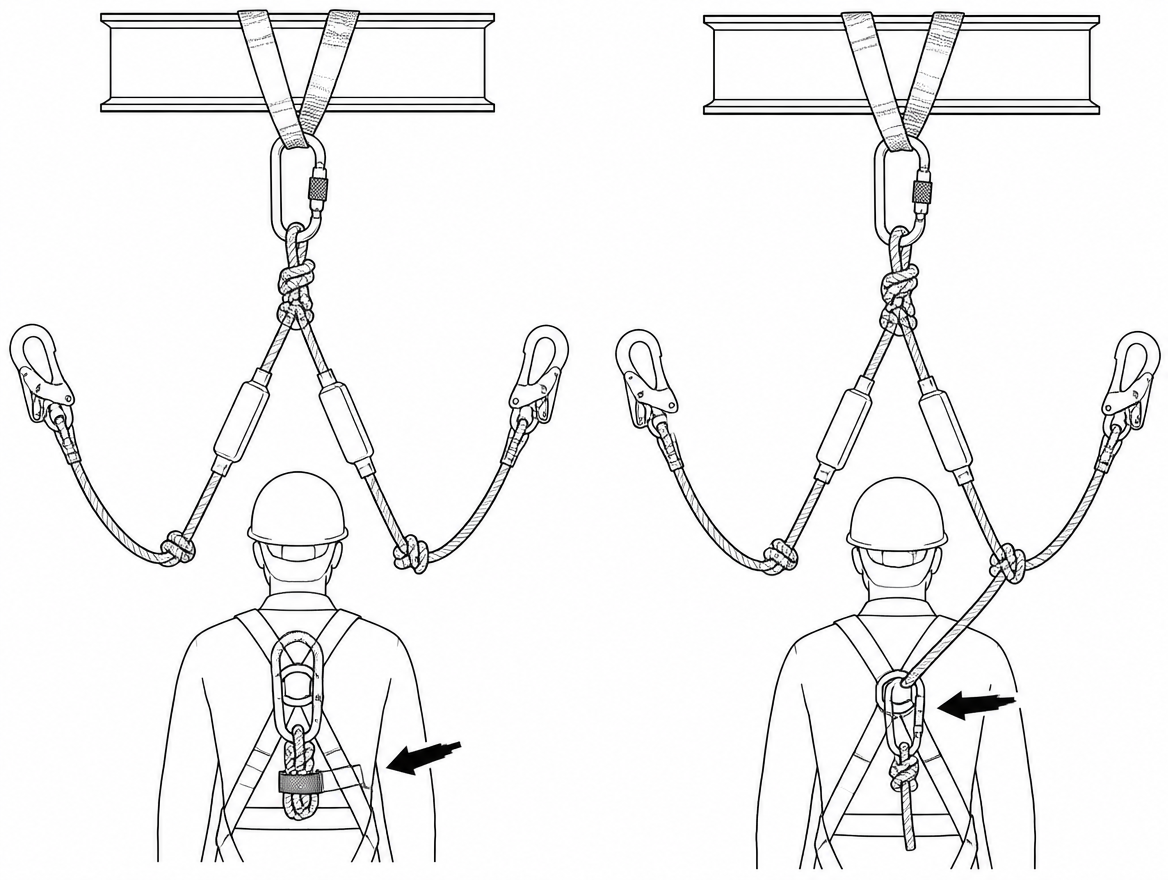
On a manufactured twin-tail lanyard, the fork is an engineered junction: both tails feed into the single absorber, and the unused tail is parked so that it cannot interfere with deployment.
A knot behaves differently. When one leg is loaded, the knot cinches and tightens asymmetrically, the legs end up unequal, and the free leg is dragged into whatever it is attached to. If the free leg has been clipped back to the harness attachment element or to a structural part of the harness – which is the usual improvisation – the assembly can be loaded from both ends at once. On a real Y-lanyard that same error can jam the absorber and prevent it from tearing open at all.
Two rules follow, and they apply to certified equipment just as much as they condemn the improvised version:
- The unused tail is parked on the harness’s dedicated lanyard parking element – the elastic keeper or breakaway loop provided by the manufacturer for that purpose.
- The unused tail is never clipped to the fall arrest attachment point, to a harness webbing strap, to a tool loop, or back onto the absorber.
The conformity position: this is Category III PPE
Fall protection equipment is Category III personal protective equipment under Regulation (EU) 2016/425. That places it in the most demanding conformity route: EU type-examination by a notified body, plus ongoing production surveillance (supervised product checks or a production quality assurance system), CE marking accompanied by the notified body’s identification number, an EU Declaration of Conformity, and instructions for use supplied in the language of the country of use.
An assembly tied on site has none of that. It has not been type-examined as an assembly, its components were never certified to work together, and no instructions for use exist for it. In addition, EN 365 is explicit that no alteration or addition may be made to this equipment without the manufacturer’s prior written consent – knotting a sling into a lanyard is a modification of the most fundamental kind.
On the employer side, Directive 89/656/EEC requires PPE to be appropriate to the risk and to comply with the relevant PPE provisions, and the temporary work at height requirements consolidated in Directive 2009/104/EC require the collective and personal measures selected to be suitable for the work. Under ISO 45001, an improvised lanyard is evidence of a gap in clause 8.1 operational control and clause 7.2 competence long before it is evidence of an individual’s poor decision.
What the sling was actually for
Slings are useful equipment. They are just not lanyards, and the type matters:
- EN 795 Type B anchor slings and straps – transportable temporary anchor devices. These are designed to be wrapped around a structural member in the configurations the manufacturer’s instructions permit (typically choke or basket), and to serve as the anchor for a separate, certified lanyard or fall arrester. EN 795:2012 covers single-user anchor devices; multi-user configurations fall under CEN/TS 16415.
- EN 566 mountaineering slings – rated for static strength for rope-access and mountaineering systems. Static rating, again, is not arrest performance.
- EN 1492-1 and EN 1492-2 webbing slings and roundslings – lifting accessories, not PPE at all. Their own use instructions prohibit knotting, because the strength reduction and localised damage are well documented in a lifting context too.
Even where a sling is the right component, it goes into the system as an anchor device – shortened only by the method its instructions describe, never by a knot.
Equipment that does the job the knot was covering
The reason someone reaches for a sling is almost always the need for uninterrupted attachment while moving. Choose from equipment designed for that:
- Twin-tail energy-absorbing lanyard (EN 355 absorber with EN 354 tails and EN 362 connectors) – for leapfrogging anchor to anchor on steelwork or scaffold, with gate openings matched to the members being used.
- Twin retractable type fall arresters to EN 360 – shorter arrest distance and less slack than a 2 m lanyard, useful where clearance is tight, provided the manufacturer permits the intended anchor position and orientation.
- Guided type fall arrester on a flexible or rigid anchor line, EN 353-2 or EN 353-1 – the correct answer for vertical climbing, rather than repeatedly re-clipping tails.
- Temporary horizontal lifeline, EN 795 Type C – continuous horizontal travel without disconnection, installed to the instructions with the sag and end-load implications accounted for.
- Restraint – where the work can be organised so the edge cannot be reached, an EN 354 lanyard in a restraint configuration removes the fall arrest problem instead of managing it.
The knot also breaks your clearance calculation
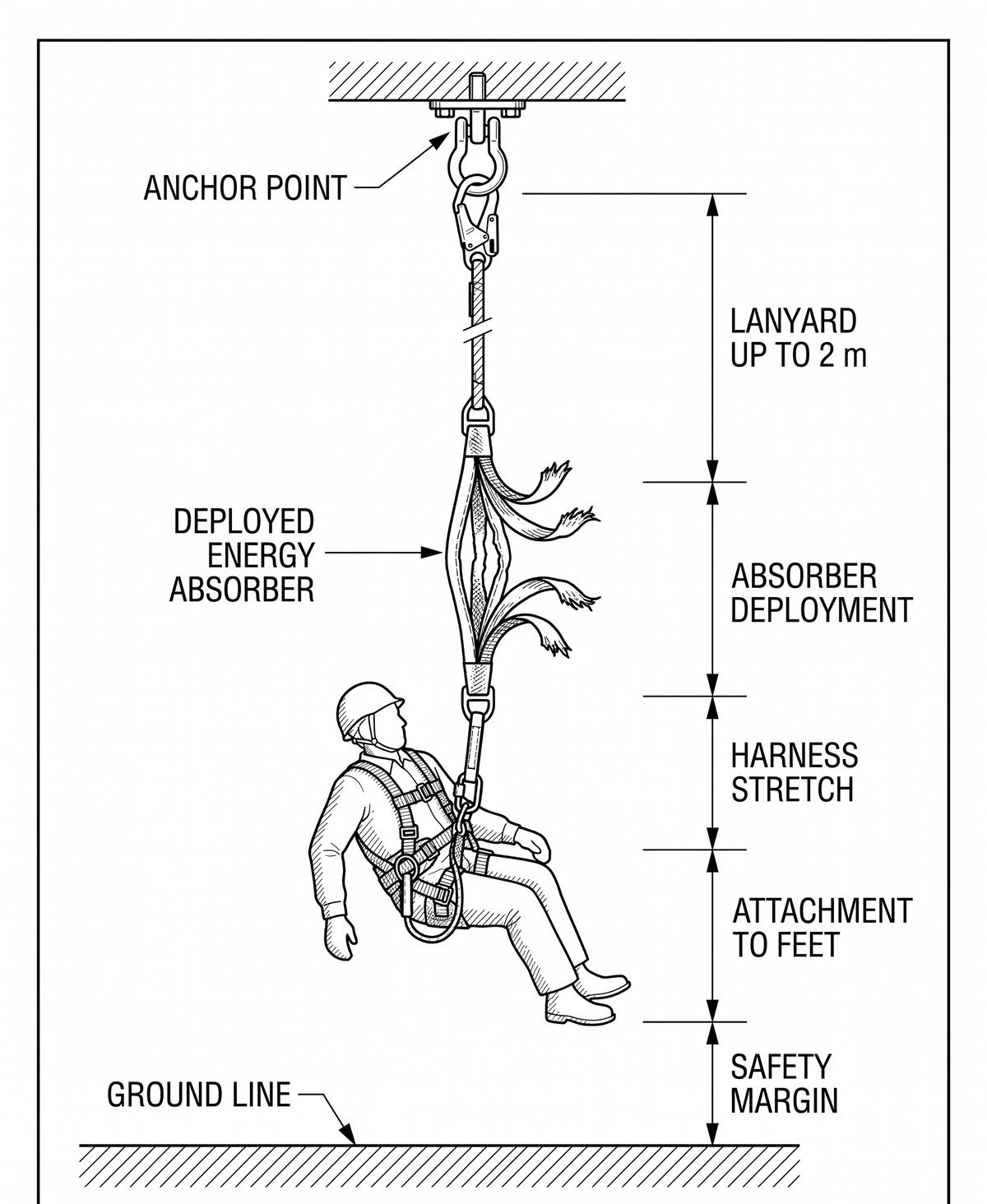
Fall clearance beneath the working position is an additive sum, and every element in it has to be known:
- lanyard length (up to 2 m for an EN 355 assembly);
- absorber deployment (the value in the manufacturer’s instructions);
- harness stretch and sliding of the dorsal attachment element (manufacturers commonly instruct that a fixed allowance be added – use theirs);
- the distance from the attachment point down to the worker’s feet;
- a residual safety margin below the feet at the lowest point of the arrest.
With a knotted sling, two of those numbers do not exist. The length is whatever the knot left, and the deployment is zero – which sounds favourable until you remember what replaced it in failure mode 2. No clearance calculation can be documented for an assembly with undefined inputs, and no risk assessment can be signed off on it.
If you find one on site
- Stop the work at height and bring the worker to a position of safety by another means before removing the improvised attachment.
- Quarantine the components. Any sling, connector or harness that formed part of the improvised assembly is withdrawn pending examination by the competent person – not returned to the store, not left in the van.
- Treat it as a nonconformity, not just a bad habit. Under ISO 45001 clause 10.2 it is recorded, investigated for root cause, and the corrective action addresses why certified equipment was unavailable or unfamiliar.
- Check the periodic examination regime. EN 365 requires periodic examination of this equipment by a competent person at least every 12 months, with the outcome recorded – more often where the frequency and severity of use, or the manufacturer’s instructions, require it. Pre-use checks by the user happen every time, on top of that.
- Verify supply. If the twin-tail lanyard was not on site, the store list, the pick process or the task planning is the thing that needs fixing.
The short version for a toolbox talk
A Y-lanyard is not a shape. It is a single EN 355 energy absorber feeding two EN 354 tails with EN 362 connectors, type-examined as an assembly under Regulation (EU) 2016/425, supplied with instructions, and used at its supplied length. A knotted sling reproduces the shape and none of the function: unknown strength, no energy absorption, a junction that cinches instead of sharing load, and no clearance figures to calculate with.
Next step: take the manufacturer’s instructions for the twin-tail lanyards actually held in your store, extract the deployment allowance and the harness-stretch allowance from them, and check those figures against the minimum clearance available at each of your current work positions. Where the numbers do not fit, the answer is an EN 360 or EN 353-2 solution – not a shorter lanyard, and never a knotted one.
Frequently asked questions
Can I make a Y-lanyard by tying a webbing sling into a loop and clipping a connector into each leg?
No. The result has two tails and a junction, so it looks like a Y-lanyard, but in a genuine fall it will do none of the three things a Y-lanyard is built to do. A compliant twin-tail energy-absorbing lanyard is a certified assembly of components covered by EN 355, EN 354, EN 362 and EN 361, with one energy absorber at the harness end shared by both tails — an architecture a knot cannot reproduce.
How much strength does a knot take out of a sling?
Published laboratory data on knots in ropes and webbing shows reductions across a broad band — roughly a fifth to a half of the rated strength — depending on the knot, the material, the sling width, edge contact and whether the assembly is wet. The point is not the figure but that you cannot know which figure applies to the sling in your hand, tied by that person, on that morning, with that tail length. A 22 kN sling with a knot in it has an unknown strength, and unknown strength is not a design value.
Why are overhand and water knots in flat webbing a particular problem?
They creep. Overhand and water knots in webbing are known to work their tails inward under repeated loading and slackening — exactly the load cycle a climbing worker applies all shift — until the tail pulls through and the knot capsizes. A shift on steelwork gives nobody the opportunity to re-check tail length every few minutes.
Why does a static sling not protect the user in a fall arrest event?
A webbing sling is designed to hold a static or slowly applied load, not to dissipate the kinetic energy of a falling person. It transmits the peak force straight through to the harness attachment, the worker's body, the connector and the anchor. The whole architecture of an EN 361 harness assumes that force has been capped at 6 kN by an EN 355 absorber first, and a 22 kN static rating tells you nothing about the arrest force the sling will transmit.
What does the geometry of a knotted assembly do wrong compared with an engineered fork?
On a manufactured twin-tail lanyard the fork is an engineered junction: both tails feed into the single absorber and the unused tail is parked so it cannot interfere with deployment. A knot cinches and tightens asymmetrically when one leg is loaded, the legs end up unequal, and the free leg is dragged into whatever it is attached to. If the free leg has been clipped back to the harness attachment element or a structural part of the harness, the assembly can be loaded from both ends at once; on a real Y-lanyard the same error can jam the absorber so it never tears open.
Need this as a document you can issue? The template library gives you the risk assessments, permits and inspection logs in editable form — and employer plans cover a whole team with completion records.