Safety / Tips and Tricks / Tree care and grounds
Activity 04 · Tree care
Working Near Overhead Lines During Tree Work
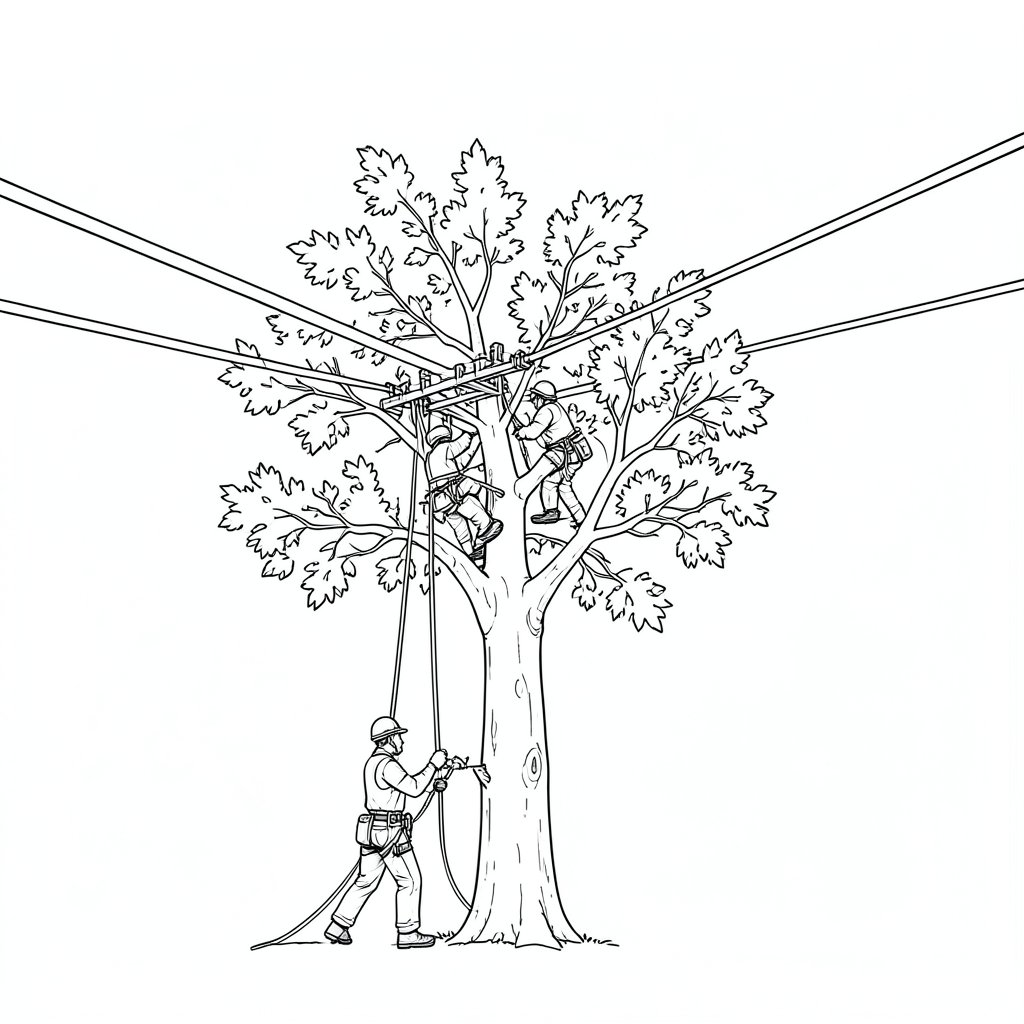
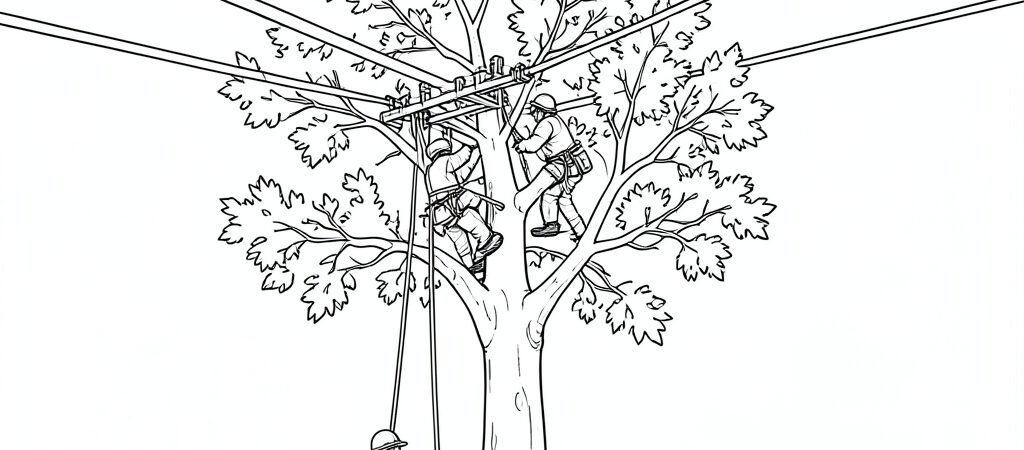
Trees and overhead power lines share space constantly, and tree work near lines carries a compounding hazard that neither tree work nor electrical work alone fully prepares a crew for — a falling limb can bring a live conductor down with it, or a climber or thrown line can bridge the gap to a line that was never touched directly.
Why tree work near lines is a distinct hazard category
A conductive object does not need to touch a line directly to become part of a circuit at higher voltages, since electricity can arc across a gap, meaning a metal pole saw, a wet rope, or even a wet branch can conduct current toward the ground or toward a person without physical contact with the line itself. This is compounded by the fact that a tree itself can conduct current, particularly when wet, meaning contact anywhere in a tree that is also touching or very close to a line can be hazardous even at a point in the tree well away from the line.
Who is actually qualified to work this close
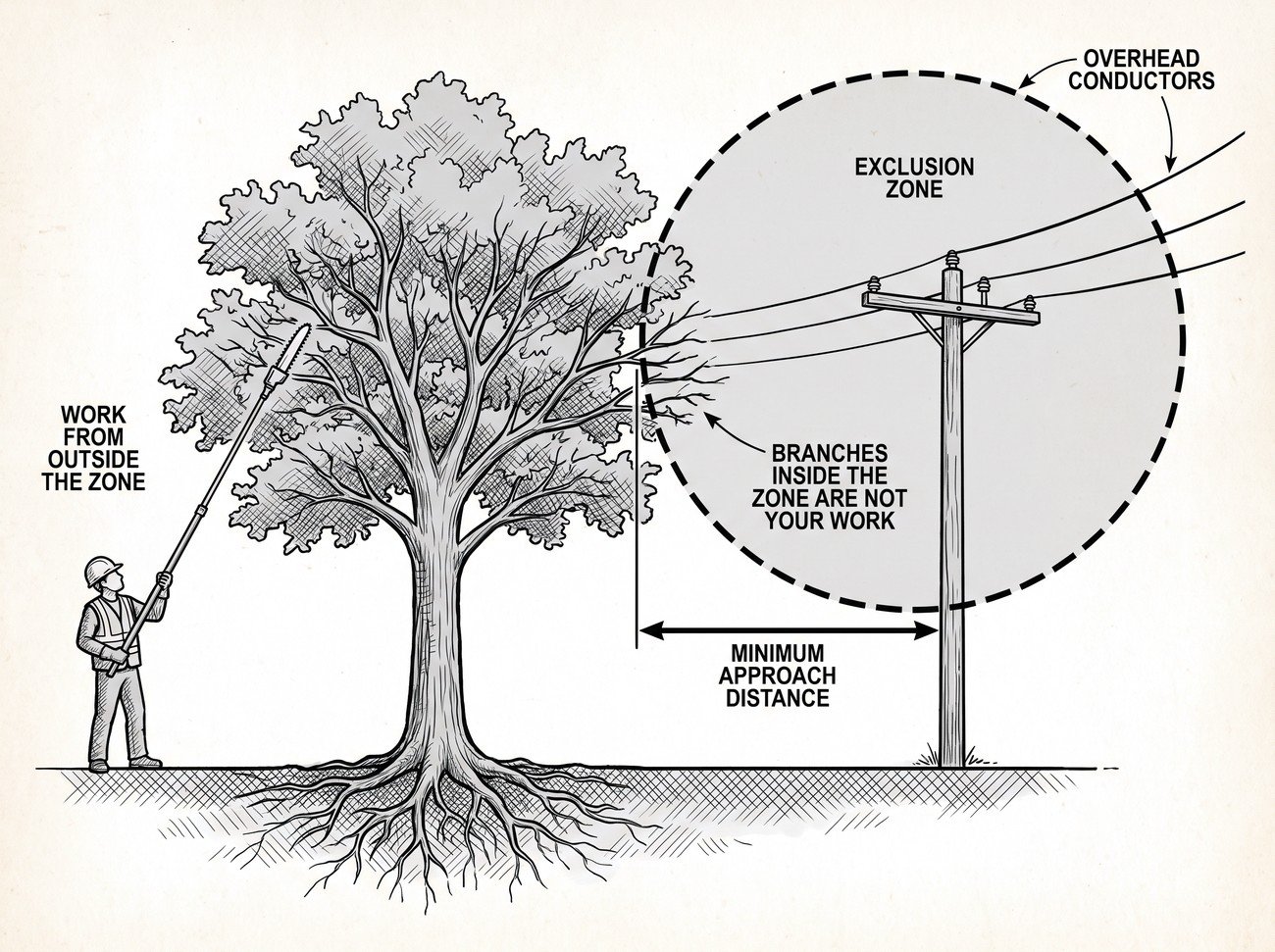
Work within a defined clearance distance of a line generally requires specific training beyond standard arborist competence, often a distinct qualification for line-clearance tree work, and untrained personnel should not be assigned tasks that bring them or their equipment within that clearance regardless of time pressure. Where the crew is not specifically qualified for line-clearance work, the correct response to a tree requiring work near a line is to arrange for the network operator or a qualified line-clearance crew, not to attempt the work with standard tree-care competence alone.
Equipment and tool selection near lines
Metal-handled tools, aluminium ladders, and standard chainsaws are not designed or rated for use near live conductors, and line-clearance work uses specifically insulated or non-conductive equipment selected for that purpose. Bringing standard grounds equipment into proximity with a line because it is what is normally carried on the truck, rather than the equipment actually rated for the task, closes a gap that should never have been open.
Assuming a line is live
Any overhead line should be treated as live unless the network operator has specifically confirmed otherwise and the isolation has been verified through the appropriate process — a line’s appearance gives no reliable indication of whether it is energised, and a line that is normally de-energised for maintenance elsewhere on the network can still be re-energised without local warning.
Planning felling and pruning direction around lines
Where a tree must be felled or significantly pruned near a line, the direction of fall or the specific limbs removed need planning specifically to keep the falling material clear of the line, which may mean roping and lowering sections rather than allowing a free fall, even where free felling would be the normal technique for that tree in an open area.
For the equivalent hazard from an excavation perspective, see the broader guidance in Energy and Networks.
Related standards
The standards below set the test methods and performance levels behind the equipment referenced in this note.
- EN 60903 — Insulating gloves for electrical work
- EN 397 — Industrial safety helmets
- EN 61482 — Arc flash protective clothing
Common errors
1Assuming a line is de-energised because it is old, low, or looks disconnected.
2Using standard non-insulated tools and ladders within the clearance distance of a line.
3Assigning tree work near a line to crew without specific line-clearance qualification.
4Felling or pruning without specifically planning the fall or lowering direction to keep material clear of the line.
Frequently asked questions
Why can tree work near power lines be hazardous without any direct contact?
At higher voltages electricity can arc across a gap, so a conductive object such as a metal pole saw, wet rope or wet branch can bring current toward the ground or a person without physically touching the line.
Why can a tree itself be hazardous even at a point well away from the line?
A tree can conduct current, particularly when wet, so contact anywhere in a tree that is also touching or very close to a line can be hazardous even far from the actual point of contact with the line.
Who should carry out tree work within the clearance distance of a power line?
Personnel with specific line-clearance qualification beyond standard arborist competence – where the crew is not qualified for this, the correct response is to involve the network operator or a qualified line-clearance crew.
Why can't standard tree-care tools be used near overhead lines?
Metal-handled tools, aluminium ladders and standard chainsaws are not designed or rated for use near live conductors, so line-clearance work uses specifically insulated or non-conductive equipment instead.
Should an overhead line ever be assumed to be dead without confirmation?
No, any line should be treated as live unless the network operator has specifically confirmed otherwise and isolation has been verified, since appearance gives no reliable indication of whether a line is energised.
Need this as a document you can issue? The template library gives you the risk assessments, permits and inspection logs in editable form — and employer plans cover a whole team with completion records.