Safety / Tips and Tricks / Rope access and confined space
Activity 01 · Rope access
Work Positioning with a Rope Grab: Standards, Setup and Site Checks
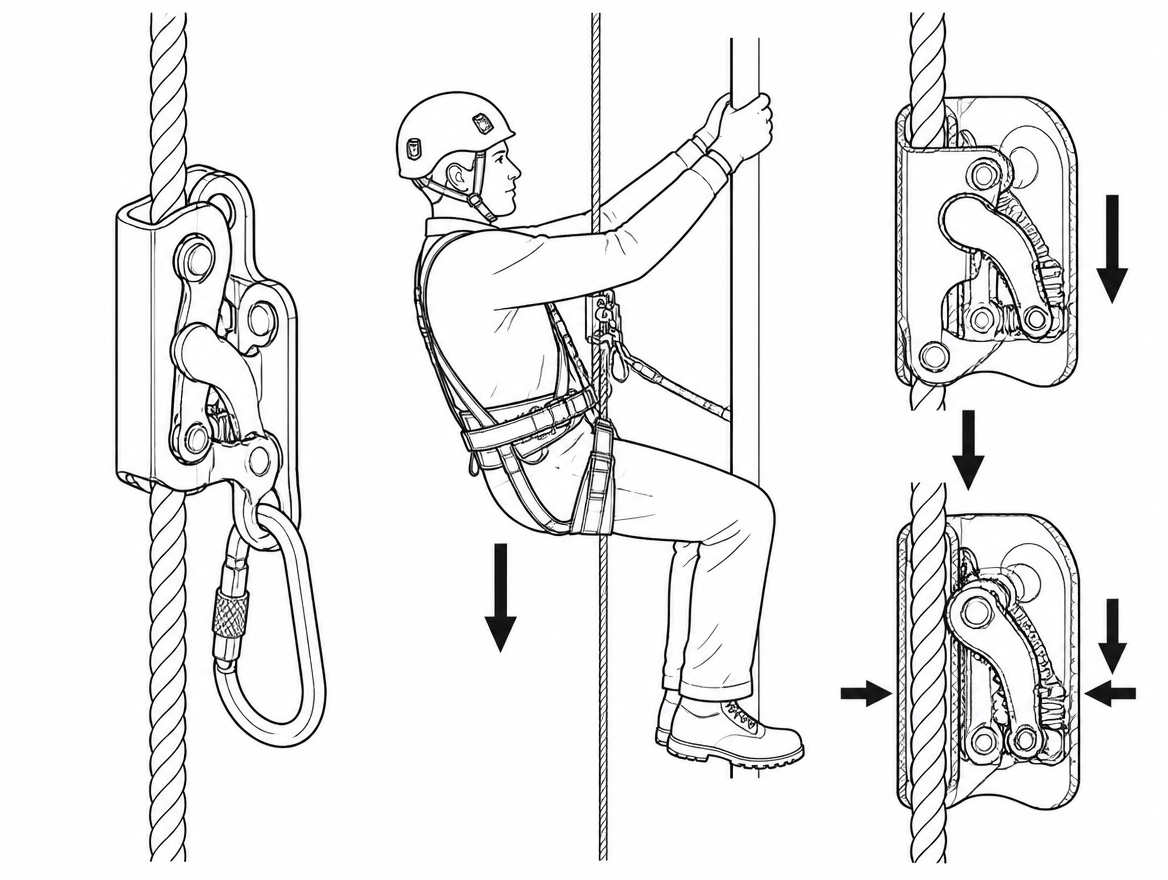
A rope grab lets a worker set and hold a working height on a vertical or inclined line, take the load off the legs, and keep both hands on the task. It is also one of the most frequently mis-specified items on a site: the same shape of device can be certified for ascent, for back-up on a safety line, or for adjusting a work positioning lanyard, and those three functions are not interchangeable. Getting rope grab work positioning right comes down to four decisions – which standard the device is certified to, which rope it is allowed to run on, where it sits relative to the harness attachment point, and what independent system catches the worker if the positioning system is lost.
What the rope grab is actually doing
In a work positioning system, the rope grab is the adjustment element. It slides along a fixed line when unloaded and locks – by cam, toothed cam, or clamping jaw – when loaded in the intended direction. The worker adjusts the grab up or down the line, then leans back into a taut connection so the system carries body weight while the hands stay free.
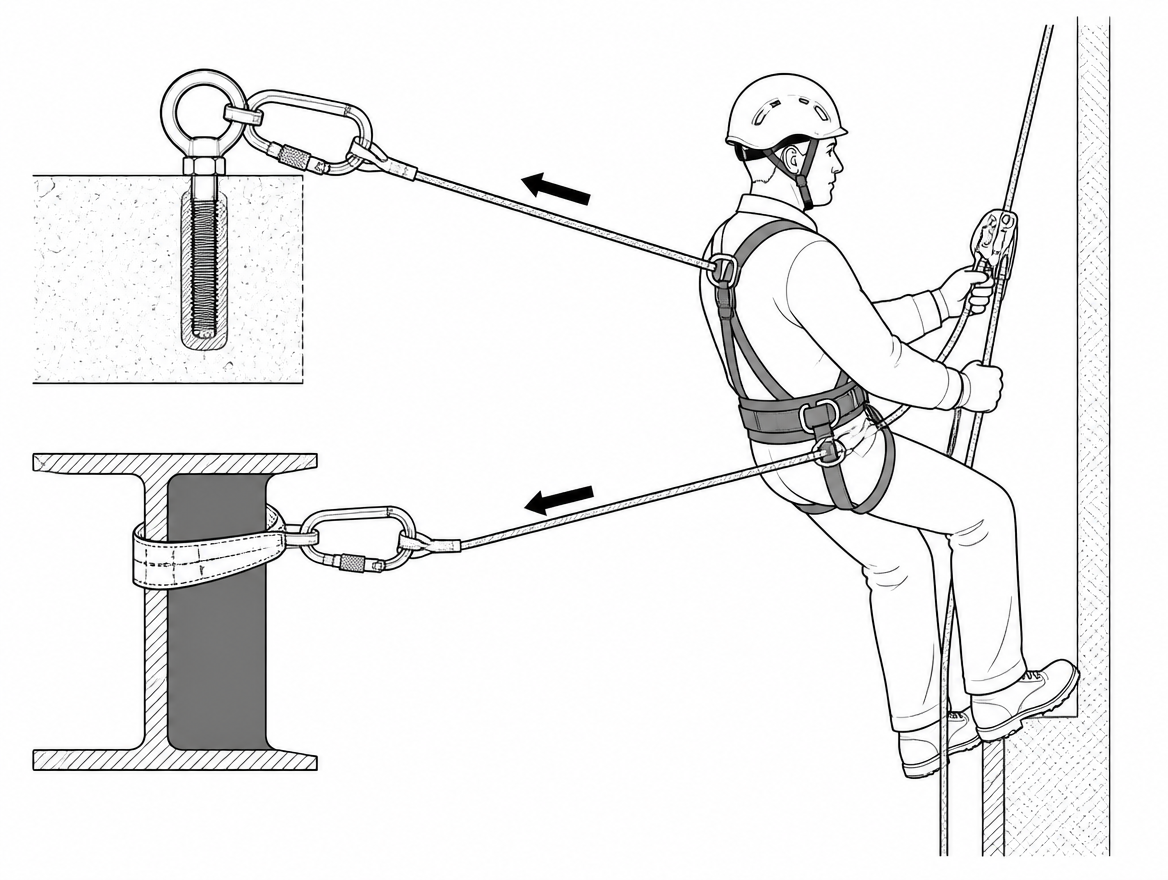
Work positioning is not fall arrest and it is not restraint. Restraint prevents the worker from reaching a fall edge at all. Fall arrest allows a fall and then stops it within a controlled distance and force. Work positioning holds the worker in place at the work position, under tension, with the free fall distance deliberately kept close to zero. EN 358 is explicit that work positioning equipment is not suitable for arresting a fall, and that where a risk of free fall exists, a fall arrest system to EN 363 is required in addition.
Three standards, three different devices
Before the device goes on the rope, identify what it is certified as. The marking on the body of the device and the manufacturer’s instructions tell you this; the shape of the housing does not.
- EN 358 – belts for work positioning and restraint, and work positioning lanyards. A rope grab supplied as part of an adjustable work positioning lanyard is certified under this standard. Lanyard length is limited (commonly up to 2 m; confirm against the marking and instructions), and the connection is made to the lateral attachment points of the belt or harness.
- EN 12841 – rope adjustment devices for rope access systems, split into three types: Type A back-up devices for the safety line, Type B ascending devices for the working line, and Type C descending devices. A Type B ascender is designed to be loaded in one direction along a taut line during ascent; it is not a back-up device, and using it as one is a scope error, not a preference.
- EN 353-2 – guided type fall arresters including a flexible anchor line. These are fall arrest devices and are certified as a system with a specific anchor line. Substituting a different rope voids the certification.
The practical consequence: a device marked only to EN 12841 Type B has no fall arrest function, and a device marked to EN 353-2 is not a positioning adjuster. Where a rope grab carries more than one certification, the instructions state the conditions for each use case separately.
Attachment points: belt, harness, or sit harness
The attachment point determines how the load passes through the body and which standard governs it.
- Lateral (side) attachment points on an EN 358 belt take the work positioning lanyard. They are used in pairs, with the worker leaning back into a taut lanyard – typical for pole, tower and formwork positioning.
- Ventral (low, front) attachment point on an EN 813 sit harness takes suspended work positioning, where body weight hangs on the line rather than leaning against a structure.
- Sternal and dorsal attachment points on an EN 361 full body harness are for fall arrest only. The back-up device on the safety line connects here – never to the belt’s lateral points.
Connectors between elements are governed by EN 362. For a rope grab that will be loaded and unloaded repeatedly during a shift, a self-closing, self-locking connector reduces the chance of an unnoticed open gate.
Rope and device compatibility
A rope grab is certified for a stated rope construction and a stated diameter band, and that is a hard limit rather than guidance. Devices to EN 12841 are intended for low-stretch kernmantle rope to EN 1891 Type A, with the permitted diameter range given on the device and in the instructions – in practice a narrow band within the 10-13 mm region.
Points that decide whether the grab holds:
- Diameter and construction. An undersized rope reduces cam bite; an oversized or stiff, heavily used rope can prevent the cam closing fully. Dynamic climbing rope stretches under load and is outside the certification of most positioning grabs.
- Surface condition. Ice, mud, grease, paint overspray and drilling slurry all reduce friction. A grab that holds cleanly on dry rope in the store can slip on a contaminated line on site.
- Sheath integrity. Glazing, fused fibres, a soft or hollow-feeling core, or sheath slippage along the core are reasons to withdraw the rope, not to keep it for one more span.
- Rope end. A stopper knot in the lower end of the working line prevents the grab running off the rope during adjustment.
Setting the device: orientation, height and tension
Rope grabs are directional. The device body carries an orientation indication showing which way is up and where the load is applied; installed inverted, the cam cannot rotate into the rope and the device will run down the line under load. Every installation ends with the same three checks: correct orientation, cam fully engaged on the rope, connector closed and locked.
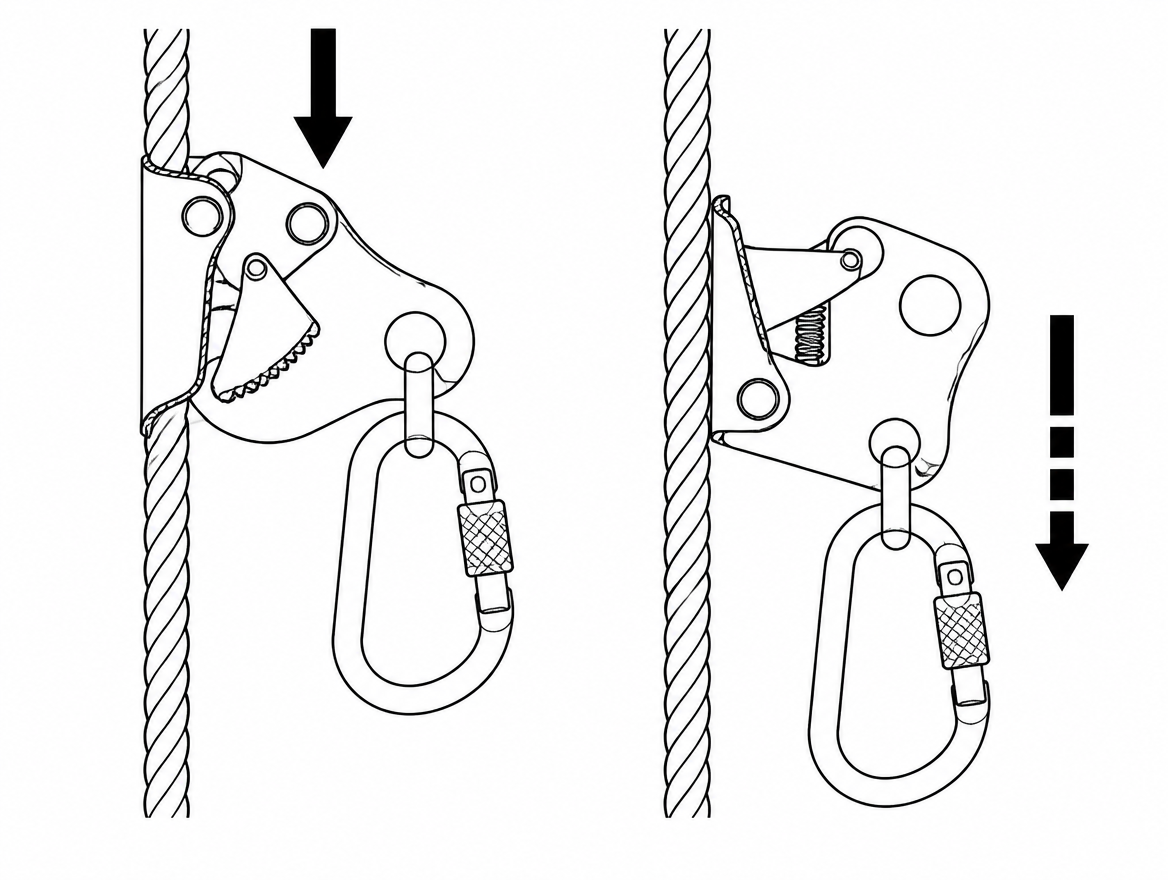
Height and tension then determine how much free fall exists in the system. The anchor – and therefore the grab – should be at or above the level of the attachment point being used, and the connection kept taut. A grab positioned below the waist with a slack lanyard converts a slip into a free fall onto a system that has no energy absorber and loads the abdomen and spine through a waist-level attachment point.
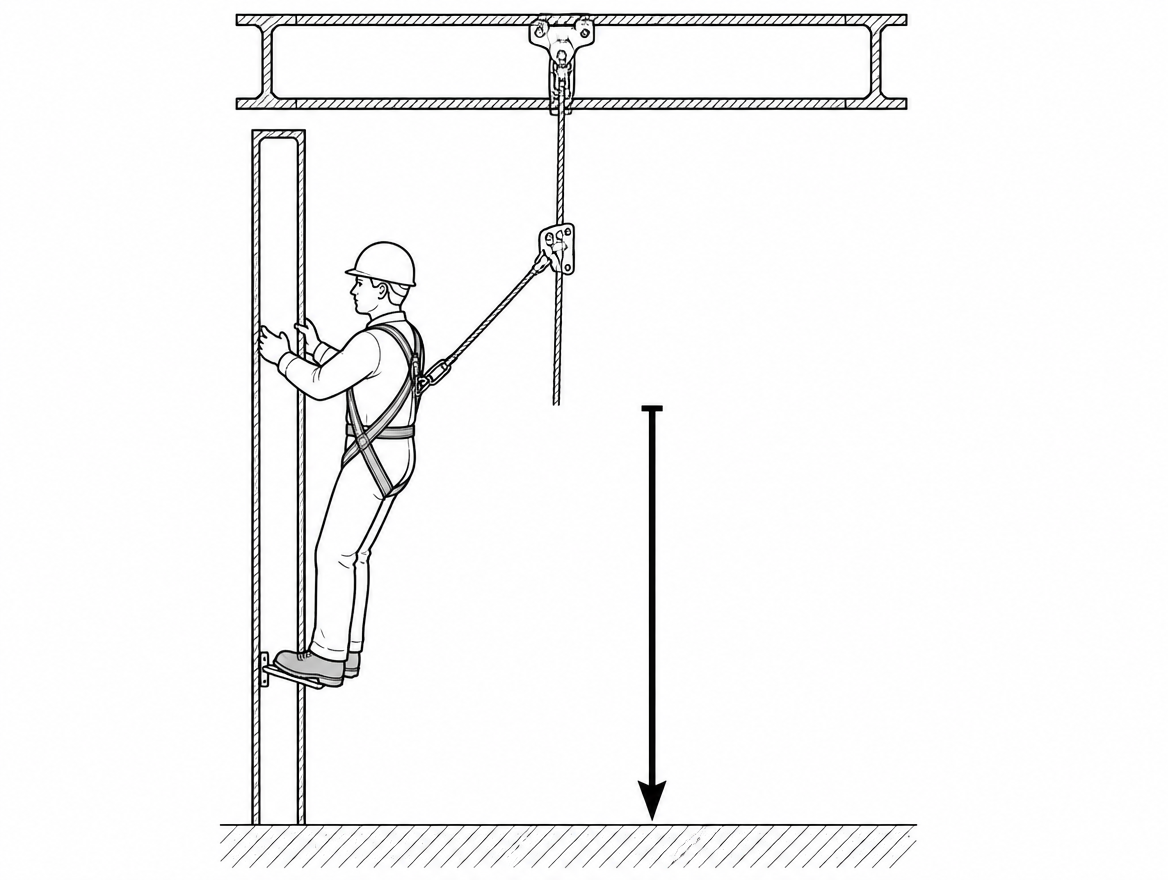
Why the connection between grab and harness matters
Adding length between the rope grab and the harness – an extra sling, a spare lanyard, a second connector chained on to reach further – changes the mechanics of the system in two ways. It increases the potential fall distance, and it increases the force delivered into the device and the rope if that fall happens. A toothed cam loaded dynamically can damage the sheath, and in a sufficiently severe drop can cut into the rope. This is why manufacturers specify how the device is to be connected and with what, and why the answer is normally the shortest permitted connection rather than the most convenient one.
Lateral loading is the other common misuse. Grabs are designed for load along the axis of the rope. Pulling the device sideways over an edge, or letting the rope run across a beam flange above the grab, loads it in a direction it was never tested for and abrades the line at the same time.
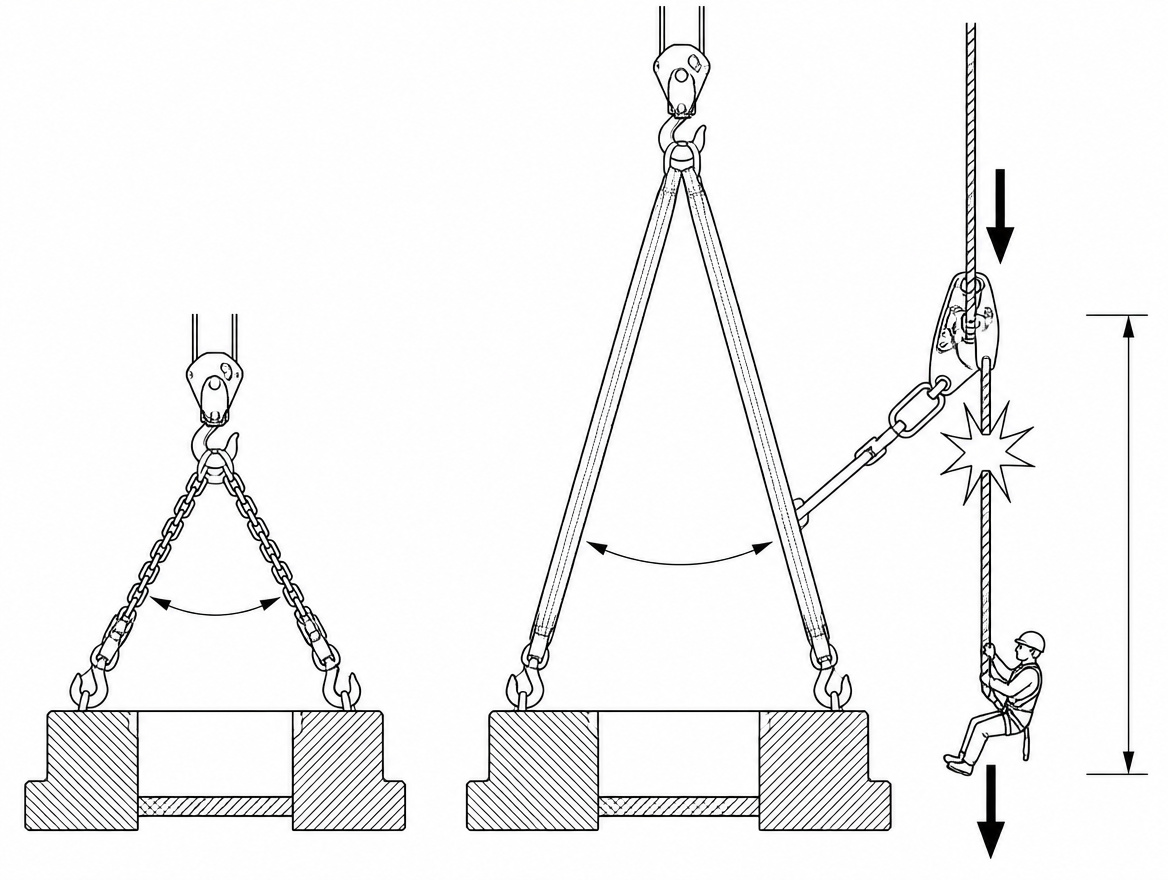
The safety line is part of the system, not an accessory
Where rope access and positioning techniques are used, Directive 2009/104/EC (Annex II, point 4.4) sets the baseline: as a general rule, two separately anchored lines – one working line for access, descent and support, and one safety line – with the worker’s harness connected to the safety line. Single-rope working is only contemplated where a risk assessment shows the second line would make the work more dangerous, and then only with additional measures.
In practice that means the positioning grab on the working line is paired with an independent back-up on the safety line: a Type A back-up device to EN 12841, or a guided type fall arrester to EN 353-2 used with its own certified anchor line, connected to the sternal or dorsal point of an EN 361 harness. Both lines need their own anchor. Two devices on one rope, or two anchors on the same single bolt, do not create redundancy.
Anchor selection follows EN 795 for the anchor device, with the strength of the underlying structure verified by a competent person. Positioning the anchor to keep the worker beneath it, rather than off to one side, also removes the pendulum swing that turns a short slip into a sideways impact against the structure.
Pre-use check and periodic examination
Fall protection PPE is Category III under Regulation (EU) 2016/425, which means users require specific training in its use, and the equipment falls under the inspection regime described in EN 365.
- Every use, by the user: device body for cracks, deformation and corrosion; cam and teeth for wear, clogging and burrs; springs and safety catch for full, positive function; rivets and axles for movement; the rope over its full working length by hand and eye; connectors for gate and lock function. Function-test the grab on the actual rope before loading it.
- Periodic examination, by a competent person: at intervals of no more than 12 months under EN 365, more frequently where use is intensive or the environment is aggressive, with the result recorded in the equipment record. Manufacturers may specify shorter intervals or a maximum service life; the shorter requirement governs.
- After any arrested fall or shock load: withdraw the device and the rope from service pending examination against the manufacturer’s criteria. Sheath damage from a toothed cam is not always visible from one side of the rope.
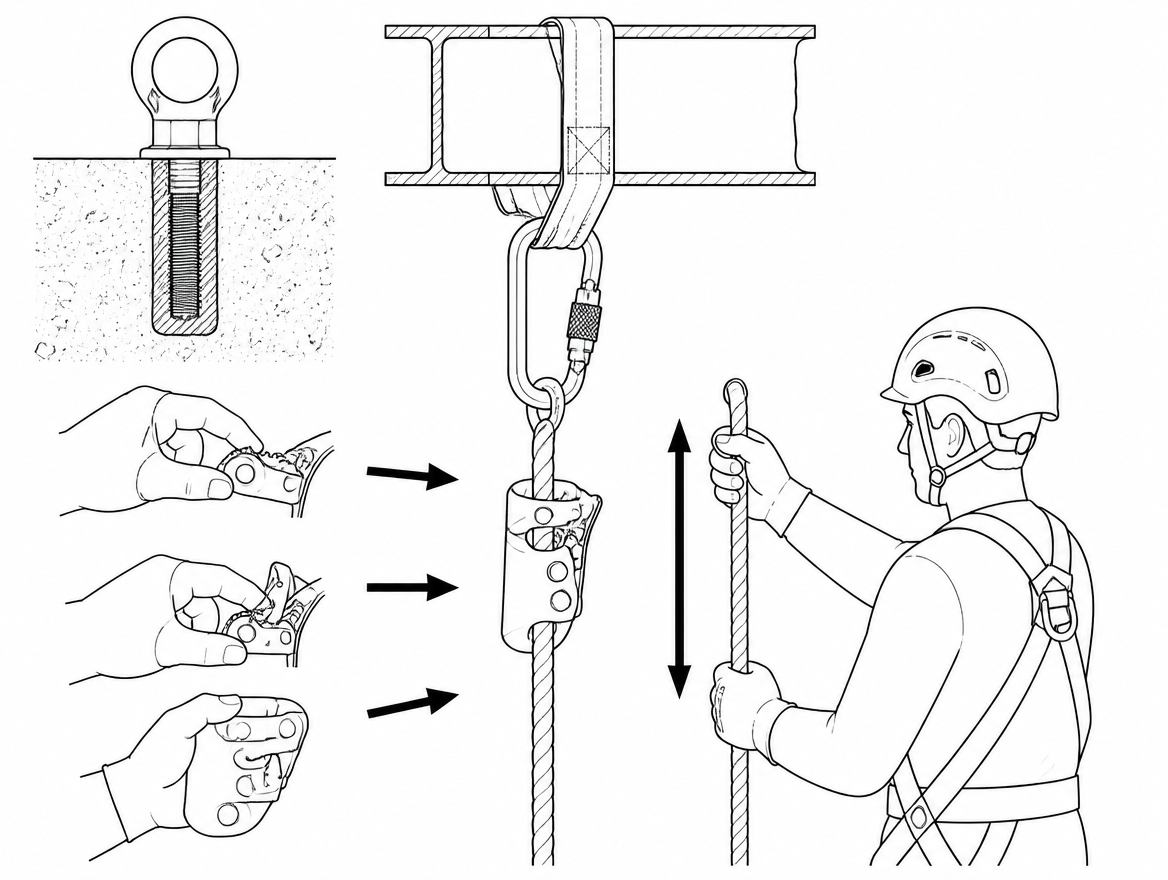
Failure patterns worth naming in the toolbox talk
- An EN 12841 Type B ascender used as the back-up device on the safety line.
- A rope grab installed inverted, discovered only when the worker leans back.
- A grab run on a rope outside its certified diameter range, or on dynamic rope.
- The back-up device connected to a belt lateral point instead of the EN 361 fall arrest point.
- Extra slings added between grab and harness to gain reach, increasing both fall distance and impact force.
- Working line and safety line sharing a single anchor.
- No stopper knot in the end of the working line.
Rescue planned before the first ascent
A worker held on a positioning system may be unable to self-recover, and suspension in a harness has its own physiological limits, so recovery time is measured in minutes rather than hours. The rescue method, the equipment it needs – typically a descender to EN 341 and, where a casualty must be lifted or lowered, a rescue harness to EN 1497 – and the people trained to use it are established before work starts, not improvised afterwards. Under an ISO 45001 management system this sits with the operational control and emergency preparedness arrangements for the activity, and the plan should be specific to the structure being worked on.
Takeaway
Before a rope grab is used for work positioning, three facts should be verifiable on site: the certification marked on the device and what it permits, the rope type and diameter range it is approved for, and the presence of an independent safety line with its own anchor and its own back-up device. If any of the three cannot be confirmed from the device marking and the manufacturer’s instructions, the system is not ready to load.
Next step: read the instructions supplied with the specific grab alongside EN 358 (work positioning belts and lanyards) and EN 12841 (rope adjustment devices), and compare the stated rope compatibility against what is actually rigged on site.
Frequently asked questions
Is work positioning with a rope grab the same as fall arrest?
No. Work positioning holds the worker in place at the work position, under tension, with free fall distance deliberately kept close to zero. Fall arrest allows a fall and then stops it within a controlled distance and force, and restraint prevents the worker from reaching a fall edge at all. EN 358 is explicit that work positioning equipment is not suitable for arresting a fall, and where a risk of free fall exists a fall arrest system to EN 363 is required in addition.
How do I tell which standard my rope grab is certified to?
The marking on the body of the device and the manufacturer's instructions tell you this – the shape of the housing does not. A device marked only to EN 12841 Type B has no fall arrest function, and a device marked to EN 353-2 is not a positioning adjuster. Where a rope grab carries more than one certification, the instructions state the conditions for each use case separately.
Which harness attachment point should the device connect to?
It depends on the function. Lateral (side) attachment points on an EN 358 belt take the work positioning lanyard and are used in pairs, with the worker leaning back into a taut lanyard – typical for pole, tower and formwork positioning. The ventral (low, front) point on an EN 813 sit harness takes suspended work positioning. Sternal and dorsal points on an EN 361 full body harness are for fall arrest only, and the back-up device on the safety line connects there – never to the belt's lateral points.
What rope can a rope grab be used on?
A rope grab is certified for a stated rope construction and a stated diameter band, and that is a hard limit rather than guidance. Devices to EN 12841 are intended for low-stretch kernmantle rope to EN 1891 Type A, with the permitted diameter range given on the device and in the instructions – in practice a narrow band within the 10-13 mm region. Dynamic climbing rope stretches under load and is outside the certification of most positioning grabs. For EN 353-2 devices, substituting a different rope voids the certification.
What checks does every rope grab installation need?
Every installation ends with the same three checks: correct orientation, cam fully engaged on the rope, and connector closed and locked. Rope grabs are directional – the device body carries an orientation indication showing which way is up and where the load is applied, and installed inverted the cam cannot rotate into the rope and the device will run down the line under load. A stopper knot in the lower end of the working line prevents the grab running off the rope during adjustment, and rope surface condition matters because ice, mud, grease, paint overspray and drilling slurry all reduce friction.
Need this as a document you can issue? The template library gives you the risk assessments, permits and inspection logs in editable form — and employer plans cover a whole team with completion records.