Safety / Tips and Tricks / Rope access and confined space
Activity 01 · Rope access
Vertical Extraction from a Confined Space: Rigging, Standards and Timing
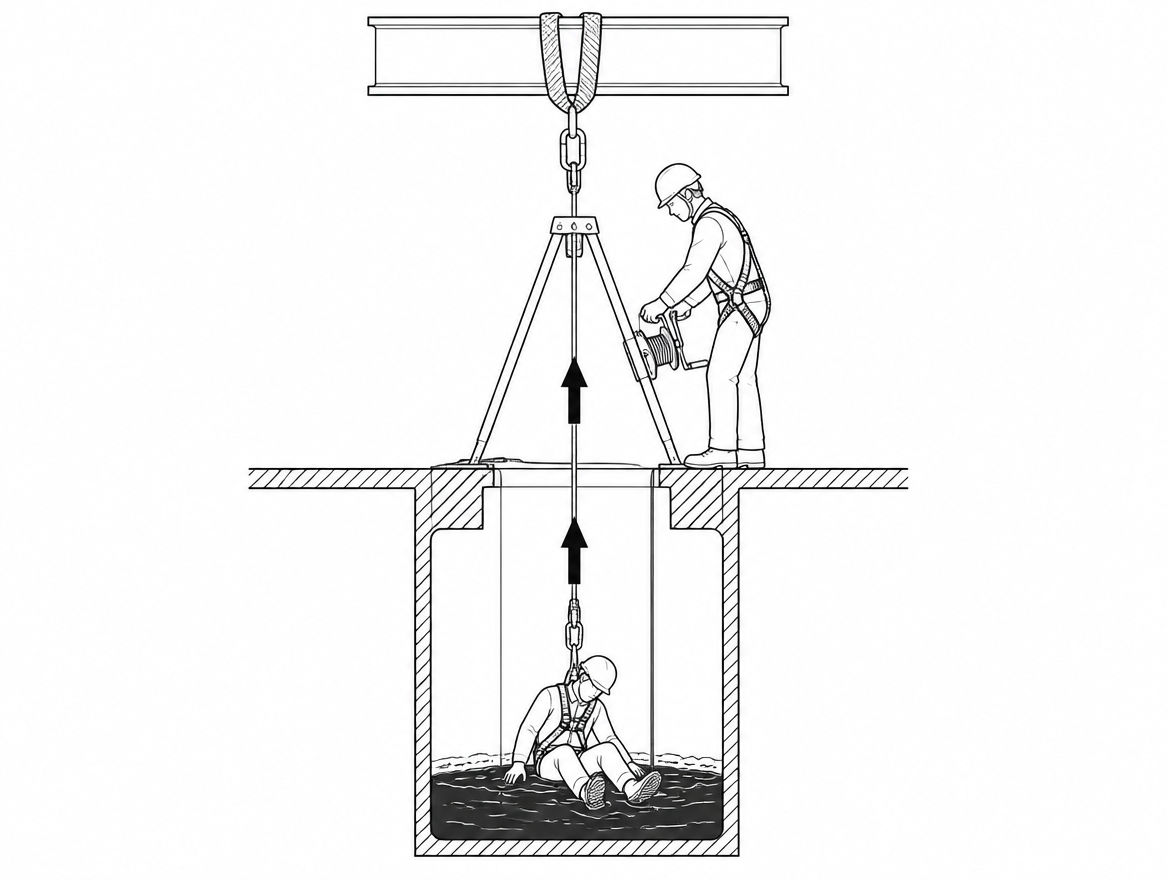
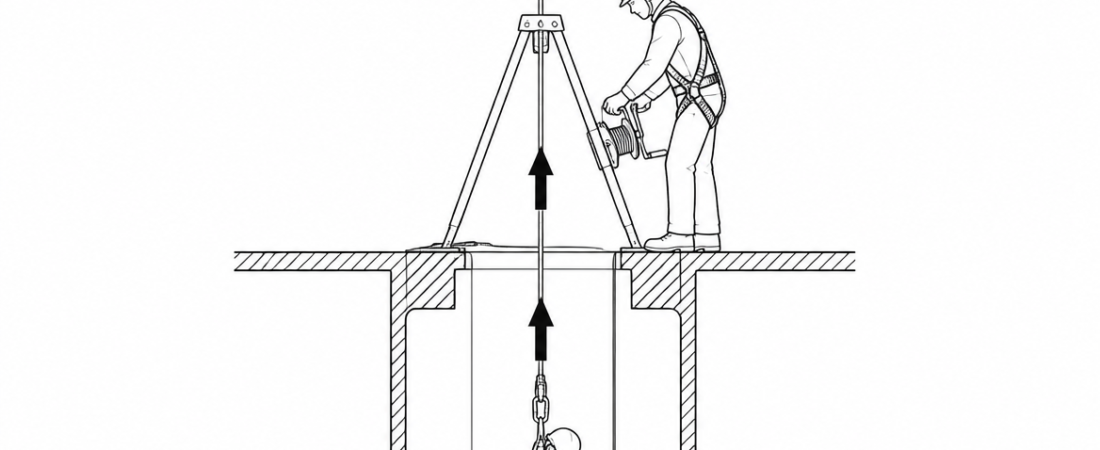
A worker who collapses at the bottom of a five-metre sludge chamber cannot be walked out. The only route is the one they came in through: straight up, often through an opening around 600 mm across, on a line that has to be anchored, tensioned and hauled before the atmosphere, a head injury or the casualty's own suspended posture does further damage. That is why confined space vertical extraction is not an accessory to the entry plan. It is the part of the plan that decides whether the entry is permitted to start at all: if the team cannot describe, in equipment terms, how an unresponsive entrant leaves the space, the permit is not complete.
Non-entry retrieval is the default, not the fallback
The hierarchy for a vertical space runs in one direction: self-rescue, then non-entry retrieval from outside, then entry rescue as the last resort. Entry rescue is where rescuers are most often injured, because the hazard that disabled the entrant is still present and a second person is now exposed to it.
Non-entry retrieval means the entrant is connected to a retrieval line running to a lifting device at the surface for the whole time they are in the space, so that the attendant can begin raising them without anyone crossing the plane of the opening. The retrieval system is only omitted where it demonstrably increases risk — for example where the line would snag in an agitator, an auger or a horizontal branch the entrant has to traverse — and where that decision is written into the entry plan alongside the alternative arrangement.
Under ISO 45001:2018, this sits in clause 8.2, emergency preparedness and response: the response has to be planned, resourced and periodically tested, not asserted. A permit that names the local fire service as the rescue plan for a shaft entry, with no rigging on site and no verified response time, does not meet that bar.
The anchor above the opening: tripods, davit arms and the load path
Portable anchor devices for this work are covered by EN 795:2012, which classifies them by type; a rescue tripod or a socket-mounted davit arm is a Type B portable anchor device. Two points about that standard matter on site:
- EN 795:2012 covers anchor devices intended for one person at a time. Where a rescuer and casualty will be suspended from the same anchor simultaneously, the relevant technical specification is CEN/TS 16415:2013, which addresses anchor devices for use by more than one person. Check the manufacturer’s documentation for that second qualification before planning a tandem lift.
- The rating is a system rating, not a component boast. A tripod’s stated capacity assumes the leg spread, footing, chain restraint and head arrangement described in its instructions for use, and it applies to a load hanging vertically from the head — not to a line pulled off at an angle.
The geometry that keeps the rating valid is straightforward: apex centred over the opening, legs spread evenly to the position fixed by the leg-spread restraint chain or strap, feet on firm level ground clear of the shaft edge, and the restraint taut rather than hanging slack. A leg that lands on a hinged cover, a spoil heap or the collar of the chamber itself is the failure most commonly found during drills.
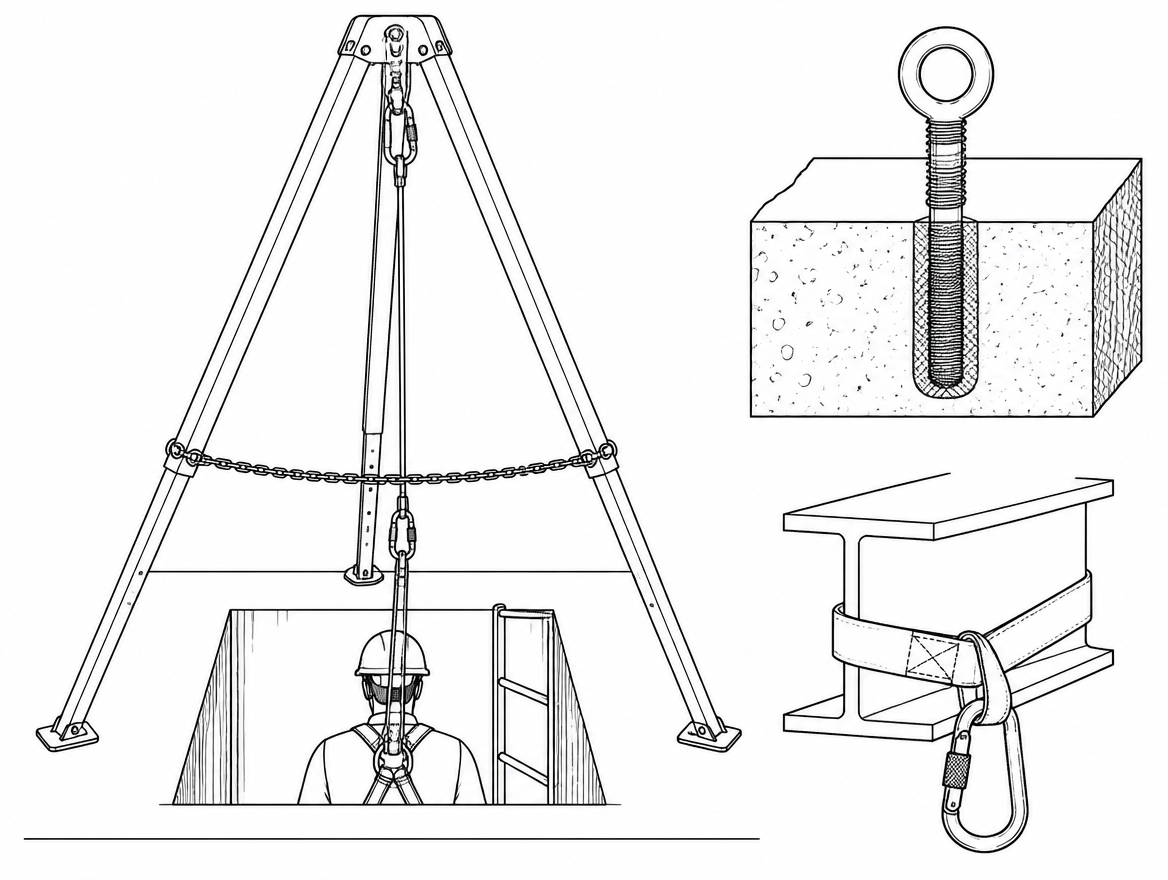
Two further details are worth checking before the first entry of the day: that the winch is mounted on the leg the manufacturer specifies, with the rope taking the intended path over the head pulley, and that nothing has been improvised in the load path — no substituted pins, no additional slings, no second device hung off a leg.
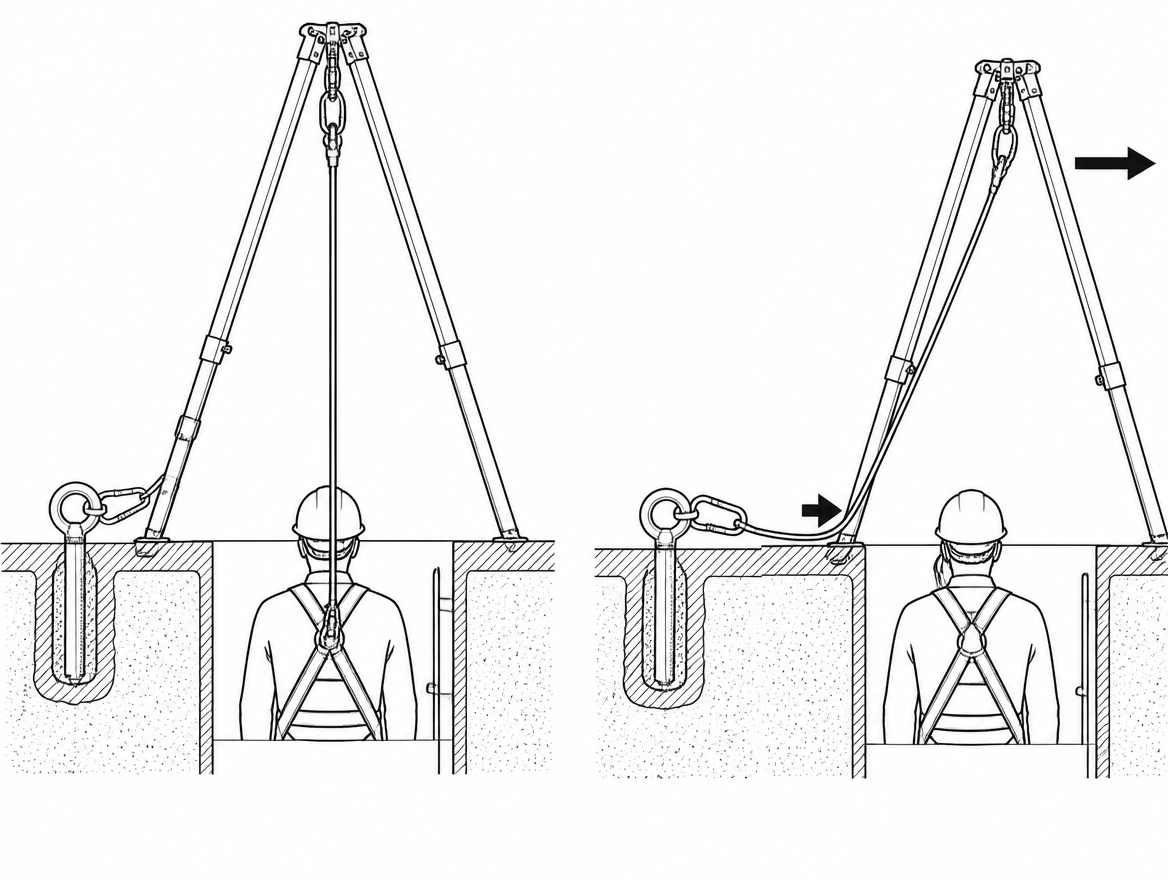
Where the opening is offset, obstructed, or where a fixed base socket already exists on the structure, a davit arm gives a lifting point directly over the hole without straddling it. It also introduces a bending moment into the mast and the socket, so davit systems are only ever used with the base assembly and mast the manufacturer supplies and tests together.
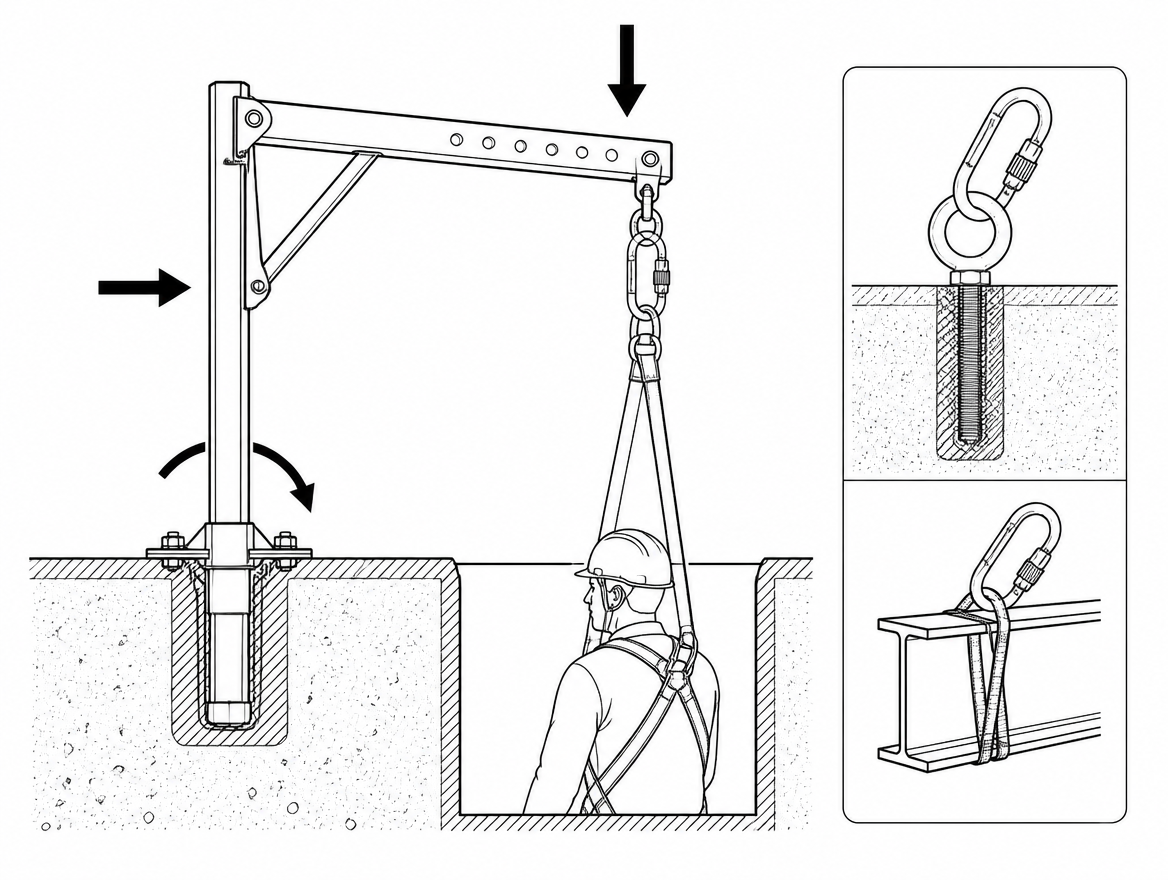
Lifting devices: what EN 1496 requires, and why a material winch is not a substitute
Devices used to raise a person during rescue are covered by EN 1496. The standard distinguishes a class of device capable of raising only from a class capable of both raising and lowering — a distinction with real operational consequences. If the entrant has to be lowered a short distance to free a trapped limb or clear an obstruction, a raise-only device cannot do it, and the team will be tempted to improvise mid-rescue.
A general-purpose materials hoist is not an alternative. Rescue lifting devices are required to be self-braking with no free-spool release under load, and they are designed and tested for the dynamics of a human load. Many retrieval assemblies combine a retractable type fall arrester to EN 360 with an integrated rescue lifting function to EN 1496, giving fall arrest during entry and a haul capability afterwards from one housing — but that dual function only exists where the device is certified to both standards.
Rope-based systems are equally legitimate where the team is trained for them: descender devices for rescue to EN 341:2011, rope adjustment devices to EN 12841:2006 (Type A backup, Type B ascending, Type C descending), and low-stretch kernmantel rope to EN 1891. What is not acceptable is a hybrid assembled from whatever is in the van, with no manufacturer-sanctioned compatibility between the components.
Two lines, two jobs
A vertical entry needs a fall arrest function during the descent and ascent, and a retrieval function for the extraction. Where one device cannot do both, run two independent lines to two independent anchor points: the retrieval line to the lifting device, and a backup fall arrest line on a separate anchor. This also removes the single point of failure that a lone winch line represents while a person is suspended over a drop.
Personal fall protection systems as a whole are defined by EN 363, which is a useful cross-check when the assembly starts to look complicated: every element should have an identifiable place in a recognised system type, connected by connectors to EN 362, with compatibility confirmed in the instructions for use.
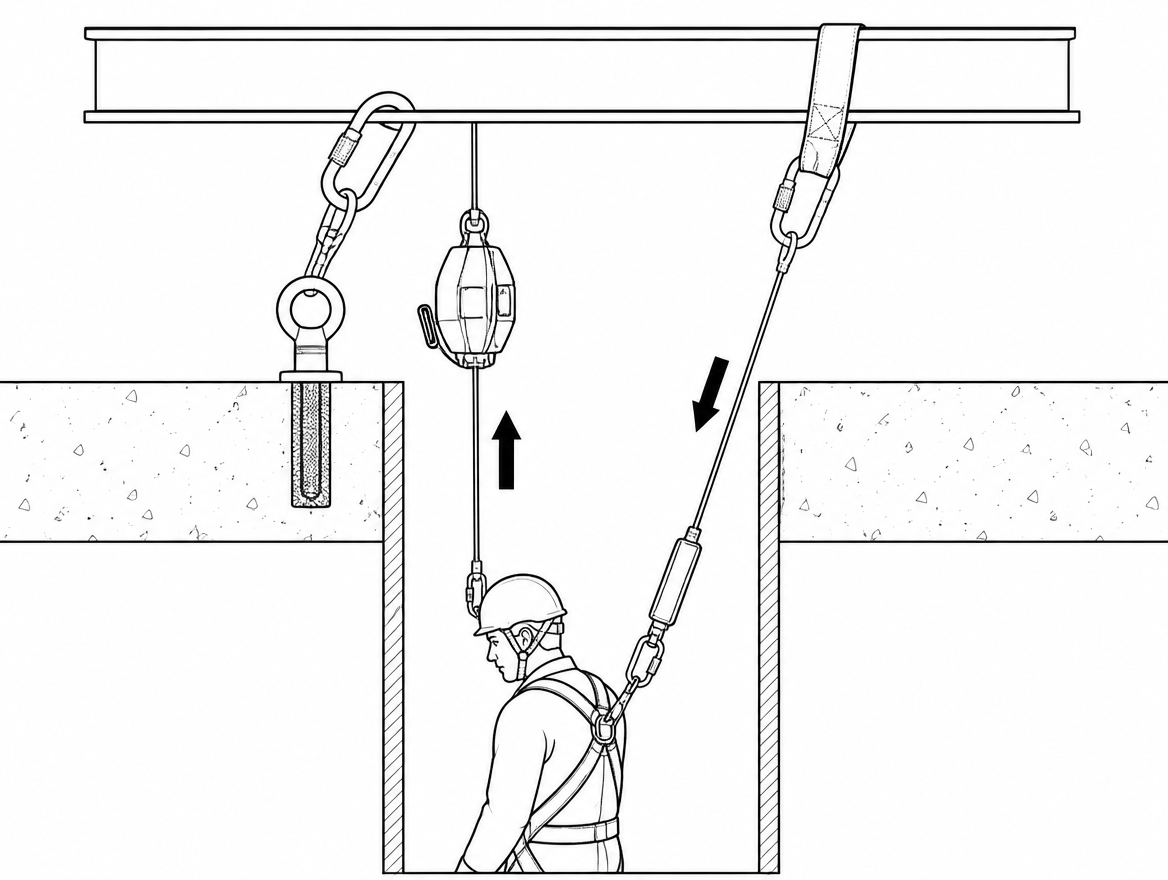
Work positioning belts to EN 358 are not part of this. They are not fall arrest equipment and are not intended for suspension; nobody is raised out of a shaft on one.
Harness and attachment: keeping the casualty vertical and clear of the wall
A full body harness to EN 361 provides the fall arrest attachment points, dorsal and sometimes sternal. For extraction, the more useful feature is the rescue attachment provided by EN 1497: a rescue harness has attachment points positioned so that an unresponsive person hangs in a stable, near-upright posture with the head clear, rather than folding forward. Many harnesses are dual-certified to EN 361 and EN 1497; where they are, the shoulder rescue points are the ones used for the lift.
Hauling an unconscious casualty on a dorsal D-ring alone tends to pitch the torso forward, drop the head and present the shoulders across the diameter of the opening — exactly the position that jams a body at the collar of a 600 mm manhole. In a narrow shaft, posture is not a comfort issue; it is what determines whether the casualty fits through the hole.
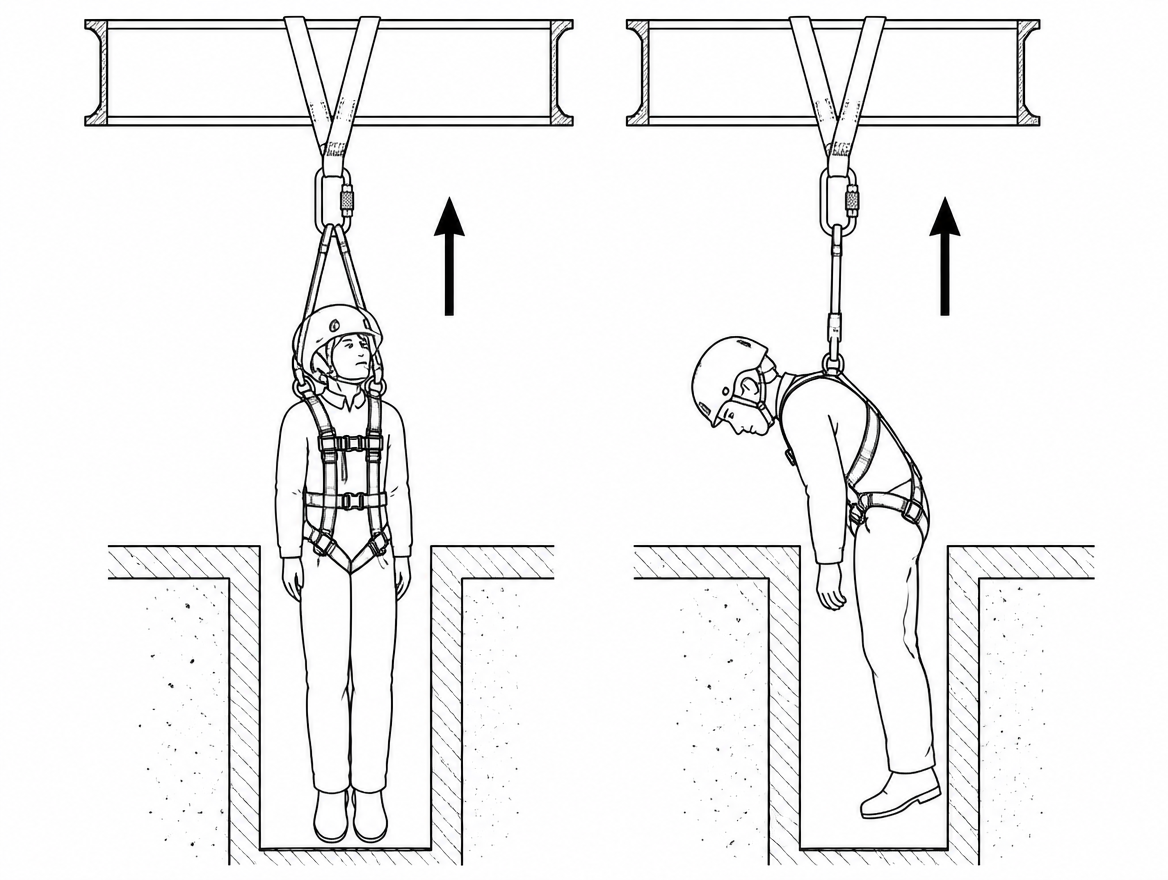
Rescue loops to EN 1498 exist in several classes and support the body less completely than a rescue harness. They are short-duration rescue devices for trained users, used strictly within the manufacturer’s stated limits, and they are not a substitute for fitting the entrant with an appropriate harness before entry.
Suspension time and orthostatic intolerance
A motionless suspended person can develop orthostatic intolerance — pooling of blood in the lower limbs with falling cerebral perfusion — within minutes, and an unconscious casualty cannot move their legs to delay it. This is the reason retrieval capability has to be immediate rather than summoned, and the reason a suspended entrant is raised rather than left hanging while the team discusses options.
Post-rescue handling has moved on from older advice that a rescued casualty should be held semi-upright for a fixed period before being laid flat. Current practice is to treat suspension as a medical emergency, hand over to emergency medical services with the duration of suspension reported, and not to delay airway management, resuscitation or normal casualty positioning on the strength of that older rule. Agree the handover protocol with your medical provider in advance, in writing, rather than at the shaft edge.
When a harness lift will not do: vertical stretchers and splinting
A suspected spinal injury, a fracture, or a casualty who has been in an atmosphere requiring immobilisation changes the extraction from a harness lift to a packaged lift. That means a vertical-capable stretcher or spinal splint device, rigged with a spreader or bridle so the casualty comes up along the axis of the shaft, and normally an attendant in the space to tend the package past the rim and any pipework.
This is the configuration that most often fails on the day, for a mechanical reason: the packaged casualty is wider and longer than a person on a harness line, and the shaft, the tripod head and the opening collar all have to accommodate it. Measure it during rehearsal with the actual stretcher, in the actual space.
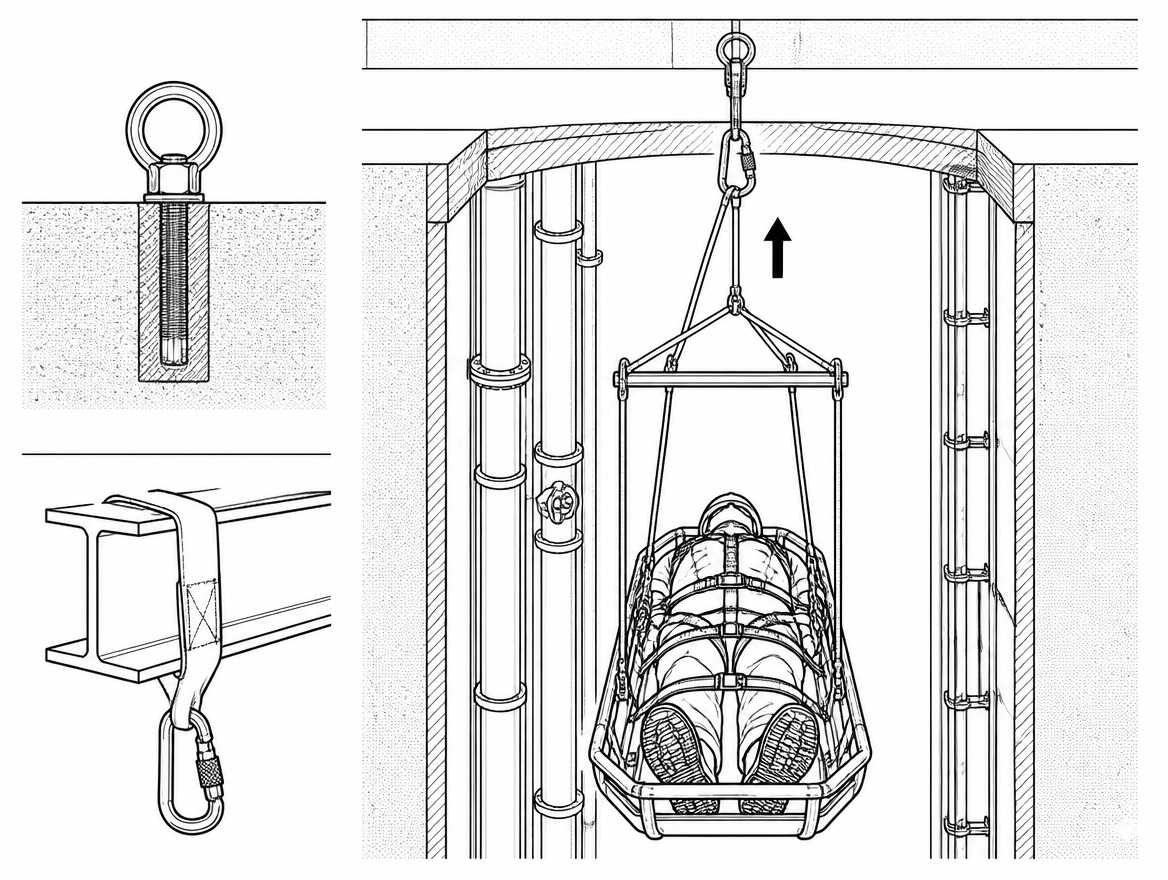
Entry rescue: what changes when a rescuer goes in
Once entry rescue is on the table, the atmosphere becomes the controlling factor. Continuous monitoring covers oxygen, flammable gas and the toxic contaminants credible for that space, using instruments whose performance is established against the relevant standards — EN 50104 for oxygen detection, EN 60079-29-1 for flammable gas detectors, and the EN 45544 series for toxic gases. Where the atmosphere is or may become immediately dangerous, escape-set thinking is not enough: the rescuer needs respiratory protective equipment appropriate to the hazard, such as self-contained breathing apparatus to EN 137 or compressed air line apparatus to EN 14593 or EN 14594, supplied with breathing air meeting EN 12021.
In a potentially explosive atmosphere, equipment selection is constrained by the ATEX framework — Directive 2014/34/EU for the equipment and Directive 1999/92/EC for the workplace — which includes lighting, radios and gas detectors, not just the powered plant.
A rescuer entering also changes the anchor question raised earlier: two people suspended from one tripod is a multi-person load, and needs an anchor device qualified for it.
Rehearsal, communication and the numbers you should be able to state
The measure of a vertical extraction plan is elapsed time from the attendant recognising a problem to the casualty being clear of the opening and accessible for treatment. That number is obtained by rehearsing the lift with a weighted manikin, on the actual site, with the actual rigging, and timing it — not by estimating it.
Rehearsal reliably exposes the same handful of problems: a haul ratio that a single attendant cannot sustain for the full shaft depth, a line that drags across an unprotected concrete rim, a stretcher that will not turn at the collar, an attendant whose hands are full of both a radio and a haul line, and comms that fail as soon as a blower starts. Fix them in the plan, then re-time it.
Inspection and periodic examination
EN 365:2004 sets the general requirements for instructions for use, marking, periodic examination and repair of personal fall protection equipment. The headline requirement is a periodic examination by a competent person at least every 12 months, or more frequently where the manufacturer’s instructions or the conditions of use demand it — and shaft work in wet, chemically aggressive or abrasive conditions frequently does.
Alongside that: pre-use inspection of harnesses, connectors, wire rope and winch function before each entry; documented removal from service of any item involved in a fall arrest or an actual rescue until assessed by the manufacturer or a competent person; and legible markings on every component, checked against the equipment register. If a marking cannot be read, the item cannot be verified, and an unverifiable component has no place in a rescue load path.
What to check first
If one item on this list is unresolved, resolve it before the next shaft entry:
- Every entrant is connected to a retrieval line served by a lifting device certified to EN 1496, or the entry plan documents why not and what replaces it.
- The anchor device is certified to EN 795:2012 for single-person use, and to CEN/TS 16415 if two people may be suspended from it.
- The lifting device can lower as well as raise, or the plan accounts for the fact that it cannot.
- Harnesses provide rescue attachment points to EN 1497, and the team knows to lift from them.
- The full extraction — including the stretcher, if a packaged lift is credible — has been rehearsed and timed in the actual space within the last 12 months.
The logical next step is to fold those five checks into the confined space permit itself, so the rescue configuration is verified and signed at the same moment as the gas test rather than assumed. For the equipment side, work through the manufacturer’s instructions for use for your specific tripod, winch and harness combination against EN 365 examination intervals, and record the result in the equipment register.
Frequently asked questions
What is the order of preference for rescue from a vertical confined space?
The hierarchy runs in one direction: self-rescue first, then non-entry retrieval from outside, then entry rescue as the last resort. Entry rescue is where rescuers are most often injured, because the hazard that disabled the entrant is still present and a second person is then exposed to it.
When can a retrieval system be left off the entry plan?
Only where it demonstrably increases risk — for example where the line would snag in an agitator, an auger or a horizontal branch the entrant has to traverse — and where that decision is written into the entry plan alongside the alternative arrangement.
Does EN 795:2012 cover a tripod used for a tandem lift with rescuer and casualty?
No. EN 795:2012 covers anchor devices intended for one person at a time. Where a rescuer and casualty will be suspended from the same anchor simultaneously, the relevant technical specification is CEN/TS 16415:2013, which addresses anchor devices for use by more than one person, so the manufacturer's documentation should be checked for that second qualification before planning a tandem lift.
What geometry keeps a tripod's rating valid?
Apex centred over the opening, legs spread evenly to the position fixed by the leg-spread restraint chain or strap, feet on firm level ground clear of the shaft edge, and the restraint taut rather than slack. The stated capacity applies to a load hanging vertically from the head, not to a line pulled off at an angle. A leg landing on a hinged cover, a spoil heap or the chamber collar is the failure most commonly found during drills.
Why can't a general-purpose materials hoist be used to raise a person?
Devices used to raise a person during rescue are covered by EN 1496, which distinguishes raise-only devices from those that can both raise and lower. Rescue lifting devices are required to be self-braking with no free-spool release under load and are designed and tested for the dynamics of a human load, so a materials hoist is not an alternative. A raise-only device also cannot lower an entrant a short distance to free a trapped limb or clear an obstruction.
Need this as a document you can issue? The template library gives you the risk assessments, permits and inspection logs in editable form — and employer plans cover a whole team with completion records.