Safety / Tips and Tricks / Rope access and confined space
Activity 01 · Rope access
Suspension Trauma: Why Minutes Matter
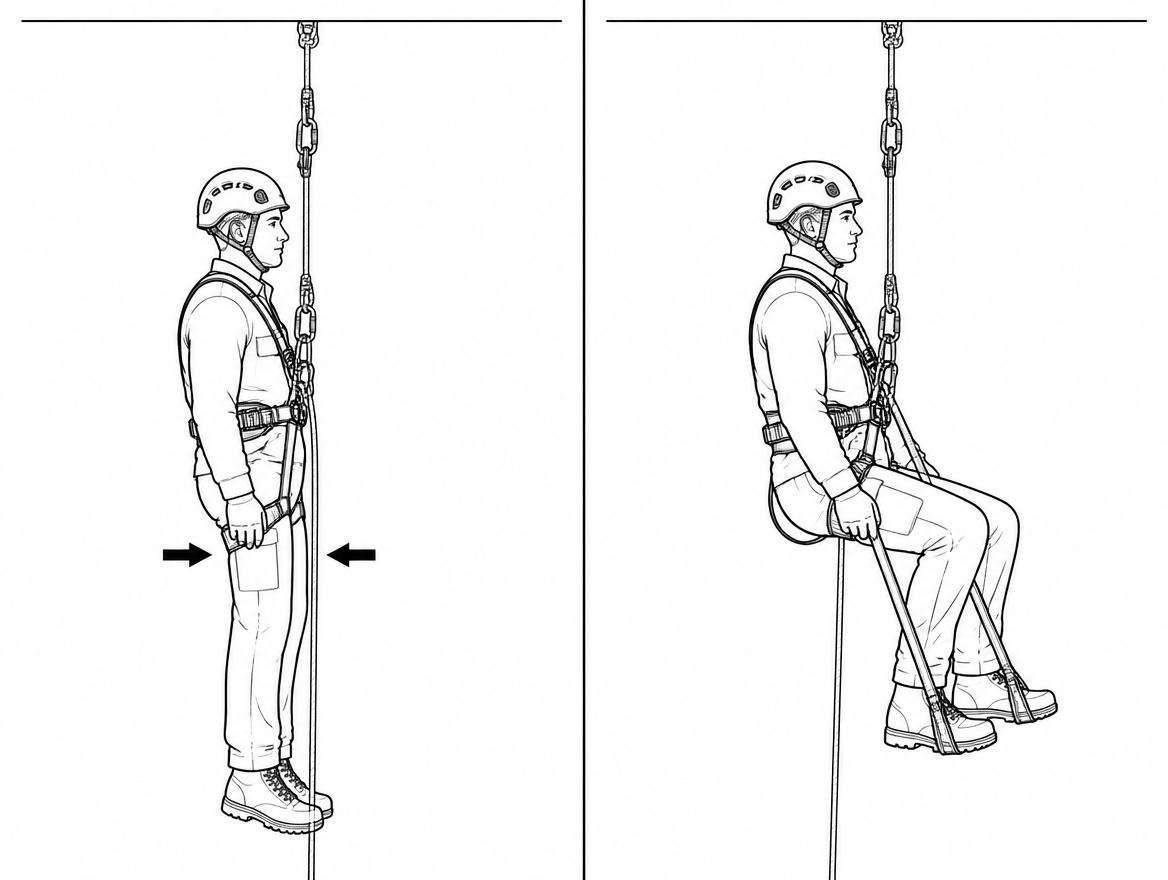
A worker who has been arrested in a fall is not safe. They are alive, which is what the fall arrest system was designed to achieve, but they are now hanging motionless in a harness, and a second and largely separate hazard has just started: suspension trauma. This is the reason a rescue plan for work at height has to be timed in minutes, not "we'll call the fire service." It is also the reason that harness fit, attachment point choice and the presence of suspension relief straps are not comfort details but survivability details.
What suspension trauma is, physiologically
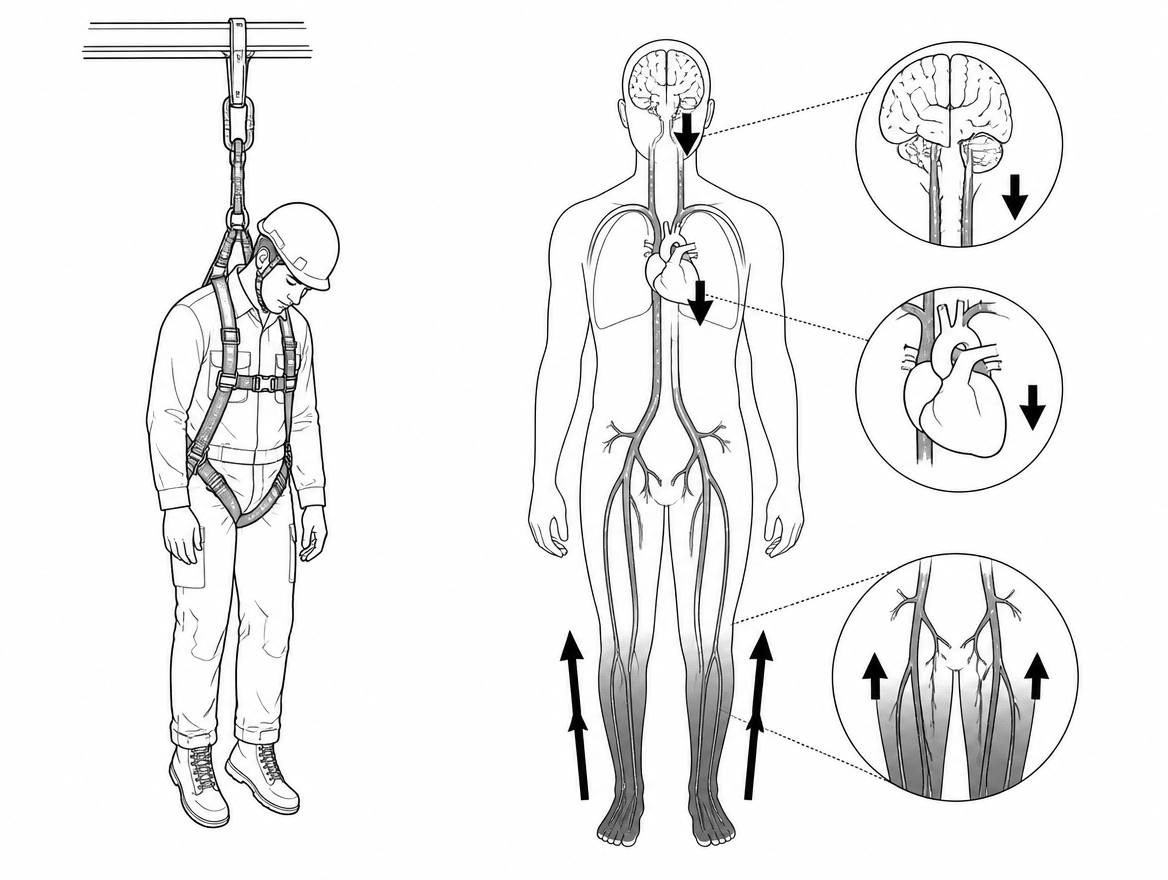
Suspension trauma – also described in the literature as orthostatic intolerance during suspension, or harness hang syndrome – is a circulatory failure caused by immobile upright suspension.
When a person hangs vertically and cannot move their legs, two things happen at once. The leg muscles stop contracting, so the muscle pump that normally pushes venous blood back toward the heart stops working. At the same time, the harness thigh straps compress the soft tissue of the upper legs, restricting venous return further while arterial pressure keeps delivering blood into the limbs. Blood pools in the legs and pelvis. Venous return to the heart falls, cardiac output falls with it, and cerebral perfusion drops.
The result is a classic presyncopal sequence: light-headedness, nausea, sweating, greying or narrowing vision, unusually slow or unusually fast pulse, then loss of consciousness. It can develop in a person who is uninjured, conscious and talking at the start of the suspension.
Why fainting in a harness is more dangerous than fainting on the ground
On the ground, syncope is self-correcting. The person collapses, ends up horizontal, gravity stops working against venous return, and cerebral perfusion is restored within seconds.
A suspended person cannot collapse. The harness holds them upright, so the position that caused the hypoperfusion is maintained after they lose consciousness. An unconscious casualty also cannot move their legs, cannot use suspension relief straps, and cannot protect their own airway – a slumped head-forward posture in a dorsal-attachment harness can obstruct breathing on its own. What would be a brief faint at ground level becomes a continuing insult to the brain for as long as the suspension continues.
How long is too long
There is no single number that applies to every person, and any source that offers one should be treated with suspicion. The most frequently cited experimental work is the UK Health and Safety Executive research report on harness suspension (Seddon, HSE Research Report 451, 2002), which reviewed the available suspension studies and found that tolerance to motionless vertical suspension varied enormously between individuals – some test subjects reached presyncopal symptoms within a few minutes, others tolerated suspension far longer. Tests were stopped on symptoms, not on collapse.
Two conclusions follow, and they are the ones that matter for planning:
- Individual tolerance cannot be predicted in advance. Fitness, hydration, injury sustained in the fall, harness fit, ambient temperature and the amount of leg movement possible all influence it. A young, fit worker is not exempt.
- Rescue has to be planned against a short target, and that target has to be tested. A rescue capability measured in tens of minutes cannot be justified against the physiology. Many organisations plan on relieving suspension inside roughly ten minutes; that is a planning benchmark drawn from practice, not a figure fixed by an EN standard. What the standards framework does require is that the means of rescue exist, be suitable, and be available – the number your site adopts must come from an actual timed drill in the actual work location.
The harness decisions that change the outcome
Suspension trauma develops faster or slower depending on how the worker ends up hanging, and that is largely determined by equipment selection and adjustment.
Attachment point
A full body harness to EN 361 has its fall arrest attachment points – the dorsal point between the shoulder blades, and in most designs a sternal point – identified by the capital letter A marking. Rear (dorsal) attachment produces a head-forward, feet-down posture with limited ability to shift position. A sternal attachment generally leaves the suspended worker more upright and better able to see and manage their own situation. Where the work is rope access or sustained positioning rather than fall arrest, a sit harness to EN 813 with a low ventral attachment supports the pelvis and thighs in a seated posture and is far more tolerable for long suspension.
Thigh strap adjustment
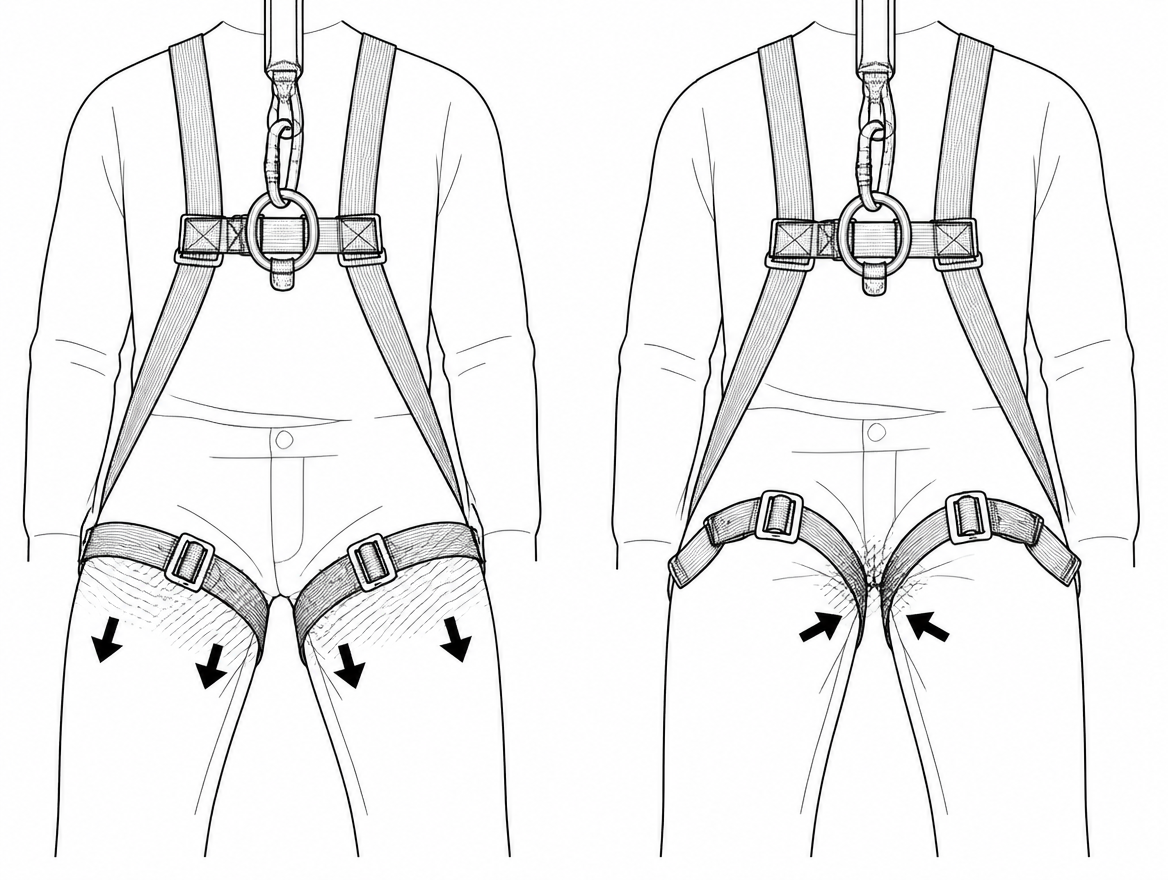
Loose thigh straps are the common defect. Slack straps let the harness ride up under load, concentrating pressure into the groin and the femoral vessels instead of distributing it across the front of the thigh. They also allow the body to sag lower in the harness, worsening the posture. Adjustment should be checked with the harness loaded, not standing relaxed on the ground – the standard practical check is a flat hand’s width of clearance under the thigh strap with no slack that can be pulled through.
Suspension relief straps: useful, and strictly limited
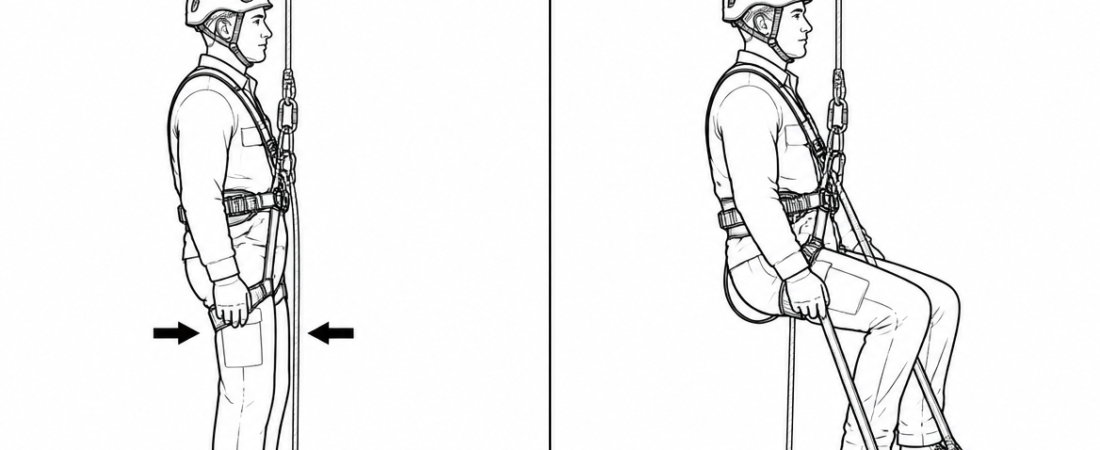
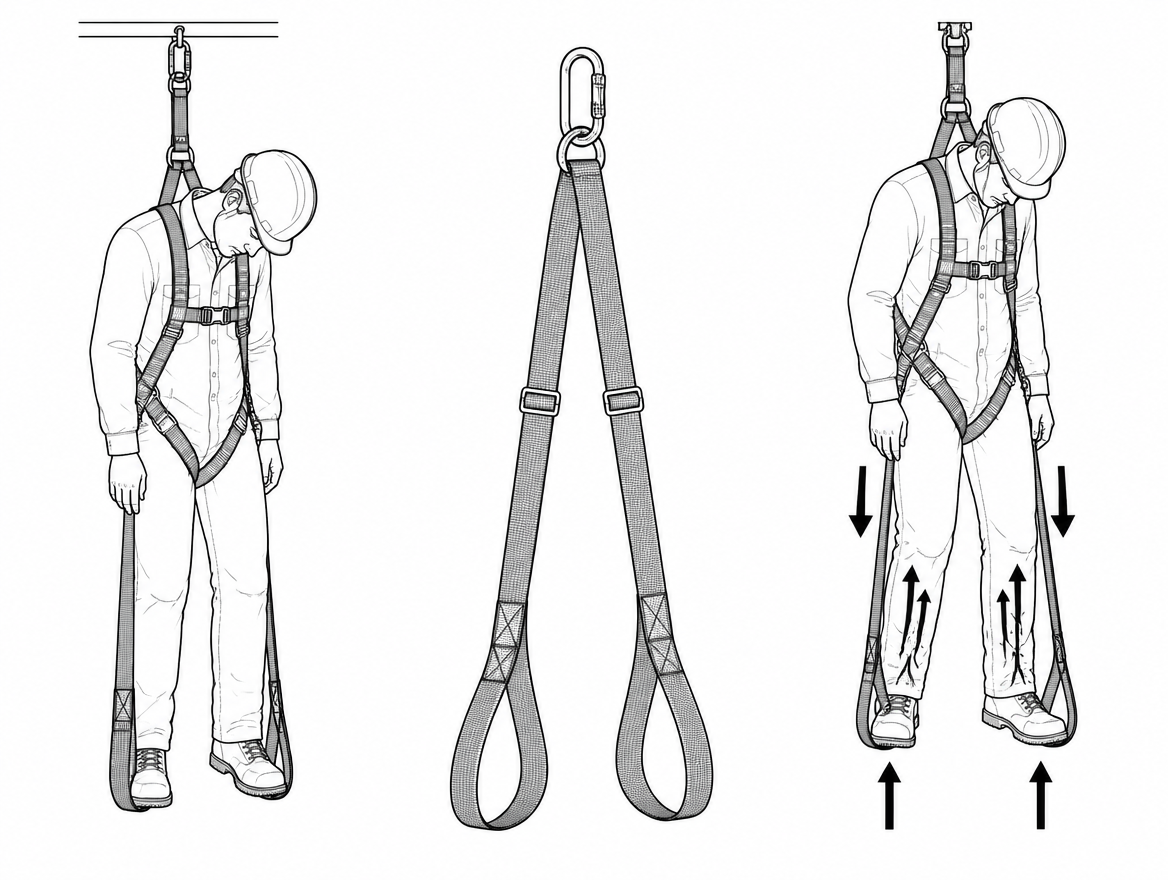
Suspension relief straps – also sold as trauma straps or relief steps – are short stowed webbing loops attached to the harness that the suspended worker deploys and stands in. Standing in the loops takes body weight off the thigh straps, unloads the femoral area, straightens the posture and lets the calf muscles work, which restores some venous return. Where they are fitted and the worker knows how to deploy them, they extend tolerable suspension time significantly.
Their limitations need to be stated just as plainly:
- They require a conscious, uninjured, aware casualty. They do nothing for someone who is already unconscious, has an arm or leg injury from the fall, or is disoriented.
- They must be deployed early. A worker who waits until symptoms are advanced may not be able to complete the movement.
- They buy time for rescue. They are not a rescue, and they are not a reason to slow one down.
- There is no dedicated harmonised EN product standard for suspension relief straps as a stand-alone item; they are supplied as harness accessories and must be used, inspected and stowed strictly according to the harness manufacturer’s instructions, which under EN 365 must be supplied with the equipment and kept with it.
Deployment is a trained skill. If relief straps are issued, workers should have deployed them at least once while actually suspended in a controlled training environment, not only been shown the pouch.
Designing the work so nobody hangs in the first place
The fastest rescue is the one that is never needed. The hierarchy that applies to work at height under the work equipment provisions of Directive 2009/104/EC, as transposed into national law, puts collective protection and restraint ahead of fall arrest for a reason: fall arrest accepts the fall and its consequences, including suspension.
- Restraint – a system that physically prevents the worker from reaching the fall edge, typically a work positioning or restraint belt and lanyard to EN 358 used with a fixed-length lanyard – removes suspension trauma from the risk picture entirely.
- Work positioning keeps the worker supported and able to move rather than hanging inert.
- Where fall arrest is unavoidable, minimise the consequences: reduce free fall distance, anchor overhead, choose an EN 360 retractable type fall arrester over a long lanyard where geometry allows, and select anchor devices to EN 795 that are positioned so a suspended casualty can actually be reached.
- No lone working in fall arrest. A suspended worker with nobody to raise the alarm has no rescue timeline at all.
The rescue plan: equipment, standards and a stopwatch
EN 363 treats rescue systems as part of the personal fall protection system family, not as an afterthought. A usable plan names the equipment, the people and the sequence for the specific work location.
Equipment
- EN 341 – descender devices for rescue, for lowering a casualty to a safe level.
- EN 1496 – rescue lifting devices, for raising a casualty; frequently integrated with a retractable fall arrester for confined space and tower work.
- EN 1497 rescue harnesses and EN 1498 rescue loops, for attaching a casualty who is not already in a suitable harness.
- EN 795 anchor devices for the rescue attachment, which must be assessed for the rescue load, not only the original work load.
- EN 365 governs the instructions for use, marking, periodic examination and withdrawal from service for all of it – including the requirement to withdraw equipment from use and have it examined by a competent person after it has arrested a fall, and to carry out periodic examination at intervals set by the manufacturer’s instructions and at least every twelve months where those instructions require it.
Sequence
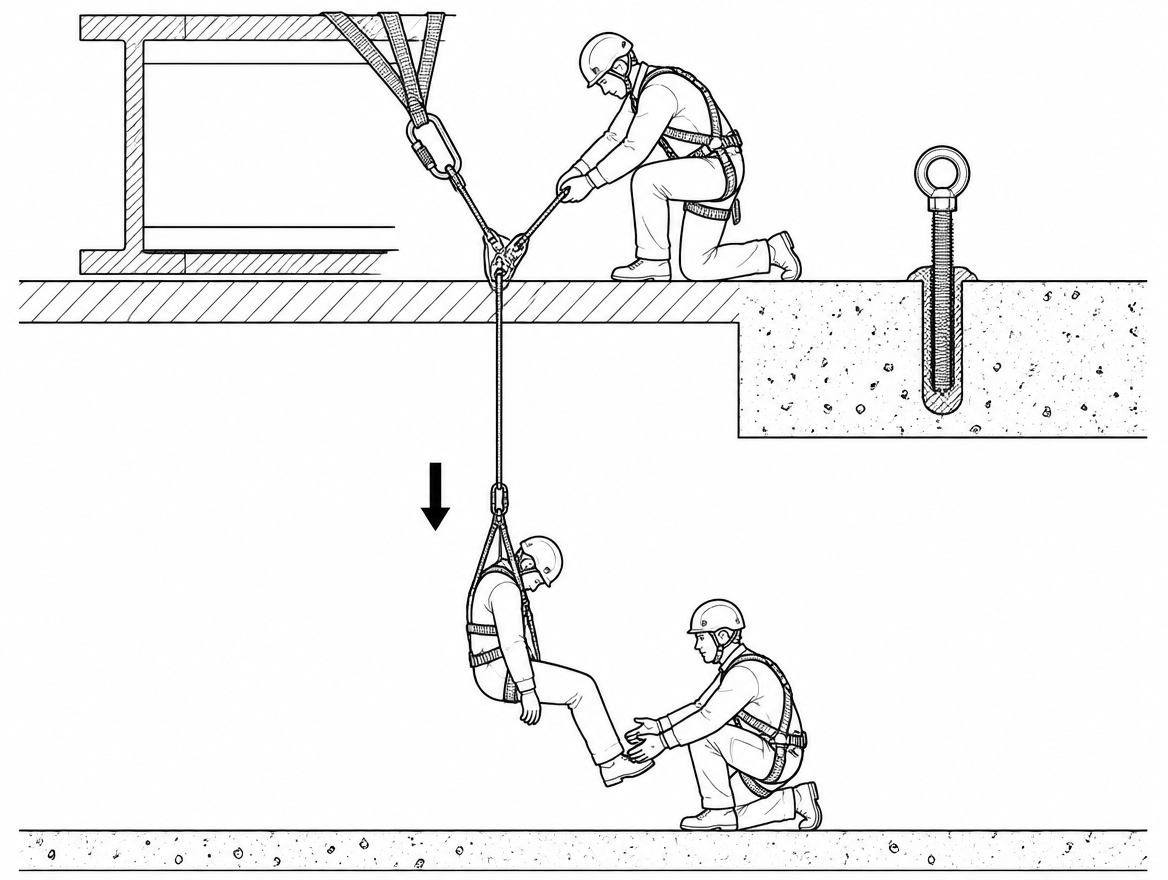
The plan should answer, for each work position: who raises the alarm, who reaches the casualty, from where, with what equipment, and how the casualty is brought to a level where they can be laid flat. Options in rough order of speed are assisted self-rescue (the casualty descends or is lowered under their own control), rescue from above using a lifting or lowering device from a pre-rigged anchor, retrieval by a mobile elevating work platform positioned under the work area, and ladder-based rescue for low-level suspension. Emergency services attendance is a fallback for the residual case, not the primary plan – their response time is outside the site’s control and is rarely inside the physiological window.
Timing
Run the rescue as a drill, in the real location, with the real equipment, against a stopwatch, using a weighted manikin or an instructed volunteer at a safe height. Record the time from alarm to suspension relieved. If that time is not credible against the physiology described above, the method or the equipment layout changes – not the target.
First aid after rescue: the old “keep them sitting up” advice has changed
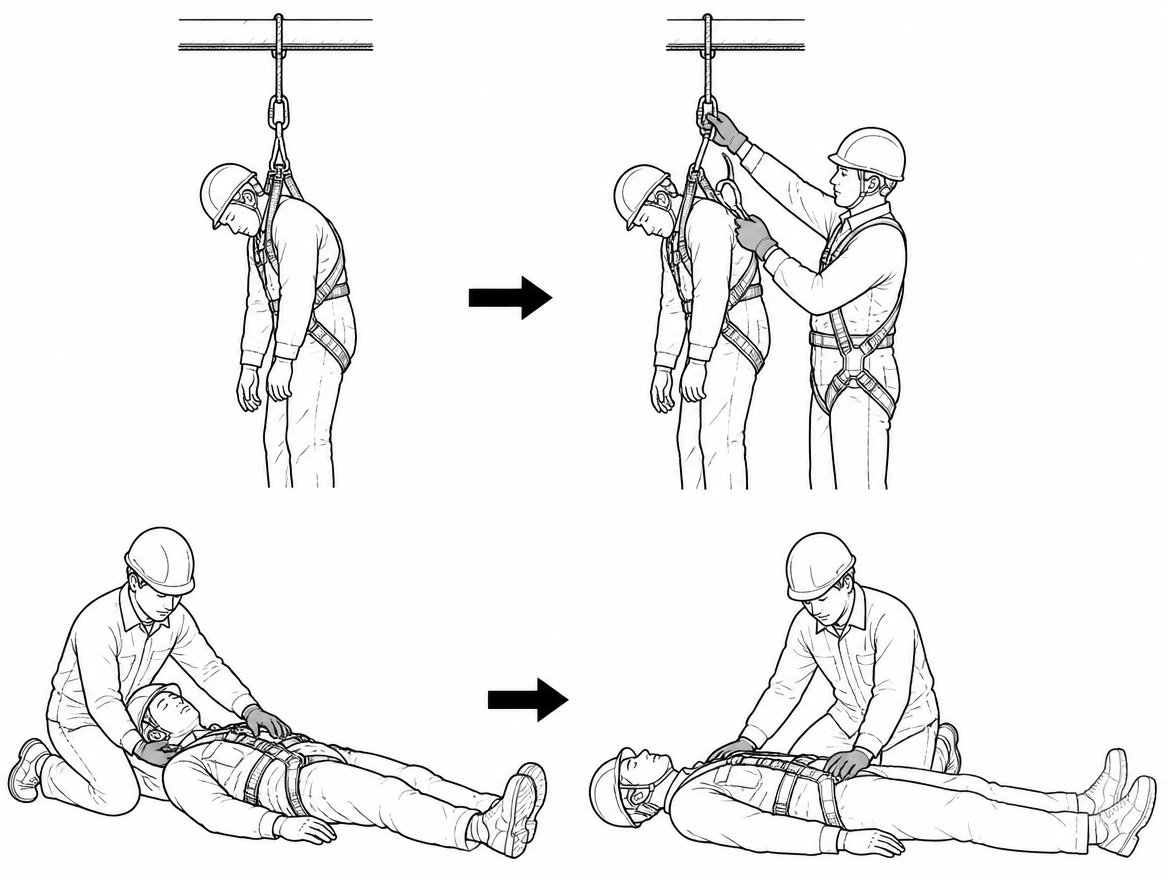
For years, guidance circulated that a rescued casualty should be kept semi-upright for a period after release, on the theory that laying them flat would send a bolus of deoxygenated, acidotic and potassium-rich blood from the legs to the heart – sometimes called reflow syndrome or rescue death. The evidence base for that mechanism has always been thin, and current resuscitation guidance no longer supports delaying normal management or withholding a horizontal position on those grounds.
The practical implications for a site first aider:
- Manage the casualty by standard first aid principles: assess response, airway, breathing and circulation.
- If the casualty is unresponsive and not breathing normally, start CPR immediately. Nothing about suspension justifies delaying resuscitation or keeping the casualty upright.
- Do not keep a collapsed casualty seated in order to “protect the heart.” Position them as their condition dictates.
- Release harness leg straps once the casualty is supported and the load is off, so that compression is relieved.
- Call emergency medical services for every case of prolonged or symptomatic suspension, even if the casualty appears to recover fully. Suspension may have been secondary to a medical event or a fall injury, and delayed complications are possible. A casualty who says they feel fine should still be assessed and should not drive.
Site first aid content and casualty handling should be confirmed against current European Resuscitation Council guidance and the organisation’s occupational health provider or medical adviser, because this is a point on which published advice has genuinely reversed and older training material is still in circulation.
What to check before the next shift at height
- Is a written, location-specific rescue method in place for every fall arrest work position – and has it been timed?
- Are the rescue anchors and rescue equipment pre-positioned and accessible, or stored in a locked container at ground level?
- Do the harnesses in use have suspension relief straps, and have the workers who wear them deployed them while suspended?
- Are thigh straps checked under load during the pre-use check, or only glanced at?
- Could this task be done in restraint to EN 358 instead of fall arrest?
- Is anyone working in a fall arrest system alone?
- Does the first aid team know that the sitting-up advice has been superseded?
The next practical step is to take one existing work-at-height method statement, find the sentence that describes rescue, and check whether it names equipment, an anchor and a time. If it does not, that is the document to fix first. For the equipment side of the same review, the periodic examination and withdrawal-from-service requirements in EN 365 and the harness attachment point requirements in EN 361 are the two standards to have open on the desk.
Frequently asked questions
What is suspension trauma?
Suspension trauma – also described as orthostatic intolerance during suspension, or harness hang syndrome – is a circulatory failure caused by immobile upright suspension. The leg muscle pump stops working while the harness thigh straps compress the soft tissue of the upper legs, so blood pools in the legs and pelvis, venous return and cardiac output fall, and cerebral perfusion drops.
What are the warning signs?
The article describes a classic presyncopal sequence: light-headedness, nausea, sweating, greying or narrowing vision, unusually slow or unusually fast pulse, then loss of consciousness. It can develop in a person who is uninjured, conscious and talking at the start of the suspension.
Why is fainting in a harness more dangerous than fainting on the ground?
On the ground, syncope is self-correcting: the person ends up horizontal, gravity stops working against venous return and cerebral perfusion is restored within seconds. A suspended person cannot collapse – the harness holds them upright, so the position that caused the hypoperfusion is maintained. An unconscious casualty also cannot move their legs, cannot use suspension relief straps and cannot protect their own airway, and a slumped head-forward posture in a dorsal-attachment harness can obstruct breathing on its own.
How long can a person safely hang in a harness?
There is no single number that applies to every person. HSE Research Report 451 (Seddon, 2002) found tolerance to motionless vertical suspension varied enormously between individuals – some subjects reached presyncopal symptoms within a few minutes, others tolerated suspension far longer. Many organisations plan on relieving suspension inside roughly ten minutes, but that is a planning benchmark drawn from practice, not a figure fixed by an EN standard; the number your site adopts must come from an actual timed drill in the actual work location.
Do attachment point choice and thigh strap adjustment matter?
Yes. Rear (dorsal) attachment produces a head-forward, feet-down posture with limited ability to shift position, while a sternal attachment generally leaves the worker more upright and better able to manage their situation; for rope access or sustained positioning, an EN 813 sit harness with a low ventral attachment supports the pelvis and thighs and is far more tolerable. Loose thigh straps are the common defect – slack lets the harness ride up and concentrate pressure into the groin and femoral vessels, so fit should be checked with the harness loaded, with a flat hand's width of clearance under the thigh strap and no slack that can be pulled through.
Need this as a document you can issue? The template library gives you the risk assessments, permits and inspection logs in editable form — and employer plans cover a whole team with completion records.