Safety / Tips and Tricks / Rope access and confined space
Activity 01 · Rope access
Rescuing a Person Hanging on an Energy Absorber
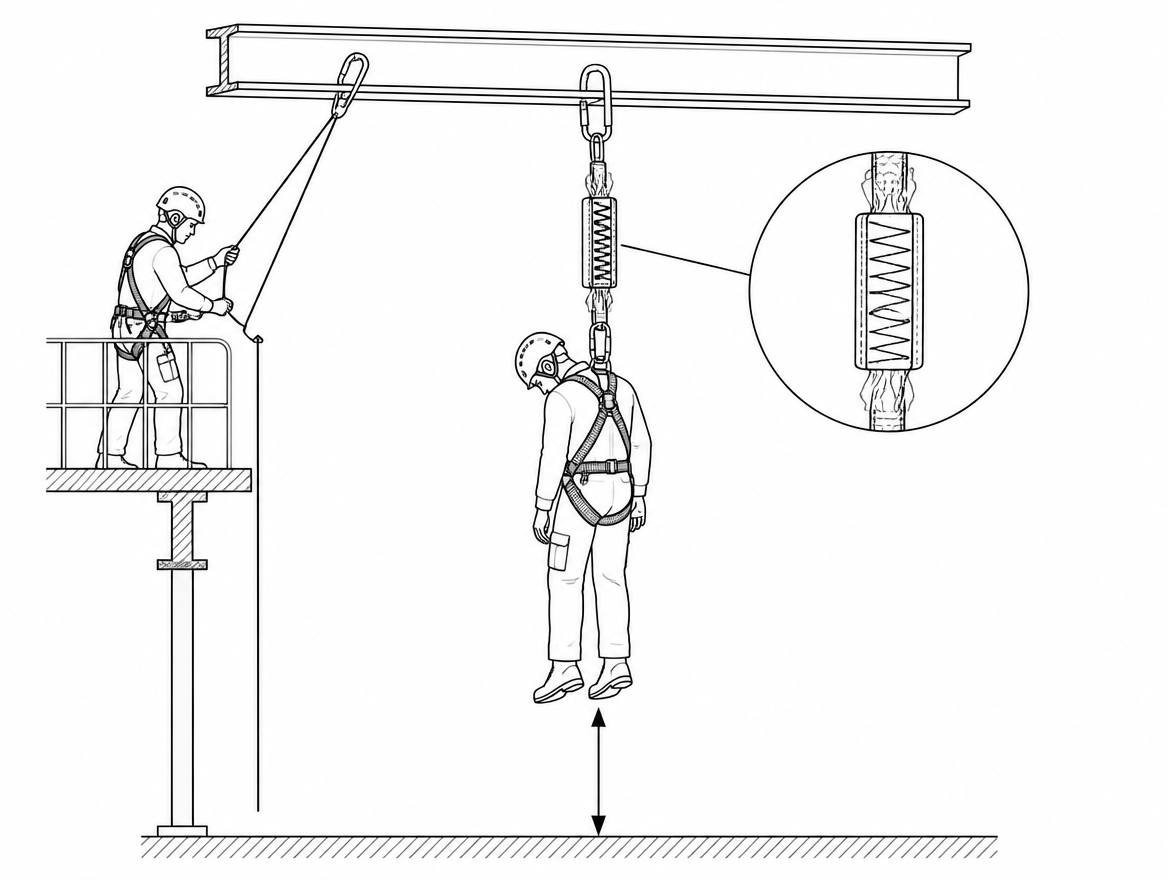
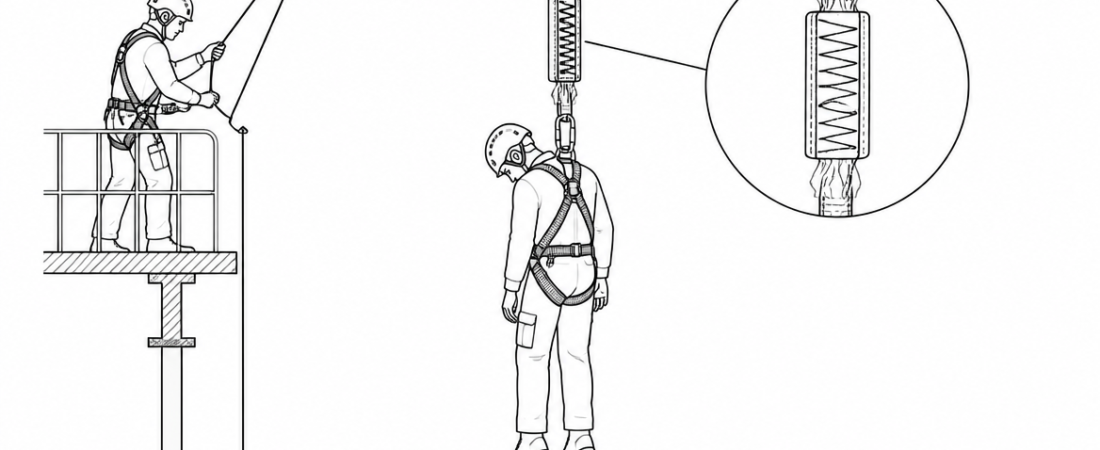
An energy absorber that has deployed has done its job: it has kept the arrest force on the faller within the 6 kN limit set by EN 355. What it has not done is get anyone down. From the moment the fall is arrested, a suspended worker is a casualty in a harness, hanging up to 1.75 m lower than anyone on site expected, possibly unconscious, and dependent entirely on how well the rescue was planned before work started. This article covers what a deployed absorber changes about the recovery, how to rescue a person on an absorber using EN-conforming rescue equipment, and what has to happen to the kit afterwards.
What a deployed absorber tells the rescue team
The torn-open absorber pack is not just evidence that a fall happened. It carries three pieces of operational information.
- The casualty is lower than the drawings suggest. EN 355 permits the absorber assembly to extend during arrest, and EN 354 caps the total length of a lanyard assembly including absorber and connectors at 2 m. In practice this means the suspension point of the casualty’s body can sit well over a metre below where the un-deployed lanyard would have held them. Reach from a platform, ladder or roof edge that was adequate on paper may not be adequate now.
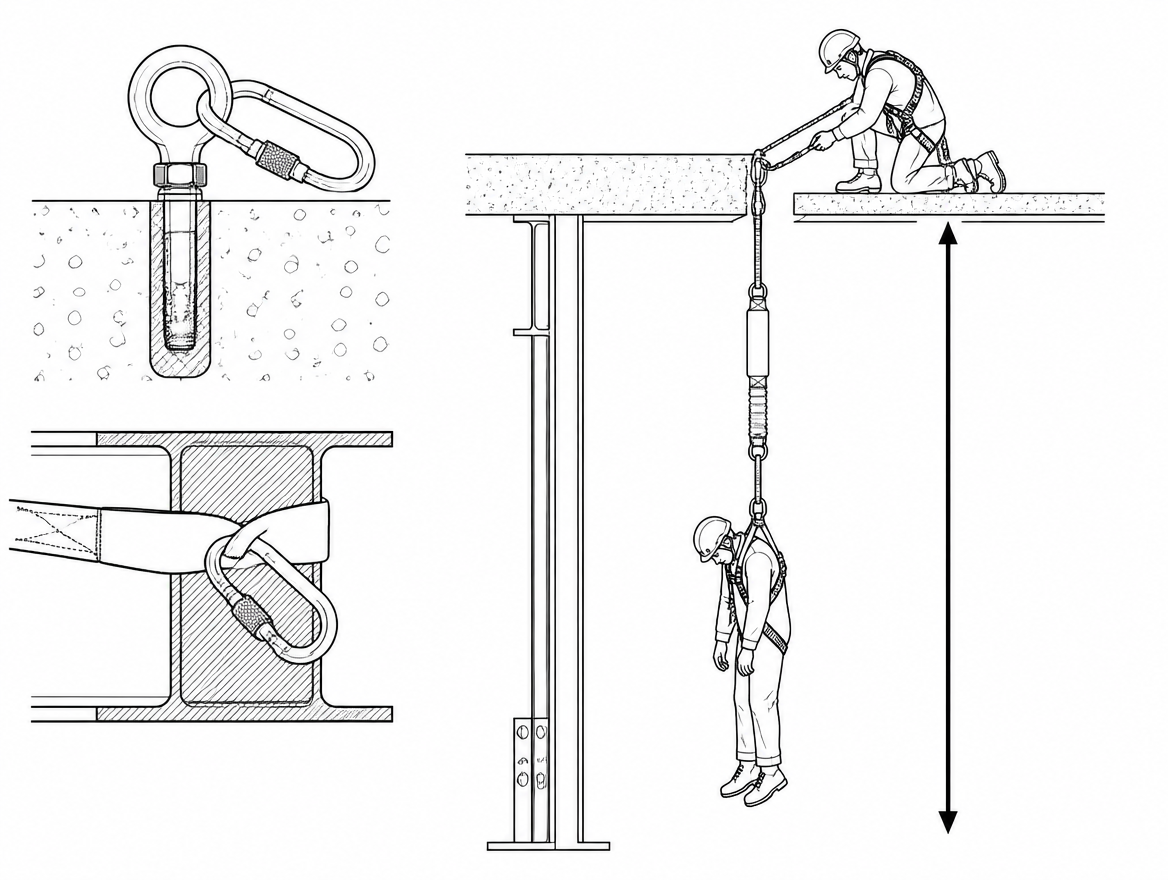
- The whole system has already taken a fall. Harness, lanyard, connectors and anchor have all seen an arrest load of up to 6 kN. Anchor devices type-tested to EN 795 are proven against static loads far above that, but a type test says nothing about the condition of this anchor, this bolt, this parapet, after a real event. Inspect before adding any further load.
- The absorber is spent and must not be treated as part of the rescue system. A partially deployed absorber can continue to tear if it is shock-loaded again, for example by a rescuer swinging a casualty or by a second person clipping into the same assembly. Every rescue load path must be built on a separate, verified anchor.
The first assessment, before anyone climbs
The point of the initial assessment is to choose a rescue method quickly, not to compile a report. Five questions decide almost everything:
- Is the casualty conscious and responsive? Establish voice contact and note the time of arrest. A responsive casualty may be able to assist; an unresponsive or head-down casualty needs the fastest available method regardless of preference order.
- Which harness attachment point is loaded? A worker suspended from the dorsal attachment of an EN 361 harness typically hangs slightly forward, with limited ability to reach their own chest or the connector above them. Suspension from a sternal attachment leaves more scope for assisted self-rescue.
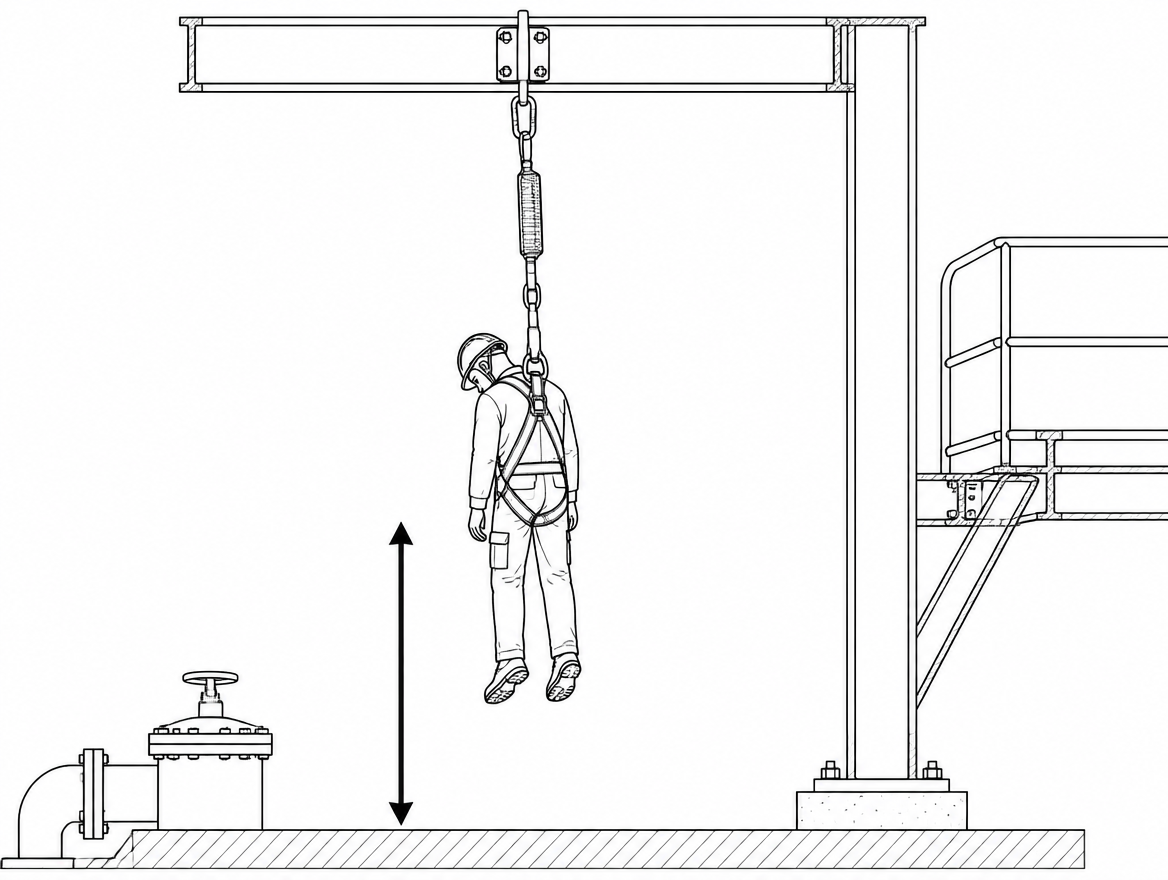
- What is directly below and around the casualty? Deployment has lowered them. Check for lower structure, edges, plant, live conductors, hot surfaces or open water they may now be close to, and for pendulum swing if the fall was off to one side of the anchor.
- Is the anchor sound? Look at the anchor and its interface with the structure before loading it again. If there is any doubt, the rescue system goes on a different anchor.
- What is below the casualty on the ground? Establish an exclusion zone. Tools, fasteners and the casualty’s own equipment can fall during a recovery.
Assisted self-rescue: fastest when it is genuinely available
If the casualty is uninjured, responsive and within reach of sound structure, the shortest route out of suspension is their own. That may mean stepping back onto a beam or platform edge, using a work positioning lanyard to EN 358 to stabilise, or transferring to a ladder held and footed by others. Two conditions apply: the casualty must be able to establish independent secondary attachment before the spent lanyard is unloaded, and no one should be talking them into a manoeuvre they have said they cannot manage.
While any method is being set up, keep the casualty active. Encouraging them to push against the structure with their legs, or to move their feet and thighs, helps counteract the venous pooling that causes suspension intolerance. If their harness or lanyard is fitted with suspension relief straps, prompt them to deploy and stand in them.
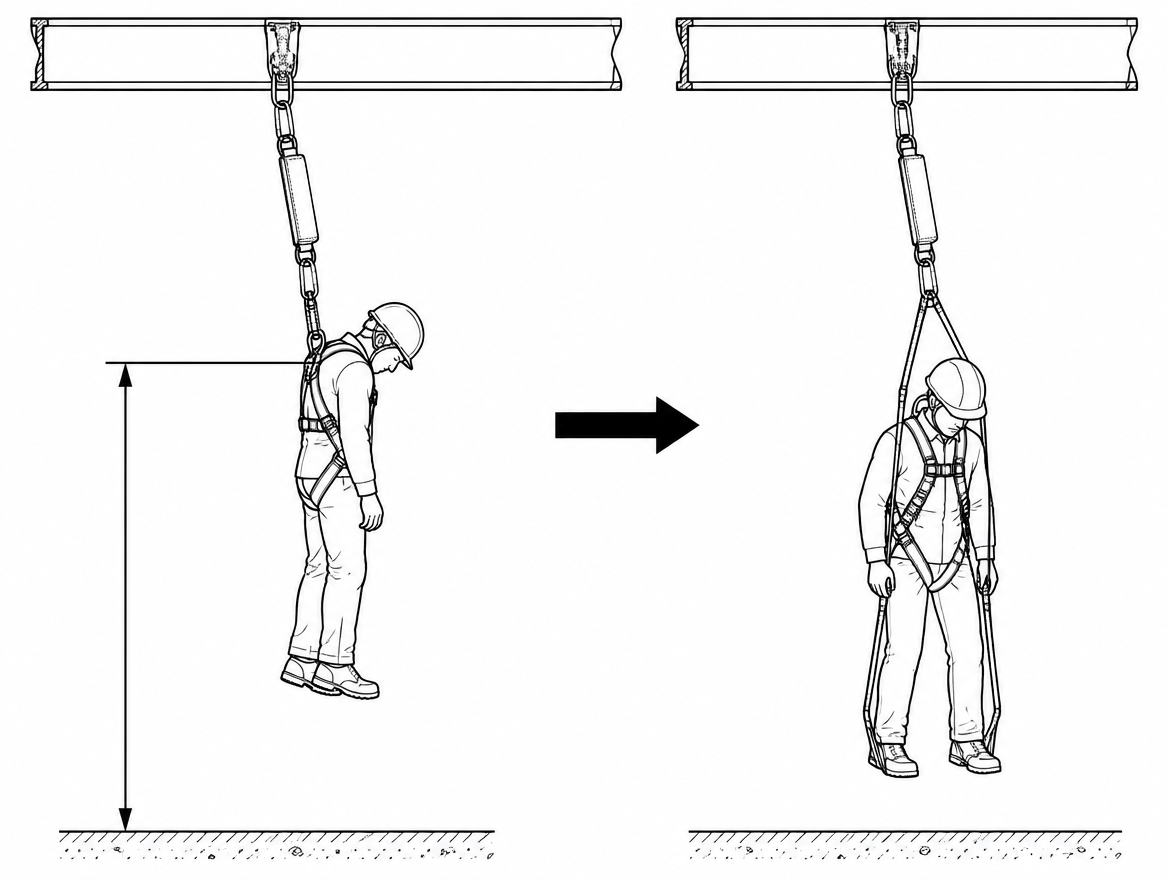
Rescue from above: lifting or lowering off an independent anchor
Where the casualty cannot self-rescue and access from above exists, recovery is normally done with equipment designed for it under the EN 363 system framework:
- Rescue lifting devices to EN 1496. Rigged to a suitable anchor, these raise the casualty far enough to take their weight off the fall arrest lanyard so it can be disconnected. Class B devices also allow controlled lowering after the transfer.
- Descender devices for rescue to EN 341. The rescue line is attached to the casualty’s harness attachment point, the load is transferred, and the casualty is lowered to a safe level. Select the device for the actual descent height and total mass; EN 341 classifies devices by descent energy, and a device chosen for a short descent is not automatically suitable for a facade.
- Rescue harnesses and loops to EN 1497 and EN 1498. Used where the casualty’s own attachment point cannot be reached or used, or where their harness has been damaged.
- Rescue poles. A pole with a hook or connector on the end is often the only way to place a rescue line onto a casualty who has swung out of arm’s reach.
Two frequent planning errors show up at this stage. The first is a rescue anchor that is the same anchor, or the same anchor line, that has just arrested the fall. The second is exceeding the rated load of the rescue device or anchor: if a rescuer descends with the casualty, that is a two-person load, and both the anchor and the descender must be declared by the manufacturer as suitable for it.
Transferring the load off the spent lanyard
This is the step where rescues go wrong. Sequence it deliberately:
- Attach the rescue line to the casualty’s harness attachment point and confirm the connector gate is closed and locked.
- Take up the load until the fall arrest lanyard is visibly slack. Slack in the lanyard is the confirmation that the load has transferred, not the rescuer’s impression that it has.
- Disconnect the fall arrest lanyard by opening its connector wherever possible. A karabiner that has been loaded to several kilonewtons may be difficult to open but is still the preferred route.
- Cut the lanyard only if the connector cannot be released, only with a hook-blade rescue knife, and only after slack has confirmed the transfer. Never cut a loaded line.
- Lower or raise in a controlled manner, keeping the casualty clear of edges and protruding structure.
Rescue from below: MEWPs and other platforms
Where a mobile elevating work platform to EN 280 is already on site and can reach the casualty, it is often the quickest and least technical option. The platform is brought alongside — not directly under — the casualty, the casualty is supported on the platform floor or seated, then the fall arrest lanyard is disconnected once their weight is fully on the platform.
Points that are easy to miss: the deployed absorber has changed the working height the operator needs; the casualty must not be dragged sideways while still suspended, because that both loads the spent absorber and risks a swing on release; and platform occupants remain attached to the platform’s own anchor points throughout.
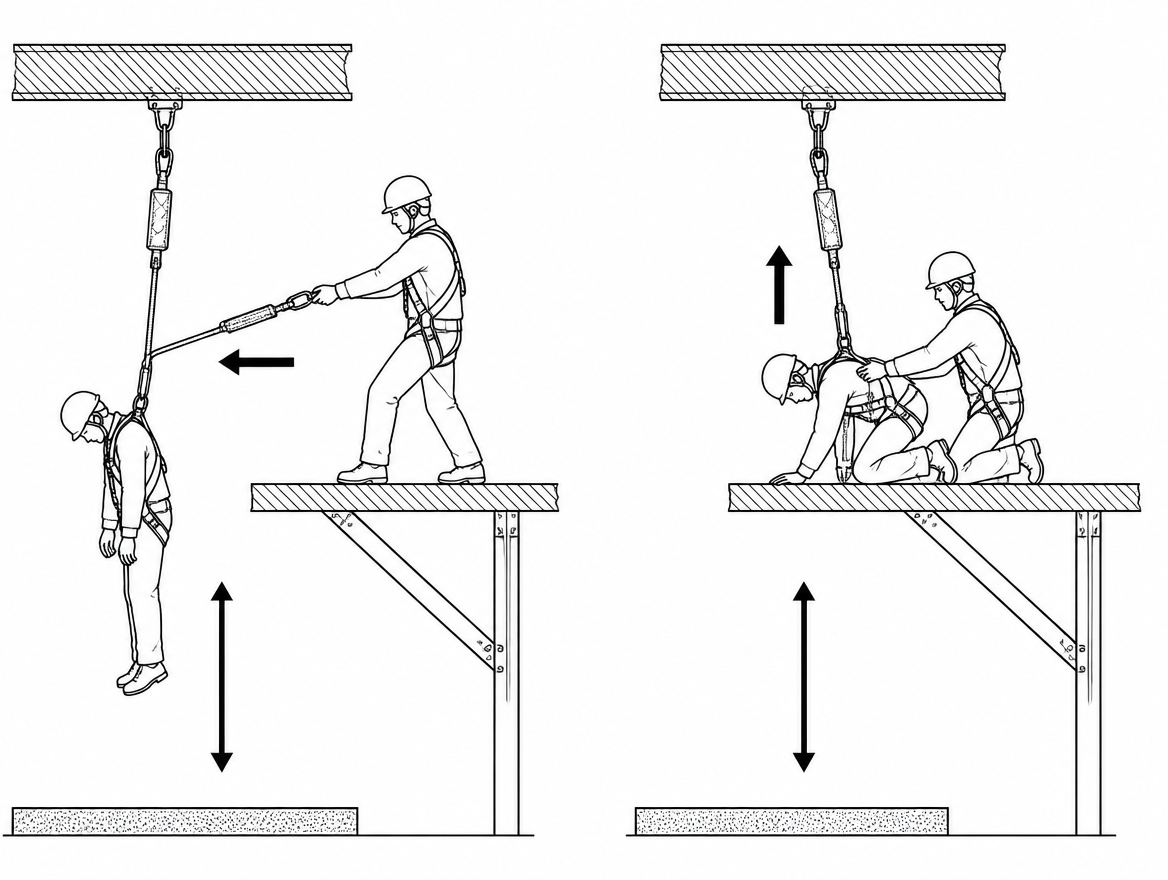
Do not build the plan around the emergency services
EU law on temporary work at height, introduced by Directive 2001/45/EC and now consolidated in Directive 2009/104/EC together with national implementing regulations, requires work at height to be planned, and that planning includes emergency and rescue arrangements. ISO 45001 clause 8.2 requires organisations to establish, implement and maintain processes for responding to foreseeable emergency situations, including a planned response, competent people, and periodic testing of the arrangements.
A plan that consists of calling the fire service does not satisfy either. Aerial appliance access to the specific work position, travel time and set-up time all have to be established in advance, in writing, for that location — and if the answer is that the appliance cannot reach the third bay of the roof void, on-site capability has to exist instead.
A workable plan states, for each work position: who performs the rescue, what equipment is used, where that equipment is stored, how the casualty is communicated with, how the alarm is raised, and how long the whole sequence took the last time it was rehearsed. Timed drills are what turn the plan from a document into a capability.
How long is too long in suspension
Motionless suspension in a fall arrest harness restricts venous return from the legs and can lead to orthostatic intolerance, with dizziness, nausea and loss of consciousness. The commonly quoted figure of a fixed number of minutes before harm occurs is not well supported: the HSE research report RR708 reviewed the evidence base for suspension trauma guidance and found the widely repeated timings and the associated first-aid advice were not established by the available research.
The practical conclusion is not that time is unimportant — it is that no threshold should be treated as a safe window. The rescue target is minutes, driven by capability rather than by a number lifted from a training slide. Equally, the older advice to keep a rescued casualty semi-upright to avoid so-called reflow death is no longer part of mainstream European resuscitation guidance; casualty positioning and treatment should follow current national first aid and resuscitation guidance and the site’s medical adviser, not legacy fall protection folklore.
Record the time of arrest and the time the casualty came out of suspension, and hand both to the medical responders. Anyone who has been suspended after a fall requires medical assessment even if they appear unharmed.
What happens to the equipment afterwards
EN 365 sets out the general requirements for instructions, maintenance, periodic examination and records for personal fall protection equipment. Applied after a fall, the consequences are straightforward:
- The energy absorber and lanyard assembly are withdrawn from service permanently once deployment has occurred. A partially torn absorber is not repairable and not reusable.
- The harness, connectors, and any flexible anchor line or retractable fall arrester to EN 360 involved in the arrest are withdrawn and quarantined pending examination by a competent person or the manufacturer, following the manufacturer’s instructions.
- The anchor device is inspected before further use; EN 795 anchor devices with structural fixings may require re-verification of the fixing, not just a visual check.
- Quarantined equipment is physically separated and clearly identified so it cannot be picked back up off the rack. Record the event in the equipment records alongside the periodic examination history, which EN 365 requires at intervals of no more than 12 months.
Concrete takeaway
Every work position protected by an energy-absorbing lanyard needs a matching answer to one question: if this absorber deploys, who reaches the casualty, with what, from where, and how long does it take? Walk the site with that question, note the positions where the answer is vague, and close them out with dedicated rescue equipment to EN 1496 or EN 341, a verified independent anchor, and a timed drill. Then confirm your post-fall quarantine procedure matches the withdrawal and examination requirements in EN 365, because the recovery is not finished when the casualty is on the ground.
Frequently asked questions
How much lower does a deployed energy absorber leave the casualty?
EN 355 permits the absorber assembly to extend during arrest, and EN 354 caps the total length of a lanyard assembly including absorber and connectors at 2 m. In practice the casualty's suspension point can sit well over a metre below where the un-deployed lanyard would have held them — up to 1.75 m lower than anyone on site expected. Reach from a platform, ladder or roof edge that looked adequate on paper may no longer be adequate.
Can the deployed absorber or its anchor be used as part of the rescue system?
No. The absorber is spent and must not be treated as part of the rescue system: a partially deployed absorber can continue to tear if shock-loaded again, for example by a rescuer swinging a casualty or by a second person clipping into the same assembly. Every rescue load path must be built on a separate, verified anchor. The harness, lanyard, connectors and anchor have all already seen an arrest load of up to 6 kN, and a type test says nothing about the condition of that particular anchor, bolt or parapet after a real event — so inspect before adding any further load.
What should the first assessment cover before anyone climbs?
The point is to choose a rescue method quickly, not compile a report. Five questions decide almost everything: is the casualty conscious and responsive (establish voice contact and note the time of arrest); which harness attachment point is loaded; what is directly below and around the casualty after deployment lowered them; is the anchor sound; and what is below the casualty on the ground, where an exclusion zone should be established because tools, fasteners and the casualty's own equipment can fall during recovery.
Does the loaded attachment point affect the chance of assisted self-rescue?
Yes. A worker suspended from the dorsal attachment of an EN 361 harness typically hangs slightly forward, with limited ability to reach their own chest or the connector above them. Suspension from a sternal attachment leaves more scope for assisted self-rescue.
What can be done for the casualty while the rescue system is being rigged?
Keep the casualty active. Encouraging them to push against the structure with their legs, or to move their feet and thighs, helps counteract the venous pooling that causes suspension intolerance. If their harness or lanyard has suspension relief straps, prompt them to deploy and stand in them so the leg straps are unloaded, following the manufacturer's instructions for deployment.
Need this as a document you can issue? The template library gives you the risk assessments, permits and inspection logs in editable form — and employer plans cover a whole team with completion records.