
Safety / Tips and Tricks / Rope access and confined space
Activity 01 · Rope access
Release and Rescue from a Fall-Arrest System: Building a Retrieval Plan That Works in Minutes
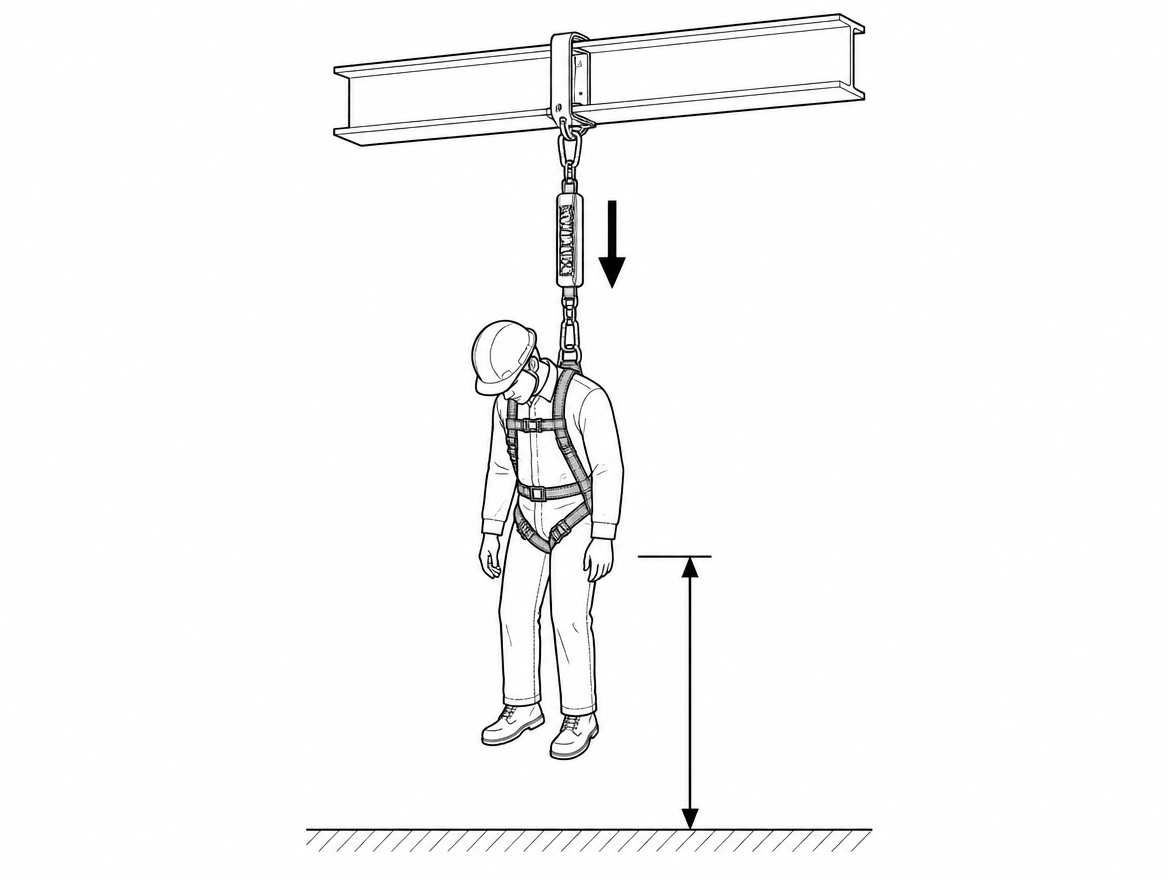
A fall-arrest system that works has done half its job. The worker is alive, the energy absorber has deployed , and the load is held – but a person hanging in a harness is not a person who has been rescued. Suspension is a time-critical condition, and in most fall scenarios the arrested worker cannot get themselves back to a working surface. The interval between the fall and the moment the casualty is back on a stable surface is the part of the system that is most often left undefined on site, and it is the part that EN 365 explicitly requires to be planned in advance: a rescue plan must be in place before personal fall protection equipment is used, and it must cover any emergency foreseeable during the work.
This article covers what has to be decided before the fall: how the load gets released from the fall-arrest system, which retrieval methods are realistic for a given work position, what equipment each method requires under the relevant EN standards, and how the casualty is handled once retrieved.
Why suspension time is the governing constraint
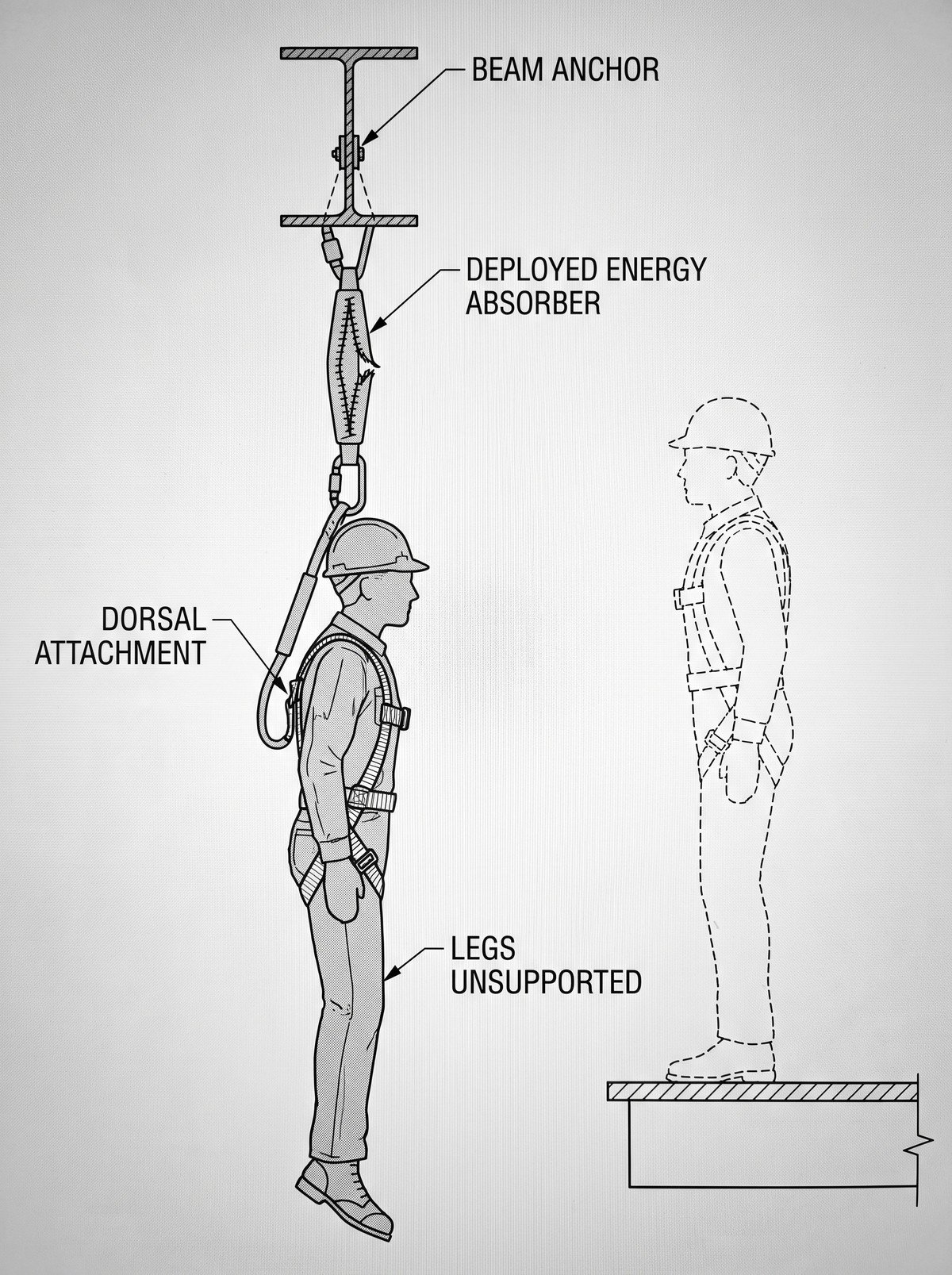
An arrested worker hangs in a full body harness (EN 361) with the load carried through the dorsal or sternal attachment. In that position the legs are unsupported and largely immobile, the harness leg straps compress the femoral vessels, and venous return from the legs is reduced. The result – commonly described as suspension intolerance or orthostatic intolerance in suspension – can produce dizziness, nausea, greying of vision and loss of consciousness. Onset varies enormously between individuals and with the severity of the fall: some people tolerate suspension for a long period, while others show symptoms within a few minutes, and an unconscious or injured worker who cannot use their legs at all is the worst case.
Two consequences follow for planning:
- Retrieval targets are measured in minutes. Many organisations set a planning target of getting the casualty onto a stable surface within roughly ten to fifteen minutes of the fall. Whatever figure a site adopts, it has to be justified by the equipment and people actually available at the work position, not by an aspiration.
- An emergency services call is not a rescue plan. Public rescue services may be a valuable second layer, but their response and set-up time is outside the employer’s control and is normally longer than the retrieval target above. Under the Framework Directive 89/391/EEC the employer is responsible for arranging first aid, evacuation and emergency response measures; that responsibility cannot be transferred to an external service by assumption.
A further point worth stating plainly, because outdated training material still circulates: the once-standard instruction to keep a retrieved casualty sitting or semi-upright to avoid so-called “rescue death” is not supported by the evidence review HSE published as Research Report RR708 (2009), which found no adequate basis for that specific first-aid instruction. Casualties retrieved from suspension should be assessed and treated as any other trauma casualty, with airway, breathing and circulation taking priority, and positioning decided by the first aider on clinical grounds.
Suspension relief straps buy time; they do not replace rescue
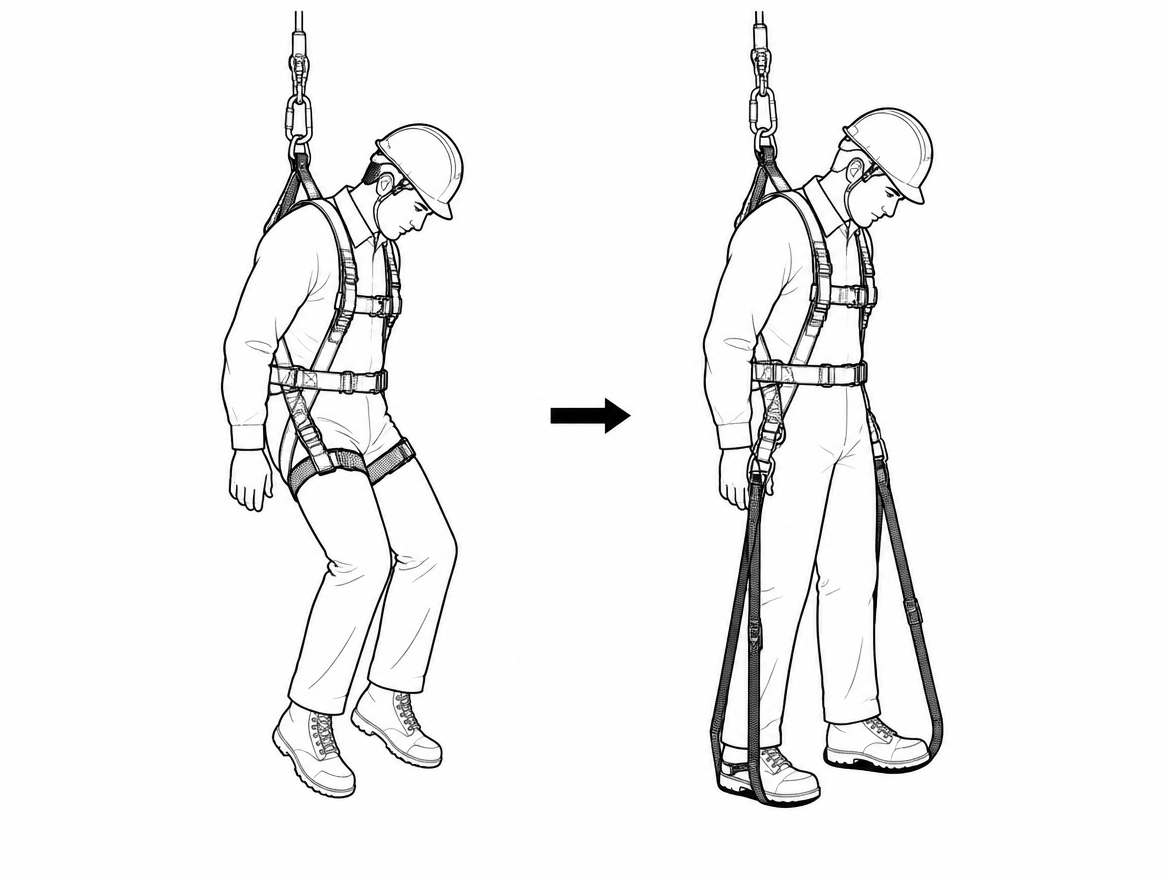
Suspension relief straps (also sold as trauma straps or relief steps) are short webbing loops stowed on the harness hip area. After a fall, a conscious worker deploys them, clips them together or to a harness attachment, and stands in the resulting stirrup to take load off the leg straps and restore some leg movement. They are cheap, they add almost no bulk, and they meaningfully extend tolerable suspension time.
Their limitations matter just as much. They require a conscious, uninjured worker with free hands, they do nothing for someone knocked unconscious or with an arm or spinal injury, and they do not return anyone to a working surface. They are a bridging measure that widens the window in which the planned rescue happens.
What the rescue plan has to specify
EN 365 requires the plan; the site decides its content. A plan that can actually be executed under pressure names the following for each work position or work phase:
- Who raises the alarm and how – the specific means of communication at that position, tested where radio or mobile coverage is doubtful.
- Who performs the rescue – named, trained, present on site during the work, and not the same person who might be the casualty.
- Which method is primary and which is the fallback – with the fallback triggered by a defined condition (for example: casualty unresponsive, or primary anchor unusable).
- Which equipment, stored where – pre-rigged as far as practicable, at or adjacent to the work position rather than in a store or a vehicle at the site gate.
- The anchor to be used for the rescue – identified before work starts, with its rating and, for anchor devices to EN 795, its type (A to E) and the fact that it is suitable for the loads a rescue imposes. Where a system may be loaded by more than one person simultaneously – casualty plus rescuer – the multi-user requirements of CEN/TS 16415 are the relevant reference.
- The clear path – where the casualty will be lowered or raised to, checked for obstructions, live plant, edges, energised conductors and traffic.
- The handover – first-aid provision on site and the route and access point for the ambulance service.
The plan is not a filed document if nobody has practised it. Rescue drills at realistic height, with the actual kit, are what turn a plan into a capability; annual practice is a common minimum, with additional practice whenever the method, kit or crew changes.
Assessing the scene before touching the system
The first actions after a fall are diagnostic, and they take seconds:
- Establish that the rescuer is protected. Approaching an unprotected edge to look at a casualty has killed rescuers. The rescuer’s own attachment goes on first, to an anchor independent of the one loaded by the casualty where that is possible.
- Determine whether the casualty is conscious and responsive. This decides whether self-rescue or relief straps are available at all, and whether the retrieval must be a pick-off with the casualty handled as a dead weight.
- Read the loaded system. Which anchor is loaded? Has the energy absorber deployed to full length (which changes the casualty’s position and the clearance below)? Is the lanyard or lifeline bearing on an edge, a sharp profile or a corner? Was there a swing fall that has left the casualty over an obstruction or against a structure?
- Identify secondary hazards – suspended loads, hot surfaces, moving plant, confined-space atmosphere, contact with electrical apparatus.
Retrieval methods, and what each one requires
Assisted self-rescue
A conscious worker who has fallen a short distance and is within reach of a stable surface, a ladder, or a work platform may be able to regain it with assistance and with the fall-arrest system still connected. This is the fastest option where it is genuinely available. It stops being available the moment the casualty is free-hanging away from structure, or is injured, or is out of reach.
Rescue by mobile elevating work platform
Where a MEWP can be positioned under or beside the casualty, it is often the simplest method: the platform is brought up, the casualty is supported and connected to an anchor in the platform basket, the fall-arrest connection is released once the load has transferred, and the platform is lowered. It depends entirely on ground conditions, machine availability and an operator on site at the time – which is why a MEWP-based plan needs the machine and operator held available for the duration of the work at height, not merely present on site.
Controlled lowering with a descender device
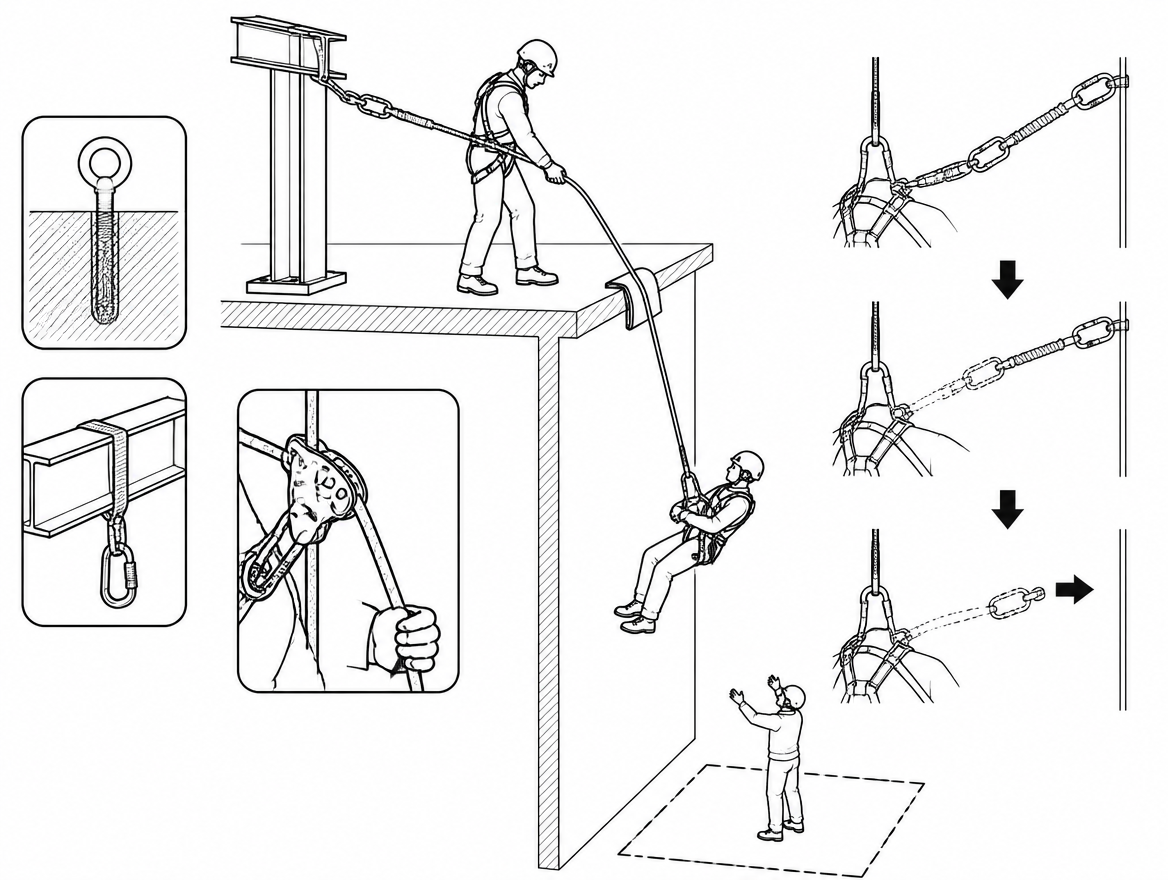
Lowering is usually the method of choice for a free-hanging casualty when there is clear space below. It uses a descender device for rescue conforming to EN 341, which classifies devices by the descent energy they are rated to dissipate and requires marking of the permissible descent height and load range. The rescue line is attached to the casualty’s harness, the load is transferred from the fall-arrest system to the rescue line, the fall-arrest connection is released, and the casualty is lowered at a controlled rate to a landing area that has been checked and kept clear.
Points that decide whether this works in practice: the descender must be rated for the actual descent height at that work position; the rope must be an appropriate low-stretch kernmantle line (EN 1891) of the type specified by the device manufacturer; edge protection is needed wherever the line runs over a parapet, purlin or beam flange; and someone must be at the landing point to receive the casualty.
Raising with a rescue lifting device
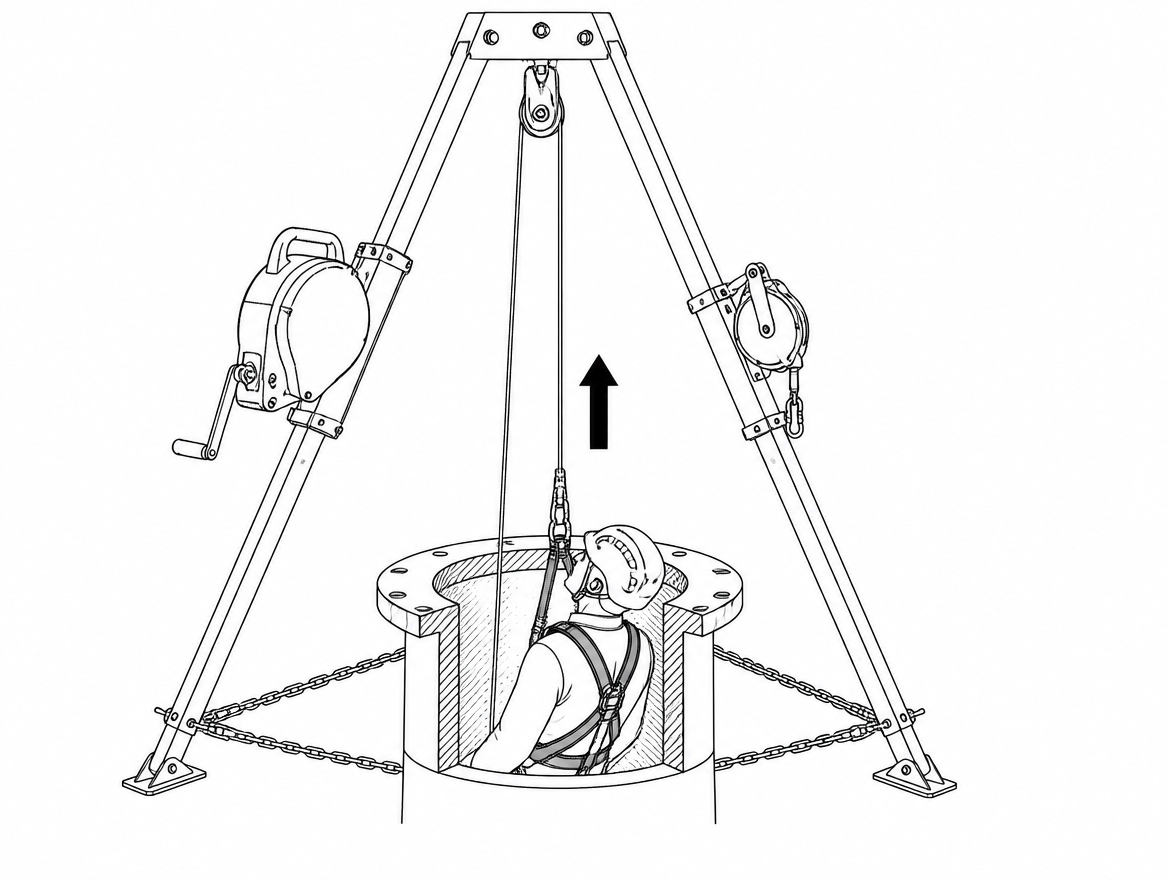
Where there is no clear space below – a shaft, a tank, a silo, a manhole, water beneath – the casualty has to come up. Rescue lifting devices are covered by EN 1496, which distinguishes Class A devices, intended for raising, from Class B devices, which can lower as well as raise. Many retractable type fall arresters to EN 360 used with a tripod or davit arm have an integrated retrieval winch certified to EN 1496, and this is the standard arrangement for confined-space entry: the entrant is protected against a fall and can be recovered through the same opening without a rescuer entering.
Raising a dead weight by hand is heavy work. Where the geometry allows it, a mechanical advantage system built with pulleys to EN 12278 and progress-capture reduces the required force, at the cost of rope travel and set-up time. That trade-off is a decision to make while writing the plan, not while a casualty is hanging.
Pick-off rescue by a rope access team
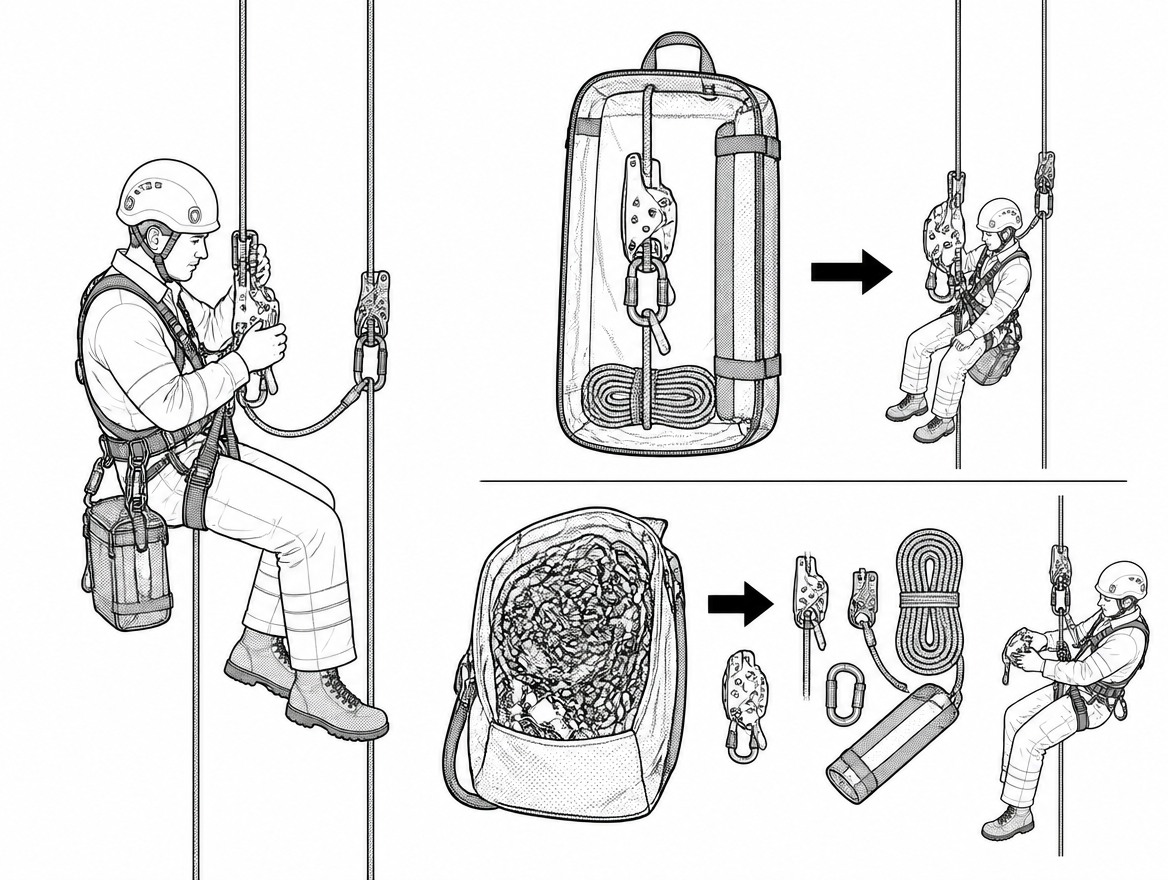
When the casualty is unconscious, entangled, injured such that they cannot assist, or positioned where neither a straight lower nor a straight raise reaches them, a rescuer has to go to the casualty. This is rope access work: it uses rope adjustment devices to EN 12841 (type A back-up, type B ascent, type C descent) on a two-rope system, a sit harness to EN 813 in combination with the full body harness, and connectors to EN 362. The rescuer reaches the casualty, connects them to their own system, transfers the casualty’s load off the fall-arrest system, and descends with them.
Pick-off rescue is a trained discipline with real technical depth and it does not transfer from a classroom to a structure without practice. Sites relying on it need either a competent in-house team, kept in practice, or a contracted rope access provider with a defined response time – and the contract has to reflect the retrieval target.
Releasing the load from the fall-arrest system
The word “release” is where improvised rescues go wrong. A fall-arrest lanyard or lifeline holding a person’s full body weight cannot simply be unclipped: a loaded connector cannot be opened, and a loaded connector that is opened drops the casualty. The sequence is always the same, in this order:
- Attach the rescue system to the casualty’s harness, using a designated attachment point on the EN 361 harness, or a rescue harness (EN 1497) or rescue loop (EN 1498) where one is used.
- Transfer the load onto the rescue system – by raising the casualty slightly, or by taking the weight through the rescue line – until the fall-arrest connection is slack.
- Confirm the fall-arrest connector is genuinely unloaded, then open and remove it.
- Only then lower or raise.
Cutting a loaded lanyard is not a load-transfer method. Where a knife is carried for cutting entangled webbing, it is used after the load has transferred and after the connection to be cut has been positively identified; cutting the wrong line, or cutting before transfer, is a fatal error. For the same reason, rescue kits that are pre-rigged with the transfer step built in – a descender pre-installed on the rope, a set of connectors already attached, edge protection in the bag – consistently outperform a bag of loose components when the crew is under pressure.
After the retrieval: casualty, equipment, and system
The casualty. Even where there is no visible injury, a fall arrest imposes significant forces on the body and a period of suspension carries the physiological effects described above. The casualty is handed to first aid and referred for medical assessment, and is not returned to work at height on the basis of feeling fine.
The equipment. Every item that took part in the arrest – harness, energy absorber, lanyard, retractable device, connectors, anchor device, and any rope loaded during the rescue – comes out of service immediately and is quarantined so it cannot be picked up and reused. Under EN 365, equipment involved in a fall is withdrawn from use until examined and released in writing by a competent person; energy absorbers and lanyards that have arrested a fall are normally scrapped rather than repaired. EN 365 also sets the framework for the routine regime that should already have been in place: periodic examination by a competent person at intervals of no more than 12 months, with records, and pre-use checks by the user before each use.
The system. An arrested fall is a system failure upstream of the harness. The investigation looks at why the fall happened, whether collective protection could have removed the need for personal fall protection in the first place, whether the anchor and clearance were correct, and whether the rescue met the planned retrieval time. ISO 45001 clause 8.2 requires that emergency response arrangements are tested and, where necessary, revised – a real event is the most informative test a site will ever get, and the findings belong in the revised plan.
Concrete takeaway
Before the next work-at-height task starts, three questions should have documented answers: who retrieves a suspended worker at this specific position, with which equipment stored where, and in how many minutes – demonstrated, not estimated. If the answer to any of them is “we would call the emergency services,” the fall protection system described in EN 363 is incomplete, because a personal fall protection system includes the means of getting the arrested person back to safety.
Next step: review the rescue arrangements for each work position against the instructions for use supplied with your descender (EN 341) or rescue lifting device (EN 1496), confirm the rescue anchor is rated and identified, and schedule a timed drill with the crew who would actually perform the rescue.
Frequently asked questions
Why is suspension after a fall arrest treated as time-critical?
An arrested worker hangs in a full body harness with the load carried through the dorsal or sternal attachment, leaving the legs unsupported and largely immobile. The leg straps compress the femoral vessels and venous return from the legs is reduced, which can produce dizziness, nausea, greying of vision and loss of consciousness. Onset varies enormously between individuals and with the severity of the fall – some people tolerate suspension for a long period, others show symptoms within a few minutes, and an unconscious or injured worker who cannot use their legs at all is the worst case.
How quickly should a retrieval plan get the casualty back onto a stable surface?
Many organisations set a planning target of getting the casualty onto a stable surface within roughly ten to fifteen minutes of the fall. Whatever figure a site adopts has to be justified by the equipment and people actually available at the work position, not by an aspiration.
Can calling the emergency services count as the rescue plan?
No. Public rescue services may be a valuable second layer, but their response and set-up time is outside the employer's control and is normally longer than a ten to fifteen minute retrieval target. Under the Framework Directive 89/391/EEC the employer is responsible for arranging first aid, evacuation and emergency response measures, and that responsibility cannot be transferred to an external service by assumption.
Do suspension relief straps replace the need for a rescue?
No. Relief straps (also sold as trauma straps or relief steps) are short webbing loops stowed on the harness hip area; a conscious worker deploys them and stands in the resulting stirrup to take load off the leg straps and restore some leg movement. They require a conscious, uninjured worker with free hands, do nothing for someone knocked unconscious or with an arm or spinal injury, and do not return anyone to a working surface. They are a bridging measure that widens the window in which the planned rescue happens.
Should a retrieved casualty be kept sitting upright to avoid "rescue death"?
That once-standard instruction is not supported by the evidence review HSE published as Research Report RR708 (2009), which found no adequate basis for that specific first-aid instruction. Casualties retrieved from suspension should be assessed and treated as any other trauma casualty, with airway, breathing and circulation taking priority, and positioning decided by the first aider on clinical grounds.
Need this as a document you can issue? The template library gives you the risk assessments, permits and inspection logs in editable form — and employer plans cover a whole team with completion records.