Safety / Tips and Tricks / Rope access and confined space
Activity 01 · Rope access
Release and Rescue from a Long Rope: Getting a Suspended Worker Down Safely
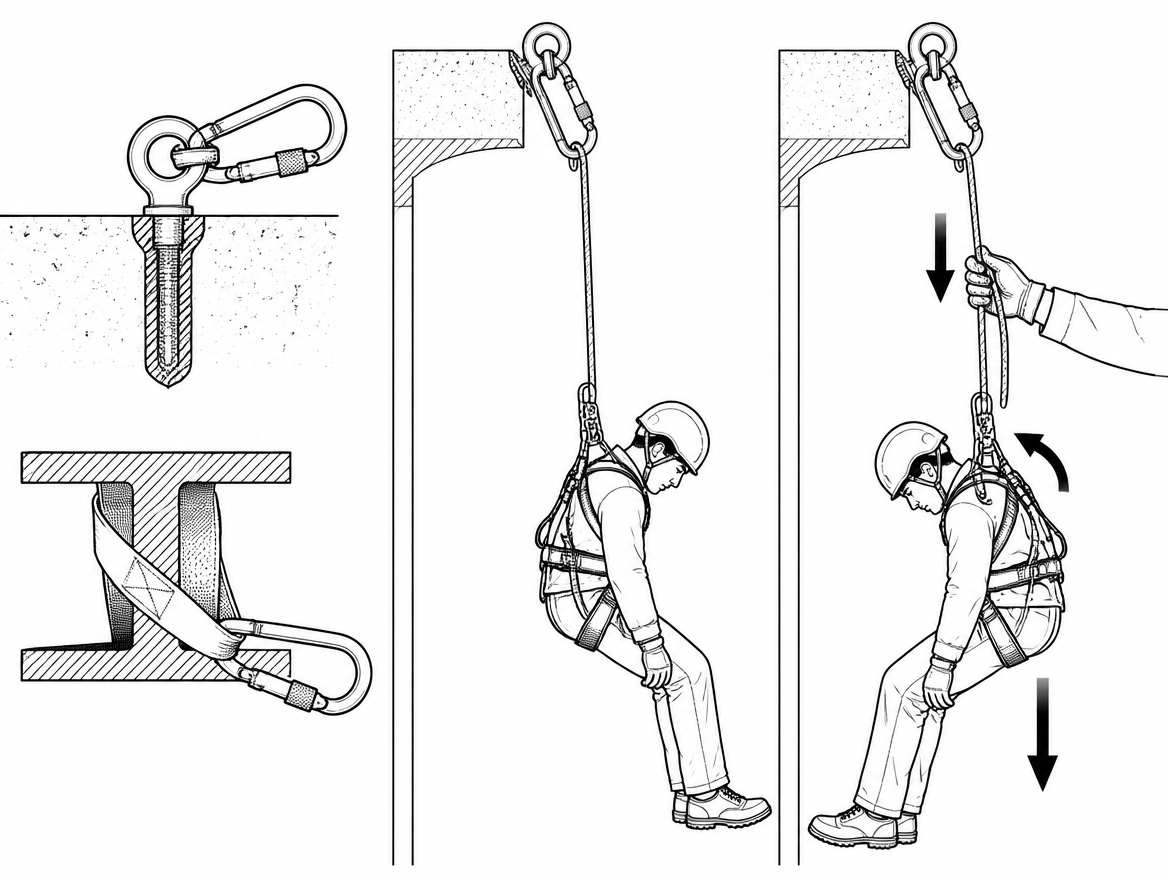
When a worker ends up suspended part-way down a long rope — on a work line in a rope access system, on a guided-type fall arrester on a vertical anchor line, or on a lifeline after an arrested fall — the clock starts immediately. The casualty is out of reach from above and from below, the loaded device on the rope cannot simply be opened, and no ladder, MEWP or pole rescue will bridge the distance. Everything then depends on three decisions made in the first minutes: whether the casualty can help themselves, how the load is transferred off the jammed device, and whether the casualty travels down or up. This article sets out how those decisions are made and what equipment and standards govern each of them.
Why a long rope is a different rescue problem
Short-lanyard rescues on a roof edge or a scaffold platform are usually solved by proximity: the team can reach the casualty, support them on a second anchor, and pull them back over the edge. A long rope removes that option. Typical complications on a 30–100 m working length:
- The casualty is mid-span. Neither the anchor above nor the ground below is within reach, so a rescuer has to travel to them or the casualty’s own line has to be converted into a lowering line.
- Rope stretch becomes measurable. EN 1891 limits static elongation of low-stretch kernmantle rope to 5 %. On a long working length that means the casualty will drop noticeably the moment their weight transfers onto a new line — enough to shock-load a slack system or trap a limb.
- Descent energy is finite. Descender devices for rescue to EN 341 are supplied with a manufacturer-declared maximum descent height and maximum total descent energy. A long single-pitch lowering can approach both, and the device gets hot while doing it.
- Communication degrades. Voice contact fails over distance, in wind and through hearing protection. Radios or agreed hand signals have to be part of the plan, not improvised on the day.
- Suspension intolerance is running in the background. A motionless suspended casualty can develop pre-syncope symptoms within minutes. The rescue has to be measured in minutes, not in the time it takes an external team to arrive, mobilise and rig.
The rescue plan is a legal and system requirement, not an extra
EN 365 requires that a rescue plan be in place for every situation where personal fall protection equipment is used, and EN 363 treats the rescue system as one of the recognised personal fall protection systems — not as an accessory to the fall arrest system. For organisations working to ISO 45001:2018, clause 8.2 on emergency preparedness and response requires the planned response to be tested periodically, which for long-rope work means rehearsed rescues at realistic heights and rope lengths, not a tabletop discussion.
For rope access work in the EU, Annex II of Directive 2009/104/EC establishes the two-line principle: as a general rule a working line and a separately anchored safety line. That principle carries straight into the rescue: the rescuer who goes to the casualty descends on their own working line with a backup device on an independent safety line, and does not clip into the casualty’s compromised system as a substitute.
A workable plan for long-rope work names, for each work position:
- the rescue method (assisted self-rescue, remote lowering, pick-off and counterbalance lowering, or raise);
- the specific kit and where it is stored — descender to EN 341 or rope adjustment device to EN 12841 Type C, backup to EN 12841 Type A, ascending device to EN 12841 Type B, pulleys to EN 12278, rescue harness to EN 1497 or rescue loop to EN 1498 if the casualty may be unconscious;
- rope lengths on site against the actual drop, plus tail;
- who is competent to perform it, and who takes command;
- the handover point and access route for the emergency services.
First: can the casualty assist themselves?
Assisted self-rescue is faster than any rigged rescue and should be assessed before a rescuer commits to the rope. A conscious, uninjured casualty suspended in a harness to EN 361 can often resolve the situation with instruction from the ground or the anchor level.
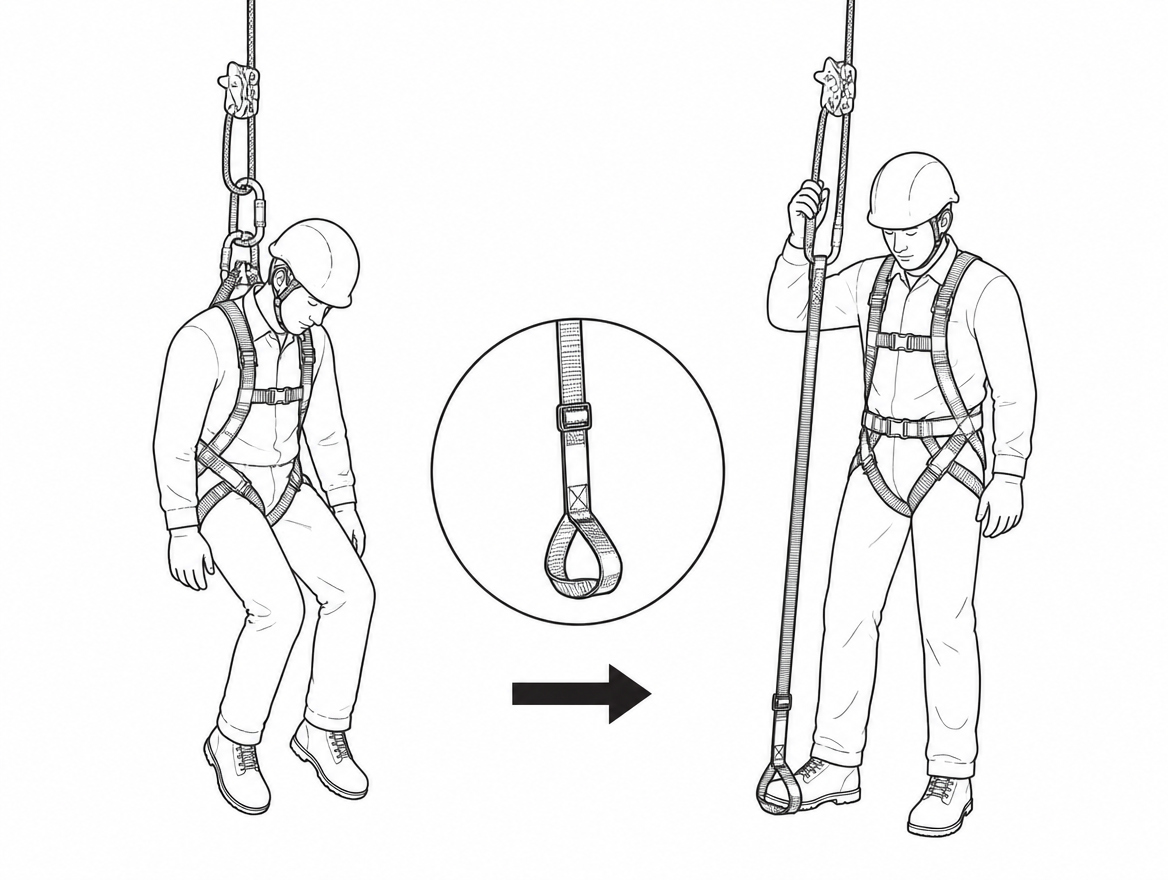
- Relieve the leg loops. Suspension relief straps or a foot loop let the casualty stand and restore venous return. Where the harness has integrated relief straps, they are deployed from the hip attachment points. If the casualty is near the structure, pushing against it with the legs achieves the same effect.
- Re-establish a working position. On a rope access system, the casualty may be able to unweight and reset a jammed EN 12841 Type A backup device and continue the descent on their own EN 12841 Type C device.
- Keep them talking. Continuous voice or radio contact tells the team whether the casualty’s condition is stable and whether self-rescue remains realistic. The moment answers become confused or slow, treat it as a full rescue.
Where the fall was arrested by an energy absorber to EN 355, expect the extended absorber to have added length to the system and note that the absorber and the harness are now to be withdrawn from service and examined under the manufacturer’s instructions, in line with EN 365 — regardless of how the casualty gets down.
Releasing a device that is loaded with the casualty’s weight
This is the technical heart of a long-rope rescue. A guided-type fall arrester on a flexible anchor line to EN 353-2, or a backup device to EN 12841 Type A, clamps the rope under load. It cannot be slid, opened or removed while it carries the casualty. Release always follows the same sequence:
- Build an independent load path. The casualty’s weight must be capable of being carried by something other than the jammed device — the rescuer’s own descender, a rescue lifting device to EN 1496 rigged at the anchor, or a haul system on an anchor device to EN 795.
- Connect the casualty to it. A short connection between the casualty’s sternal or dorsal attachment point and the rescuer’s system keeps the casualty high relative to the rescuer, which matters when the pair passes obstructions. Where the casualty is unresponsive and cannot be trusted to stay upright in a fall arrest harness alone, a rescue loop to EN 1498 or a rescue harness to EN 1497 supports the torso.
- Take up the slack completely. On a long rope, any slack in the new load path is converted into a drop the moment the casualty transfers, amplified by rope elongation. Tension the new path before unweighting anything.
- Transfer the load. Raise the casualty a few centimetres — using an ascending device to EN 12841 Type B and a foot loop, a small mechanical advantage system, or the rescue lifting device — until the jammed device is visibly slack.
- Release and remove the device. Only now can the fall arrester or backup be opened and taken off the line, or the shock-loaded lanyard disconnected.
Cutting a loaded rope or a loaded lanyard is a last-resort technique for teams that have specifically trained for it, and it is only ever done after the casualty is fully supported on two independent load paths and the correct connection to be cut has been positively identified by touch and sight. It is not a shortcut around the load transfer above.
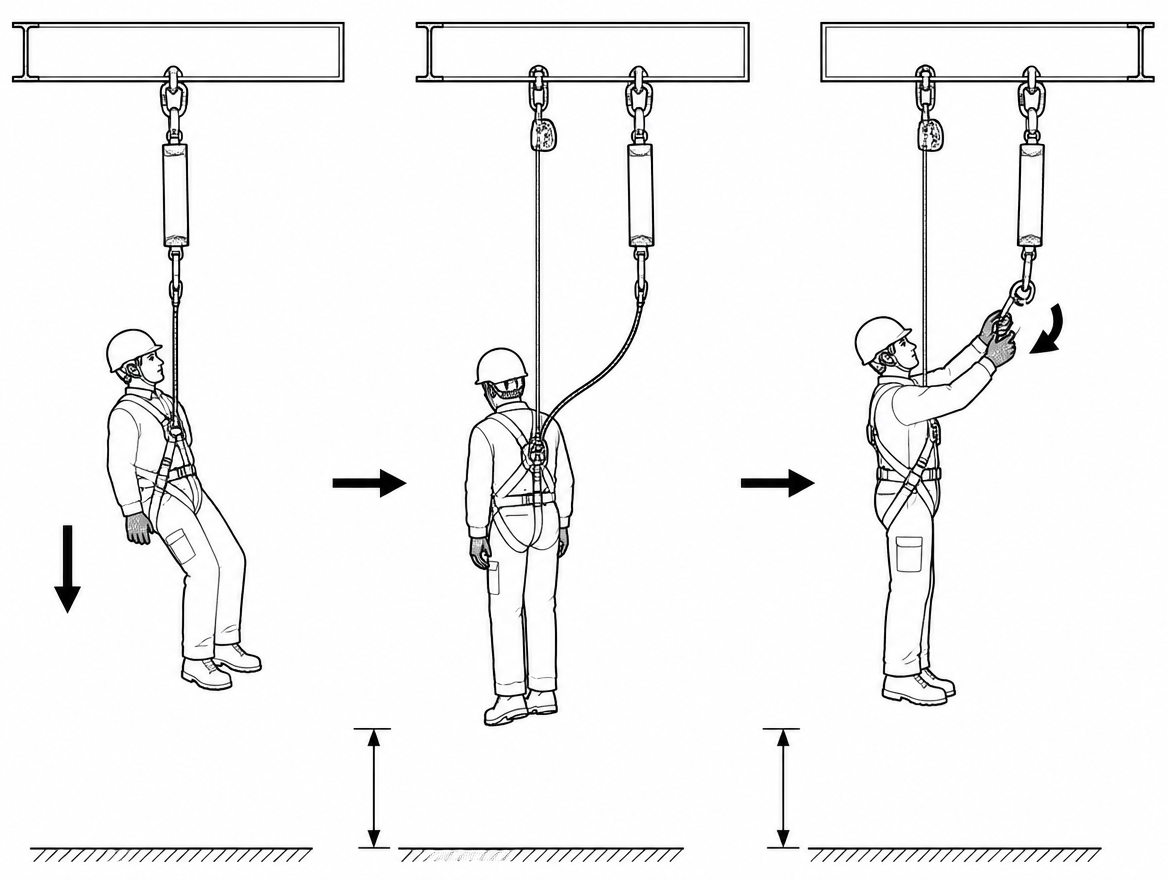
Down or up? Deciding by geometry, not by habit
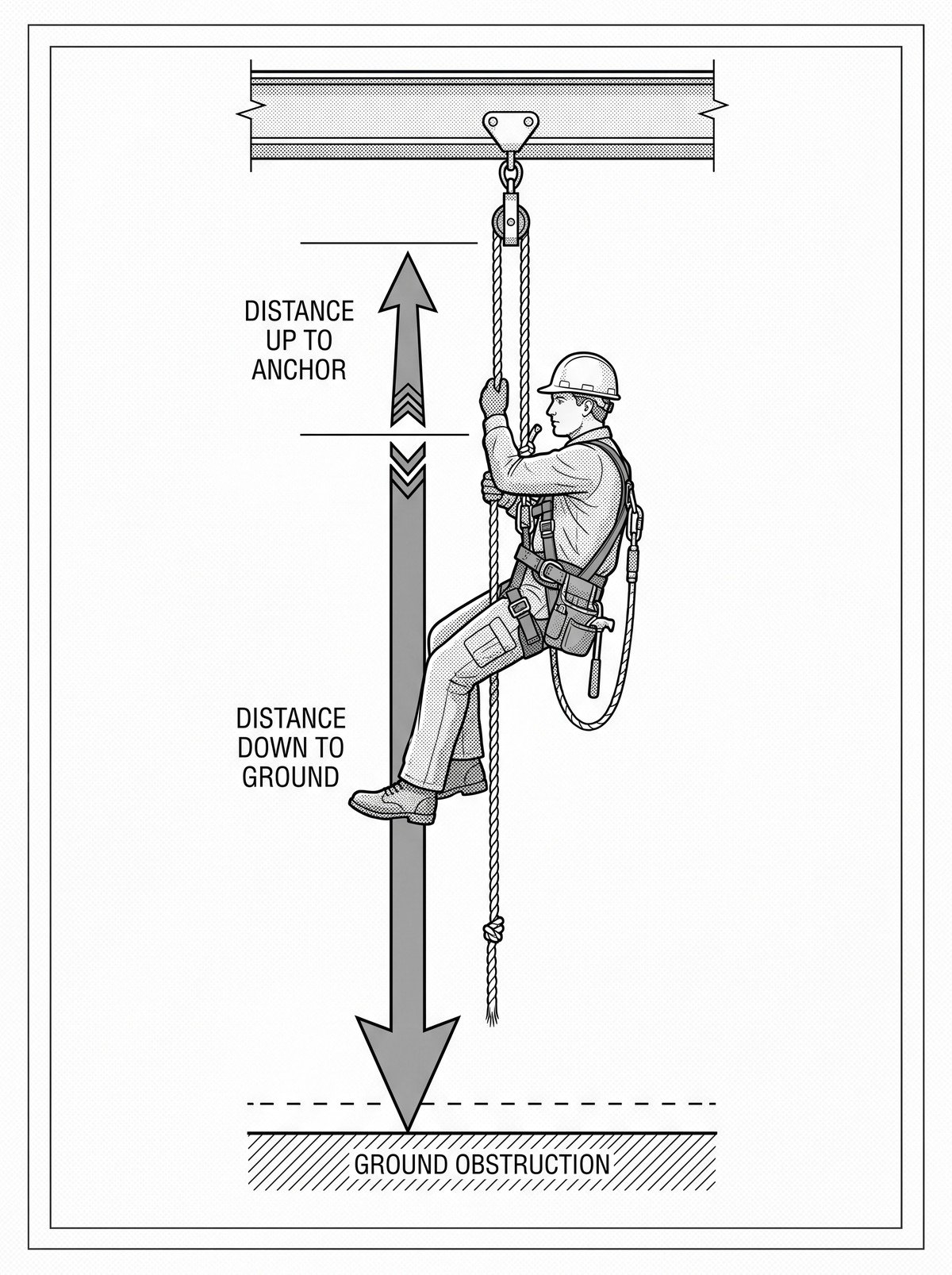
Lowering is normally the first choice. It works with gravity, needs less equipment and less force, and one rescuer can control it. It is only viable if the ground below is clear and reachable.
Choose lowering when
- there is a clear, attended landing area below with no obstructions, live plant, water or traffic;
- the rope in service is long enough for the full remaining drop plus a tail, with a stopper knot at the end;
- the descender in use is within its declared maximum descent height and descent energy for the mass being lowered — two people on a counterbalance lowering is roughly double the mass of a single descent, and the manufacturer’s instructions to EN 341 are the reference for whether that is permitted;
- the rope path is protected wherever it crosses an edge or fitting.
Choose raising when
- the casualty is below an overhang, inside a shaft, or above a hazard that cannot be cleared;
- remaining rope length below the casualty is unknown or insufficient;
- the anchor level offers a safe, level working platform for the team and the casualty needs to be recovered over an edge.
Raising demands mechanical advantage — commonly a 3:1 or 5:1 arrangement built with pulleys to EN 12278, a rope clamp for progress capture and a rope grab as a load-holding device — and it increases the force on the anchor. Anchor devices to EN 795 are selected and installed for the loads the rescue will generate, not just for the loads of the work task, and the structure they are fixed to has to be verified for it. Where a rescue lifting device to EN 1496 is installed, models rated for lowering as well as raising give the team the option to change direction mid-rescue; confirm the rating in the instructions rather than assuming it.
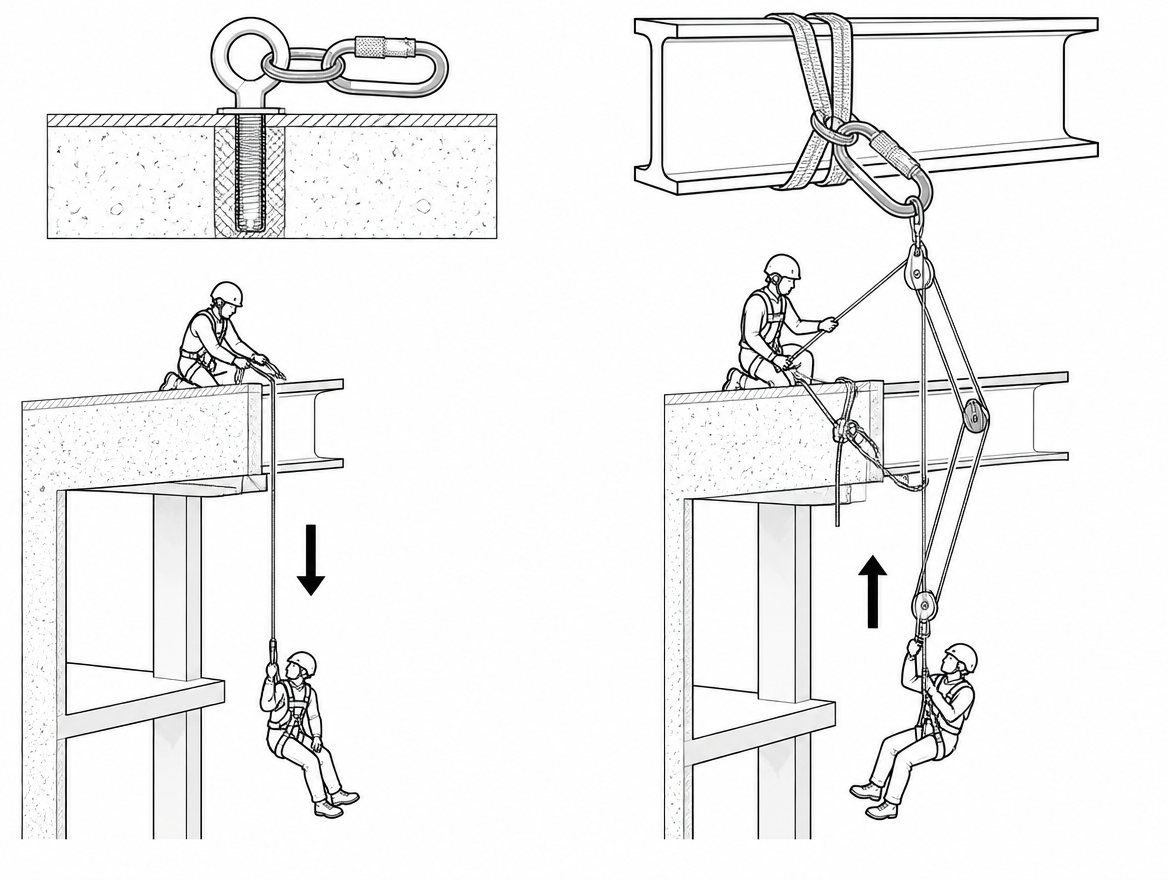
Remote lowering from the anchor
If the casualty’s suspension is taken by a line that runs to an accessible anchor, the fastest long-rope rescue often involves no rescuer on the rope at all. The line is transferred to a lowering device at the anchor and the casualty is lowered from above.
What has to be verified before committing:
- Which line actually carries the load. Follow the loaded line by hand from the anchor to confirm it is the one under tension, and identify what the second line is doing.
- Rope length below the casualty. Measured or known, not estimated from the ground.
- The casualty’s own devices. A backup device to EN 12841 Type A on a second line will arrest the descent partway down unless it is released or the second line is managed. A lowering that suddenly stops with the casualty out of reach is a worse position than the starting one.
- Edge and friction. Rope protection at the edge, and awareness that friction over an edge or through a redirect reduces the force felt at the device and changes the feel of the lower.
- Rope end control. A stopper knot in the end of the lowering line, and a person tending the tail.
The device at the anchor is a descender device for rescue to EN 341 or a rope adjustment device for descent to EN 12841 Type C used in accordance with its instructions for lowering a load. Not every descender is approved for lowering another person; that permission comes from the manufacturer’s instructions, and a device rated only for personal descent is not to be pressed into service as a lowering device.
Pick-off and counterbalance lowering
When the casualty’s line cannot be released from above — a shock-loaded fall arrester on a fixed anchor line, a damaged rope, an unresponsive casualty who cannot manage their own devices — a rescuer descends to them.
- The rescuer rigs on an independent working line with a backup device on a separate anchored safety line, and descends past or alongside the casualty so that the rescuer’s attachment ends up slightly below the casualty’s.
- The casualty is connected short to the rescuer’s system and the connection is tensioned.
- The rescuer raises the casualty just enough to unweight the jammed device, using an ascending device and foot loop or a small haul, then releases and removes it.
- The pair descends on the rescuer’s descender, with the rescuer controlling speed and keeping the casualty clear of the structure. Both masses are now on one device, which changes braking force and heat build-up — a controlled, steady descent with a planned stop is better than a fast one.
- On the ground, the casualty is disconnected only once fully supported, and the harness is not cut off in a way that destroys evidence needed for the incident investigation.
The connecting element between rescuer and casualty is load-rated equipment — a lanyard to EN 354, an adjustable rescue connection supplied for the purpose, or a sling and connector rated for the combined load. Improvised connections made from work positioning belts to EN 358, which are not designed to arrest a fall or to suspend a person, do not belong in this chain.
Managing the casualty after release
Suspension intolerance is the reason the whole exercise is time-critical, and it does not stop being relevant at the moment of release. While the casualty is still suspended, encouraging leg movement, use of relief straps or pushing against the structure supports venous return. Once the casualty is down, treatment follows current resuscitation and first-aid protocol as taught to the site’s first aiders and as directed by the responding medical service. The older practice of holding a rescued casualty upright for a fixed period after suspension is no longer supported by current resuscitation guidance; the site’s medical protocol, not folklore, governs post-rescue positioning.
Practical handover points for the emergency services: the exact access route to the base of the drop, the height and position of the casualty, whether they were suspended and for roughly how long, whether they are already down, and what equipment is still loaded or unstable.
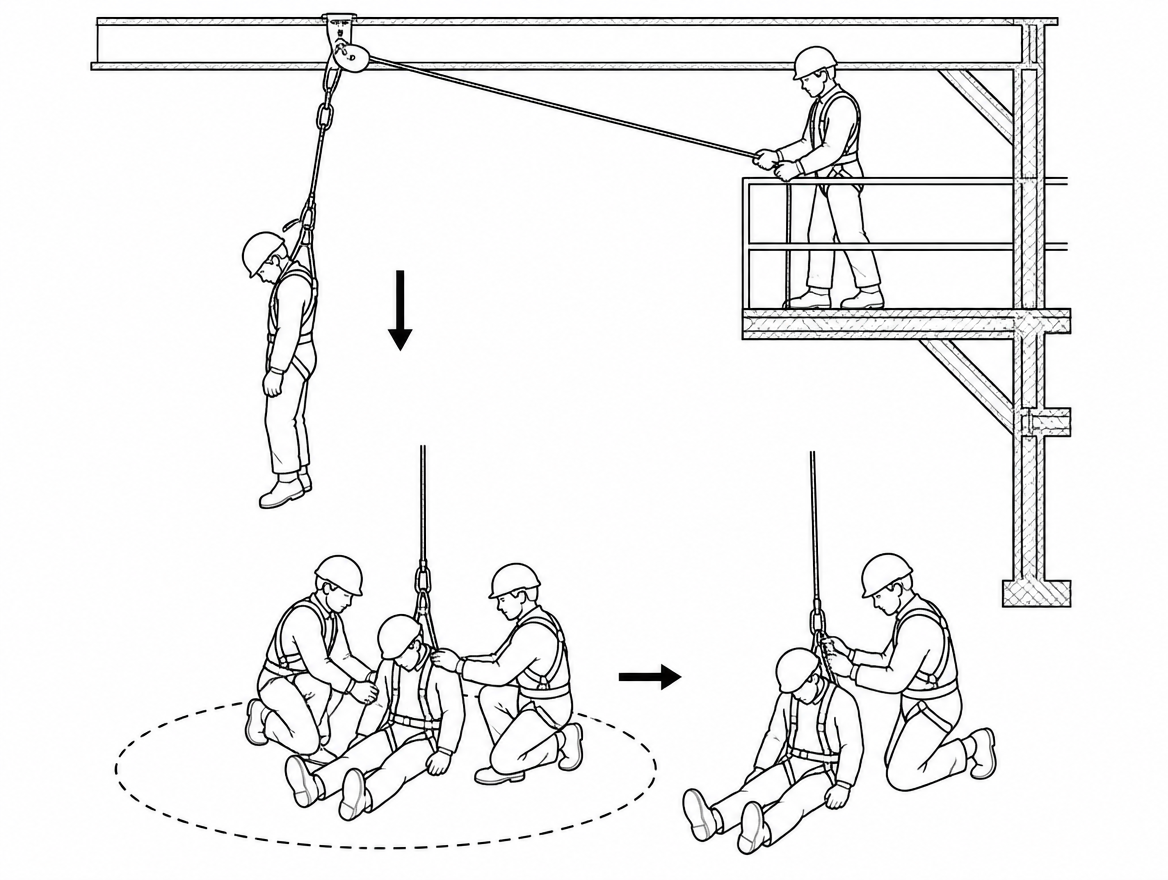
What to check before the next long-rope task
- Rope lengths on site cover the full drop plus tail, and are recorded against each work position.
- Rescue kit is at the workface, not in a vehicle or a store — descender rated for lowering a person, ascending device, backup device, pulleys, connectors, rescue loop or rescue harness if unconscious-casualty rescue is foreseeable.
- The declared maximum descent height and descent energy of the descender have been checked against the actual drop and the likely rescue mass.
- Anchors are selected for rescue loads, including the higher loads generated by a raise.
- Two people on site are competent to perform the planned method, and the method has been rehearsed at realistic height within the last review period.
- Communication method is agreed and tested at the actual distance involved.
- Edge protection is in place wherever a working, safety or rescue line crosses an edge.
- Every item involved in an arrested fall is withdrawn from service and referred for examination.
The next step is to read the rescue plan for a specific work position against this list and identify which of the four methods — assisted self-rescue, remote lowering, pick-off and counterbalance lowering, or raise — it actually names, and whether the equipment on site supports it. Where the plan says only “call the emergency services”, it is not a rescue plan in the sense EN 365 requires. For the underlying equipment requirements, work from the manufacturer’s instructions together with EN 341, EN 12841, EN 1496 and EN 795.
Frequently asked questions
Why is a long rope a different rescue problem from a short-lanyard rescue?
Short-lanyard rescues on a roof edge or scaffold platform are usually solved by proximity: the team can reach the casualty, support them on a second anchor and pull them back over the edge. On a long rope the casualty is mid-span, so neither the anchor above nor the ground below is within reach. A rescuer has to travel to them or the casualty's own line has to be converted into a lowering line, and no ladder, MEWP or pole rescue will bridge the distance.
How much stretch should be expected on a long working length?
EN 1891 limits static elongation of low-stretch kernmantle rope to 5 %. Over a 30–100 m working length that means the casualty will drop noticeably the moment their weight transfers onto a new line — enough to shock-load a slack system or trap a limb.
What do the standards require in terms of a rescue plan?
EN 365 requires a rescue plan for every situation where personal fall protection equipment is used, and EN 363 treats the rescue system as one of the recognised personal fall protection systems rather than an accessory to the fall arrest system. For organisations working to ISO 45001:2018, clause 8.2 on emergency preparedness and response requires the planned response to be tested periodically — for long-rope work that means rehearsed rescues at realistic heights and rope lengths, not a tabletop discussion.
Can the rescuer clip into the casualty's system?
No. Annex II of Directive 2009/104/EC establishes the two-line principle for rope access in the EU: as a general rule a working line and a separately anchored safety line. That carries into the rescue — the rescuer descends on their own working line with a backup device on an independent safety line and does not clip into the casualty's compromised system as a substitute.
What can a conscious casualty do to help themselves while the rescue is rigged?
Assisted self-rescue is faster than any rigged rescue and should be assessed first. Suspension relief straps or a foot loop let the casualty stand and restore venous return; where the harness has integrated relief straps they are deployed from the hip attachment points, and if the casualty is near the structure, pushing against it with the legs achieves the same effect. On a rope access system they may be able to unweight and reset a jammed EN 12841 Type A backup device and continue the descent on their own Type C device. Continuous voice or radio contact must be kept — the moment answers become confused or slow, treat it as a full rescue.
Need this as a document you can issue? The template library gives you the risk assessments, permits and inspection logs in editable form — and employer plans cover a whole team with completion records.