Safety / Tips and Tricks / Rope access and confined space
Activity 01 · Rope access
Release and Rescue of a Co-Worker Using a Rescue Kit
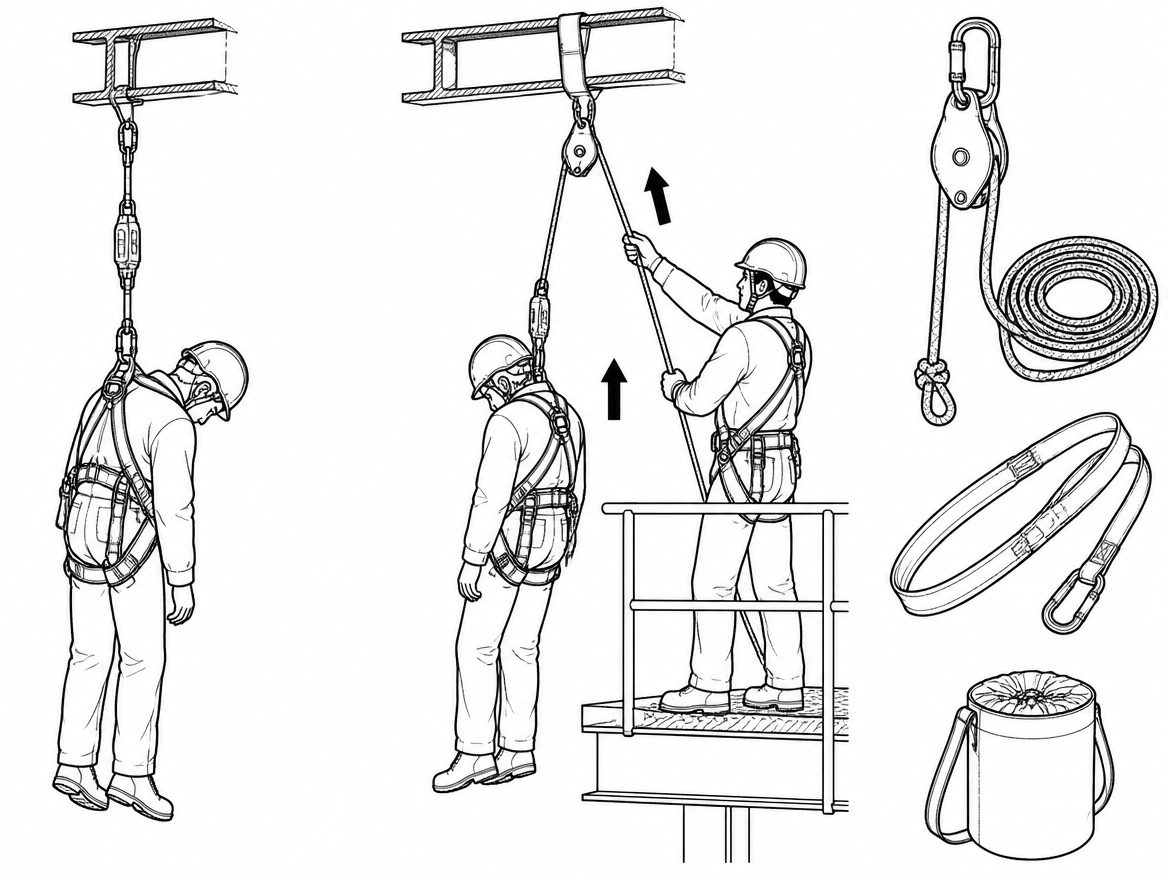
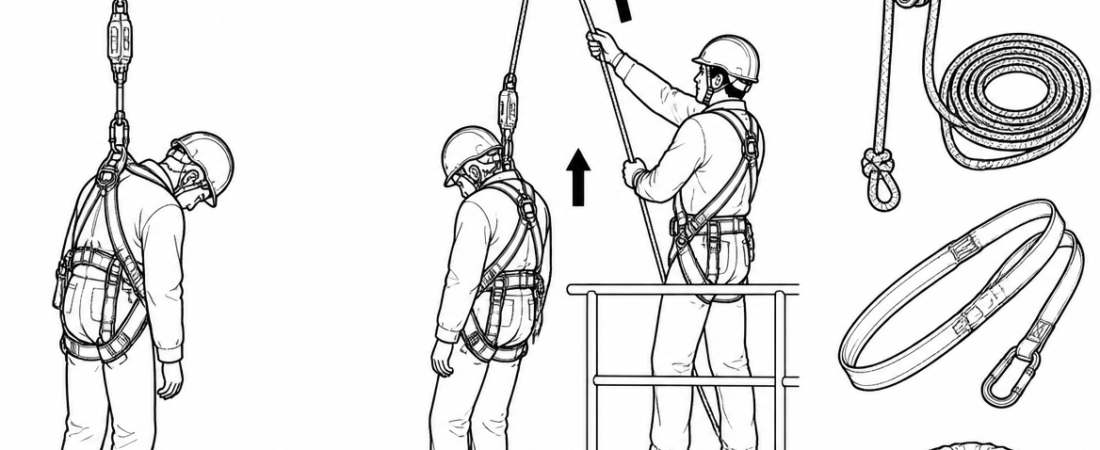
A worker whose fall has been arrested is not safe. They are alive, and they are hanging in a harness, motionless, with their body weight concentrated in the thigh straps and their legs unable to pump blood back to the heart. Suspension intolerance can begin to produce symptoms within minutes. That is the whole reason a rescue kit exists on site: to get a suspended casualty released from the fall arrest system and back onto a stable surface without a second person joining them in the air, and without waiting for a fire and rescue service that may need half an hour to arrive and rig. This article covers what a rescue kit contains, the standards that govern its parts, and the sequence used to release and lower a suspended co-worker.
Why the arrest is only half the system
EN 363 treats personal fall protection as a set of complete systems, and a rescue system is one of them. A fall arrest system that stops a fall but leaves no way of retrieving the person is an incomplete arrangement, not a compliant one. ISO 45001 makes the same point from the management side: clause 8.2 requires planned, tested emergency preparedness and response for identified emergency situations, and a suspended worker at height is exactly that.
The practical consequence is that the rescue method has to be decided before anyone goes up, written into the rescue plan for that specific location, and rehearsed with the equipment that will actually be on site. “Call the emergency services” is a valid element of a rescue plan only where the realistic response and rigging time is inside the tolerance the risk assessment sets for that casualty.
What suspension intolerance actually does
The mechanism is orthostatic: an upright, immobile suspended posture allows blood to pool in the legs, venous return drops, and the casualty becomes pre-syncopal. Typical progression is pallor, sweating, nausea, dizziness, visual disturbance and then loss of consciousness. An unconscious casualty slumped in a harness may also have their airway compromised by head position.
Two operational points follow. First, an alert casualty who can get weight onto their legs, stand in suspension relief straps, or reach a ladder or step buys time and should be encouraged and coached to do so while the rescue system is rigged. Second, guidance on post-rescue positioning has changed: the older instruction to keep a rescued casualty sitting upright for a period before laying them flat has been withdrawn by a number of national bodies. Site first aiders should work to the current national first-aid protocol they are trained under, not to legacy course material, and should tell arriving medical responders how long the casualty was suspended.
What is in a rescue kit, and which standard covers each part
Kits are sold pre-rigged and bagged, but the reader who has to trust one should be able to identify the parts and the conformity claim behind each.
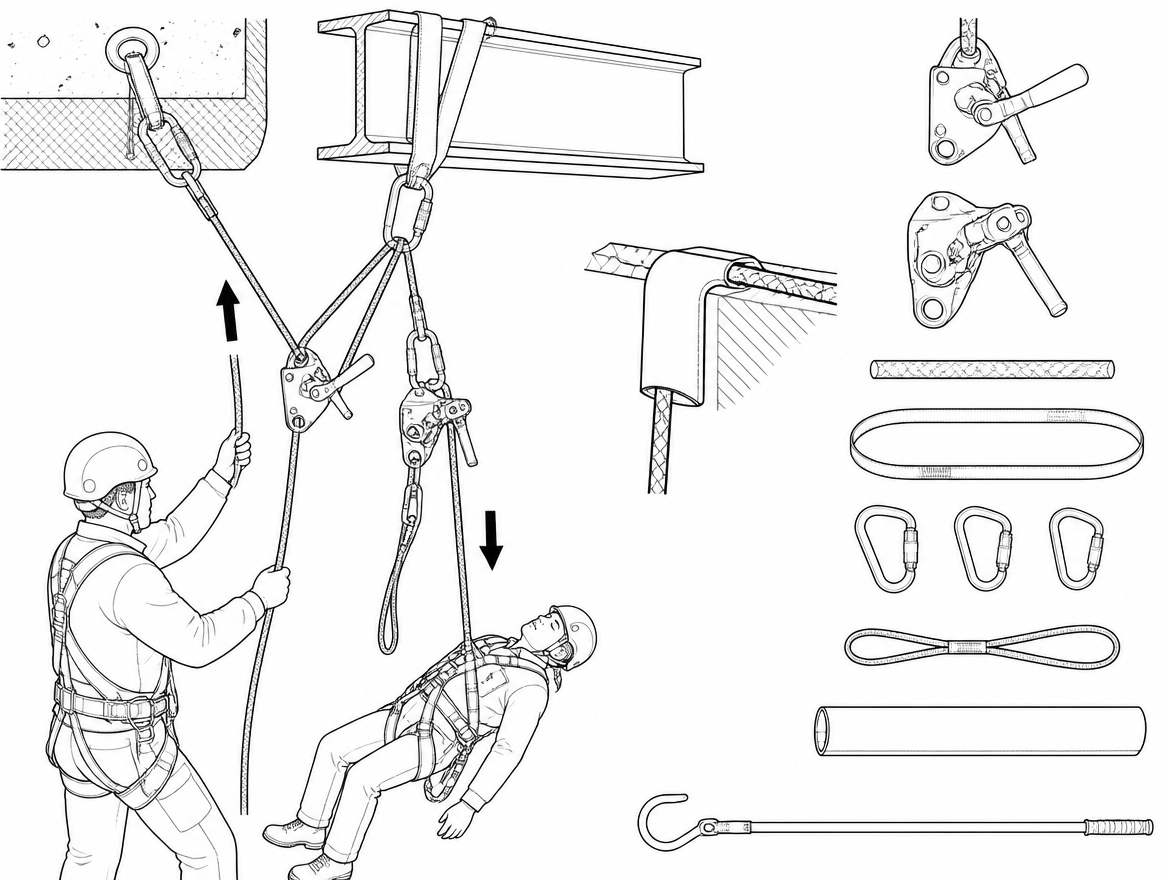
| Component | Function in the rescue | Primary standard |
|---|---|---|
| Rescue descender / lowering device | Controls the casualty’s descent under friction | EN 341 |
| Rescue lifting device | Raises the casualty to unload the fall arrest system; Class B devices can also lower | EN 1496 |
| Low-stretch kernmantle rope | Load line for lowering and hauling | EN 1891 (Type A for rescue loading) |
| Anchor sling or strap | Establishes the rescue anchor independently of the arrested system | EN 795 (Type B portable anchors) |
| Connectors | Join anchor, device, rope and casualty; self-closing and self-locking types for rescue use | EN 362 |
| Casualty attachment (rescue harness or rescue loop) | Supports the casualty where their own harness attachment cannot be used | EN 1497 / EN 1498 |
| Full body harness (casualty’s own) | Dorsal or sternal attachment point taken by the rescue line | EN 361 |
| Telescopic rescue pole with hook | Places a connector on an out-of-reach casualty’s attachment point | Manufacturer specification; check EN 365 instructions |
| Edge protection | Prevents rope damage over parapets, beams and deck edges | Manufacturer specification |
Two load questions decide whether a kit is suitable for the job in front of it. The device rating: EN 341 descenders and EN 1496 lifting devices carry a manufacturer-stated permissible load range and, for descenders, a maximum descent height and total descent energy for the class. A device suited to a two-metre pit is not automatically suited to a 40-metre mast. The anchor rating: EN 795 anchor devices are type-tested for use by one person. Where a rescuer will be suspended on the same anchor as the casualty, the relevant reference is CEN/TS 16415, the Technical Specification covering anchor devices for use by more than one person, together with the manufacturer’s stated two-person rating.
Before the kit is opened: three decisions
- Raise the alarm and start the clock. One person calls it in and records the time of the fall. That time is the single most useful piece of information handed over to medical responders.
- Confirm the rescuer will not become a second casualty. The rescuer works from a position that is either physically restrained from the edge or independently protected by their own fall arrest or work positioning system. This is not optional urgency management; a second suspended worker removes the last competent person from the scene.
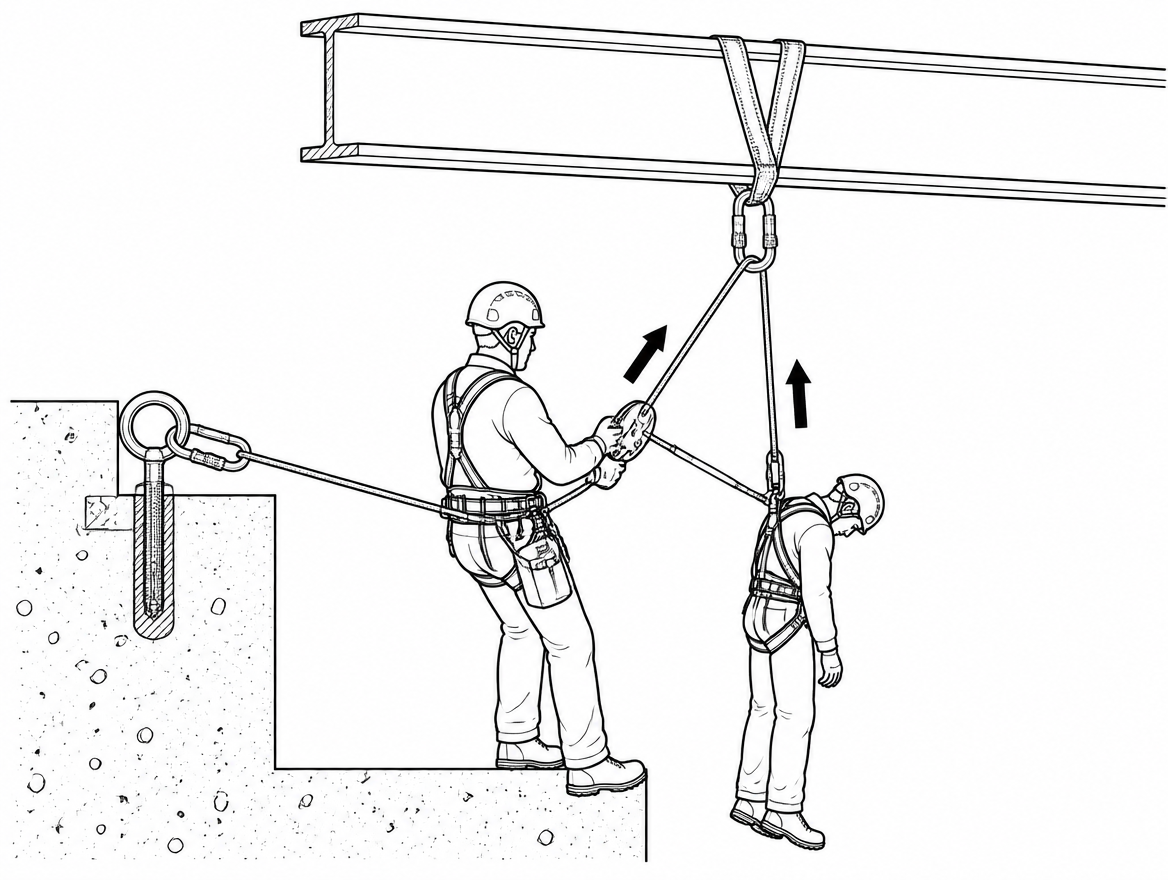
- Decide lower or raise. Lowering to the level below is usually faster and needs less force. Raising is chosen where there is no clear descent path, where the casualty is below a deck edge and can be brought back over it, or where the descent height exceeds the descender’s rated capability.
The release sequence
1. Rig the rescue system to an independent anchor
The rescue line goes onto its own anchor, not onto the anchor point or connector currently holding the casualty. The arrested system is loaded, its energy absorber may be deployed, and its connectors cannot be released while under tension. An independent anchor also means the release step in stage 4 does not disturb the rescue load path.
2. Make the connection to the casualty
Where the casualty is within reach, the rescue line connector goes onto the dorsal or sternal fall arrest attachment of their EN 361 harness. Where they are out of reach, a telescopic pole places the connector on that attachment point from the rescuer’s safe position. If the casualty’s own attachment point is inaccessible or damaged, an EN 1497 rescue harness or EN 1498 rescue loop is fitted, which normally requires a rescuer to reach the casualty and therefore a two-person rated anchor and system.
The connector is visually confirmed closed and locked, and confirmed to be through the correct attachment element and not through a fabric loop, label pocket or accessory keeper.
3. Take the load onto the rescue system
Using an EN 1496 lifting device or a pulley system, the casualty is raised just enough to put slack into the lanyard, energy absorber or self-retracting lanyard holding them. A few centimetres is usually enough. The visual cue is the arrested line going from straight and tensioned to visibly slack.
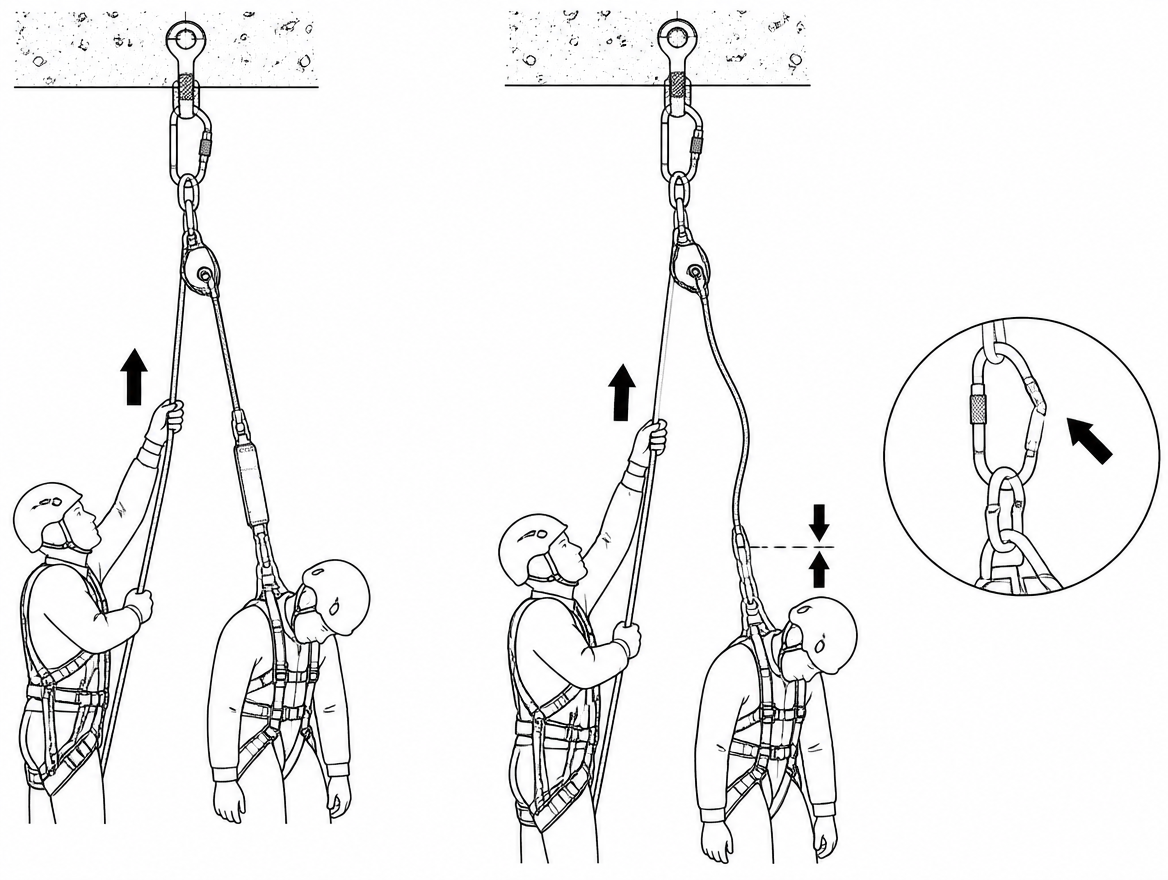
4. Release the fall arrest connection
With the arrested line unloaded, its connector is opened and removed. If the connector is still bearing any load, it does not come open and it must not be forced. Cutting a loaded line, or cutting any part of the casualty’s harness, is not a release technique. A retracted self-retracting lanyard that cannot be released is handled instead by lowering on the rescue system while a rescuer manages the SRL as a trailing line, unless that specific SRL has an integrated EN 1496 Class B recovery function, in which case it can be used to lower the casualty directly.
5. Lower under control
The descent runs at a controlled, steady speed on the EN 341 descender or the Class B lifting device. Edge protection is placed wherever the rope crosses a hard edge. The rescuer keeps voice contact with an alert casualty and watches for entanglement with structure, cabling, scaffold ties or plant on the way down. Where possible, a second worker at the lower level guides the casualty’s feet clear of obstructions and receives them at the bottom.
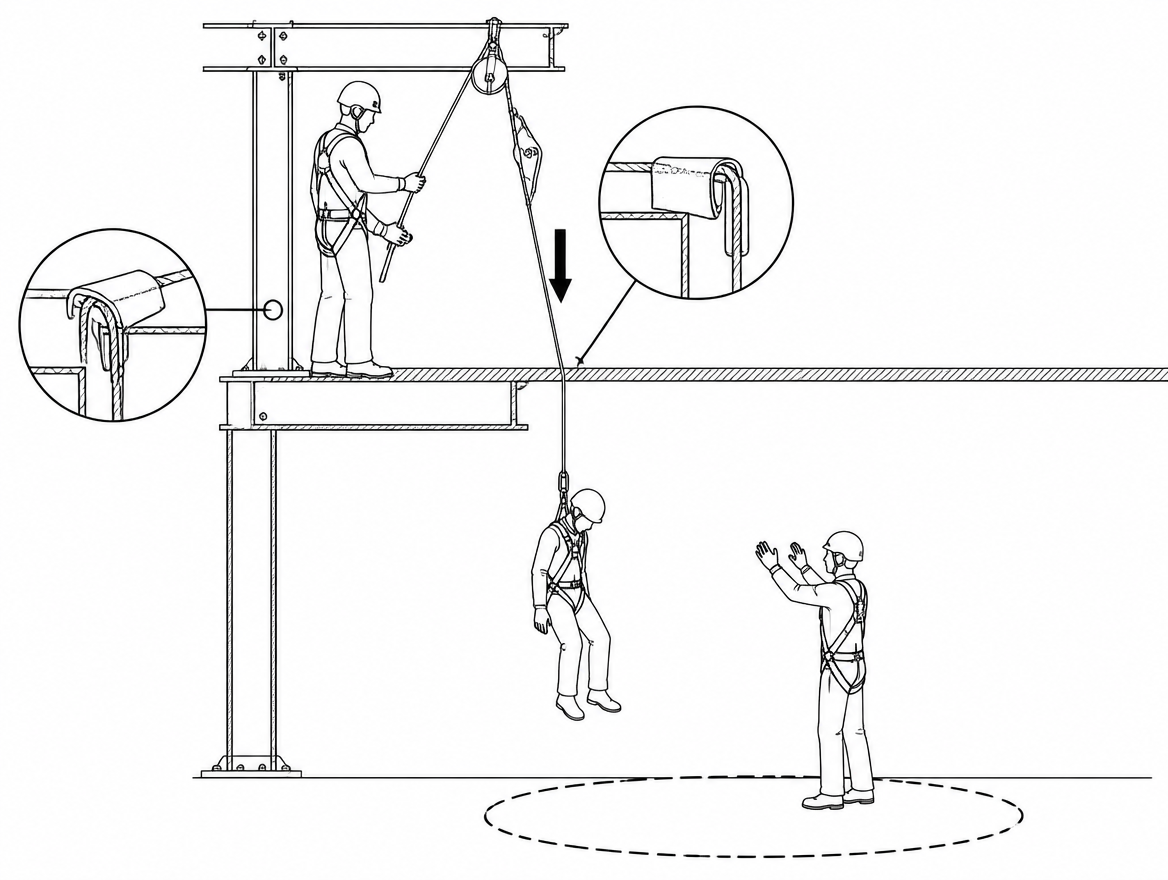
6. Handover and post-incident actions
On the ground, first aid is delivered by trained first aiders to current national protocol, with the suspension duration passed on to responders. All equipment involved in arresting the fall, and any rescue equipment loaded during the rescue, is taken out of service, marked as unfit for use and withheld from the store pending assessment by a competent person, in line with EN 365 and the manufacturer’s instructions. Deployed energy absorbers and shock-loaded harnesses are not returned to service. The incident then feeds the investigation and corrective action process — the ISO 45001 clause 10.2 route — including a review of whether the rescue plan performed as written.
Where these rescues go wrong
- The kit is on the ground and the casualty is not. A rescue kit stored in the site cabin while the work happens 30 metres up is a compliance artefact, not a rescue capability. The kit travels with the work.
- Nobody has rigged that kit before. Pre-rigged systems still require the user to identify the load side of the rope, thread the descender the correct way round, and know how the anti-panic function behaves. First-time rigging under stress is slow and error-prone.
- The rescue anchor is the arrested anchor. This blocks the release step and stacks two loads onto a point type-tested for one person.
- Descent height exceeds the device rating. Checked at planning stage against the manufacturer’s stated maximum descent height for the EN 341 class, not estimated at the edge.
- Rope run unprotected over an edge. A dynamic, loaded rope moving across a sharp steel edge is a foreseeable failure mode with a known and cheap control.
- No second-level receiver. Casualties are lowered onto scaffold boards, plant, spoil heaps or open water because nobody looked at the landing zone first.
Keeping the kit fit for use
EN 365 sets the framework the whole kit sits inside: manufacturer instructions must accompany the equipment, pre-use checks are made by the user, and periodic examination by a competent person is carried out at intervals of no more than 12 months, or more frequently where the manufacturer’s instructions or the conditions of use require it. In practice, for a bagged rescue kit that means:
- The seal or tamper indicator on the bag is checked as part of the routine site inspection, and a broken seal triggers a full re-inspection rather than a re-seal.
- Rope is inspected along its full length at periodic examination — sheath damage, glazing, core inconsistency, contamination — not just at the terminations.
- Textile components carry a manufacturer-stated maximum service life from date of first use and, separately, from date of manufacture; both dates are tracked in the equipment register.
- Descenders and lifting devices are function-tested through their range, including the brake and any anti-panic mechanism, and checked for rope groove wear.
- The kit contents are checked against the manufacturer’s parts list. Kits lose their pole hooks and edge protectors quietly.
Training and drills
Competence for rescue is specific to the equipment and to the structure. Training delivered on the manufacturer’s device the site actually owns, and rehearsed at or on a representative anchor, is the only version that predicts performance. A useful drill standard is a timed release-and-lower of a weighted mannequin, run by the people rostered on the shift, with the kit taken from its normal storage position. Where the drill time consistently exceeds the tolerance the risk assessment set for a suspended casualty, the method or the equipment position needs to change, not the tolerance. The re-drill interval should come from the risk assessment and the turnover rate of the crew; annual repetition alongside refresher training is common practice rather than a fixed requirement.
Concrete takeaway
For every location where a fall arrest system is used, the rescue plan should be able to answer six questions in writing: who performs the rescue, from what protected position, using which named device, on which independent anchor, with what maximum descent height, and how long the rehearsed sequence takes. If any of those six answers is missing, the gap is in the plan, not in the kit. The next step is to check the manufacturer’s instructions supplied with the specific rescue kit on site against the EN 341 and EN 1496 ratings assumed in that plan, and to consult EN 363 for how the rescue system is expected to sit alongside the fall arrest system it is there to release.
Frequently asked questions
Why is a worker whose fall has been arrested not yet safe?
Because they are hanging motionless in a harness with their body weight concentrated in the thigh straps and their legs unable to pump blood back to the heart. Suspension intolerance can begin to produce symptoms within minutes, so the casualty must be released from the fall arrest system and returned to a stable surface.
What does suspension intolerance do to the casualty?
The mechanism is orthostatic: an upright, immobile suspended posture allows blood to pool in the legs, venous return drops and the casualty becomes pre-syncopal. Typical progression is pallor, sweating, nausea, dizziness, visual disturbance and then loss of consciousness. An unconscious casualty slumped in a harness may also have their airway compromised by head position.
Is "call the emergency services" an acceptable rescue plan on its own?
Only where the realistic response and rigging time is inside the tolerance the risk assessment sets for that casualty. A fire and rescue service may need half an hour to arrive and rig, so the rescue method must be decided before anyone goes up, written into the rescue plan for that specific location, and rehearsed with the equipment that will actually be on site.
Which standards cover the main parts of a rescue kit?
The article lists: rescue descender/lowering device to EN 341; rescue lifting device to EN 1496 (Class B devices can also lower); low-stretch kernmantle rope to EN 1891 (Type A for rescue loading); anchor sling or strap to EN 795 (Type B portable anchors); connectors to EN 362; casualty attachment to EN 1497/EN 1498; and the casualty's own full body harness to EN 361. Telescopic rescue poles and edge protection follow manufacturer specification, with EN 365 instructions checked.
What three decisions come before the kit is opened?
First, raise the alarm and start the clock, with one person calling it in and recording the time of the fall, which is the most useful information for medical responders. Second, confirm the rescuer will not become a second casualty by working either physically restrained from the edge or independently protected by their own fall arrest or work positioning system. Third, decide whether to lower or raise: lowering to the level below is usually faster and needs less force, while raising is chosen where there is no clear descent path, where the casualty is below a deck edge, or where the descent height exceeds the descender's rated capability.
Need this as a document you can issue? The template library gives you the risk assessments, permits and inspection logs in editable form — and employer plans cover a whole team with completion records.