Safety / Tips and Tricks / Rope access and confined space
Activity 01 · Rope access
Limiting Rope Stretch with Two Descenders: Load Sharing on Long Lowers
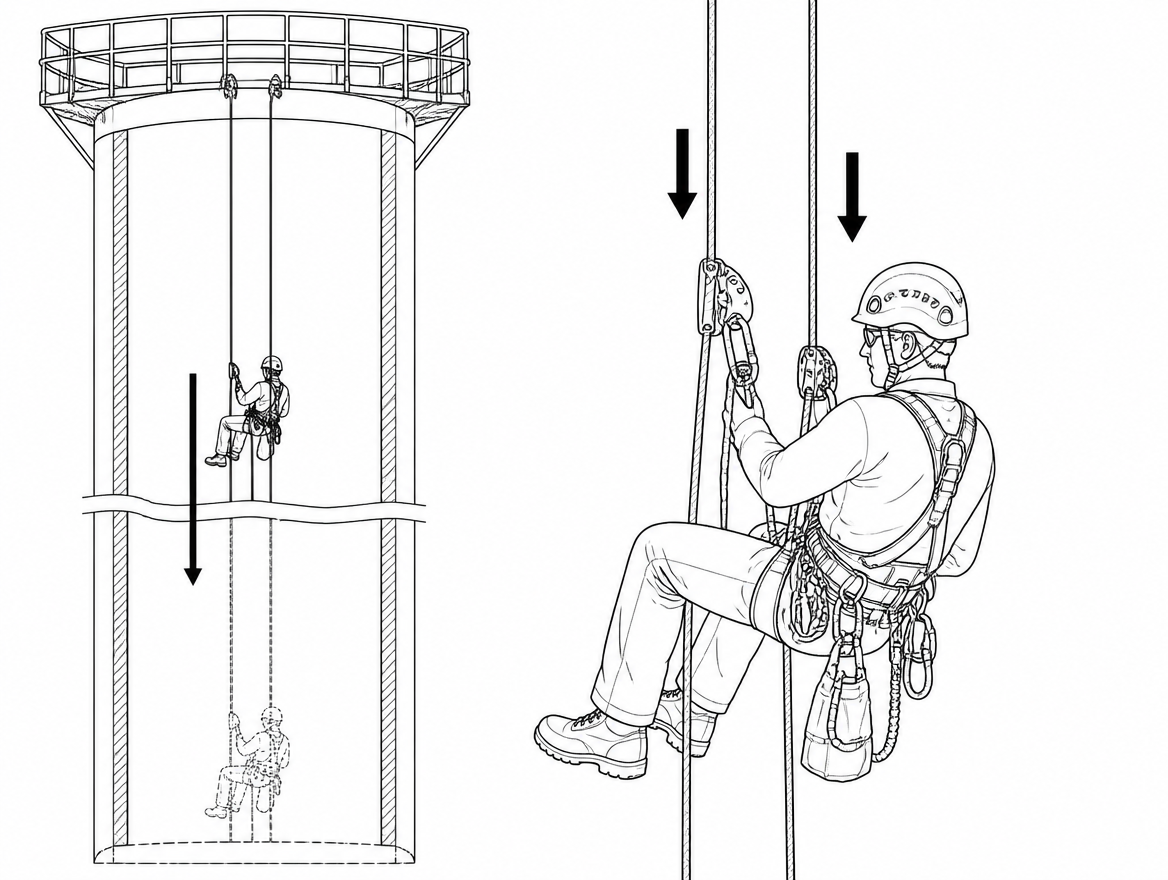
On a long lower — a 60 m shaft, a silo, a turbine tower, a rescue package coming off a high-level walkway — rope stretch stops being a technical footnote and becomes an operational problem. The load lands further down than the rope pay-out suggests, the edge transition has to be re-tensioned mid-operation, and a stretcher that needs to be held level at a specific working height keeps creeping. Running two tensioned lines, each controlled by its own descender, roughly halves the tension in each rope, roughly halves the elongation at the load, and changes what happens if one line or one anchor fails. This article covers when that configuration is appropriate, how to rig it, and where it is the wrong answer.
What “two descenders” means in this context
Two distinct configurations get described with the same phrase, and they do very different things:
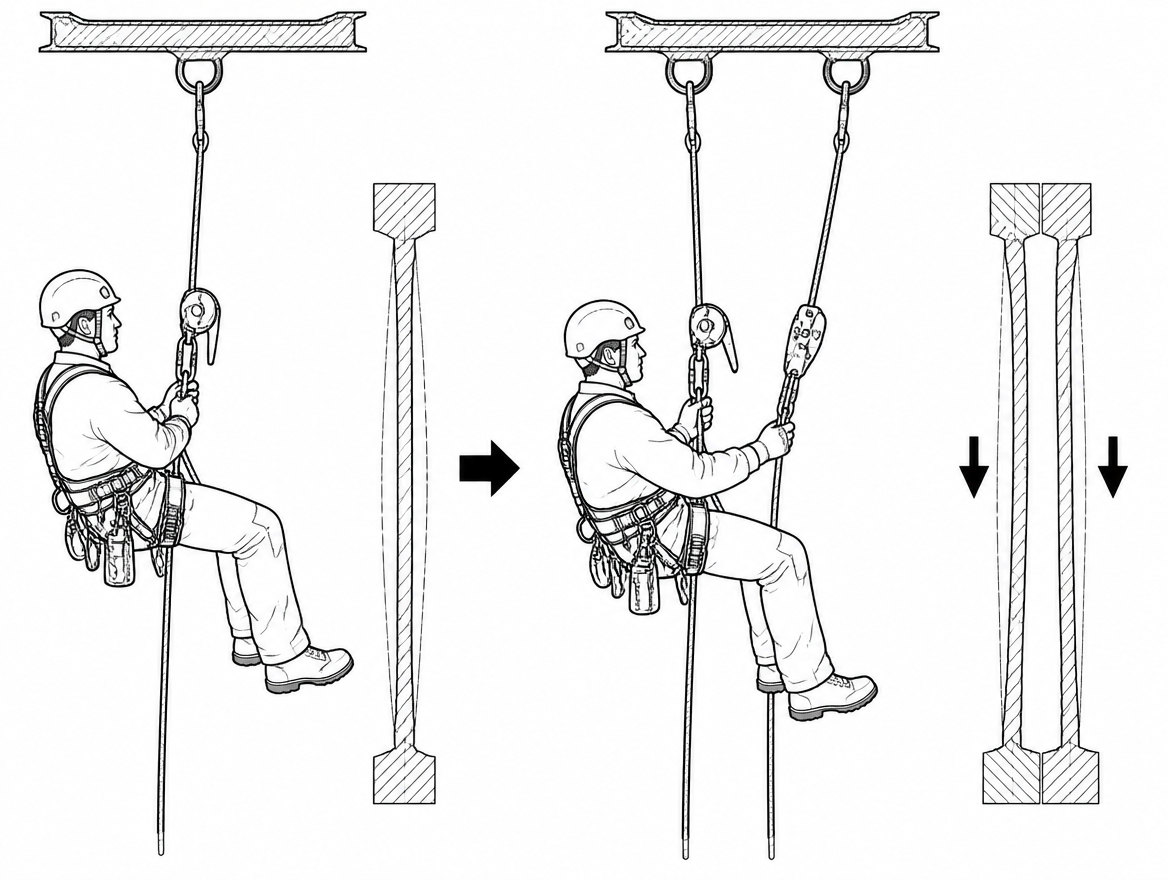
- Two descenders on two separate tensioned ropes (dual-tension lowering). Both lines carry the load simultaneously, each through its own descent control device on its own anchor. This is the configuration that reduces stretch at the load and limits the drop distance if one line fails. It is the subject of this article.
- Two descenders in series on a single rope. Used to add friction where a single device cannot control a heavy load or a very long descent without excessive heat or hand force. This adds braking capacity only. The rope still carries 100% of the load, so total elongation is unchanged.
Confusing the two leads to a predictable error: a team adds friction, expects the load to sit higher, and finds nothing has changed.
How much a low-stretch rope actually stretches
Kernmantle rope for rope access and rescue work in Europe is specified to EN 1891 (low stretch kernmantle ropes), Type A or Type B. The standard limits elongation to a maximum of 5% when the applied load increases from 50 kg to 150 kg. “Low stretch” is not “no stretch”, and typical published values for a Type A working line sit in the low single-digit percentages — the specific figure belongs to the rope’s own data sheet, not to a rule of thumb.
The consequence scales with length. A working figure of around 3–4% elongation under a full single-person load means:
- on a 10 m lower, a few tens of centimetres — usually irrelevant;
- on a 100 m lower, several metres — enough to misjudge a landing, to leave the load hanging below an intended access point, or to run out of rope tail at the bottom.
Two additional effects are worth allowing for on top of the data-sheet figure: constructional stretch in a new or lightly used rope, which is larger than the settled figure, and knot tightening at terminations under first load. Neither is a defect; both add to the distance the load travels before it stops moving.
Halving the tension halves the stretch
Rope elongation follows tension, so splitting the load between two tensioned lines reduces the elongation each line contributes. Taking a 200 kg rescue load on 100 m of line as an illustration, and treating elongation as approximately proportional to tension over this range:
- One line at 200 kg: elongation on the order of 4% of 100 m ≈ 4 m of settle at the load.
- Two lines at 100 kg each: elongation on the order of 2% ≈ 2 m.
These are order-of-magnitude estimates for planning, not test results. Rope elongation is not perfectly linear, the two lines will never share exactly 50/50, and edge friction absorbs a share of the tension. The planning value comes from the ratio rather than the absolute number: a dual-tension lower puts the load significantly closer to its intended height at any given pay-out, which matters most when the load has to be positioned rather than simply landed.
What happens when one line is lost
The more important difference is behaviour under failure. Compare two systems holding the same load:
- Main line with a slack belay line. If the main line fails, the load falls until the belay line comes tight, then is arrested. The fall distance is the slack plus the elongation absorbed during arrest, and the force on the load and the anchor rises sharply with fall distance. Personal fall protection systems designed to EN 363 are built around a maximum arrest force on the user of 6 kN, which indicates the order of loading involved.
- Two tensioned lines. If one line, connector or anchor fails, the surviving line is already loaded and already stretched. It does not have to arrest a fall — it takes up the additional tension and settles. The load drops by the difference in elongation between half load and full load, plus any device slip. On a 30 m lower that difference is typically a few tens of centimetres; on a 100 m lower it is proportionately larger, on the order of a couple of metres.
The distance is not zero, and on very long lines it is not trivial. What changes is the character of the event: a stretch-limited settle at a fall factor near zero, rather than a free fall arrested by a slack line. That is the reason dual-tension rigging is chosen for suspended casualties, stretcher work and confined-space extraction, where a shock load on the packaged person is itself a hazard.
Rigging a dual-tension lower: what each component has to be rated for
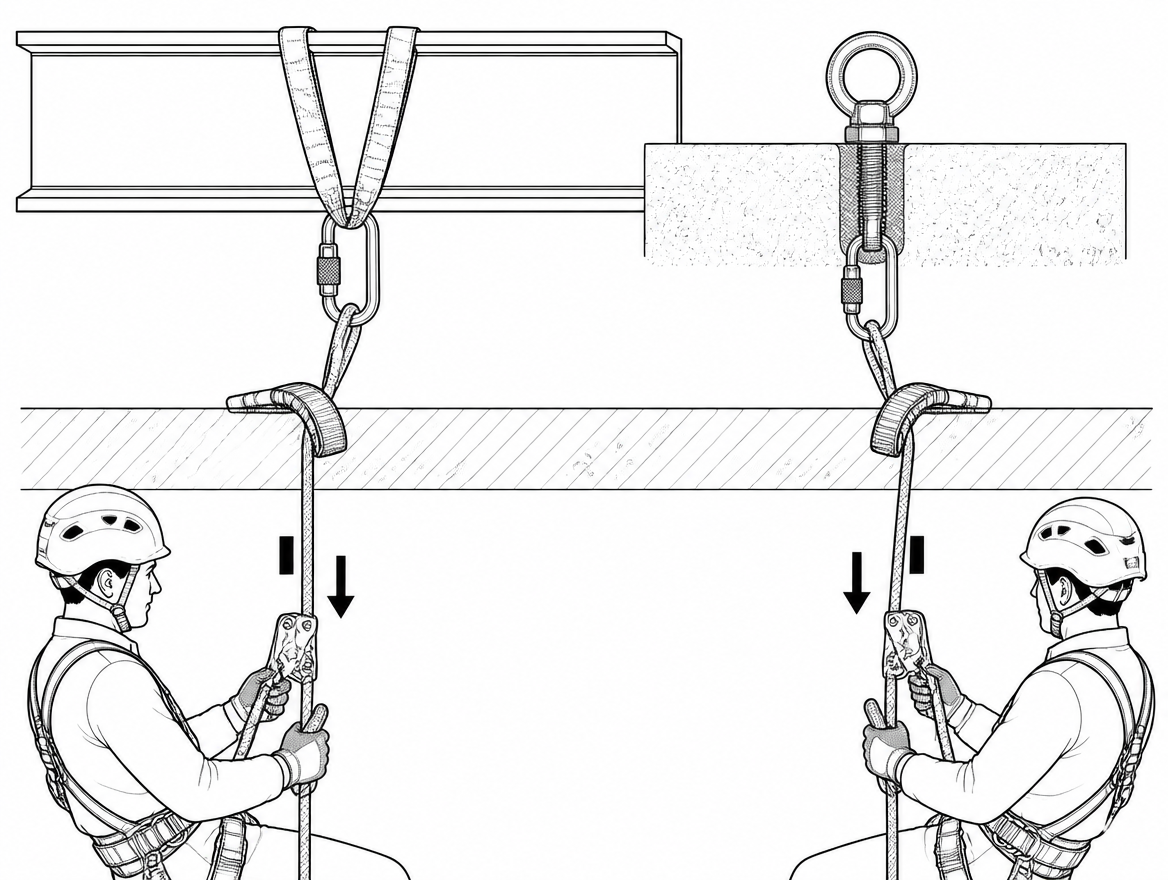
The single most misapplied idea in load-sharing systems is that sharing reduces the strength required of each part. It does not. Load sharing is never guaranteed, and the failure case puts the entire load on one line. Every line, anchor, connector and device in the system is rated for the full load acting alone.
- Ropes: two EN 1891 ropes, matched in type, diameter, model and ideally batch and length. Mismatched ropes have different elongation curves and will not share load predictably. Diameter must fall within the range stated in each descender’s instructions.
- Descent control devices: devices rated for the actual load and descent length. EN 341 covers descender devices for rescue; EN 12841 covers rope adjustment devices for rope access, with Type C designating descenders. Many devices carry a higher rated load for rescue use than for single-person work — commonly 200 kg for a two-person load — but that figure and its conditions come from the manufacturer’s instructions, not from the standard number.
- Anchors: two independent anchor points, each capable of holding the full load, selected or installed to EN 795 where anchor devices are used. Two devices hung off the same eye bolt is a single point of failure wearing a redundant-looking rigging.
- Connectors: EN 362, locking, with gates positioned so they cannot be cross-loaded or unscrewed by rope movement.
- Load attachment: both lines terminate at the load’s attachment point — an EN 361 full body harness attachment or a stretcher bridle rated for the purpose — not one line to the harness and one to an item of equipment.
- Edge protection: separate protection for each rope. Shared rollers or shared padding create a shared abrasion point and a shared failure mode.
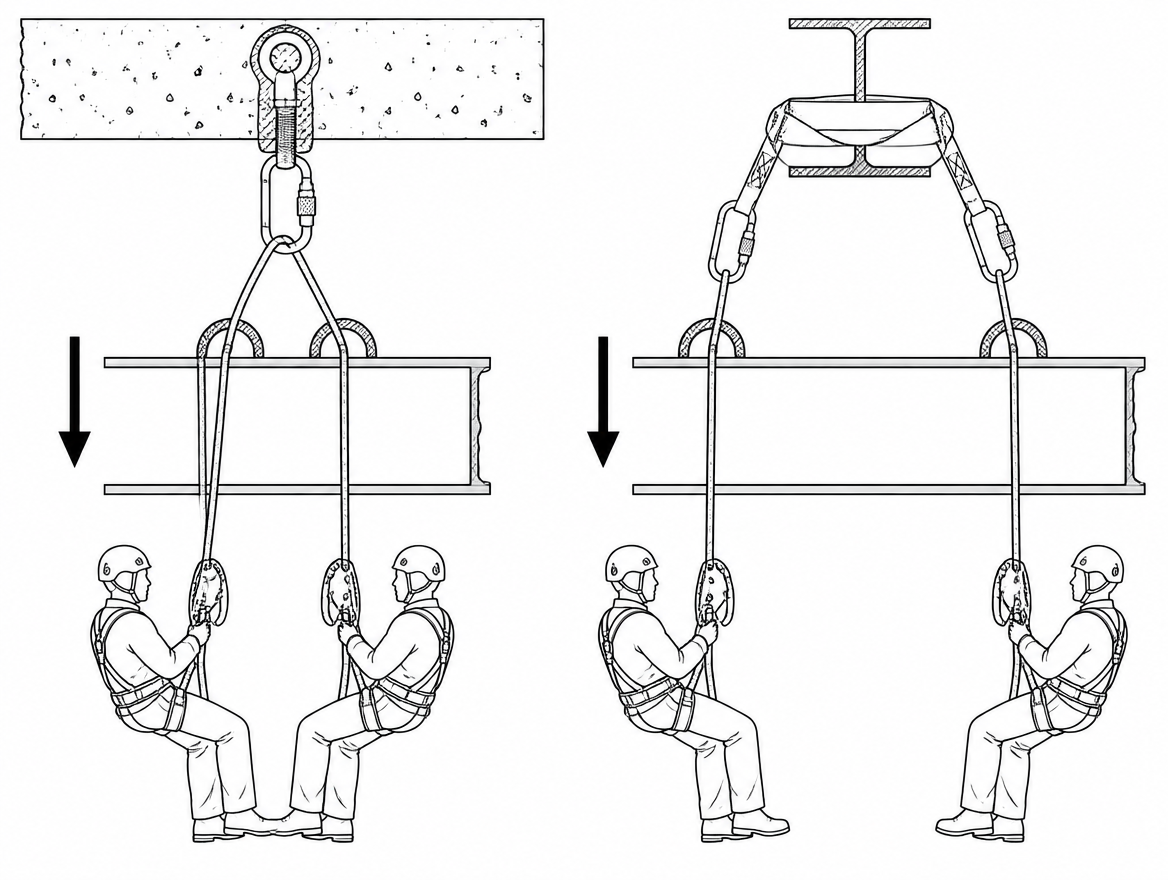
Getting the load sharing right during the lower
Two tensioned lines only behave as described if both stay tensioned. A line that goes slack has silently transferred its share to the other, and the system reverts to a single line with a slack backup — with the added complication that nobody has noticed.
Before the load goes over the edge
- Pre-tension both lines and take up constructional stretch and knot tightening with the load still supported on the structure.
- Set the two rope paths so they are the same effective length and pass over comparable edge geometry. A rope crossing a sharper edge with more friction carries less tension below the edge.
- Confirm both devices are reeved correctly and both operators can lock off independently.
During the lower
- One operator calls the rate; the second matches it. Separate operators with separate hands on separate devices are the point of the configuration — a single operator controlling both devices reintroduces a common-mode human failure.
- An edge attendant watches rope curvature, not just rope movement. A rope that has developed a visible bow is unloaded.
- Descent speed and device heat are monitored against the manufacturer’s stated limits. Splitting the load between two devices also splits the heat, which is one of the practical reasons the configuration suits long lowers.
- Communication is agreed before the lower, including the call to stop both devices simultaneously.
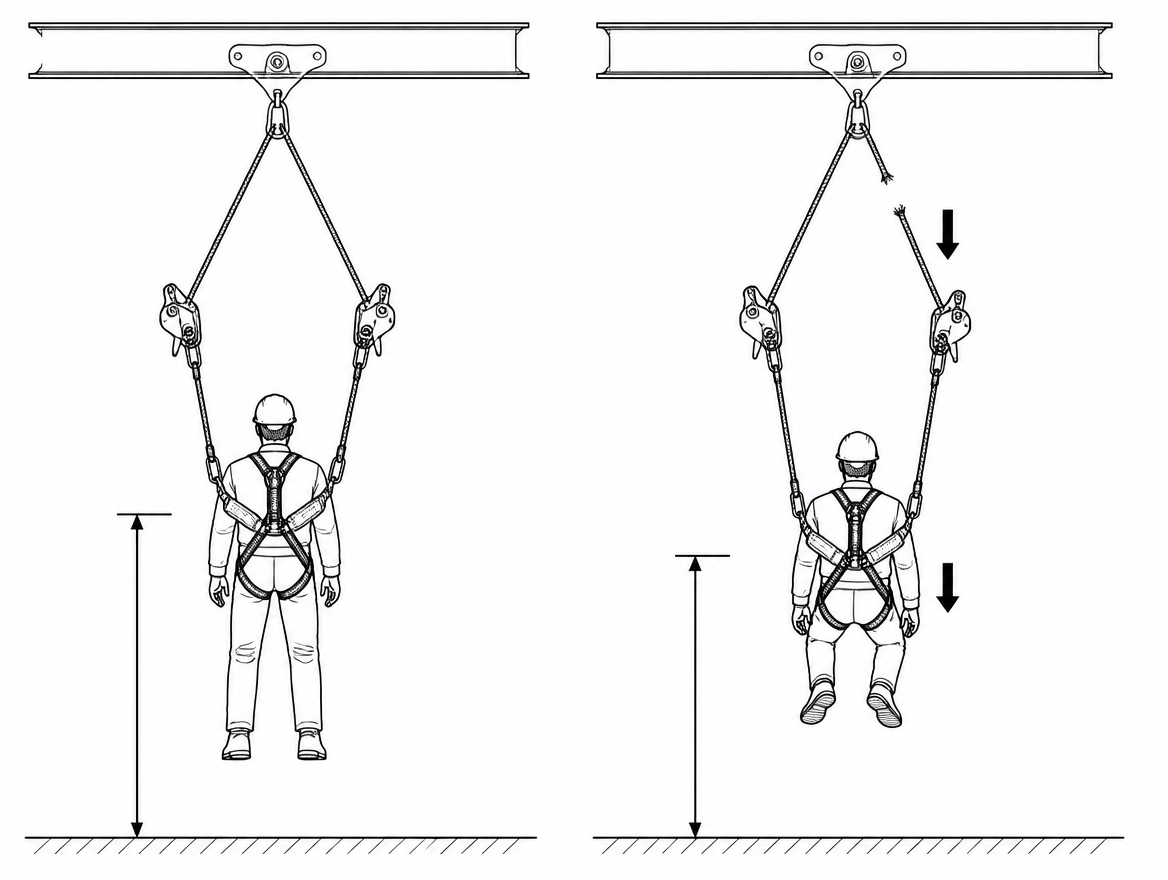
Failure modes specific to two-descender systems
- Correlated operator error. Two devices under one pair of hands, or two operators taking the same wrong instruction, defeat the redundancy.
- Rope-on-rope contact. Two lines running at different speeds and touching under tension will abrade. Rope paths are kept separated along their full length, not just at the anchor.
- Unbalanced friction. Differing edge angles, deviation anchors on one line only, or one rope dragging on the structure will bias the sharing, sometimes heavily.
- Manufacturer restrictions. Some devices are not approved for two-person or rescue loads, and some are not approved for use in a load-sharing configuration at all. The instructions for use govern; a device used outside them is outside its certification.
- Untested assumptions about sharing. Where the operation warrants it, inline load cells give a real reading rather than an inference from rope curvature.
Where a two-descender configuration is not the right answer
Dual tension is a lowering and rescue technique in which the load is controlled from the anchor by attendants. It is not a substitute for the rope access configuration required for a worker descending under their own control.
Under EN 12841, personal rope access work is built on two lines with distinct roles: a Type C descender on the working line and a Type A backup device on a separate safety line, each used with EN 1891 rope of the diameter stated by the manufacturer. Replacing the Type A backup device with a second descender removes the component designed to arrest the user if the working line fails, and removes it from a system where the user cannot see or manage both devices under load. Where a worker descends on their own devices, the EN 12841 arrangement stands.
Similarly, on short lowers — a few metres from a mezzanine or a tank top — the stretch argument largely disappears, and the added complexity of two operators and two rope paths may introduce more risk than it removes. The configuration earns its place on long spans, on heavy or packaged loads, and where a shock load on the person being lowered is unacceptable.
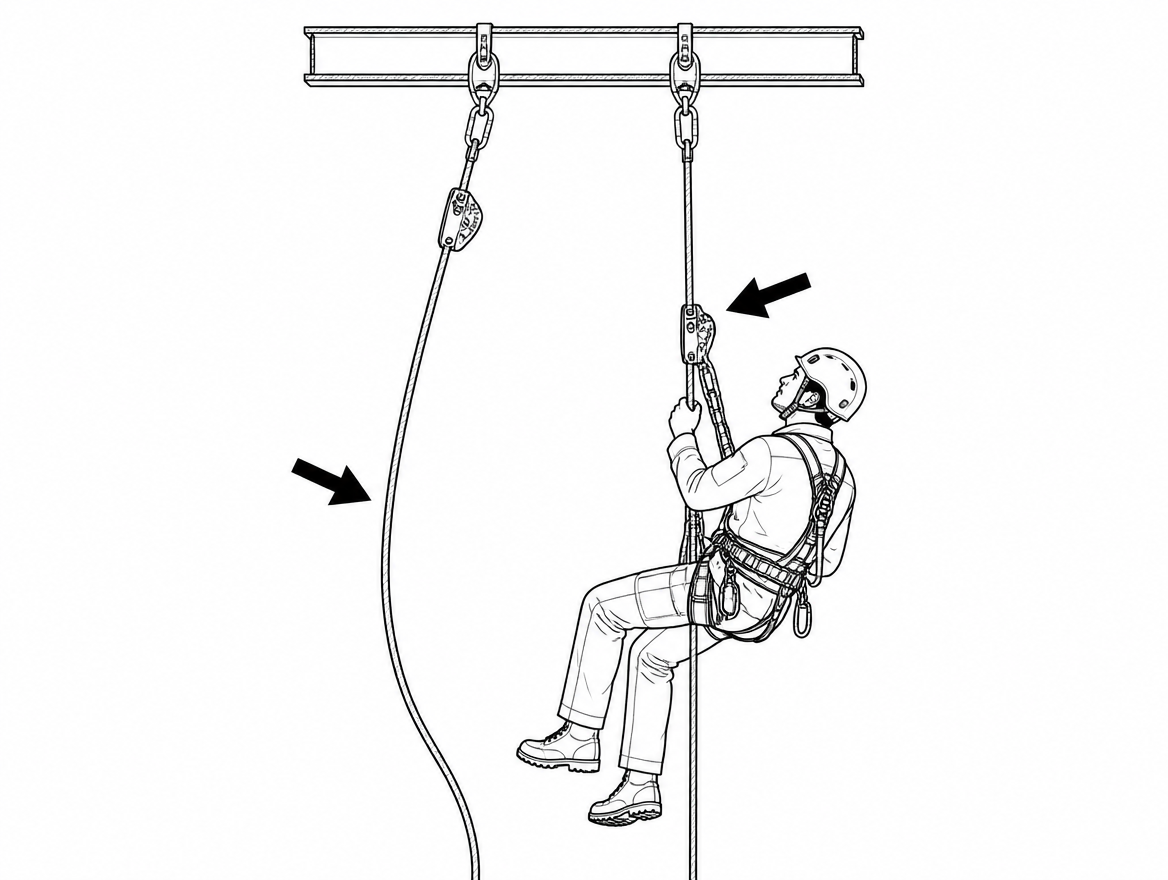
Competence, inspection and documentation
Two-descender lowering is a team skill with a defined rate, defined calls and a defined abort action, and it is practised as such rather than assembled for the first time during an incident. Within an occupational health and safety management system to ISO 45001, this sits across hazard identification and risk assessment (clause 6.1.2), competence (clause 7.2) and emergency preparedness and response (clause 8.2) — rescue rigging is usually part of the emergency response arrangements, not of routine work.
On the equipment side, EN 365 sets out general requirements for instructions for use, marking, maintenance and periodic examination, including periodic examination by a competent person at intervals not exceeding 12 months. Ropes used in load-sharing systems benefit from being kept as matched pairs with matched service histories, since elongation behaviour changes with use: a heavily used rope paired with a new one will not share load the way the plan assumes.
Before the next long lower
Three checks decide whether a two-descender lower delivers what it promises:
- Calculate expected stretch from the rope’s own elongation data and the actual line length, and add rope tail accordingly — then confirm the landing or working position still works with the load sitting that far down.
- Rate every element for the full load alone — both ropes, both anchors, both devices, both connectors — and confirm the devices are approved by their manufacturers for the load and configuration in use.
- Keep both lines tensioned and separately controlled, with an attendant whose job is to see a line go slack.
For the next step, the primary references are the descender manufacturer’s instructions for use (rated load, rope diameter range, descent length and heat limits) and the elongation figures on the rope’s technical data sheet, read alongside EN 1891, EN 12841 and, for rescue descenders, EN 341.
Frequently asked questions
What is the difference between two descenders on two ropes and two descenders in series?
Two descenders on two separate tensioned ropes (dual-tension lowering) means both lines carry the load simultaneously, each through its own descent control device on its own anchor — this reduces stretch at the load and limits the drop if one line fails. Two descenders in series on a single rope only adds friction where one device cannot control a heavy load or a very long descent without excessive heat or hand force; the rope still carries 100% of the load, so total elongation is unchanged. Confusing the two leads to a team adding friction, expecting the load to sit higher, and finding nothing has changed.
How much does a low-stretch rope actually stretch?
EN 1891 low stretch kernmantle ropes (Type A or Type B) are limited to a maximum of 5% elongation when the applied load increases from 50 kg to 150 kg. "Low stretch" is not "no stretch": typical published values for a Type A working line sit in the low single-digit percentages, and the specific figure belongs to the rope's own data sheet rather than to a rule of thumb.
Why does rope length change how serious stretch is?
The consequence scales with length. At a working figure of around 3–4% elongation under a full single-person load, a 10 m lower gives a few tens of centimetres — usually irrelevant. A 100 m lower gives several metres, which is enough to misjudge a landing, leave the load hanging below an intended access point, or run out of rope tail at the bottom. Constructional stretch in a new or lightly used rope and knot tightening at terminations under first load both add to that distance.
What happens if one line is lost in a dual-tension system?
The surviving line is already loaded and already stretched, so it does not have to arrest a fall — it takes up the additional tension and settles. The load drops by the difference in elongation between half load and full load, plus any device slip: typically a few tens of centimetres on a 30 m lower, and on the order of a couple of metres on a 100 m lower. The event is a stretch-limited settle at a fall factor near zero rather than a free fall arrested by a slack line, which is why dual-tension rigging is chosen for suspended casualties, stretcher work and confined-space extraction.
Does sharing the load between two lines reduce the strength each component needs?
No. That is the single most misapplied idea in load-sharing systems. Load sharing is never guaranteed, and the failure case puts the entire load on one line, so every line, anchor, connector and device is rated for the full load acting alone. The two ropes should be EN 1891 and matched in type, diameter, model and ideally batch and length, because mismatched ropes have different elongation curves and will not share load predictably.
Need this as a document you can issue? The template library gives you the risk assessments, permits and inspection logs in editable form — and employer plans cover a whole team with completion records.