Courses / PPE Selection to EN Standards
PPE Selection to EN Standards
About this certificate. This is a theory course. The certificate records that you completed the theory and passed its assessment. It is not an accredited qualification. Many countries also require practical assessment before theory counts towards a statutory requirement — check what applies where you work. Full terms.
What the markings on a helmet, glove, filter and boot actually certify, and how to match equipment to the hazard instead of to whatever is on the shelf.

Create a free account to start this course
The lessons are free once you have an account. The assessment and the certificate are part of a subscription.
EN 397 – industrial safety helmets
EN 397 is the European standard specifying requirements, test methods and markings for industrial safety helmets designed to protect the wearer from falling objects and other head impact hazards in workplaces such as construction sites, factories and warehouses. This guide explains the mandatory and optional requirements of EN 397, how to read the markings on a helmet, and how to select and maintain the right helmet for your work environment.
EN 397 applies to industrial safety helmets intended to protect against falling objects, impact with fixed obstacles, and accidental contact with live conductors at low voltage. It defines basic mandatory requirements – shock absorption, resistance to penetration, and flame resistance – along with a set of optional performance requirements that manufacturers may certify depending on the intended use of the helmet.
EN 397 optional markings identify extra protections such as electrical insulation, cold resistance, and molten metal resistance.
Selecting an EN 397 helmet starts with identifying the specific hazards on site: falling objects alone require only the basic requirements, while electrical work near live conductors requires the 440V AC marking, foundries and welding environments benefit from molten metal (MM) resistance, and outdoor winter work calls for a low-temperature rated shell. Fit, chin strap comfort and compatibility with other PPE such as eye and hearing protection should also be considered.
Key points
- Does not cover hearing protection integrated with helmets – see EN 352 hearing protectors .
- Does not cover helmets for industrial use with higher electrical insulation requirements – those may require additional certification beyond EN 397.
- Climbing and mountaineering helmets are covered by EN 12492, not EN 397.
- Does not cover fall arrest connectors or anchor devices – see EN 362 connectors and EN 795 anchor devices .
- Inspect the shell and harness before each use for cracks, dents or UV degradation
Full reference: EN 397 – Industrial Safety Helmets ↗
EN 166 – personal eye protection
EN 166 is the core European standard that sets the general requirements, testing methods and marking rules for all personal eye-protection equipment used at work — safety spectacles, goggles and face shields. If a pair of safety glasses is sold as certified PPE in the EU, it has been tested against EN 166. This guide explains the scope, the marking codes stamped on the lens and frame (optical class, impact rating, field-of-use symbols), how to choose the right eye protection for a task, inspection and care, and the standards that sit alongside EN 166 in the eye-protection family.
EN 166 applies to all forms of personal eye protectors intended to protect the wearer against a range of hazards likely to be encountered in industrial, laboratory and other workplaces, including mechanical impact, dust, gas, liquid splash, molten metal and short-circuit electric arc. It defines the general build, robustness, optical quality, field-of-use and marking requirements that every certified eye protector must meet, regardless of the specific hazard it is designed for. EN 166 is normally read together with the hazard-specific filter standards (listed in section 2) that add extra requirements for optical radiation such as UV, IR, welding glare or sun glare.
EN 166 does not cover eyewear that falls under other dedicated standards. These related and referenced standards include:
For head and hearing protection worn alongside eyewear, see EN 397 industrial safety helmets and EN 352 hearing protectors . For hand protection commonly used on the same tasks, see EN 388 protective gloves .
Key points
- Robustness: impact tests fire a steel ball at defined velocities (S / F / B / A) at the lens per EN 168
- Resistance to ignition of frame and lens materials
- Resistance to corrosion for metal parts
- Field-of-use performance: droplet, dust, gas and molten-metal resistance where the relevant symbol is claimed
- Resistance to fogging, tested and marked only where the “N” rating is claimed
Full reference: EN 166 – Eye Protection ↗
Helmet standards – EN 397 and EN 12492
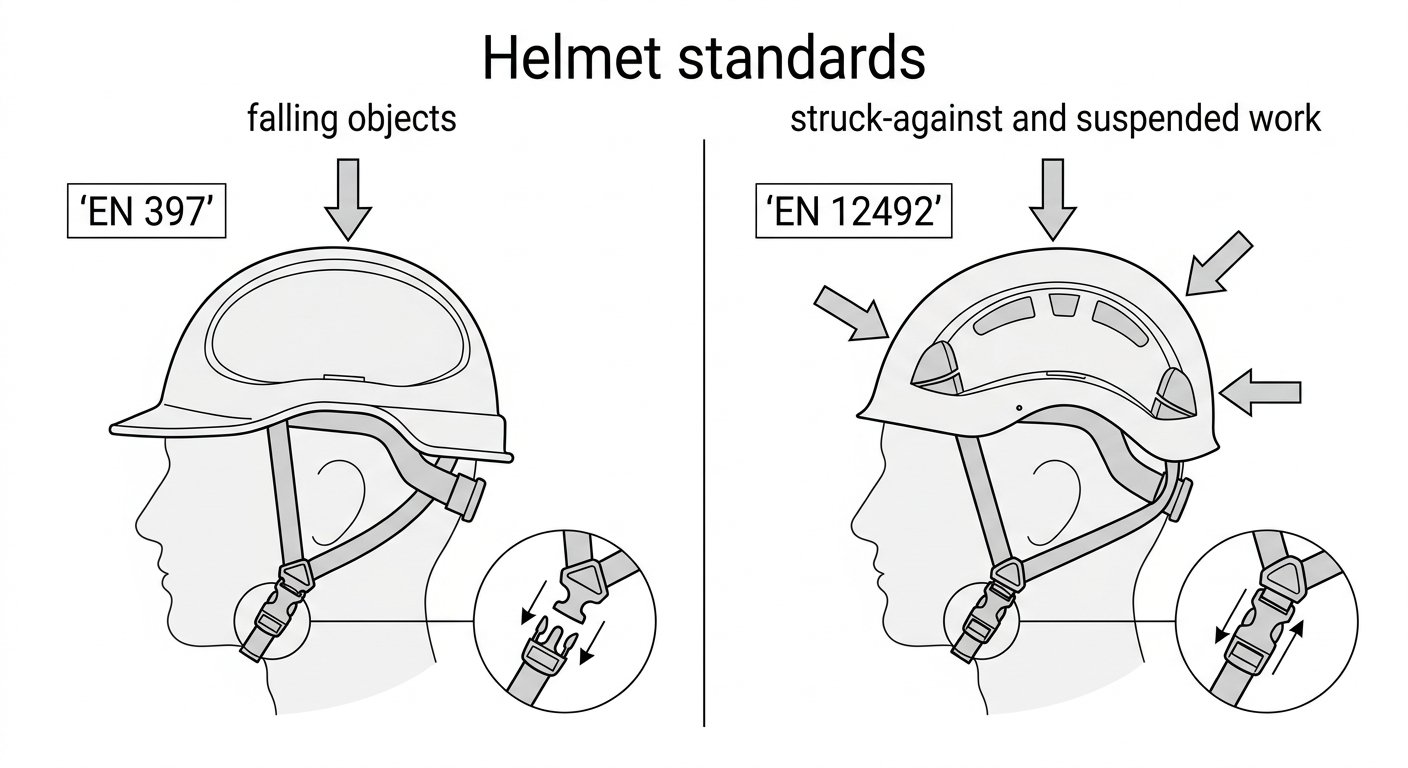
Two helmet standards dominate rope access and confined space work in Europe, and they were written for different accidents. EN 397 is an industrial safety helmet standard built around objects falling onto the head of someone standing below. EN 12492 is a mountaineering helmet standard built around a person who is moving, suspended, or falling — where the head can strike structure from the side or the rear, and where the helmet coming off is itself the failure. Choosing between them, or choosing a helmet marked with both, comes down to which of those two accidents the job actually presents.
EN 397 specifies industrial safety helmets. Its mandatory tests cover shock absorption from a vertical (crown) impact, resistance to penetration by a pointed striker, flame resistance of the shell, and the behaviour of the chin strap anchorage. It also defines a set of optional performance requirements that a manufacturer may claim and mark: very low temperature, very high temperature, electrical insulation, lateral deformation and molten metal splash.
EN 12492 specifies helmets for mountaineers, and by extension the helmets widely used for rope access, work at height on ropes, and technical rescue. Its tests cover shock absorption from the crown and from the front, sides and rear, resistance to penetration, and the retention system — both its strength and its ability to keep the helmet on the head. EN 12492 contains no flame resistance, electrical insulation, lateral deformation or molten metal clauses; those exist only on the EN 397 side.
Under EN 397 the shock absorption test is applied vertically, to the crown, with the transmitted force to the headform limited to a relatively low threshold — commonly quoted as 5 kN. The scenario being reproduced is a tool or component dropped from above onto a worker who is upright on the ground.
Key points
- The standard number, and its edition or amendment where marked (for example EN 397 with its amendment, or EN 12492).
- Head size range, in centimetres.
- Date of manufacture — usually a moulded clock or a printed month and year.
- Shell material designation.
- Optional performance codes, where claimed under EN 397: −20 °C or −30 °C for very low temperature, +150 °C for very high temperature, 440 V a.c. for electrical insulation, LD for lateral deformation, MM for molten metal splash.
Full reference: Helmet Standards: EN 397 and EN 12492 ↗
Module 1 assessment
The assessment is part of a subscription
You have full access to every lesson in this course. Taking the assessment and earning the certificate needs a subscription.
4 questions · 80% to pass · unlimited retakes. The lesson material is hidden while you answer.
1. Which requirements are mandatory under EN 397?
2. What does the marking "440 V a.c." on a helmet certify?
3. EN 166 grade B impact protection corresponds to which energy?
4. Why is a helmet meeting EN 12492 not automatically suitable for industrial use?
EN 388 – gloves against mechanical risks
EN 388 is the European standard specifying requirements, testing methods and marking for gloves that protect against mechanical risks including abrasion, cutting, tearing, puncture and impact. It is one of the most widely referenced PPE standards in industry, and its multi-digit marking system allows buyers to quickly compare glove performance across different hazards. This guide breaks down the EN 388 marking code and explains how to select and maintain the right gloves for your task.
EN 388 applies to protective gloves of all materials designed to guard the hands against mechanical hazards encountered in manufacturing, construction, warehousing, and general industrial handling. It defines test methods for abrasion resistance, blade cut resistance, tear resistance, puncture resistance, and since its 2016 revision, impact protection and an additional ISO 13997 cut resistance test.
Selecting EN 388 gloves starts with identifying the dominant hazard on the job: general handling and light abrasion suits a lower-rated glove, while glass handling, metal sheet work or blade-heavy tasks require a high cut-resistance rating (level D/E/F). Consider dexterity trade-offs, as higher cut resistance often means thicker material and reduced grip sensitivity. Always check whether the glove is also rated for impact protection if the job involves crushing or pinch hazards.
EN 388 specifies requirements, testing and marking for protective gloves against mechanical risks including abrasion, cutting, tearing, puncture and impact.
Key points
- Cut resistance measured using a rotating circular blade (Coup test) and/or a straight blade under load (ISO 13997)
- Tear resistance measured by the force required to tear the material
- Puncture resistance measured by the force required for a stylus to pierce the glove
- Optional impact test for gloves with padded knuckle protection
- Inspect gloves before each use for cuts, thinning material or exposed stitching
Full reference: EN 388 – Protective Gloves Against Mechanical Risks ↗
EN 374 – gloves against chemicals
EN 374 is the European standard series specifying requirements and test methods for gloves protecting the hands against dangerous chemicals and micro-organisms, covering permeation resistance, penetration resistance and degradation of the glove material.
EN 374 applies to gloves intended to protect against chemical splashes, immersion, and biological hazards such as bacteria and viruses. It is split into parts covering terminology and performance requirements (374-1), penetration resistance to micro-organisms (374-2 / 374-5), and permeation resistance to chemicals (374-3, now largely folded into EN ISO 374-1).
Gloves are marked with pictograms indicating the protection type: a beaker symbol for chemical protection (Type A, B or C depending on the number and breakthrough time of tested chemicals) and a biohazard symbol for micro-organism protection where penetration resistance requirements are met.
EN 374 rates gloves for permeation resistance against specific chemicals and micro-organisms.
Key points
- Often combined with chemical protective clothing under EN 13034 or EN 14605.
- Does not cover thermal protection – see EN 407 for gloves against heat and cold hazards, or EN 511 for cold-specific protection.
- Check gloves for pinholes, tears or degradation before each use
- Never reuse gloves after exposure to a chemical beyond its tested breakthrough time
- Store away from direct sunlight, ozone sources and extreme temperatures which can degrade rubber and polymer materials
Full reference: EN 374 – Chemical and Micro-Organism Resistant Gloves ↗
EN ISO 20471 – high visibility clothing
EN ISO 20471 is the European standard specifying requirements for high-visibility clothing that visually signals the wearer’s presence in hazardous environments, such as roadworks, warehouses and low-light industrial sites, to both operators of vehicles and machinery and to other workers.
EN ISO 20471 applies to garments made from fluorescent background material and retroreflective tape designed to provide conspicuity in daylight and under artificial lighting. It defines three classes of garments (Class 1, 2 and 3) based on the minimum area of fluorescent and reflective material required.
Garments are marked with the standard number, class (1, 2 or 3) and pictogram. Class 3 offers the highest visibility with the greatest area of fluorescent and reflective material, typically required for high-risk roadside work, while Class 1 provides the minimum acceptable visibility for lower-risk environments.
EN ISO 20471 classifies garments by the area of fluorescent and reflective material they provide.
Key points
- Built on the general requirements of EN ISO 13688 for protective clothing.
- Does not cover flame-resistant high-visibility clothing, which additionally requires compliance with EN ISO 11612 or similar flame protection standards.
- Wash according to the care label; excessive washing beyond the rated cycles reduces retroreflective and fluorescent performance
- Replace garments once fluorescent colour has visibly faded or reflective tape is cracked, peeling or dulled
- Avoid contaminating garments with oil, paint or solvents, which can permanently dull fluorescent brightness
Full reference: EN ISO 20471 – High-Visibility Clothing ↗
Module 2 assessment
The assessment is part of a subscription
You have full access to every lesson in this course. Taking the assessment and earning the certificate needs a subscription.
4 questions · 80% to pass · unlimited retakes. The lesson material is hidden while you answer.
1. What does the EN 388 four-digit code report?
2. A glove rated highly under EN 388 is used to handle a solvent. Is that appropriate?
3. What determines the class of high-visibility clothing under EN ISO 20471?
4. Why does washing degrade hi-vis clothing performance?
EN 149 – filtering half masks
EN 149 is the European standard specifying requirements, test methods and marking for filtering half masks (also called FFP respirators) used to protect the wearer against airborne particles such as dust, mists and fumes. This guide explains the FFP1, FFP2 and FFP3 protection classes, how filtration efficiency is tested, and how to choose and fit the right respirator for your task.
EN 149 applies to filtering half masks that cover the nose, mouth and chin, made either fully or partly of filtering material, or fitted with replaceable filters. It classifies devices into three classes based on filtration efficiency and total inward leakage: FFP1 (lowest), FFP2, and FFP3 (highest). Masks may also carry an "R" marking for reusable (multi-shift) use or "D" for passing an optional dolomite clogging test.
Masks are marked with the EN number, protection class (FFP1, FFP2 or FFP3), and optionally R (reusable) or D (dolomite clogging test passed). Minimum filtration efficiency requirements are 80% for FFP1, 94% for FFP2, and 99% for FFP3, tested against sodium chloride and paraffin oil aerosols. Total inward leakage limits also increase in stringency from FFP1 to FFP3.
EN 149 rates disposable filtering half masks as FFP1, FFP2 or FFP3 by filtration efficiency.
Key points
- Does not cover particle filters sold separately for use with reusable masks – see EN 143.
- Does not cover supplied-air or powered respirators, which fall under separate EN standards (EN 12941/EN 12942).
- Often combined with eye protection meeting EN 166 when dust and splash hazards occur together.
- Check the seal and shape of the mask before each use; discard if damaged, dirty or misshapen
- Perform a fit check (positive/negative pressure check) every time the mask is donned
Full reference: EN 149 – Filtering Half Masks (FFP1/FFP2/FFP3) ↗
EN ISO 20345 – safety footwear
EN ISO 20345 is the European and international standard specifying basic and additional requirements for safety footwear with protective toe caps, designed to protect workers from impact, compression, slips and other foot hazards in industrial and construction environments. This guide explains the classification system, marking codes, testing requirements and how to choose the right safety boots or shoes for your job.
EN ISO 20345 applies to safety footwear fitted with a protective toe cap rated to withstand at least 200 joules of impact energy and 15 kN of compression. It defines a base classification system (SB, S1–S5) built from a common set of basic requirements, plus additional optional markings for specific hazards such as chemical resistance, heat resistance and metatarsal protection.
Choosing the right classification depends on the work environment: dry indoor sites often suit S1 or S1P footwear, wet or outdoor sites benefit from the water-resistant upper of S2 or S3, and sites with sharp debris on the ground should specify a penetration-resistant midsole (P). Additional markings like HRO (heat resistant outsole), CI (cold insulation) or M (metatarsal protection) should be matched to specific site hazards.
EN ISO 20345 specifies requirements, testing and marking for safety footwear with protective toe caps used to guard against impact, compression, slips and other workplace foot hazards.
Key points
- Does not cover hand protection – see EN 388 protective gloves .
- Does not cover head protection – see EN 397 industrial safety helmets .
- Electrically insulating footwear for live electrical work may require additional certification beyond the base standard.
- Does not cover fall protection equipment – see EN 361 full body harnesses .
- Toe cap impact resistance (200 J) and compression resistance (15 kN)
Full reference: EN ISO 20345 – Safety Footwear ↗
EN 352 – hearing protectors
EN 352 is the family of European standards that sets the general safety and performance requirements for hearing protectors used at work — earmuffs, earplugs, and specialised electronic hearing protection. It is a multi-part standard, with EN 352-1 through EN 352-8 each covering a specific product type. This guide explains the scope, the part-by-part breakdown of the EN 352 family, how attenuation is rated (SNR, H/M/L), how to select the right hearing protector for a noise level, inspection and care, and the standards referenced alongside EN 352.
EN 352 specifies general requirements, physical and acoustic test methods, and marking rules for hearing protectors intended to reduce the wearer's exposure to hazardous workplace noise. It applies to passive earmuffs and earplugs as well as electronic hearing protectors that amplify or level-limit ambient sound. Each part of the EN 352 family adds requirements specific to a construction type, while the physical and acoustic test methods used to measure attenuation are set out in EN 13819-1 and EN 13819-2.
EN 352 does not cover eye, head or respiratory protection, which fall under their own standards. Related and referenced standards include:
For head protection commonly combined with attachable earmuffs, see EN 397 industrial safety helmets . For eye protection worn on the same tasks, see EN 166 eye protection .
Key points
- Replace foam or pre-moulded earplugs after each use or per manufacturer guidance for hygiene
- Replace earmuff cushions and foam liners on the manufacturer's stated schedule, as attenuation degrades over time
- Check headband tension regularly; a stretched or loose band reduces the seal and the attenuation achieved
- Store in a clean, dry case away from solvents, oils and extreme temperatures
- Replace batteries and check electronic function on level-dependent, ANR or communication headsets before each use
Full reference: EN 352 – Hearing Protectors ↗
Module 3 assessment
The assessment is part of a subscription
You have full access to every lesson in this course. Taking the assessment and earning the certificate needs a subscription.
4 questions · 80% to pass · unlimited retakes. The lesson material is hidden while you answer.
1. Which FFP class offers the highest filtering efficiency under EN 149?
2. Why does facial hair matter for a filtering half mask?
3. Under EN ISO 20345, what does the S3 code add over S1?
4. What does the SNR value of a hearing protector describe?
Course assessment
The assessment is part of a subscription
You have full access to every lesson in this course. Taking the assessment and earning the certificate needs a subscription.
6 questions drawn from every module · 80% to pass · unlimited retakes.
1. Which requirements are mandatory under EN 397?
2. Why is a helmet meeting EN 12492 not automatically suitable for industrial use?
3. What does the EN 388 four-digit code report?
4. Why does washing degrade hi-vis clothing performance?
5. Which FFP class offers the highest filtering efficiency under EN 149?
6. What does the SNR value of a hearing protector describe?
Course complete
100%
Every module and the final assessment passed
Certificates are not issued yet — that needs a signed-in account, which is coming. Your progress is saved in this browser meanwhile.