Safety / Tips and Tricks / Rope access and confined space
Activity 01 · Rope access
Accompanied Descent with a Rope Grab: Rigging, Load Limits and Backup Discipline
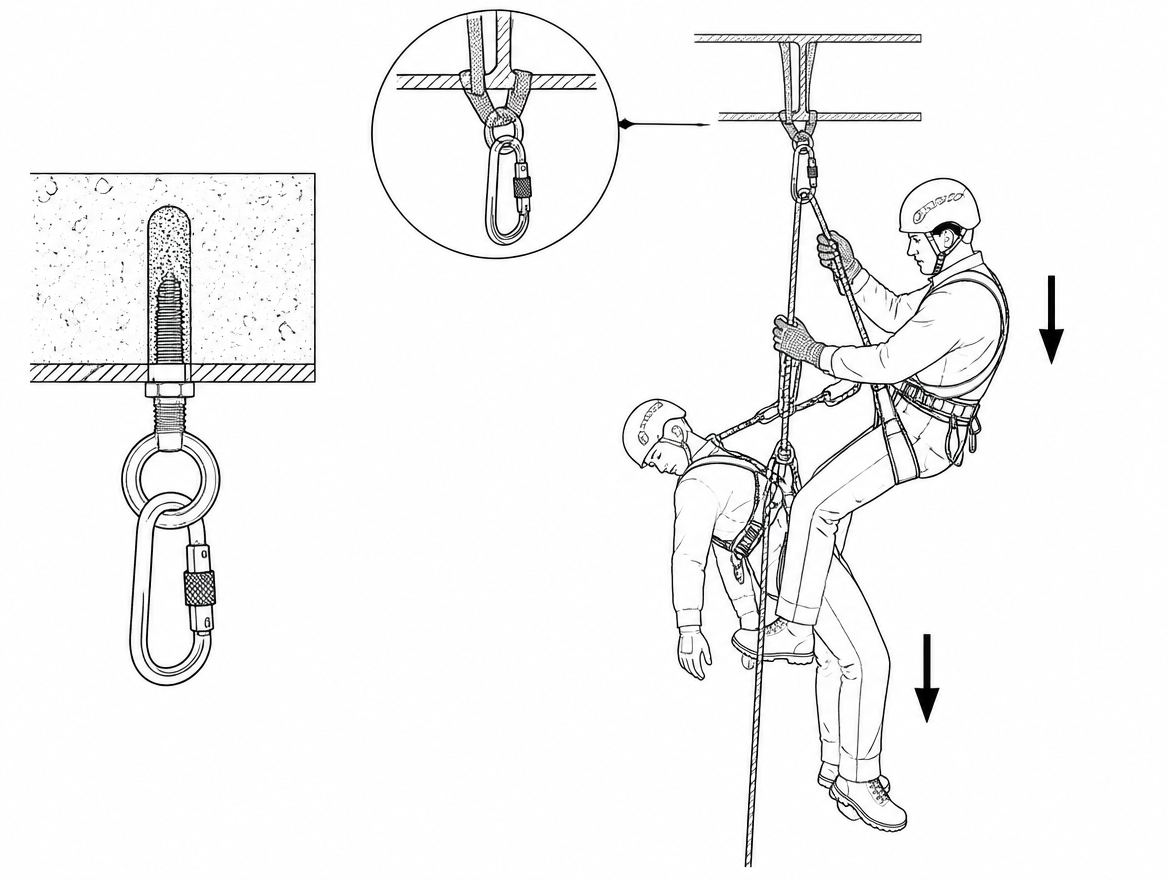
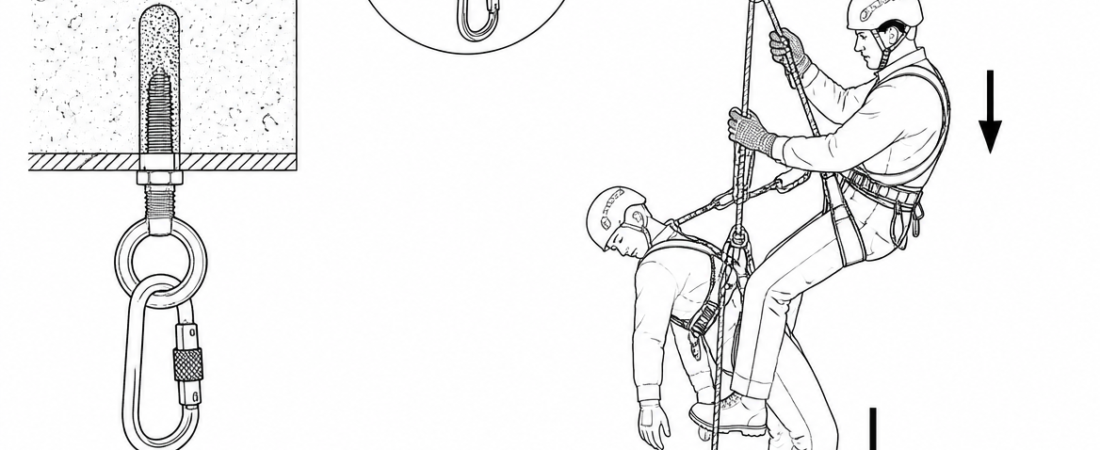
When a suspended worker cannot descend under their own power — unconscious, injured, or physically trapped in equipment — one of the fastest options available with kit already on site is for a rescuer to descend and take the casualty down with them. Accompanied descent changes two things at once: the mass on the system roughly doubles, and the rescuer is now operating a descender with a casualty attached and limited free hands. The rope grab on the safety line is the component that covers the moment control is lost. Whether it actually does that depends on its declared rated load, where it sits on the rope relative to the harness attachment, and whether anyone's hand ends up on it during the descent.
This article covers the equipment logic and rigging discipline behind an accompanied descent on a two-rope system. It is not a substitute for hands-on rescue training under instruction.
When accompanied descent is the appropriate method
Accompanied descent is one of several ways to get a suspended casualty to the ground. It is usually chosen when:
- The casualty is suspended on rope or on a fall arrest system and cannot operate their own descent device.
- Lowering the casualty from an upper level is not possible — no top access, no attendant, or the casualty’s ropes cannot be reached and released from above.
- A short haul to raise the casualty off a loaded lanyard is impractical, or the descent route to the ground is shorter and cleaner than the route up.
- The casualty needs a rescuer physically present during the transfer, for example to keep an airway clear, to free a trapped limb, or to manage a device that must be unloaded before it will release.
Where the casualty can be lowered from above by a competent attendant, that is usually the lower-risk option: one person’s mass on the system, and the operator has both hands and a stable stance. Accompanied descent is the method for when that option is not on the table.
The two-rope arrangement: working line and safety line
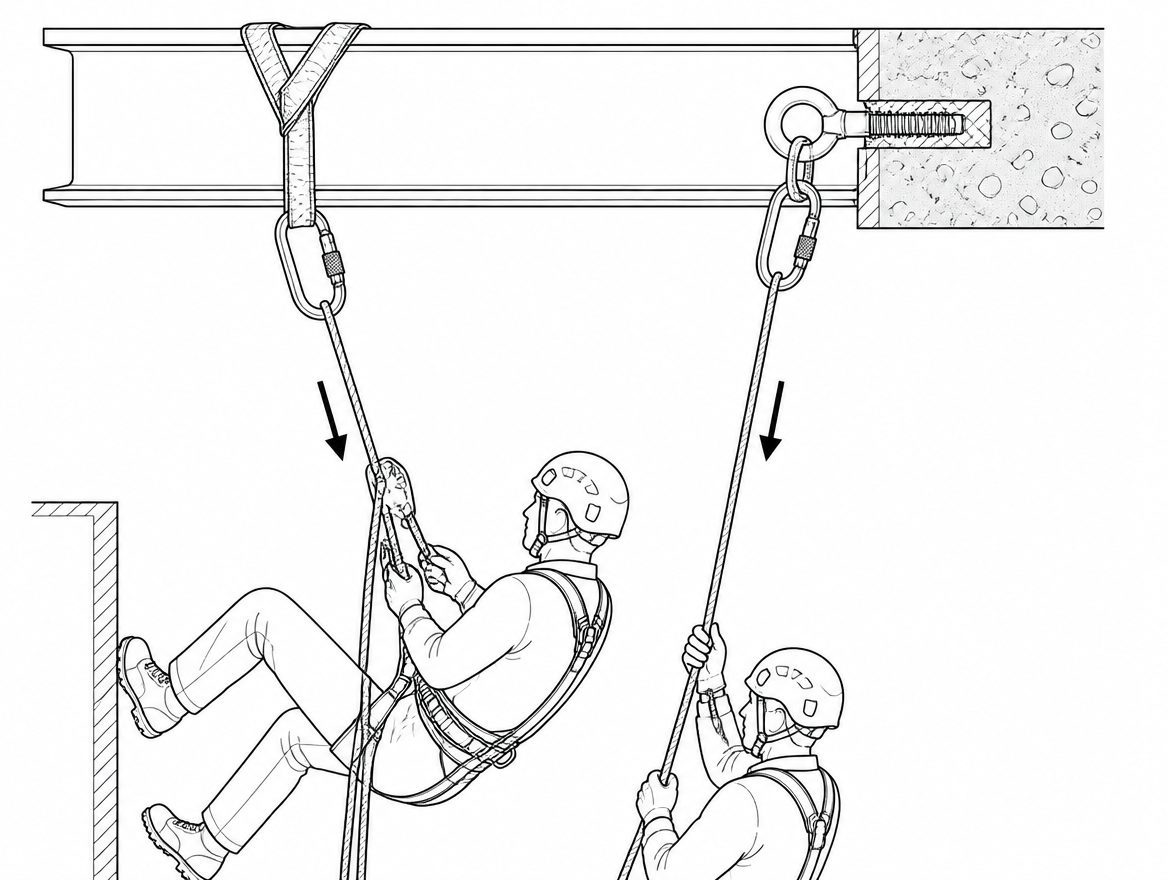
The standard configuration is two independent lines, each with its own function and its own device:
- Working line — carries the load through a descent device. Depending on the equipment and the intended use case, that device may be certified to EN 12841 as a Type C rope adjustment device (descender) for rope access work, or to EN 341 as a descender device for rescue. EN 341:2011 characterises such devices by a rated load range, a maximum descent height and a maximum descent energy; those figures are the operating envelope, not marketing numbers.
- Safety line — carries no load in normal operation and is protected by a rope grab: either a Type A rope adjustment device to EN 12841, or a guided type fall arrester to EN 353-2 used only with the anchor line it was certified with.
Both lines run to anchors, and both should be low stretch kernmantle rope to EN 1891, Type A, in a diameter the devices are approved for — typically stated as a range such as 10 mm to 13 mm in the manufacturer’s instructions. Connectors are to EN 362, locking type, with gates closed and screwed home. The rescuer’s own attachment is via a harness to EN 361 (and, for rope access work positioning, EN 813 / EN 358 as applicable).
The load doubles — check every component, not just the descender
This is the single most common technical error in accompanied descent planning: verifying that the descender is rated for two people, then assuming the rest of the system follows. It does not.
The rope grab
EN 12841 and EN 353-2 are both written around a single user. Where a device is declared suitable for descent with two persons, that declaration comes from the manufacturer’s instructions for that specific model — not from the standard. Some Type A backup devices carry an explicit two-person rescue rating; many explicitly prohibit it, because the cam geometry and rope-holding behaviour were only validated at single-person test loads. There is no way to infer this from the standard number alone. It has to be read off the instructions for the device in hand, before the day of the rescue.
The anchors
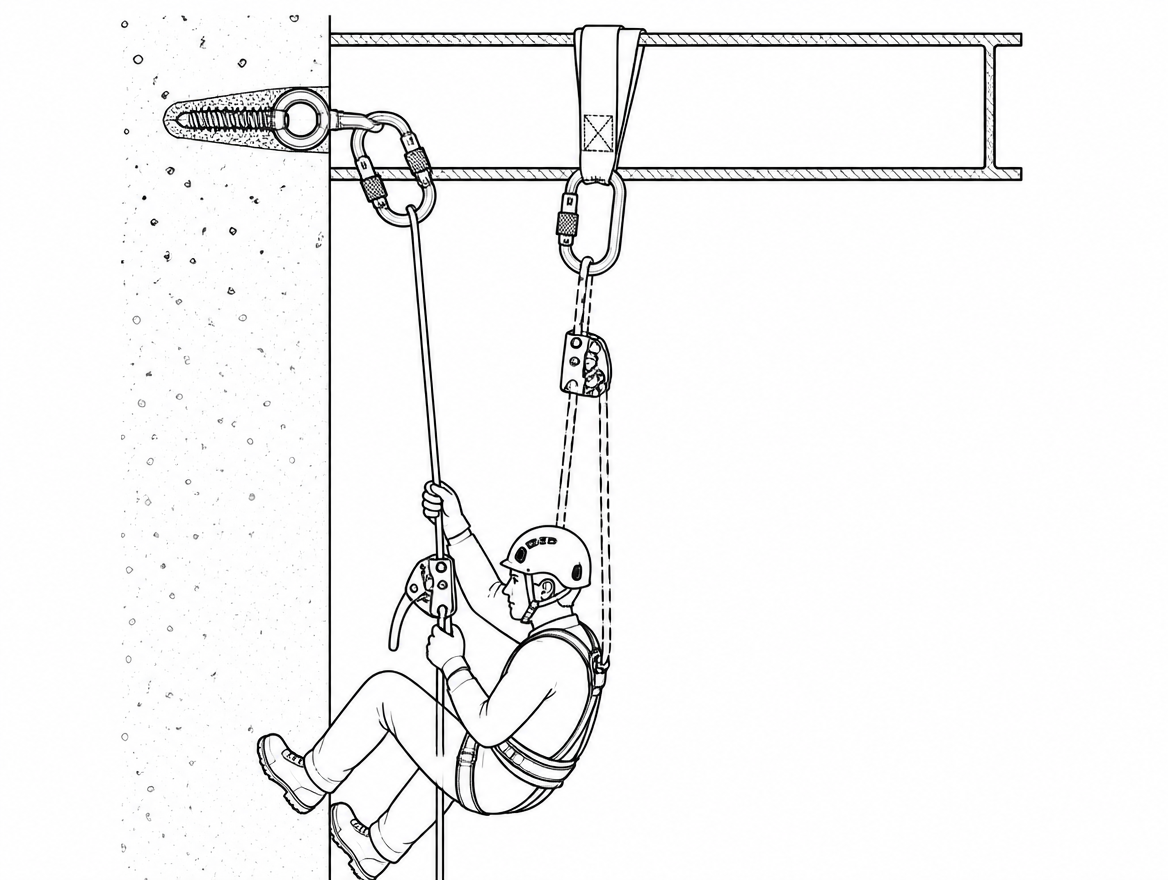
Anchor devices to EN 795:2012 are certified for a number of simultaneous users declared by the manufacturer. Where an anchor is to be loaded by more than one person at a time, CEN/TS 16415 gives the additional recommendations for multi-person use. An anchor signed off for one user is not automatically valid for a rescuer plus a casualty plus the dynamic effects of a backup device arresting that combined mass.
Rope, connectors and harnesses
EN 1891 Type A rope has ample static strength for a two-person load, but knots, edge loading and abrasion all reduce it, and rope protection at every edge becomes more important as the load rises. Connectors to EN 362 should be checked for correct alignment along the major axis — a two-person load cross-gated over a harness attachment or a sling is a far worse proposition than the same geometry under one person. Harness attachment points are rated per the relevant harness standard for one person; the casualty is supported by their own harness or rescue device, never by hanging additional mass off a point not designed for it.
Positioning the rope grab: slack is the variable that matters
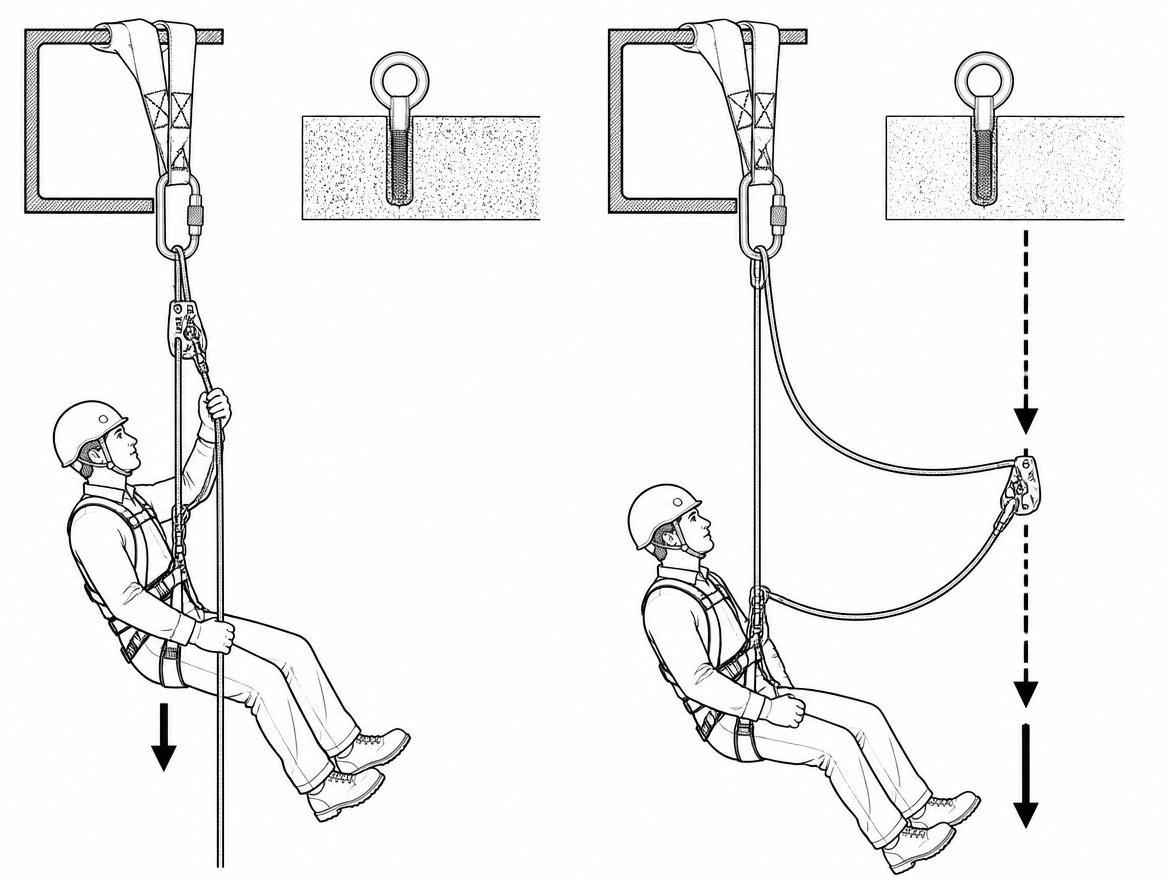
A rope grab only limits a fall to the extent that the distance it can travel before engaging is short. On a descent, the grab is pushed down the safety line by the rescuer’s movement, and the amount of rope between the grab and the harness attachment sets the potential free-fall distance if the working line or the descender fails.
- Keep the grab high, close above the attachment point, with the connecting lanyard at the length the manufacturer specifies. Substituting a longer lanyard or adding an extra connector to “give more room” directly increases both fall distance and arrest force.
- Do not allow the grab to sit below the harness attachment point. In that position the device can be loaded at an angle it was never tested for, and the rescuer falls onto it rather than being held under it.
- Keep the safety line reasonably tended so that a loop of slack does not accumulate between the grab and the anchor. On long descents, the weight of rope below the grab helps; on shorter drops with light rope, it may not.
- Check that the grab is fitted the right way up on the rope and that the cam engages before weight goes on the system. This is a two-person visual check, not a self-check, whenever a second competent person is available.
Hands stay off the backup device
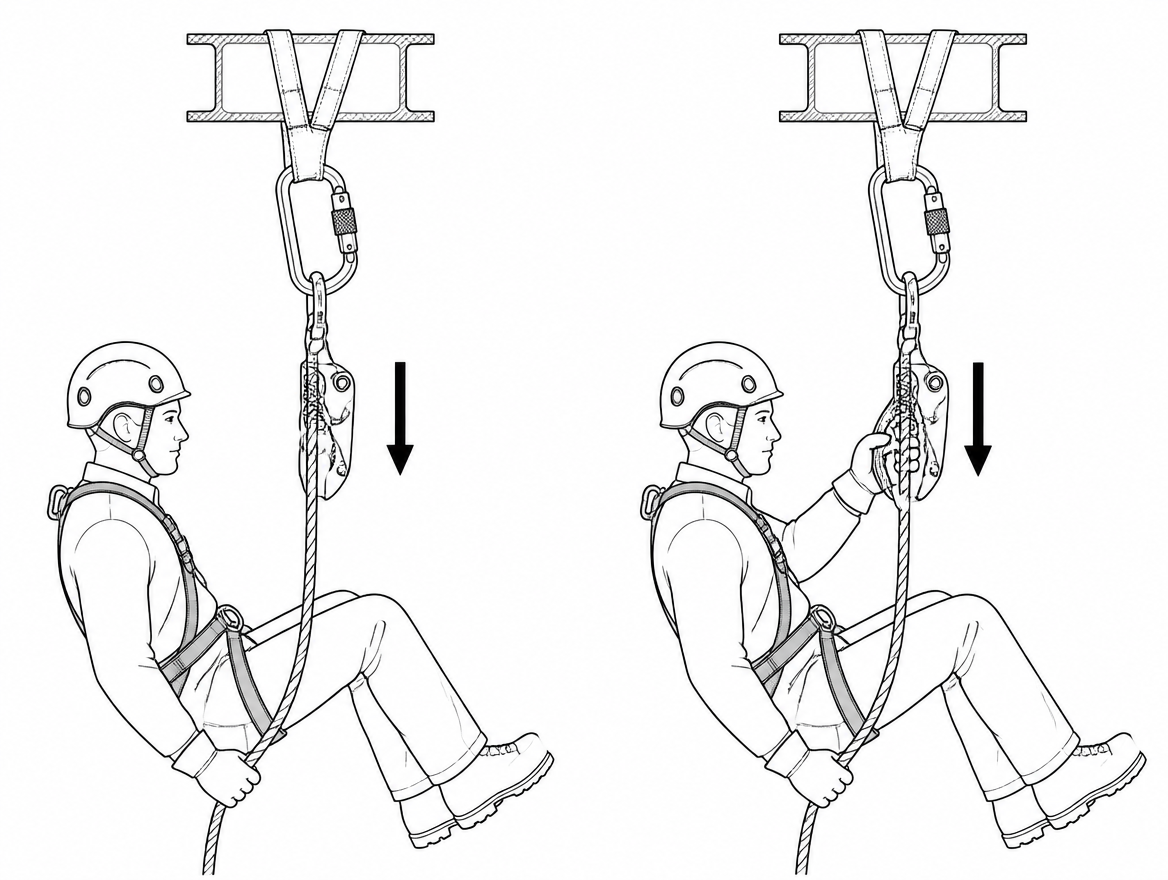
Under load and under pressure, the instinctive reaction is to grab whatever is in front of the chest — which is frequently the backup device. Gripping the body of a toothed-cam rope grab can hold the cam clear of the rope and defeat it entirely, and it will stay defeated for exactly as long as the hand stays there. In an accompanied descent the rescuer’s hands have specific jobs: one on the descender’s control side of the rope, the other free for the casualty, the radio, or the edge. Neither of them belongs on the grab. Where the grab needs to be advanced or repositioned, it is moved deliberately by the designated part of the device housing described in the instructions, with the working line under control first.
Attaching and supporting the casualty
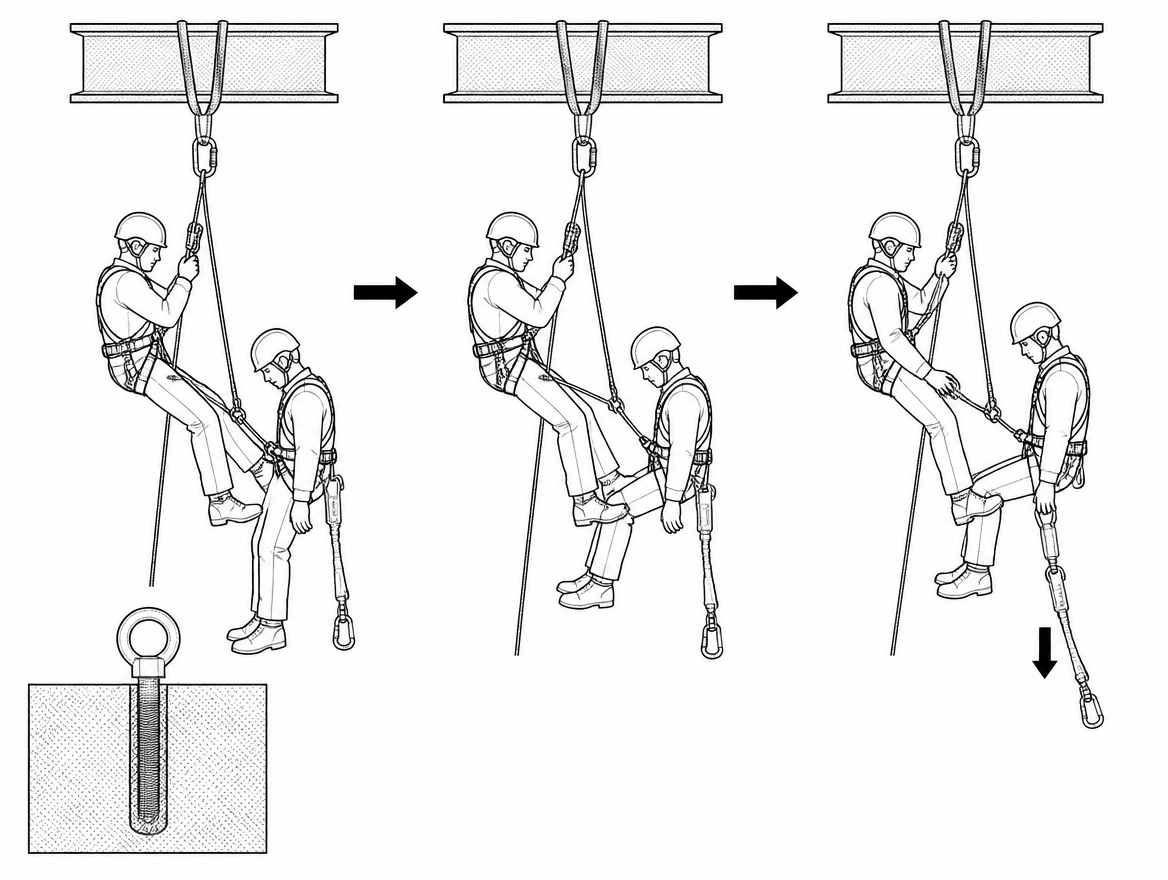
The casualty is connected to the rescuer, short, so that the two masses move as one and the casualty’s head stays clear of the descender and the rescuer’s hands.
- Where the casualty is already wearing a harness to EN 361, connection is made to a rated attachment point using a connector to EN 362 and a short, adjustable link so the casualty can be brought up or dropped slightly relative to the rescuer.
- Where the casualty must be lifted out of a system or has no usable harness, a rescue harness to EN 1497 or a rescue loop to EN 1498 is used. EN 1498 distinguishes classes of loop by the support they give; a loop that supports only under the arms is not equivalent to one that supports the thighs and torso.
- Keep the casualty in a position that supports the thighs and keeps the airway accessible. Prolonged motionless suspension in a harness is itself a clinical problem, which is why the priority is reducing time in suspension rather than perfecting the rigging.
- After the descent, casualty positioning and handling follow current first-aid protocol and the site’s emergency response arrangements. Older blanket advice about post-suspension positioning has been revised; the site’s medical guidance and trained first aiders govern, not rope technique.
A workable pre-descent check sequence
Before weight comes onto the system, and in this order:
- Anchors: both lines on anchors verified for the number of persons that will load them, working and safety lines on independent anchors where the structure allows.
- Rope: correct type and diameter for both devices, rope protection at every edge, ends terminated or knotted so nothing can run through a device.
- Descender: correctly threaded and locked off, rated load range and maximum descent height confirmed for a two-person load.
- Rope grab: correct orientation, cam engaged, manufacturer’s lanyard, positioned above the attachment point.
- Connectors: all gates closed, locked, loaded along the major axis, nothing cross-loaded over an edge or a harness loop.
- Casualty link: short, adjustable, on rated attachment points, with a plan for how the casualty’s own suspension is released and by which device.
- Communication and ground team: who calls the descent, who watches the rope ends, who receives the casualty.
Failure modes worth rehearsing before they happen
- Descender overheating or glazing the rope. Long descents with two people generate substantially more heat. This is the reason EN 341:2011 sets a maximum descent energy and a maximum descent height for the device. Plan a re-belay or a staged descent rather than a single uninterrupted drop that exceeds it.
- The casualty’s own system will not release. An energy absorbing lanyard or a loaded fall arrest block may need the casualty to be raised slightly before the connector will come off. A small haul capability — even a two-to-one with the equipment on the harness — solves a problem that otherwise stops the rescue entirely.
- Entanglement. Two harnesses, two sets of equipment loops and four lines produce a lot of opportunities for a trapped rope. Slings and tails are dressed and stowed before the descent, not during it.
- The grab is held open. Covered above. It is a training problem, and it is fixed by repetition, not by a briefing.
- Landing area not clear. The rescuer arrives with reduced mobility and a casualty attached. Somebody on the ground clears and prepares the landing zone during the descent.
Competence, inspection and planning obligations
Accompanied descent is a technique that degrades quickly without practice, and it is performed under time pressure by people who are also managing a casualty. Two structural points support it:
- Periodic examination. EN 365 sets out the framework for instructions for use, marking, and periodic examination of personal fall protection equipment by a competent person, recommended at intervals of at most 12 months, with records kept. Descenders and rope grabs used for rescue accumulate wear on cams, springs and rope-bearing surfaces; that wear is the whole subject of the examination.
- Emergency preparedness. Where an organisation runs a management system to ISO 45001:2018, clause 8.2 requires emergency response arrangements to be established and, importantly, periodically tested. A rescue plan that names accompanied descent as the method, but has never been run with the actual anchors, ropes and devices on that structure, has not been tested.
Competence requirements follow from the same logic: the rescuer needs to be trained on the specific descender and rope grab models the site holds, because cam behaviour, threading and two-person ratings are not transferable between devices.
The practical takeaway
Three checks decide whether an accompanied descent with a rope grab is a controlled operation or an improvisation: the two-person rating in the instructions for this descender and this rope grab, the number of persons the anchors are certified for under EN 795:2012 and CEN/TS 16415, and the length of the connection between the grab and the harness attachment. All three are verifiable on a quiet day with the equipment on a bench. None of them are verifiable while suspended next to a casualty.
The next step is to check each rescue device on the site inventory against its own instructions for a declared two-person load, record the result alongside the EN 365 periodic examination records, and schedule a practical rescue drill on the structure the plan actually refers to.
Frequently asked questions
When is accompanied descent the appropriate rescue method?
It is usually chosen when the casualty is suspended on rope or a fall arrest system and cannot operate their own descent device, when lowering from an upper level is not possible (no top access, no attendant, or the casualty's ropes cannot be reached and released from above), when a short haul to raise the casualty off a loaded lanyard is impractical or the descent route to the ground is shorter and cleaner than the route up, or when a rescuer must be physically present during the transfer — for example to keep an airway clear, free a trapped limb, or manage a device that must be unloaded before it will release.
Why is lowering from above usually preferred?
Where the casualty can be lowered from above by a competent attendant, that is usually the lower-risk option: only one person's mass is on the system, and the operator has both hands free and a stable stance. Accompanied descent is the method for when that option is not available.
What does the two-rope arrangement consist of?
Two independent lines, each with its own function and device. The working line carries the load through a descent device, which may be certified to EN 12841 as a Type C rope adjustment device for rope access work or to EN 341 as a descender device for rescue. The safety line carries no load in normal operation and is protected by a rope grab — either a Type A rope adjustment device to EN 12841 or a guided type fall arrester to EN 353-2 used only with the anchor line it was certified with. Both lines run to anchors and both should be low stretch kernmantle rope to EN 1891 Type A, in a diameter the devices are approved for, typically stated as a range such as 10 mm to 13 mm in the manufacturer's instructions.
Does a two-person rating on the descender mean the whole system is rated for two people?
No. Assuming the rest of the system follows once the descender is verified is described as the single most common technical error in accompanied descent planning. EN 12841 and EN 353-2 are both written around a single user; where a device is declared suitable for descent with two persons, that declaration comes from the manufacturer's instructions for that specific model, not from the standard. Some Type A backup devices carry an explicit two-person rescue rating, while many explicitly prohibit it because the cam geometry and rope-holding behaviour were only validated at single-person test loads. This has to be read off the instructions for the device in hand before the day of the rescue. Anchor devices to EN 795:2012 are certified for a declared number of simultaneous users, with CEN/TS 16415 giving additional recommendations for multi-person use.
Where should the rope grab sit on the safety line?
A rope grab only limits a fall to the extent that the distance it can travel before engaging is short. During a descent the grab is pushed down the safety line by the rescuer's movement, and the amount of rope between the grab and the harness attachment sets the potential free-fall distance if the working line or descender fails. The grab should be kept high, close above the attachment point.
Need this as a document you can issue? The template library gives you the risk assessments, permits and inspection logs in editable form — and employer plans cover a whole team with completion records.