
Home / How EN Workplace Safety Standards Fit Together: Risk Assessment, Equipment Selection and PPE
How EN Workplace Safety Standards Fit Together: Risk Assessment, Equipment Selection and PPE
A harness marked EN 361 tells you the product passed a defined set of tests. It does not tell you whether a harness is the right answer to the hazard in front of you, whether the anchor it will be clipped to can take the load, or whether the fall clearance below the work position is sufficient. That gap — between a product being certified and a system being suitable — is where most avoidable failures on site begin.
EN workplace safety standards are not a flat list of rules to comply with one by one. They form a chain: legal duties create the obligation to assess risk, method standards describe how to assess it and in what order to control it, and product standards define what a specific piece of equipment or PPE has been proven to do. Reading any one link in isolation produces predictable errors — PPE issued before the hazard has been engineered out, guards specified without a performance level, or a fall arrest system assembled from components that were never tested together.
This article maps the chain, names the standards at each link, and shows how a single hazard moves through all three levels to a defensible decision.
The three levels: management system, method, product
Almost every EN or EN ISO standard relevant to occupational safety sits at one of three levels. Knowing which level a standard belongs to tells you what question it can answer.
| Level | Typical standards | Question it answers |
|---|---|---|
| Management system | EN ISO 45001:2018; Framework Directive 89/391/EEC | Who must assess, document, review and act — and how is that governed? |
| Method / process | EN ISO 12100:2010; EN ISO 13849-1; EN ISO 14119; EN ISO 13857 | How is risk assessed, and in what order are controls chosen and verified? |
| Product | EN 361; EN 397; EN ISO 20345; EN 388; EN 149; EN 352-1; EN ISO 20471 | What has this specific item been tested to withstand, and to which limits? |
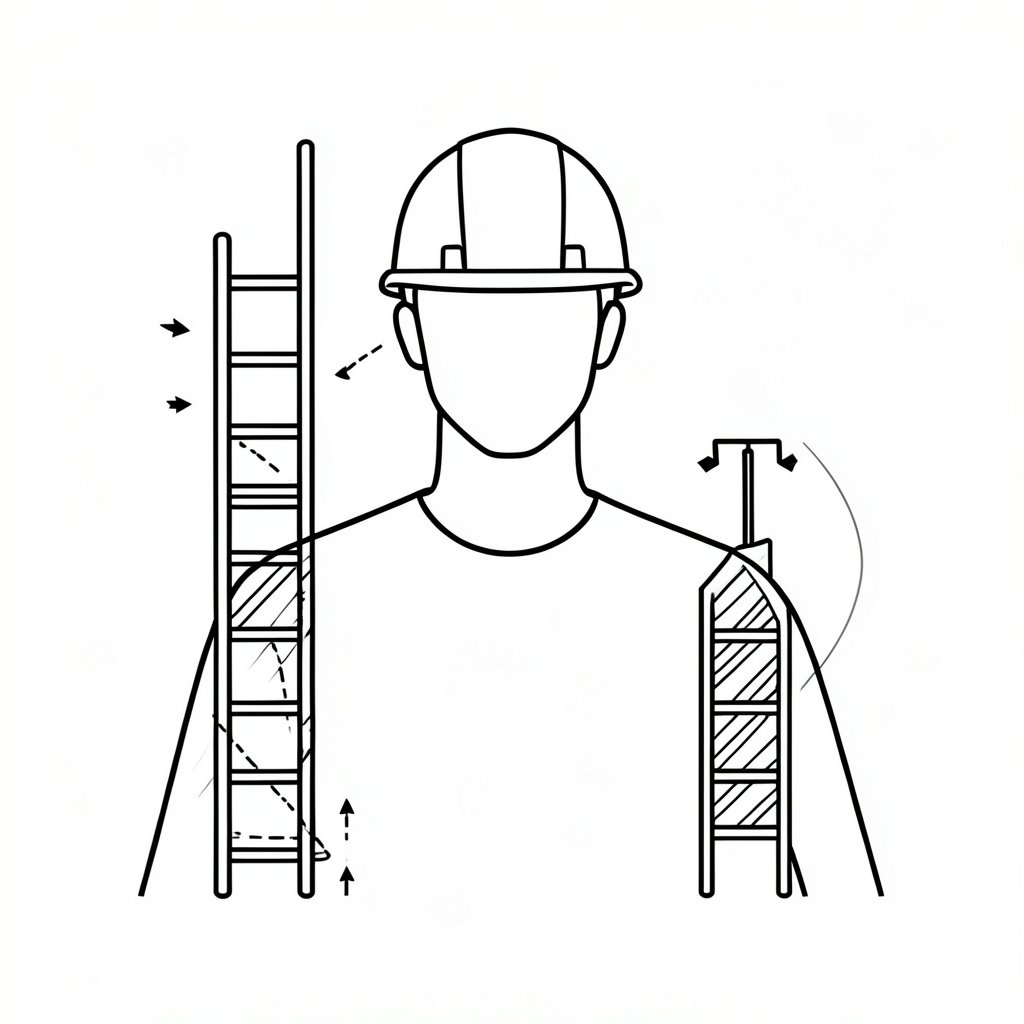
The chain runs downward: duty to assess, then method of control selection, then the specific certified product.
The direction of travel matters. Decisions flow downward — from duty, to assessment, to control selection, to the specific product. A purchasing decision made at product level and justified backwards (“the gloves are EN 388 certified, so the hand hazard is handled”) inverts the chain and leaves the actual risk unassessed.
Level 1: EN ISO 45001 and the duty to assess
EN ISO 45001:2018 is the occupational health and safety management system standard. It does not specify a glove, a guard or an anchor. It specifies the organisational machinery around those decisions.
Two clauses do most of the work on site:
- Clause 6.1.2 requires processes for ongoing, proactive hazard identification — taking into account routine and non-routine activities, human factors, changes in the organisation, and incidents that have already occurred.
- Clause 8.1.2 requires the organisation to establish processes for eliminating hazards and reducing risks using a hierarchy of controls, with PPE explicitly at the bottom of that hierarchy.
Underneath the standard sits the legal duty. Council Directive 89/391/EEC (the Framework Directive) obliges employers to evaluate risks to workers’ safety and health, and Council Directive 89/656/EEC sets the requirements for the use of PPE at work — including that PPE must be assessed for suitability against the risks it is intended to control, and that it must not itself create additional risk. Directive 89/656/EEC also makes clear that PPE is used where risks cannot be avoided or sufficiently limited by other means.
The practical consequence: a management system standard tells a supervisor that a documented assessment must exist, be current, and be reviewed after change. It does not tell them what the assessment should conclude.
Level 2: EN ISO 12100 and the order in which controls are chosen
EN ISO 12100:2010 — Safety of machinery. General principles for design. Risk assessment and risk reduction — is the method standard that underpins most machinery-related decisions in the EN framework. It is written for designers, but its structure is directly usable by anyone assessing an existing installation.
It sets out risk assessment as: determine the limits of the machine, identify hazards, estimate risk, evaluate risk, then reduce it. Risk reduction follows a three-step method, applied in order:
- Inherently safe design measures. Remove the hazard by design — reduce force or energy, eliminate the trap point, change the process so the operator never needs to reach into the danger zone.
- Safeguarding and complementary protective measures. Fixed and interlocked guards, protective devices, emergency stop, means of isolation and energy dissipation.
- Information for use. Markings, signals, warnings, instruction handbooks, and — where residual risk remains — training and PPE.
The hierarchy in EN ISO 45001 clause 8.1.2 and the three-step method in EN ISO 12100 are consistent with each other: engineer first, administer second, protect the individual last. When PPE appears early in a control plan, that is usually a signal that steps 1 and 2 were not fully worked through rather than that they were exhausted.
For work equipment more broadly, Directive 2009/104/EC sets minimum requirements for the use of work equipment, and Directive 2006/42/EC (the Machinery Directive) governs what may be placed on the market — with Regulation (EU) 2023/1230 replacing it from 20 January 2027.
Where equipment selection standards take over
Once the assessment says “guard it” or “provide safe access,” a further family of EN and EN ISO standards defines what that control has to achieve. These are the standards that turn a decision into a specification.
Machinery safeguarding
- EN ISO 14120 — general requirements for the design and construction of fixed and movable guards.
- EN ISO 14119 — interlocking devices associated with guards, including selection, design and measures against defeat.
- EN ISO 13857 — safety distances to prevent hazard zones being reached by upper and lower limbs.
- EN ISO 13855 — positioning of safeguards with respect to approach speeds of parts of the human body.
- EN ISO 13849-1 — safety-related parts of control systems, expressed as a required Performance Level (PLr, a to e). EN IEC 62061 provides the equivalent route using Safety Integrity Levels.
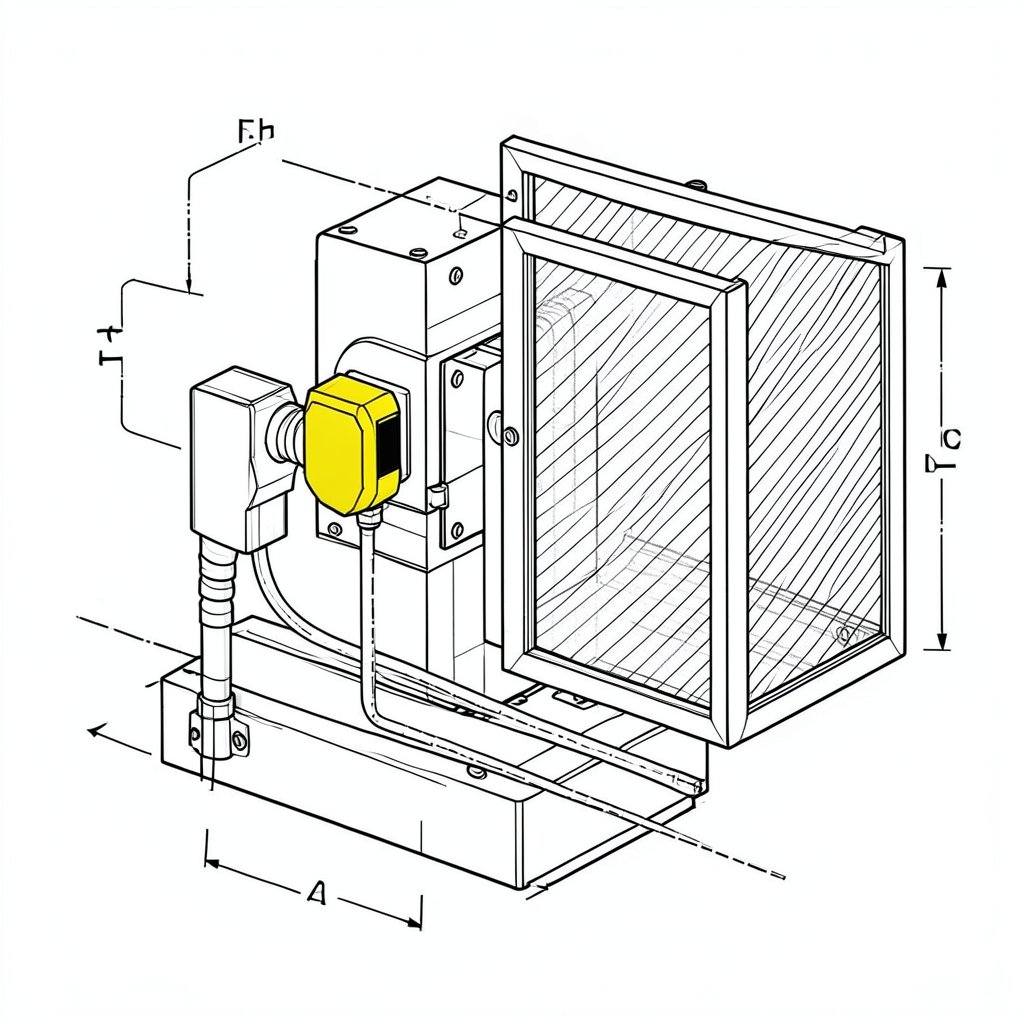
An interlocked guard is only fully specified once the required Performance Level from EN ISO 13849-1 is stated alongside EN ISO 14119 selection.
A guard specified without a required Performance Level is an incomplete specification. The risk assessment output feeds directly into PLr; the interlock, its wiring, its diagnostic coverage and its architecture then have to meet it. This is the clearest example in the whole framework of an assessment result being converted into a measurable equipment requirement.
Access and work at height equipment
- EN 1004-1:2020 — mobile access and working towers made of prefabricated elements.
- EN 131 series — ladders, including EN 131-2 for requirements and testing and EN 131-3 for marking and user instructions.
- EN 13374 — temporary edge protection systems, classified as Class A, B or C by the loading and the pitch they are designed for.
Collective protection selected under these standards protects everyone in the area without depending on the individual wearing, fitting and connecting equipment correctly. That is precisely why it precedes PPE in the hierarchy.
Level 3: what a PPE product standard actually certifies
PPE placed on the EU market is governed by Regulation (EU) 2016/425. It classifies PPE by the severity of the risk it protects against:
- Category I — minimal risks (for example, superficial mechanical injury). Manufacturer self-certification.
- Category II — risks that are neither minimal nor those listed under Category III. Requires EU type-examination by a notified body.
- Category III — risks of very serious consequences such as death or irreversible damage to health, including falls from height, harmful substances, high-voltage electricity, drowning, and harmful noise. Requires EU type-examination plus ongoing conformity surveillance by a notified body.
Harmonised EN standards give a presumption of conformity with the Regulation’s essential health and safety requirements. The standard number on the label therefore tells you which test regime the item met — and, just as importantly, which it did not.
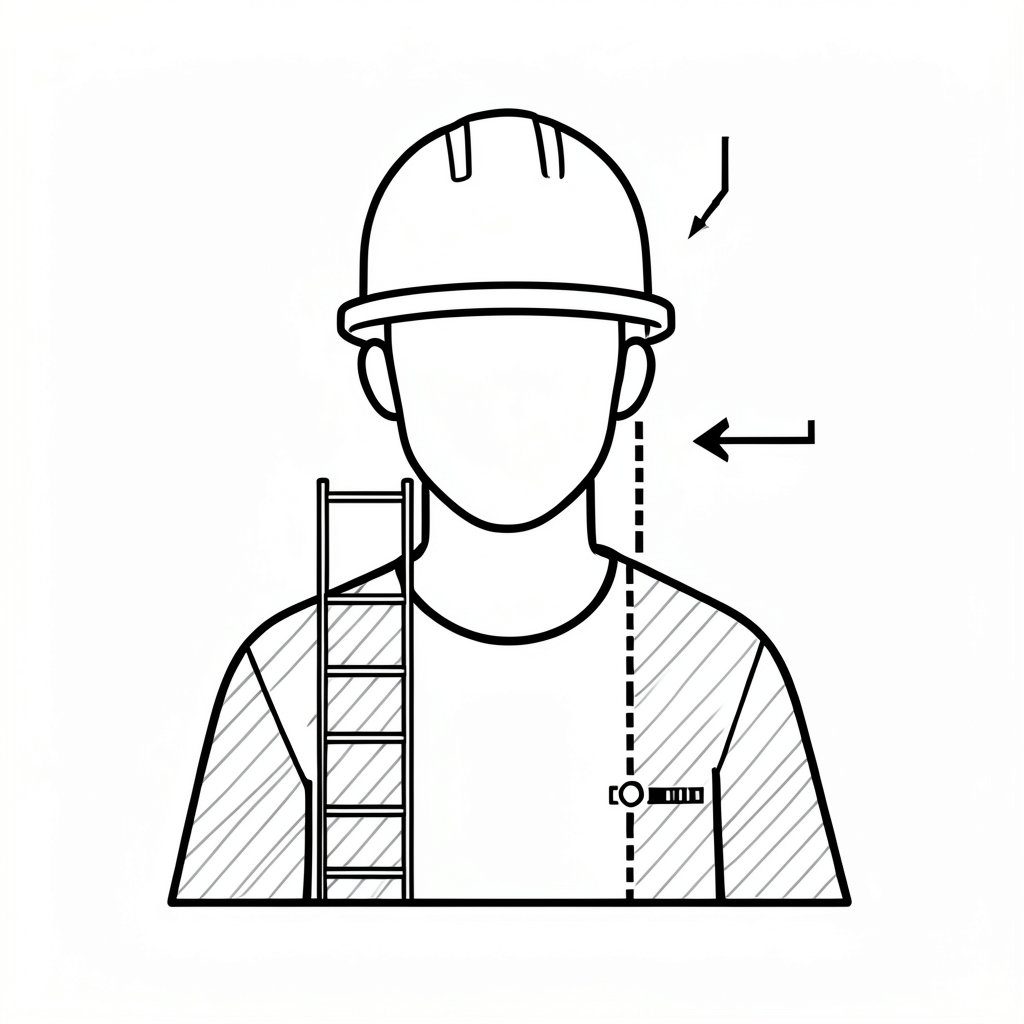
The label states which test regime the item met — EN 361 here — and provides the serial number and date needed for periodic examination records.
Common PPE product standards by hazard
- Head: EN 397 (industrial safety helmets, with optional performance markings such as −30 °C, 440 V a.c., LD lateral deformation, MM molten metal); EN 12492 (mountaineering helmets, used where a retained helmet is required at height); EN 50365 (electrically insulating helmets for live working up to 1000 V a.c.).
- Eyes and face: EN 166 (general specification, including optical class and impact levels S, F, B and A, and field-of-use symbols such as 3, 4, 5, 8 and 9); EN 169 (welding filters); EN 170 (ultraviolet filters).
- Hearing: EN 352-1 (earmuffs) and EN 352-2 (earplugs). Selection is driven by Directive 2003/10/EC, which sets a lower exposure action value of 80 dB(A), an upper action value of 85 dB(A) and an exposure limit value of 87 dB(A) taking attenuation into account.
- Respiratory: EN 149 (filtering half masks, FFP1/FFP2/FFP3); EN 140 (half masks) and EN 136 (full face masks) used with EN 143 particle filters or EN 14387 gas and combined filters.
- Hands: EN ISO 21420 (general requirements and test methods); EN 388 (mechanical risks — abrasion, blade cut, tear, puncture, plus TDM cut resistance and optional impact); EN 407 (thermal risks); EN ISO 374-1 (chemical protection).
- Feet: EN ISO 20345 (safety footwear, 200 J toecap); EN ISO 20346 (protective footwear, 100 J toecap); EN ISO 20347 (occupational footwear, no toecap requirement).
- Visibility: EN ISO 20471 (high-visibility clothing, Classes 1 to 3 by area of retroreflective and background material).
- Fall protection: EN 361 (full body harnesses); EN 358 (work positioning); EN 354 (lanyards); EN 355 (energy absorbers); EN 360 (retractable type fall arresters); EN 362 (connectors); EN 363 (personal fall protection systems); EN 795 (anchor devices); EN 365 (general requirements for instructions for use, maintenance, periodic examination, repair, marking and packaging).
Two limits are worth stating plainly. First, a product standard certifies performance against defined test conditions, not suitability for a specific task. Second, marking on PPE is only meaningful if it is read: an EN 388 glove with a low puncture rating is still an EN 388 glove.
Worked example: one hazard through all three levels
Task: replacing a damaged light fitting on a mezzanine walkway with an unprotected edge, once per year, at 4.5 m above a concrete floor.
Level 1 — the duty
The activity is non-routine, which is exactly the category EN ISO 45001 clause 6.1.2 calls out. It requires a documented assessment before work starts, not a verbal agreement on the day.
Level 2 — control selection in order
- Elimination: can the fitting be lowered, or replaced with a unit serviceable from floor level via a lowering system? If yes, the work at height hazard disappears and no fall protection standard applies.
- Collective protection: if the edge can be permanently guarded to EN ISO 14122-3 (permanent means of access to machinery — stairs, stepladders and guard-rails) or temporarily protected to EN 13374, the residual risk drops sharply for everyone using the walkway, not just the electrician.
- Personal fall protection: only if elimination and collective protection are genuinely not reasonably practicable does the assessment move to a personal system.
Level 3 — specifying the system, not the item
EN 363 describes personal fall protection systems: an anchor device, a body holding device, and a connecting subsystem, assembled so that the parts are compatible. Specifying only “an EN 361 harness” is not a specification.
- Anchor: EN 795:2012 classifies anchor devices as Types A to E and sets static strength requirements. Note the scope nuance — Types A, C and D are generally treated as permanently installed parts of the structure rather than as PPE, which changes the conformity route and means the supporting structure itself must be verified by a competent person.
- Body holding device: EN 361, connected only at a fall arrest attachment point marked A (dorsal, or a sternal pair marked A/2 where the manufacturer requires both to be used together). Work positioning attachment points to EN 358 are not fall arrest points.
- Connecting subsystem: EN 355 energy absorbing lanyard (maximum arrest force limited to 6 kN, total length including connectors not exceeding 2 m) or an EN 360 retractable type fall arrester where the geometry suits it.
- Connectors: EN 362, correctly loaded along the major axis with the gate closed and locked.
- Clearance: calculated from the manufacturer’s instructions, which govern. The calculation typically sums lanyard length, energy absorber deployment, harness extension and D-ring displacement, the height of the user below the attachment point, and a safety margin. At 4.5 m over concrete, a 2 m energy absorbing lanyard from a foot-level anchor will frequently not leave sufficient clearance — which is the point at which the specification changes, not the point at which the calculation is skipped.
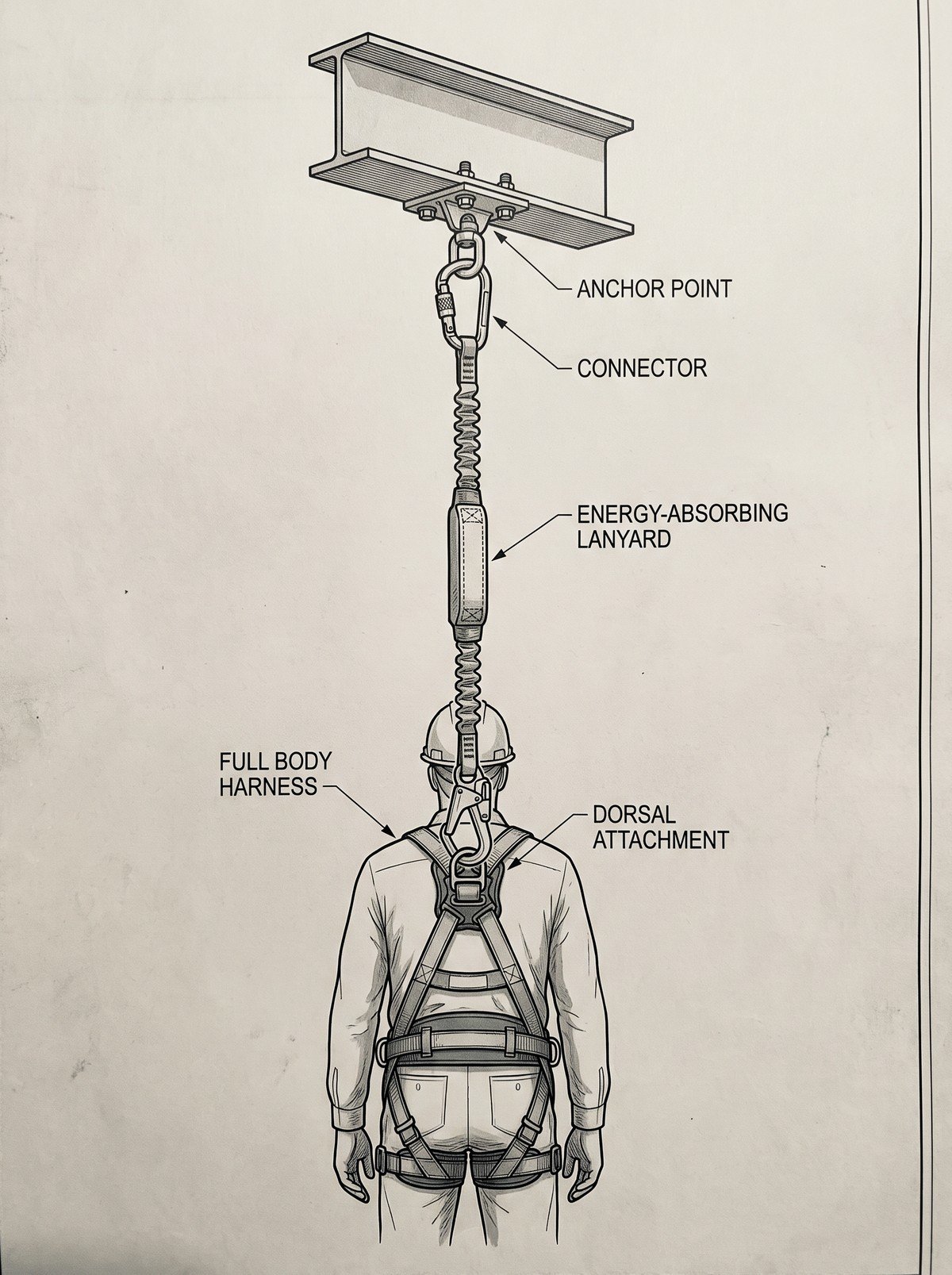
Correct: the system is specified as a whole — anchor, connectors, absorber, harness attachment point and calculated clearance from the manufacturer’s instructions.
After selection: keeping the system valid
EN 365 sets out the requirements for instructions for use, periodic examination and record keeping for personal fall protection equipment, including periodic examination by a competent person at intervals determined by the manufacturer’s instructions, and at least every 12 months where the manufacturer specifies annual examination. Pre-use checks by the wearer are separate from, and do not replace, that examination.
Five points where the chain typically breaks
- PPE issued before engineering controls are examined. The fastest indicator is a control plan whose first line item is a product purchase.
- Compatibility assumed rather than verified. Certified components from different manufacturers are not automatically a certified system. EN 363 and the manufacturers’ instructions define the permitted combinations.
- A CE marking read as a suitability judgement. Conformity under Regulation (EU) 2016/425 means the product meets the essential requirements for its category — the employer’s selection assessment under Directive 89/656/EEC is a separate exercise.
- No reassessment after change. A new anchor location, a different substrate, a modified guard, a changed work sequence — each invalidates parts of the original assessment. EN ISO 45001 clause 6.1.2 anticipates this; site practice often does not.
- Missing periodic examination records. Undocumented examination is, for audit and for liability purposes, indistinguishable from no examination.
Using the framework in practice
A workable test for any control decision is whether all three levels can be answered in one sentence each:
- Duty: which documented assessment covers this task, and when was it last reviewed?
- Method: which control step in EN ISO 12100 or EN ISO 45001 clause 8.1.2 does this measure sit at, and why were the steps above it ruled out?
- Product: which EN standard and which performance markings, ratings or Performance Level does the selected equipment carry, and do they match the hazard estimated in the assessment?
If the third question can be answered but the second cannot, the equipment may well be certified and the control still be the wrong one.
A practical next step is to take one existing risk assessment covering PPE-dependent work and trace it back up the chain: check that the selected product standard and its performance markings match the hazards actually recorded, and that the higher control steps were considered and documented. Where machinery is involved, EN ISO 12100:2010 is the standard to read first; for personal fall protection, EN 363 and EN 365 together define what a complete, maintainable system looks like.
Frequently asked questions
What are the three levels of EN safety standards?
Almost every EN or EN ISO standard relevant to occupational safety sits at one of three levels: management system standards (such as EN ISO 45001:2018 and the Framework Directive 89/391/EEC), method or process standards (such as EN ISO 12100:2010, EN ISO 13849-1, EN ISO 14119 and EN ISO 13857), and product standards (such as EN 361, EN 397, EN ISO 20345, EN 388, EN 149, EN 352-1 and EN ISO 20471). Knowing which level a standard belongs to tells you what question it can answer.
Why isn't a product certification enough on its own?
A harness marked EN 361 tells you the product passed a defined set of tests. It does not tell you whether that harness is the right answer to the hazard in front of you, whether the anchor it will be clipped to can take the load, or whether the fall clearance below the work position is sufficient. Justifying a purchase backwards — "the gloves are EN 388 certified, so the hand hazard is handled" — inverts the chain and leaves the actual risk unassessed.
Which clauses of EN ISO 45001:2018 matter most on site?
Two clauses do most of the work. Clause 6.1.2 requires processes for ongoing, proactive hazard identification, taking into account routine and non-routine activities, human factors, changes in the organisation, and incidents that have already occurred. Clause 8.1.2 requires processes for eliminating hazards and reducing risks using a hierarchy of controls, with PPE explicitly at the bottom of that hierarchy.
What is the three-step risk reduction method in EN ISO 12100?
Applied in order: first, inherently safe design measures — removing the hazard by design, reducing force or energy, eliminating the trap point, or changing the process so the operator never needs to reach into the danger zone. Second, safeguarding and complementary protective measures — fixed and interlocked guards, protective devices, emergency stop, means of isolation and energy dissipation. Third, information for use — markings, signals, warnings, instruction handbooks, and where residual risk remains, training and PPE.
What do the EU directives require regarding PPE?
Council Directive 89/391/EEC (the Framework Directive) obliges employers to evaluate risks to workers' safety and health. Council Directive 89/656/EEC sets requirements for the use of PPE at work, including that PPE must be assessed for suitability against the risks it is intended to control and must not itself create additional risk; it also makes clear that PPE is used where risks cannot be avoided or sufficiently limited by other means.
Need this as a document you can issue? The template library gives you the risk assessments, permits and inspection logs in editable form — and employer plans cover a whole team with completion records.