
Safety / Tips and Tricks / Roofing and work at height
Activity 02 · Roofing
Rescue Planning for a Fall Arrested by a Roof Edge Protection System
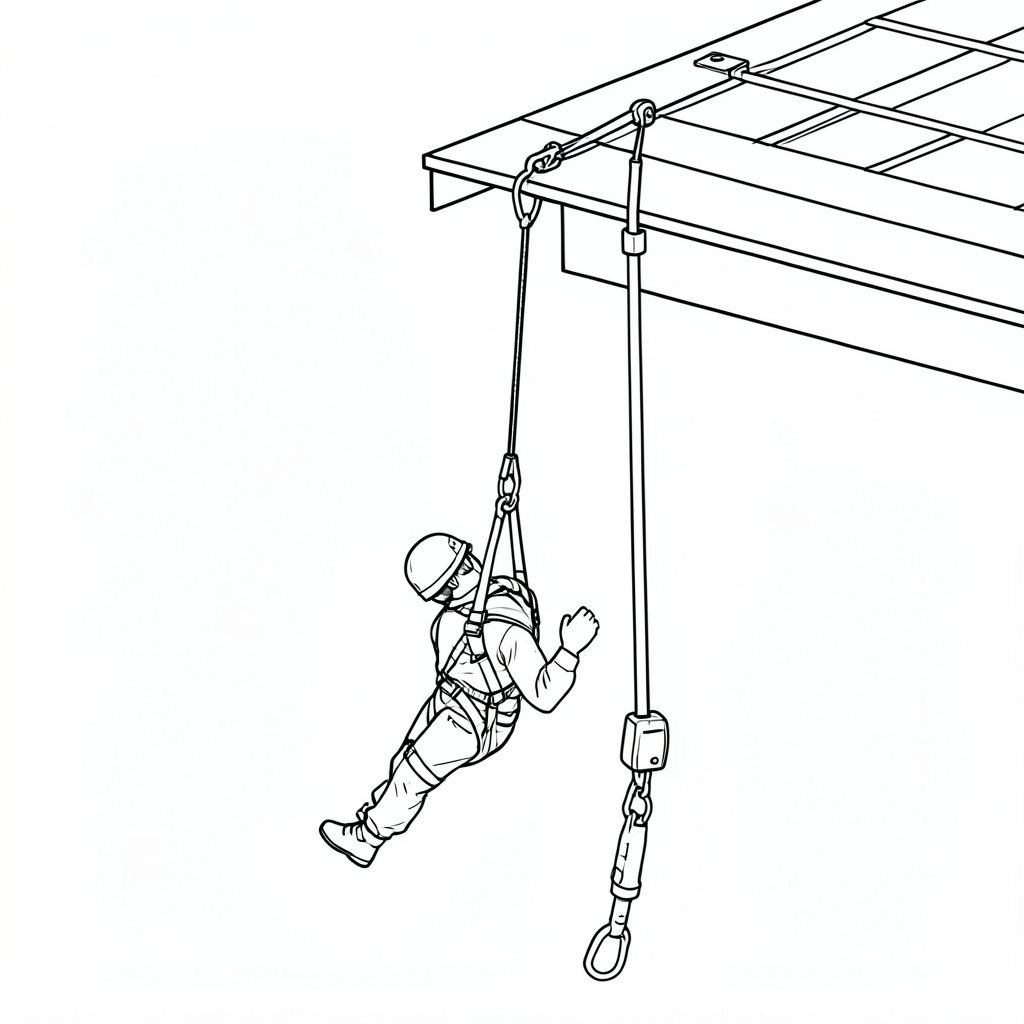
A fall-arrest system that successfully stops a fall has only completed half its job. The person is now suspended, potentially injured, and at risk from the suspension itself if they are not reached and lowered within a genuinely short window. Rescue planning is what turns a survived fall into a full recovery rather than a second, delayed emergency.
Why the clock starts immediately
Suspension trauma — a circulatory failure caused by prolonged, motionless upright suspension in a harness — can begin producing symptoms within minutes, not the extended window many people assume a rescue has. A person who is conscious and talking immediately after a fall can deteriorate quickly if left hanging, because the harness itself, particularly its leg straps, restricts blood flow in the legs in a way that becomes dangerous the longer it continues. This is why waiting for a standard emergency-service response, which can reasonably take considerably longer than the time suspension trauma allows, is not an adequate rescue plan on its own for roof-edge fall-arrest work.
What a rescue plan needs to specify before work starts
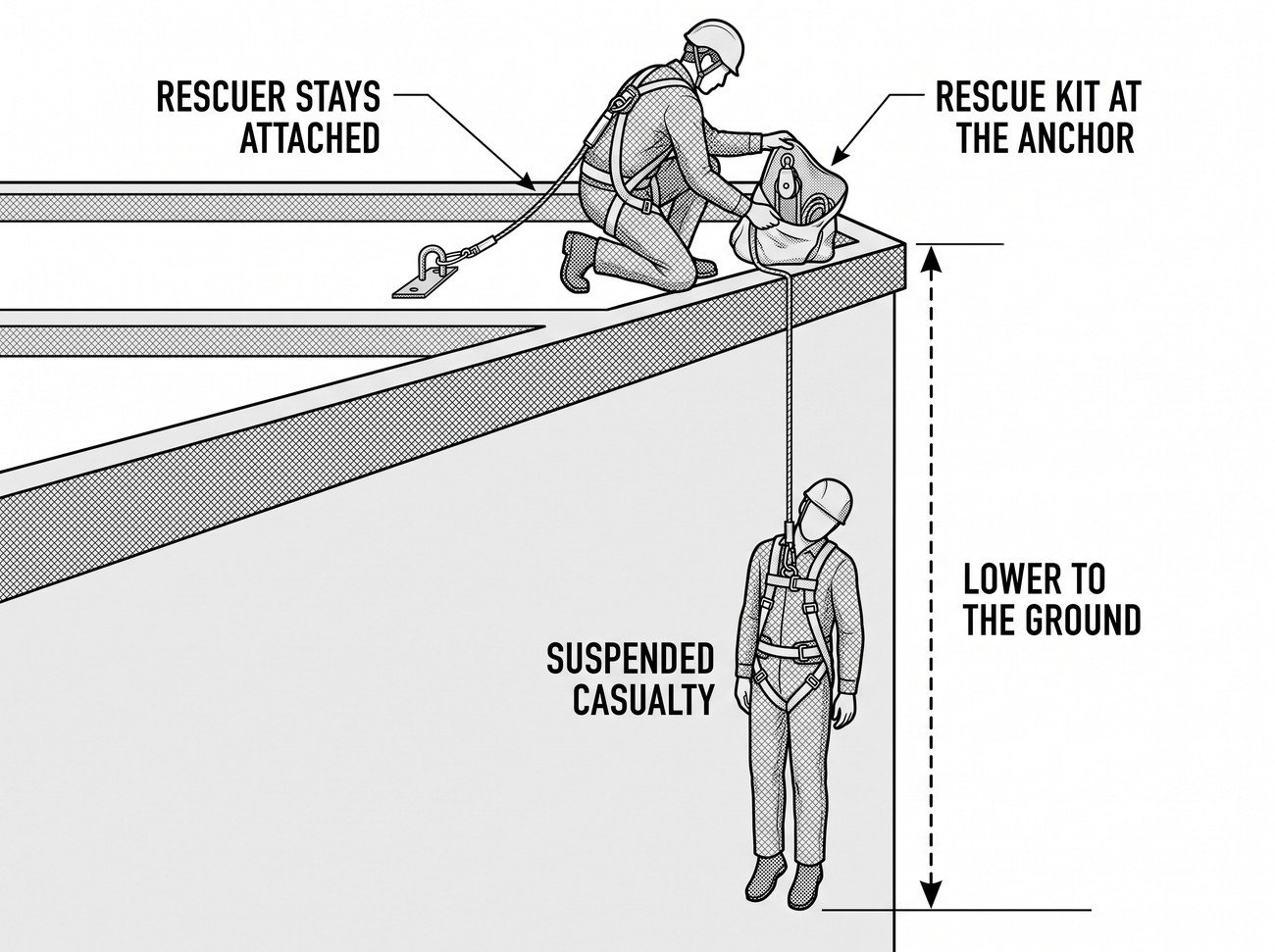
A workable plan names who initiates rescue, what equipment is on hand to reach the suspended person, and how they will actually be brought down or supported to relieve pressure on the leg straps while a full rescue is organised. For roof-edge work, this often means a pre-positioned descender device meeting EN 341 for lowering the person from above, a route for a rescuer to reach a position near them, or in some configurations, suspension-relief straps built into the harness itself that let the suspended person take some of their own weight temporarily while help arrives. Where a dedicated rescue harness is used rather than the casualty’s own fall-arrest harness, it should meet EN 1497.
Matching the plan to the actual roof and anchor configuration
A generic rescue plan copied between jobs is a weak substitute for one built around the specific roof: where the anchors are, what access exists for a rescuer to reach a suspended person along that specific edge, and what equipment is actually needed for that geometry. An edge-protection or horizontal-lifeline configuration that lets a worker be suspended along a long span needs a rescue approach that covers the whole span, not just the point closest to the access ladder.
Practising the plan, not just writing it
A rescue plan that has never been rehearsed carries real uncertainty about whether it actually works under the time pressure of a genuine incident. A practised team that has physically walked through reaching a suspended position, operating the rescue equipment, and lowering a test load finds the gaps a paper plan alone does not reveal — a route that is longer than expected, equipment that is not quite where it was assumed to be, or a step that takes longer under real conditions than anyone anticipated.
For the fall-arrest systems this rescue plan supports, see fall restraint vs fall arrest for roof work, and for lone-working considerations that affect rescue capability, see lone working on a roof.
Common errors
1Relying on emergency services alone as the rescue plan for fall-arrest work at a roof edge.
2Using a generic rescue plan that does not reflect the specific roof's anchor positions and access constraints.
3Never rehearsing the plan, so gaps only become apparent during an actual incident.
4Overlooking suspension-relief straps or equivalent measures that could reduce harm while a full rescue is organised.
Frequently asked questions
Why can't waiting for standard emergency services serve as the rescue plan for a roof-edge fall arrest?
Suspension trauma can begin producing symptoms within minutes, a window that a standard emergency-service response can reasonably exceed, so a faster, site-specific rescue capability needs to be planned in advance.
What does suspension trauma actually involve?
A circulatory failure caused by prolonged, motionless upright suspension in a harness, where the leg straps restrict blood flow in a way that becomes dangerous the longer the person remains hanging.
What should a roof-edge rescue plan specify before work begins?
Who initiates rescue, what equipment is available to reach the suspended person, and how they will be lowered or supported to relieve pressure on the leg straps while a full rescue is organised.
Why is a generic rescue plan copied between jobs a weak approach?
It does not reflect the specific roof's anchor positions, access constraints, or the geometry a rescuer would actually need to work with to reach a suspended person on that particular edge.
Why does a rescue plan need to be rehearsed, not just written?
A practised run reveals gaps a paper plan does not – a longer than expected route, equipment not quite where it was assumed to be, or steps that take longer under real conditions than anticipated.
Need this as a document you can issue? The template library gives you the risk assessments, permits and inspection logs in editable form — and employer plans cover a whole team with completion records.