Safety / Tips and Tricks / Rope access and confined space
Activity 01 · Rope access
Long or Short Rope Ascent: Choosing the Technique
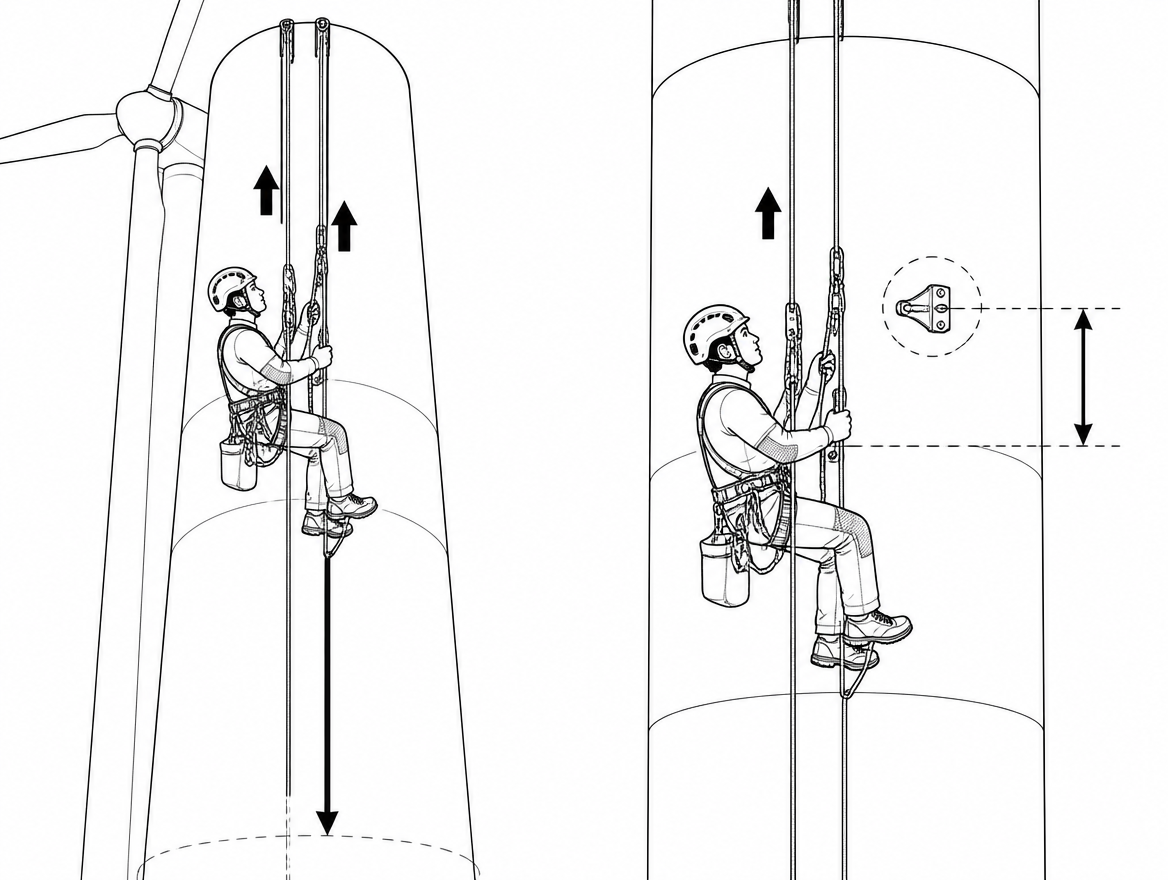
A technician who has to gain 55 m of free-hanging rope on a wind tower and a technician who has to move three metres back up to a missed fixing are doing the same thing on paper: ascending a rope. In practice they need different systems. The wrong choice costs energy on a long pitch, or adds unnecessary system changes on a short one — and system changes are where connection errors happen. This article sets out what separates a long-ascent configuration from a short-ascent configuration, what stays the same in both, and which site conditions actually decide the rope ascent technique for a given task.
Where the line falls between a “short” and a “long” ascent
There is no standard-defined threshold. In working practice the distinction is set by three things rather than by metres alone:
- Distance to be regained. Roughly, anything up to about 5–10 m is treated as a short repositioning move; sustained ascents of tens of metres are planned as long ascents with a dedicated ascending set-up.
- How many times it will be repeated. Twenty short two-metre moves across a shift add up to more vertical distance — and far more transitions — than one 40 m ascent.
- Whether the technician is already in a working configuration. If the descender is loaded and the work seat is set, a short ascent is usually best done without dismantling that configuration.
Height alone is a poor guide. A 12 m ascent through steelwork with three deviations is a different problem from a 12 m clean free hang.
The equipment baseline that does not change
Whichever technique is selected, the fundamentals of a rope access system stay the same. EN ISO 22846-1 sets out the fundamental principles for rope access work, and EN ISO 22846-2 gives the code of practice; the two-rope principle — a working line and an independently anchored safety line — applies to ascent exactly as it does to descent.
- Ropes: low-stretch kernmantel rope to EN 1891 Type A. Rope adjustment devices certified to EN 12841 are intended for use on rope within the diameter range stated in the manufacturer’s instructions (commonly a band within 10–13 mm); the instructions for the specific device, not habit, define the compatible diameter.
- Harness: a sit harness attachment conforming to EN 813 carries the working load during ascent; the fall arrest attachment points required by EN 361 remain part of the harness for connection of the backup device where the manufacturer specifies it.
- Working-line devices: rope clamps used to ascend a working line are Type B devices under EN 12841 (some ascenders also carry EN 567 as mountaineering rope clamps). They are progression devices, not fall arresters.
- Safety-line device: a Type A rope adjustment device under EN 12841 (or another device specified by the manufacturer for the safety line) travels on the second rope throughout the ascent.
- Connectors and anchors: connectors to EN 362, anchor devices to EN 795 or structural anchors verified by a competent person.
The choice of technique changes how the working line is gripped and how the legs drive the movement. It does not change the requirement for a second rope with a suitable backup device on it.
Short ascents: keep the descender on the rope
For a few metres of gain from a working position, the efficient option is normally to add the minimum needed to the configuration already in use rather than to rig a full ascending set-up.
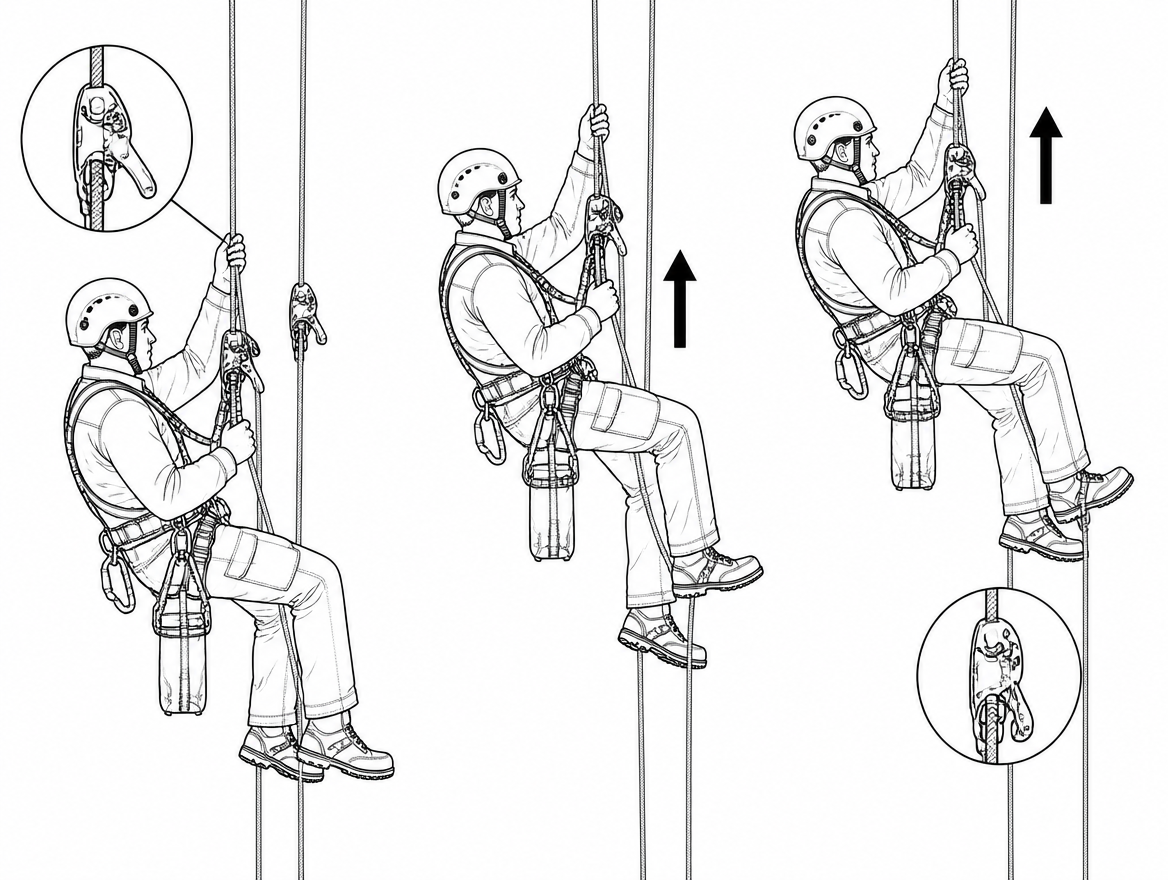
A typical short-ascent arrangement is a handled ascender (EN 12841 Type B) placed on the working line above the descender, with a foot loop of a length that lets the leg extend fully at the bottom of the step and the ascender reach comfortably at the top. The descender (EN 12841 Type C) stays on the rope and takes the load at the end of each push, so the sequence is: stand in the foot loop, take slack through the descender, sit back onto the descender, slide the ascender up, repeat. The backup device on the safety line is advanced at the same rate.
Why this suits short distances:
- No system change to enter or leave the ascent — the descender is never removed, so the technician can resume descent or work positioning immediately.
- Fewer devices on the rope, which matters in confined space, on ladders inside structures, and around edges.
- Awkward and inefficient beyond a handful of metres: each cycle gains only as much as one leg extension, and the descender must be fed by hand every cycle.
A note on descender behaviour: taking slack through a descender while standing in a foot loop means briefly unloading the device. The manufacturer’s instructions define how the working line is to be held and controlled during that action, and how the device is intended to be operated with the free end of the rope managed. Where the descender is not designed to be fed upward under partial load, the alternative is a chest ascender configuration, below.
Long ascents: the frog (sit–stand) system
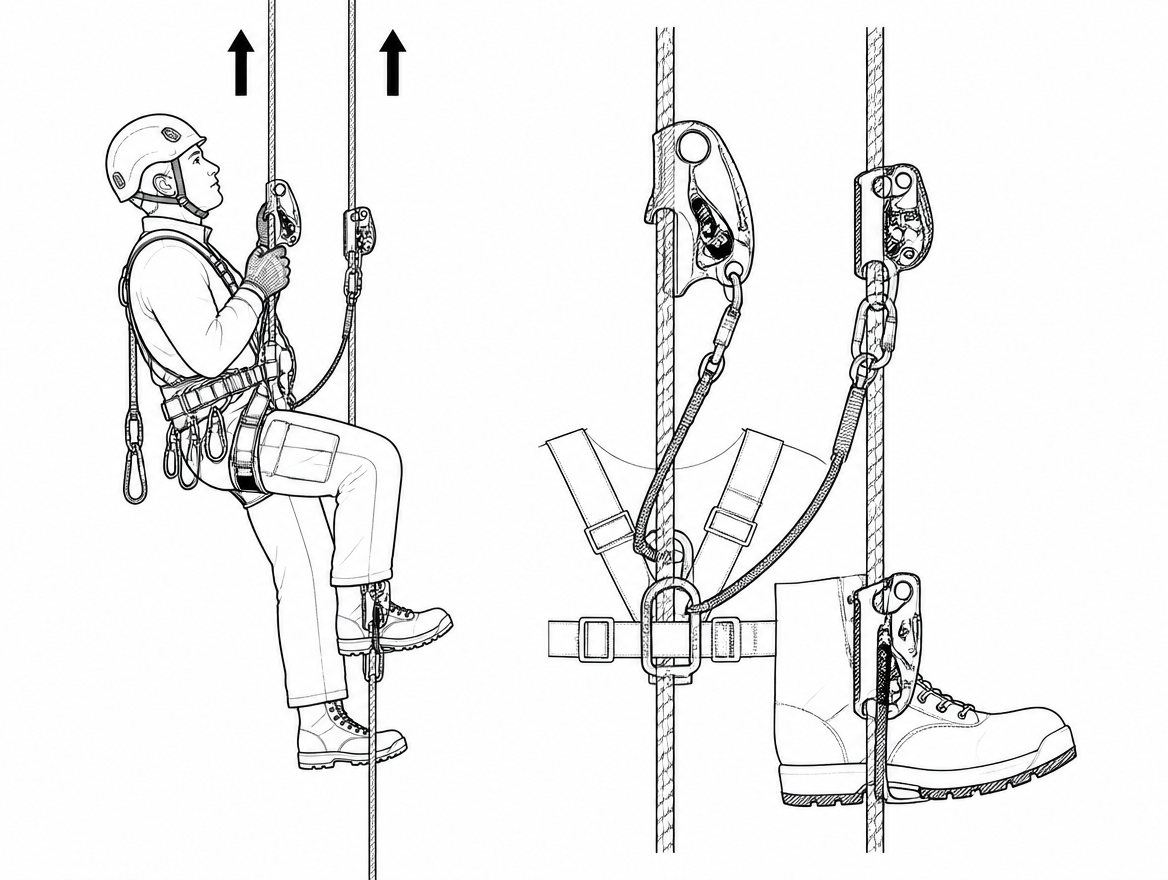
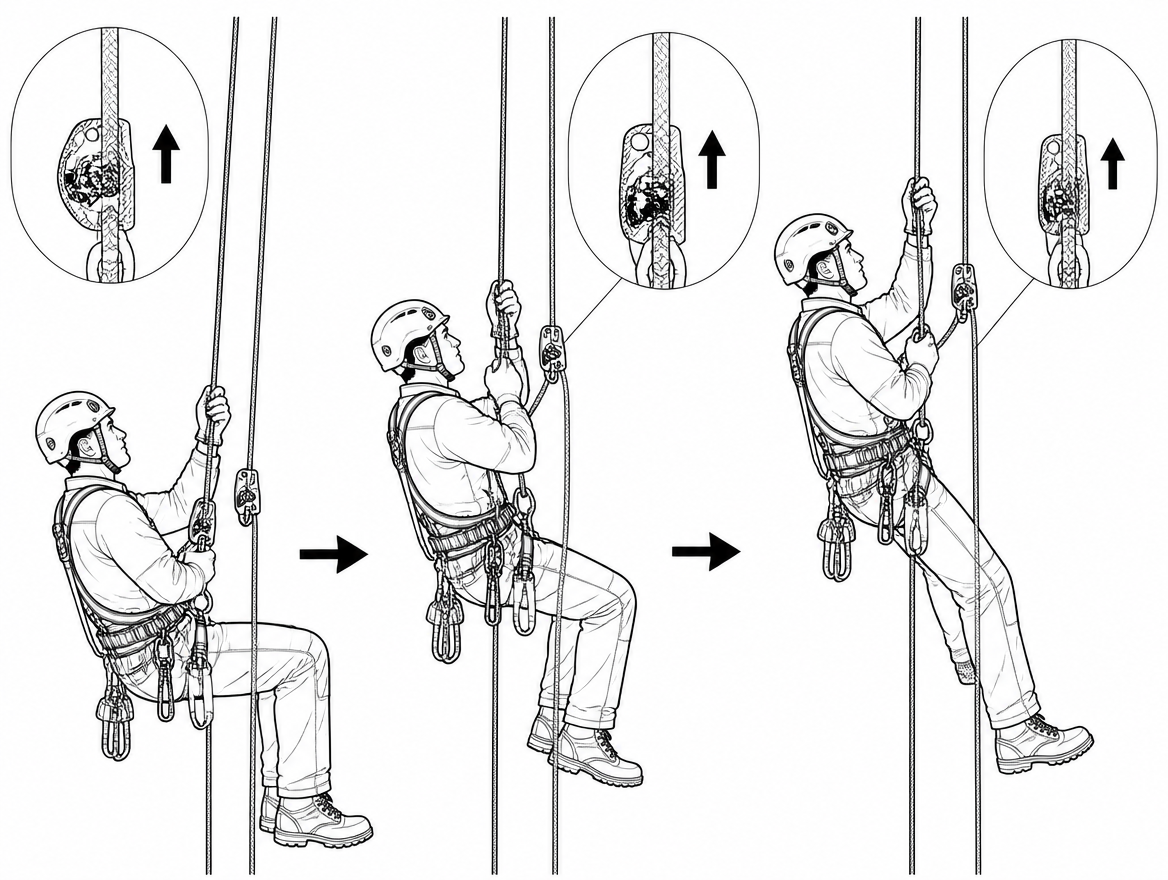
For sustained vertical gain, the standard technique across most European rope access and cave-derived practice is the frog system: a chest-mounted ascender held close to the sternum by a chest harness, plus a handled ascender above it connected to the harness attachment point and carrying a foot loop or double foot loops.
The cycle is a repeated sit–stand. Both knees come up, the handled ascender is pushed to arm’s reach, the legs straighten to drive the body upward, and the chest ascender takes the weight at the top of the movement while the hands and legs reset. The chest ascender does two jobs: it holds the position between strokes and keeps the torso upright against the rope, which is what makes the technique repeatable for long periods.
Characteristics that make it the default for long pitches:
- Energy per metre is low compared with a single-ascender method, because the large muscle groups of the legs do the work and the arms mainly guide.
- It works on non-vertical and interrupted ropes. Deviations, rebelays, knot passes, and traverses can all be handled from a frog set-up without adding devices.
- It is compatible with hauling a tool bag suspended from the harness rather than carried on the back.
- It requires a system change at the start and end of the ascent, since the descender comes off the working line (or is parked) and the chest ascender goes on. Every change is a point where the connection sequence must be checked deliberately, not from memory.
On a long line, rope elongation is noticeable even with EN 1891 Type A rope: the first strokes at the bottom of a long pitch produce bounce rather than height, and the working line stretches under load as the ascent progresses. This is normal behaviour of the rope, and it is one reason slack management on the safety line needs attention low down.
Very long free hangs: rope-walker variants
Where the pitch is long, clean, and genuinely free-hanging — shafts, tall masts, chimney interiors — rope-walking configurations are more efficient again. These use foot-mounted ascenders on the working line, often with a knee ascender, and an upper chest ascender or chest roller that keeps the rope running close to the body while the legs alternate in a walking cadence rather than a two-legged squat.
The trade-off is narrow specialisation:
- Efficiency is highest on continuous vertical rope with no intermediate anchors.
- Passing a deviation, rebelay, or knot with a rope-walker set-up is slower and more complex than with a frog, because more devices must be moved past the obstruction in sequence.
- The set-up takes longer to don and doff, so it earns its place only when the vertical distance justifies it.
- It is a poor choice inside structures, on ladders, or anywhere the ascent line is not close to plumb.
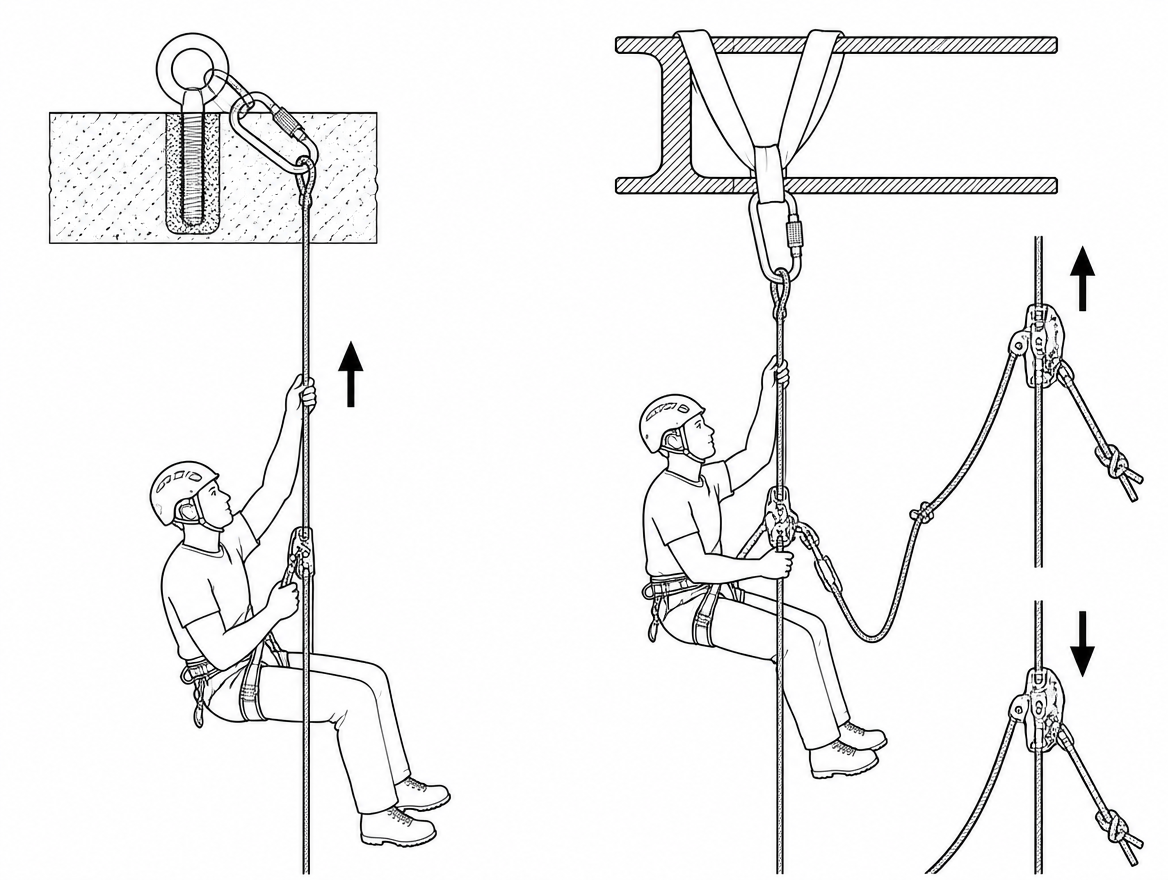
Managing the backup device while ascending
The most common technique-related problem during ascent is not the ascending method at all — it is the safety line falling behind. The device on the safety line only limits fall distance if it is positioned at or near the level the manufacturer’s instructions specify, with the connection to the harness kept short and slack kept out of the system.
- The Type A device is advanced in step with each cycle, not every third or fourth cycle.
- A device left low with a loop of slack above it converts a short slip into a longer fall with a higher arrest force, and can load the harness attachment in a direction the system was not planned around.
- Holding a backup device open, taping a cam back, or otherwise defeating its function removes the protection the second rope exists to provide. Any such practice is outside the manufacturer’s instructions and outside EN 12841.
- Ascenders on the working line are Type B progression devices; they are not substitutes for the safety-line device and are not rated for fall arrest.
Conditions that decide the choice on site
Working through these points before rigging usually settles the technique in under a minute:
- Vertical distance per uninterrupted section. Under about 5 m from a working position: short ascent with the descender in place. Tens of metres: frog. Very long clean free hang, repeated: consider a rope-walker.
- Number of intermediate anchors, deviations, and knots. More obstructions favours the frog.
- Rope line angle. Off-vertical, against a facade, or through structure favours the frog; plumb free hang favours rope-walking.
- Load carried. Heavy tool bags shift the balance toward leg-driven techniques with a chest ascender holding the torso upright.
- Number of transitions in the task. Frequent switching between ascent, descent, and work positioning favours the configuration that requires fewest device changes.
- Rope condition. Wet, muddy, icy, or heavily contaminated rope reduces cam grip and increases slip risk; manufacturer instructions state the limits, and a technique that keeps more devices on the rope does not compensate for a rope outside those limits.
- Space and edges. Confined space, hatches, and rope passing over edges limit how many devices can be operated cleanly and favour the simpler set-up with edge protection in place.
- Rescue plan. The technique chosen must be one the rest of the team can access and reverse. If a rope-walker set-up cannot be reached and converted quickly by the nominated rescuer, that is a planning problem, not a preference.
Fatigue, suspension and rescue provision
Ascending is the most physically demanding routine activity in rope access work, and pacing is part of the technique. A technician who arrives at the top of a long pitch with nothing left cannot manage a rebelay transition or assist a colleague. Practical measures: set a cadence that can be held for the whole pitch rather than sprinting the first ten metres, use rest positions on the chest ascender rather than hanging from the arms, and plan pitch lengths around rest points at intermediate anchors where the structure allows.
Suspension in a harness is not indefinitely tolerable, and an exhausted or unresponsive technician suspended mid-rope cannot self-rescue. EN ISO 22846-2 requires that rescue provision be planned and available for the duration of the work, with equipment and a competent team member able to act without delay. Under ISO 45001, that provision is part of the operational planning and emergency preparedness the organisation is expected to demonstrate, not an informal arrangement between the technicians on the rope.
Pre-use checks specific to ascending hardware
Before each ascent, on each device:
- Cam and teeth: free movement through the full travel, spring returning the cam positively, teeth not clogged with mud or ice, not worn flat or damaged.
- Safety catch or gate: functioning as intended so the device cannot come off the rope unintentionally under load.
- Body and frame: no cracks, deformation, or corrosion; sheave and roller components turning freely where fitted.
- Foot loop and connectors: webbing and stitching intact, connectors to EN 362 closed and locked, length adjusted for the technician rather than inherited from the last user.
- Function on the rope: after installation, load each device by hand and confirm it grips and releases as intended before committing weight to it.
Beyond pre-use checks, EN 365 sets the framework for periodic examination of personal fall protection equipment by a competent person — at intervals not exceeding 12 months, and more frequently where the manufacturer’s instructions, use frequency, or environment require it. Records for each item of ascending hardware should be current before the equipment goes out.
Takeaway
Match the technique to the pitch rather than to habit. Short repositioning moves are done with the descender left on the working line and a single handled ascender with a foot loop, so no system change is needed. Sustained ascents are done on a frog system, which is efficient over distance and handles deviations, rebelays, and knot passes without adding devices. Rope-walker configurations earn their complexity only on long, clean, plumb free hangs. In all three cases the safety line and its Type A device move with the technician, the devices are the ones named in the manufacturer’s instructions for the rope in use, and the rescue plan covers the configuration actually on the rope.
Next step: check the pitch lengths and intermediate anchor positions in the rigging plan against the technique selected, and confirm the rescue method for each pitch with the nominated rescuer before the first ascent of the shift.
Frequently asked questions
Where is the line between a short and a long rope ascent?
There is no standard-defined threshold. In working practice, roughly anything up to about 5–10 m is treated as a short repositioning move, while sustained ascents of tens of metres are planned as long ascents with a dedicated ascending set-up. The decision also depends on how many times the move will be repeated and whether the technician is already in a working configuration. Height alone is a poor guide: a 12 m ascent through steelwork with three deviations is a different problem from a 12 m clean free hang.
What equipment stays the same whichever ascent technique is chosen?
The fundamentals of a rope access system do not change. EN ISO 22846-1 sets out the fundamental principles and EN ISO 22846-2 gives the code of practice, and the two-rope principle — a working line and an independently anchored safety line — applies to ascent as it does to descent. Ropes are low-stretch kernmantel to EN 1891 Type A, the sit harness attachment conforms to EN 813, working-line clamps are EN 12841 Type B, the safety line carries a Type A device, connectors are to EN 362 and anchor devices to EN 795 or structural anchors verified by a competent person.
How is a short ascent from a working position normally arranged?
A typical short-ascent arrangement is a handled ascender (EN 12841 Type B) placed on the working line above the descender, with a foot loop long enough for the leg to extend fully at the bottom of the step and for the ascender to be reached comfortably at the top. The descender (EN 12841 Type C) stays on the rope and takes the load at the end of each push. The sequence is: stand in the foot loop, take slack through the descender, sit back onto the descender, slide the ascender up, repeat — while the backup device on the safety line is advanced at the same rate.
Why keep the descender on the rope for a short ascent?
Because no system change is needed to enter or leave the ascent — the descender is never removed, so the technician can resume descent or work positioning immediately. It also keeps fewer devices on the rope, which matters in confined space, on ladders inside structures and around edges. System changes are where connection errors happen. The trade-off is that the method becomes awkward and inefficient beyond a handful of metres, since each cycle gains only one leg extension and the descender must be fed by hand every cycle.
What is the frog system and why is it used for long ascents?
The frog (sit–stand) system is the standard technique across most European rope access and cave-derived practice for sustained vertical gain. It uses a chest-mounted ascender held close to the sternum by a chest harness, plus a handled ascender above it connected to the harness attachment point and carrying a foot loop or double foot loops. Both knees come up, the handled ascender is pushed to arm's reach, the legs straighten to drive the body upward, and the chest ascender takes the weight at the top of the movement while hands and legs reset. The chest ascender holds position between strokes and keeps the torso upright against the rope, which makes the technique repeatable for long periods.
Need this as a document you can issue? The template library gives you the risk assessments, permits and inspection logs in editable form — and employer plans cover a whole team with completion records.