Safety / Tips and Tricks / Rope access and confined space
Activity 01 · Rope access
Lanyard Arm Parking: How to Stow the Unused Leg of a Twin-Leg Lanyard Safely
On a twin-leg lanyard, the arm that is not connected to an anchor is doing something whether anyone intends it to or not. Parked on the wrong point, it becomes a load path that can stop the energy absorber from deploying as designed. Left hanging, it becomes a snag, a trip hazard and a swinging steel hook at knee height. Lanyard arm parking is a small habit that decides how a fall is actually arrested, and it takes about two seconds to get right.
This article covers what the second arm is for, which attachment points are designed to hold it, which points are not, and how the parking step fits into a transfer sequence that keeps the worker connected throughout.
What the second arm is for, and what “parking” means
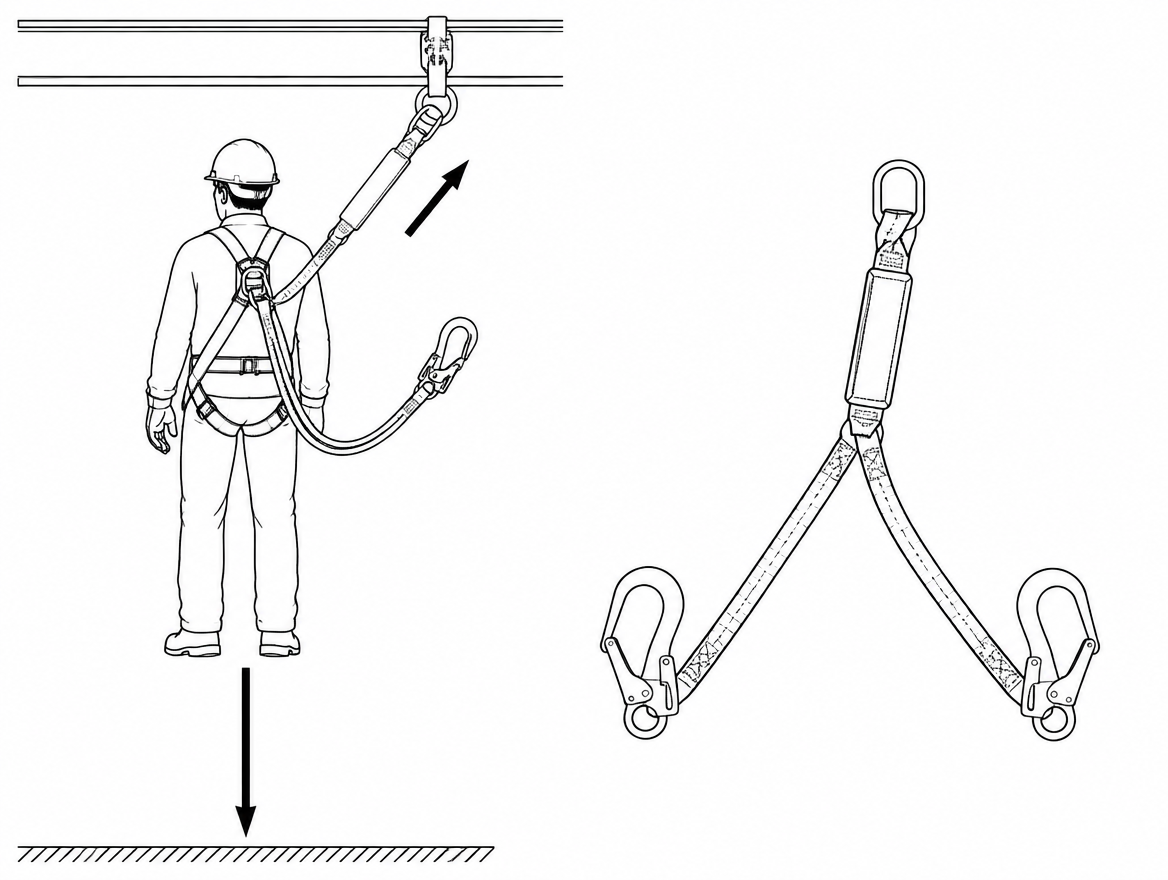
A twin-leg (Y or forked) lanyard has two webbing or rope arms joined to a single energy absorber, which connects to the fall-arrest attachment element of the harness. Its purpose is continuous attachment during movement: the worker clips the free arm to the next anchor before releasing the arm already in use, so there is never a moment with nothing connected.
The consequence is that for most of the working day, one arm is idle. Parking is the act of securing that idle arm to a point on the harness that is specifically designed to hold it and to let go of it harmlessly if it is ever loaded.
Two design facts drive everything below:
- There is normally one energy absorber, not two. It is intended to be loaded through one arm at a time. EN 355 requires the maximum arrest force in dynamic testing not to exceed 6 kN, and limits the complete assembly — absorber, lanyard and connectors — to 2 m in total length.
- The absorber has to be free to extend. It arrests a fall by tearing, ripping or paying out webbing over a distance. Anything that ties its two ends together, or that holds it against the harness, interferes with that extension.
Why clipping the spare arm to the absorber or the other leg is the dangerous option
The most common improvised parking method is to hook the free arm’s connector onto whatever is closest: the energy-absorber pack itself, the webbing of the arm in use, or a loop on the harness back plate. This creates a short circuit around the absorber. When the anchored arm is loaded in a fall, the parked connector holds the far end of the absorber, so the pack cannot extend freely. Instead of a controlled deployment limited to 6 kN, the arrest becomes a much harder stop transmitted straight through the harness to the wearer, and clearance calculations based on the manufacturer’s declared deployment distance no longer apply.
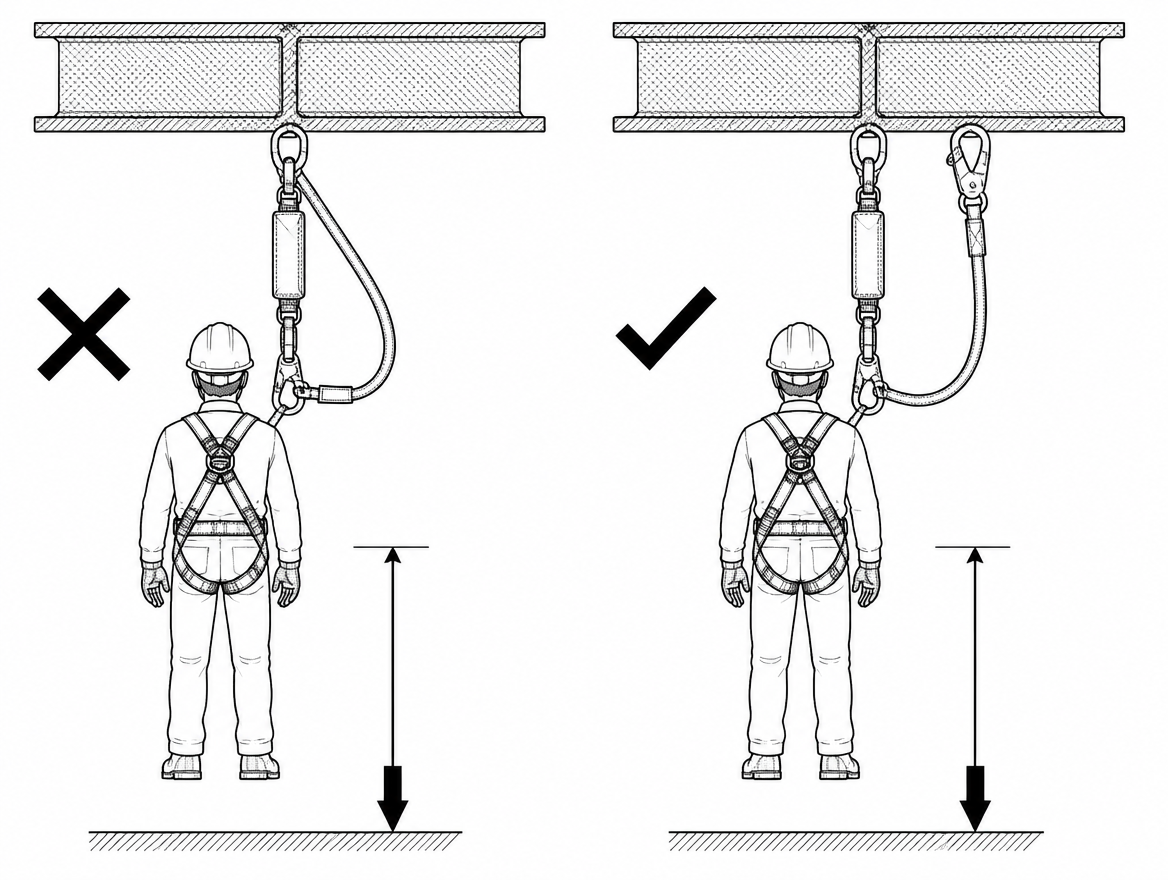
The same logic rules out clipping the free arm around the anchor sling of the anchor already in use, or back onto the anchor connector, both of which create a second load path in parallel with the absorber.
The dedicated parking attachment and how it behaves under load
Harnesses and lanyards intended for twin-leg use are supplied with parking provision: an elastic or webbing keeper on the shoulder or chest strap, a moulded plastic park hook, or a low-strength breakaway loop. These are designed to release the parked arm at a low load — well below anything that would interfere with absorber deployment or transmit force into the wearer. The release value and the correct parking location are stated in the manufacturer’s instructions for the specific harness and lanyard combination, and the two are not interchangeable between brands.
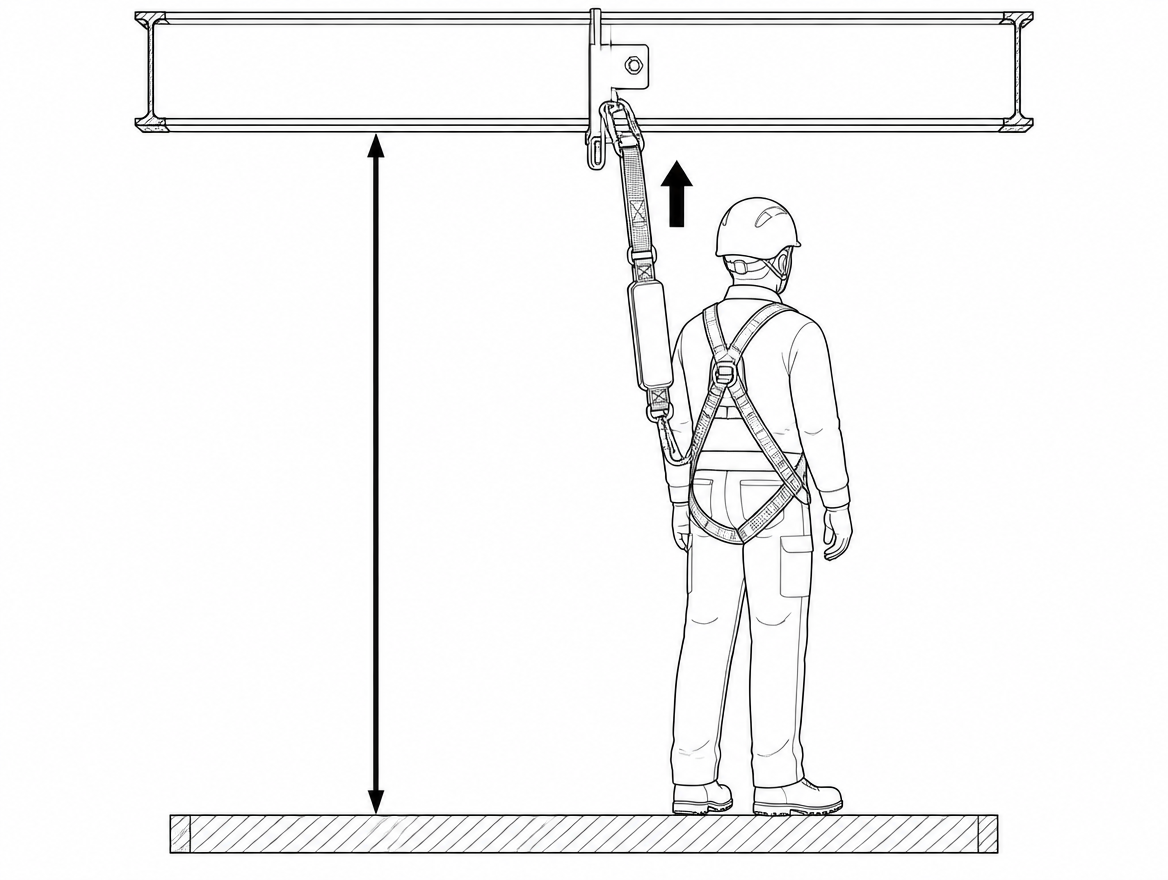
Practical points when parking to a dedicated point:
- Park the arm so the connector sits high — chest or shoulder level — and does not sag below the waist.
- Close the gate and engage the locking mechanism of the parked connector. An open hook is a snag and, on a scaffold hook, a large one.
- Route the idle webbing so it does not lie across the energy-absorber pack or wrap around the anchored arm.
- Keep the parked arm clear of the dorsal or sternal attachment element, so the arm in use can align without being fouled.
Points that are not parking points
A parking point is not a fall-arrest attachment, and a fall-arrest or work-positioning attachment is not a parking point.
- Fall-arrest attachment elements (EN 361). Dorsal and sternal elements identified by the capital letter A — or A/2 where two elements are used together — are reserved for the absorber connection. Clipping the spare arm here recreates the short circuit described above.
- Lateral work-positioning D-rings (EN 358). These are for work positioning and restraint only, not for fall arrest, and they will not release the parked arm.
- Tool loops, accessory rings and equipment holders. Rated for tool carriage, not for holding a connector that may be loaded, and they usually place the hook at hip height where it can snag.
- The harness webbing or straps themselves. Hooking a connector through a strap loads the webbing across an edge and can hide damage from the next pre-use check.
- Structure near the worker’s own position. Clipping the free arm to a nearby rung or handrail to “keep it out of the way” creates a second, uncontrolled anchor at an unknown height, plus an entrapment risk when moving.
Where a harness has no dedicated parking provision, the manufacturer’s instructions for the lanyard should be consulted before improvising one. Some lanyards are supplied with their own keepers precisely because the harness may not have them.
What happens when the arm is simply left to hang
Letting the idle arm dangle avoids the absorber short circuit but introduces its own problems, all of them predictable:
- Snagging. A hanging hook catches on grating, tube, cable trays and ladder rungs. If it snags during a fall, it becomes an unplanned load path with an unknown attachment point.
- Trips on the walking surface. A 2 m assembly with a heavy connector on the end will reach the feet on most builds.
- Dropped-object and impact risk. A large scaffold hook has real mass and swings freely at knee height around other people and around equipment.
- Contamination and wear. Webbing dragged through grit, weld spatter, concrete slurry or chemicals degrades faster and is harder to assess at the next inspection.
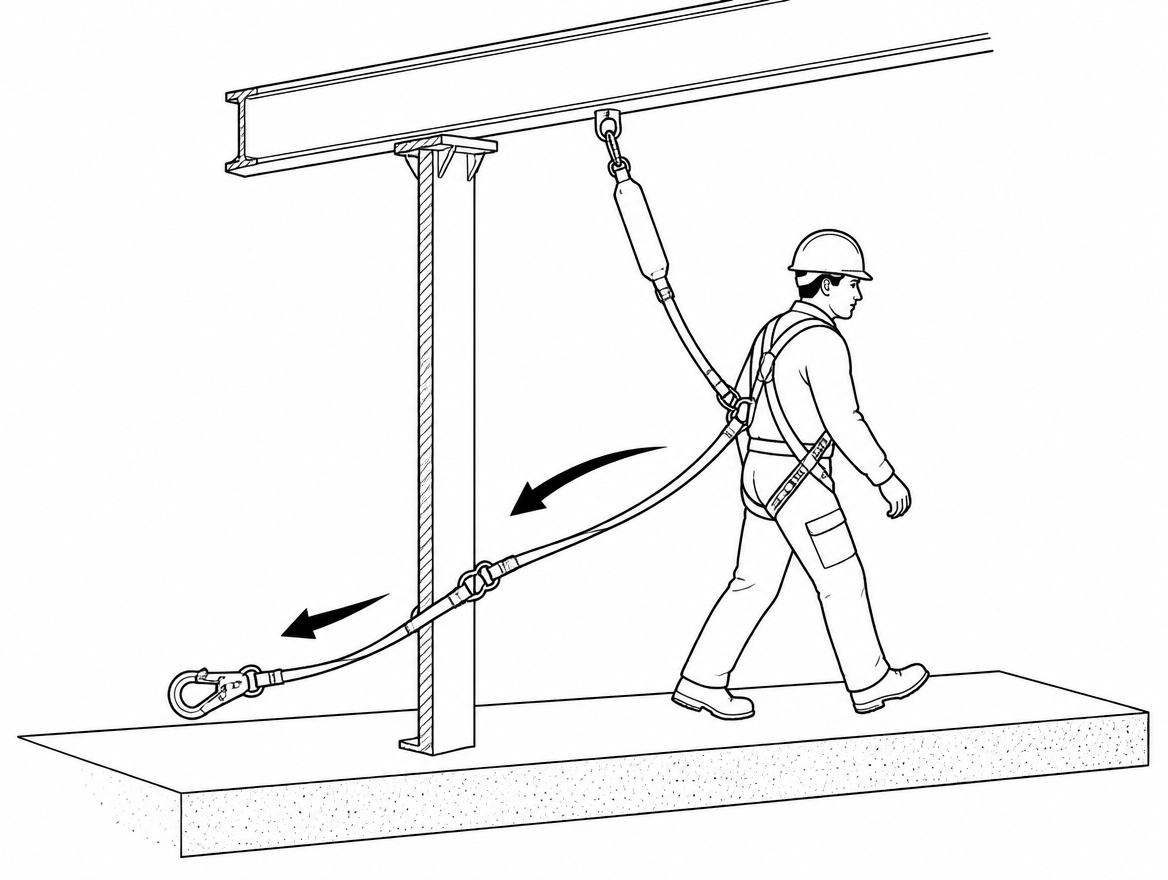
Parking inside the transfer sequence
Parking and un-parking are steps in the move, not afterthoughts. A workable order at each anchor change:
- Identify the next anchor and confirm it is suitable — an anchor device conforming to EN 795, or structure verified as capable of taking the arrest load, and positioned to limit swing fall.
- Release the parked arm from the keeper and check the connector gate and locking action as it comes off.
- Connect that arm to the next anchor and confirm the gate is closed and locked.
- Release the first arm from the anchor now being left behind.
- Park it immediately, on the dedicated point, gate closed.
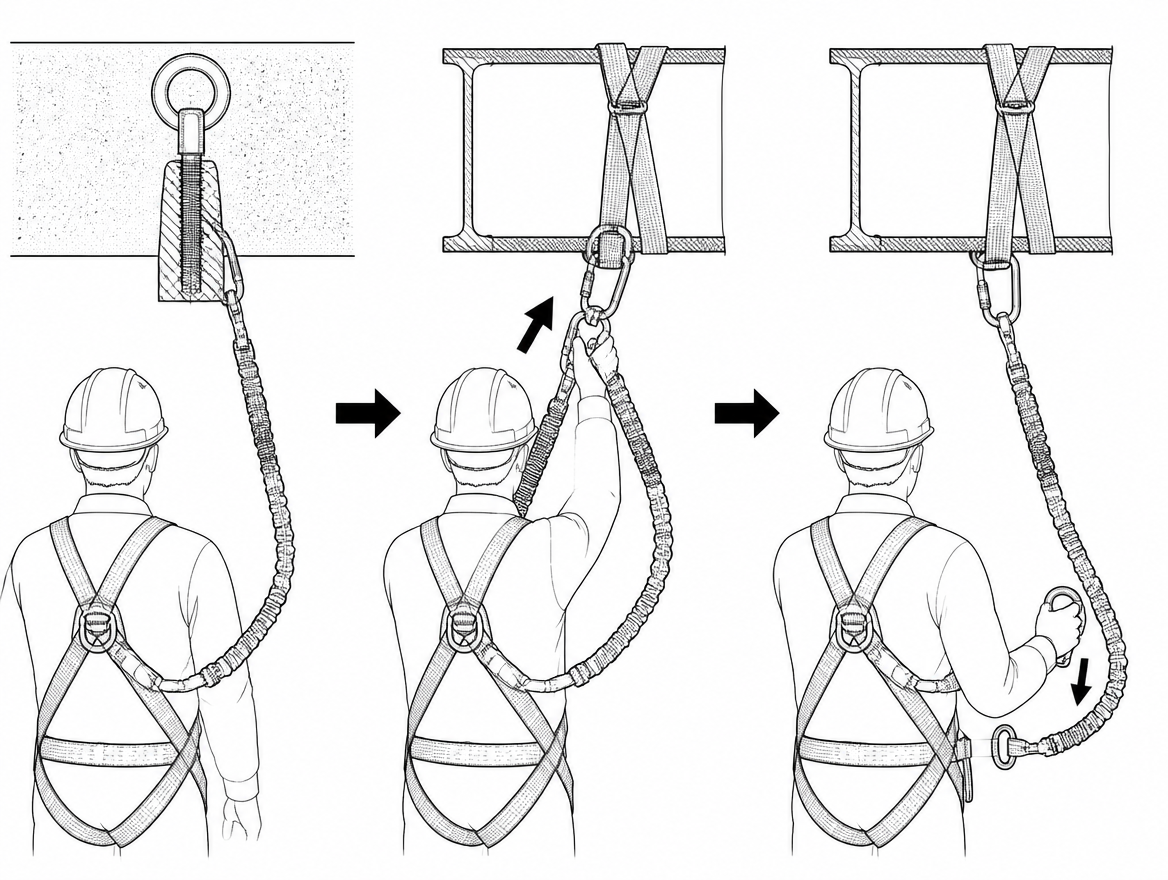
Both arms are connected only for the moment it takes to complete steps 3 and 4. Whether extended work with both arms anchored to two separate points is permitted varies between products, because it changes how load reaches the single absorber; the lanyard’s instructions for use are the deciding reference, not site custom.
The standards that frame the assembly
Lanyard arm parking sits inside a system, and the parts of that system are covered separately:
- EN 354 — lanyards.
- EN 355 — energy absorbers: arrest force limited to 6 kN, complete assembly including connectors limited to 2 m.
- EN 361 — full body harnesses, including the identification of fall-arrest attachment elements.
- EN 362 — connectors, including the class of connector and its intended use.
- EN 795 — anchor devices.
- EN 365 — general requirements for instructions for use, maintenance, periodic examination, repair and marking, including periodic examination by a competent person at intervals of no more than 12 months, and more frequently where use, environment or legislation requires it.
Note that no standard specifies the parking point, its strength or its release load. That information exists only in the manufacturer’s instructions for the specific product, which is why those instructions belong on site with the equipment rather than in an office file.
Pre-use checks that include the parking hardware
The parking provision is part of the pre-use check, alongside the usual items:
- Energy-absorber pack closed and un-deployed; stitching, cover and any deployment indicator intact.
- Both arms checked full length for cuts, abrasion, heat glazing, chemical damage and broken stitching.
- All connectors: gate closes fully, locking mechanism engages and releases, no distortion of the hook nose or wear at the bearing surfaces.
- Parking keepers present and serviceable — elastics not perished, plastic park hooks not cracked, breakaway loops not already torn or stitched back together.
- Harness attachment elements intact and correctly identified.
A parking point that has released or torn is information, not a nuisance: something loaded that arm. The assembly is taken out of service and referred for examination in line with EN 365 and the manufacturer’s instructions before it goes back on a worker.
Putting it into daily practice
Two lines in the method statement and one line in the toolbox talk cover most of the exposure: the unused arm is parked on the dedicated parking point only, never on the absorber, the fall-arrest attachment or the other arm; and it is parked immediately after release, not carried loose to the next anchor. Under a management system built to ISO 45001, this is exactly the kind of specific, checkable behaviour that belongs in operational control and in supervisory observation, rather than a general instruction to work safely at height.
Next step: pull the instructions for use for the harness and twin-leg lanyards actually issued on site, confirm which parking provision each product specifies, and recheck the required fall clearance using the manufacturer’s declared absorber deployment figure — that figure is only valid if the absorber can extend freely, which is the whole point of parking the second arm correctly.
Frequently asked questions
What is the purpose of the second arm on a twin-leg lanyard?
It provides continuous attachment during movement: the worker clips the free arm to the next anchor before releasing the arm already in use, so there is never a moment with nothing connected. Because of this, one arm is idle for most of the working day.
Why is clipping the spare arm to the energy absorber dangerous?
It creates a short circuit around the absorber. When the anchored arm is loaded in a fall, the parked connector holds the far end of the absorber so the pack cannot extend freely. Instead of a controlled deployment limited to 6 kN, the arrest becomes a much harder stop transmitted straight through the harness to the wearer, and clearance calculations based on the manufacturer's declared deployment distance no longer apply.
What does EN 355 require of a twin-leg lanyard assembly?
EN 355 requires the maximum arrest force in dynamic testing not to exceed 6 kN, and limits the complete assembly — absorber, lanyard and connectors — to 2 m in total length.
Where should the idle arm actually be parked?
On the parking provision supplied with the harness or lanyard: an elastic or webbing keeper on the shoulder or chest strap, a moulded plastic park hook, or a low-strength breakaway loop. These release the parked arm at a low load, well below anything that would interfere with absorber deployment or transmit force into the wearer. The release value and correct location are stated in the manufacturer's instructions for the specific harness and lanyard combination, and are not interchangeable between brands.
Which points must never be used to park the spare arm?
Fall-arrest attachment elements marked A or A/2 (they recreate the short circuit), lateral work-positioning D-rings under EN 358 (they will not release the parked arm), tool loops and accessory rings (rated only for tool carriage and usually at snag-prone hip height), the harness webbing or straps themselves (loading webbing across an edge and hiding damage from the pre-use check), and nearby structure such as a rung or handrail (creating a second, uncontrolled anchor and an entrapment risk).
Need this as a document you can issue? The template library gives you the risk assessments, permits and inspection logs in editable form — and employer plans cover a whole team with completion records.