
Home / Choosing and Using PPE Correctly Under EN Standards: A Practical Overview
Choosing and Using PPE Correctly Under EN Standards: A Practical Overview
Most PPE failures on site are not equipment failures. They are selection and fit failures: a glove rated for abrasion but not for cut, a filtering facepiece worn over three days of stubble, an energy-absorbing lanyard used where there is not enough clearance below the anchor for it to deploy. In each case the equipment carries a valid CE mark and a legitimate EN standard number, and in each case the wearer is less protected than the paperwork suggests. This article sets out how to read what an EN standard actually certifies, how to match that to the hazard identified in the risk assessment, and what has to happen after issue for the protection to survive daily use.
Where PPE sits in the control hierarchy
PPE is the last control in the hierarchy, not the first. ISO 45001 (clause 8.1.2) requires elimination, substitution, engineering controls and administrative controls to be considered before personal protective equipment, and the reasoning is practical rather than philosophical: every other control works whether or not an individual worker gets something right at 06:30 on a cold morning. PPE only works when it is the right specification, correctly fitted, correctly worn for the whole exposure, and still in serviceable condition.
PPE equipment usage under EN standards is governed by two separate strands of EU law that are easy to confuse:
- Regulation (EU) 2016/425 covers the product. It replaced Directive 89/686/EEC and sets out the essential health and safety requirements a manufacturer must meet, the conformity assessment route, the CE marking rules and the requirement to supply instructions in the official language(s) of the Member State where the PPE is sold.
- Directive 89/656/EEC (as amended, including by Commission Directive (EU) 2019/1832) covers the use. It places duties on the employer to assess the risks, select PPE appropriate to those risks, provide it at no cost to the worker, ensure it fits, and provide training and information on its use.
Buying certified equipment satisfies the first strand only. The second strand is where most site-level problems live.
Reading the markings before reading the catalogue
Every piece of PPE carries its own specification on the product itself. Learning to read that marking is faster and more reliable than relying on a supplier description.
Regulation (EU) 2016/425 sorts PPE into three categories by the severity of the risk it addresses: Category I for minimal risks, Category II for intermediate risks, and Category III for risks of death or irreversible harm — which includes respiratory protective equipment, fall arrest equipment, chemical protection, protection against harmful noise, and thermal and electrical hazards. Category III PPE is subject to ongoing notified body surveillance, which is why its CE mark is followed by a four-digit notified body number. A CE mark with no number after it on a harness or a filtering facepiece is a warning sign worth investigating.
Category III PPE carries a four-digit notified body number after the CE mark — a CE mark alone on a harness or respirator warrants investigation.
Alongside the CE mark, the product marking should identify the manufacturer, the model, the EN standard(s) it was certified against, the size or size range, the date or serial number, and the pictogram or performance codes described below. For fall protection equipment, EN 365 sets out what the marking and the accompanying instructions must contain, including the information needed for periodic examination.
Matching the standard to the hazard
Head protection: EN 397, EN 12492 and EN 50365
EN 397 covers industrial safety helmets, designed primarily for impact from falling objects and for the chinstrap to release under a load between 150 N and 250 N so that the helmet does not become a strangulation hazard if snagged. Optional performance can be marked on the shell: -20 °C or -30 °C for low temperature, +150 °C for high temperature, 440 V a.c. for accidental short-term contact with live conductors, LD for lateral deformation, and MM for molten metal splash.
EN 12492 (mountaineering helmets) has a retained chinstrap that is designed not to release, which is why it is specified for work at height and rope access where a helmet coming off during a fall is the greater risk. EN 50365 covers helmets electrically insulating for use on low-voltage installations up to 1000 V a.c., and is a different qualification from the optional 440 V a.c. marking under EN 397.
Eye and face protection: EN 166 and its markings
EN 166 splits its markings between the lens and the frame, and both need to be read. The lens carries the optical class (1, 2 or 3 — only class 1 is suitable for continuous wear), the mechanical strength symbol, and any filter scale number. The frame carries the field-of-use code: 3 for liquids and droplets, 4 for coarse dust, 5 for gas and fine dust, 8 for short-circuit electric arc, 9 for molten metal and hot solids.
The mechanical strength symbols run S (increased robustness), F (low-energy impact, 45 m/s), B (medium energy, 120 m/s) and A (high energy, 190 m/s). A suffix T indicates the impact performance was verified at extremes of temperature. Where the lens and frame carry different strength symbols, the lower of the two applies to the complete eye protector.
EN 166 markings are split between lens and frame; where the two carry different impact symbols, the lower rating governs the whole eye protector.
Hearing protection: EN 352 series and attenuation data
Earmuffs are certified to EN 352-1, earplugs to EN 352-2, and helmet-mounted devices to EN 352-3. Attenuation is published as a single number rating (SNR) and as H, M and L values derived under EN ISO 4869-2, describing performance against high-, medium- and low-frequency noise.
Directive 2003/10/EC sets the lower exposure action value at 80 dB(A) daily exposure (hearing protection made available), the upper action value at 85 dB(A) (use mandatory, plus a hearing conservation programme), and the exposure limit value at 87 dB(A) measured with the effect of hearing protection taken into account. Over-protection is a real selection error: driving the level at the ear far below the action values makes warning signals, reversing alarms and speech harder to detect. Selecting for an effective level at the ear in the region of 70–80 dB(A) is the usual practical target, with the protector’s H/M/L data checked against the measured noise spectrum rather than against the SNR alone.
Correct: plug rolled thin and inserted with the ear pulled up and back. A partially seated earplug loses a large part of the attenuation the EN 352-2 data assumes.
Respiratory protection: EN 149, EN 140/EN 136 and filter selection
Filtering half masks are certified to EN 149:2001+A1:2009 in three classes — FFP1, FFP2 and FFP3 — defined by total inward leakage limits of 22 %, 8 % and 2 % respectively. The suffix NR means single-shift use only; R means reusable. A D marking indicates the device passed the dolomite dust clogging test.
Reusable half masks are certified to EN 140 and full-face masks to EN 136, with filters selected separately: particle filters P1, P2 and P3 to EN 143, and gas and combined filters to EN 14387. Gas filter types are colour-coded and classified 1, 2 or 3 by capacity:
| Type | Colour | Typical field of use |
|---|---|---|
| A | Brown | Organic vapours with boiling point above 65 °C |
| B | Grey | Inorganic gases and vapours (e.g. chlorine, hydrogen sulphide) |
| E | Yellow | Sulphur dioxide and acid gases |
| K | Green | Ammonia and organic ammonia derivatives |
Every tight-fitting facepiece depends on a face seal against bare skin. Facial hair crossing the sealing surface, spectacle side-arms, and the wrong faceblank size all break that seal, and the leakage bypasses the filter entirely. EN 529 provides guidance on selection, use, care and maintenance of respiratory protective equipment, including the case for fit testing; ISO 16975-3 describes fit-testing methods. A pre-use seal check by the wearer at every donning is separate from, and does not replace, a documented fit test.
Anything crossing the sealing surface — stubble, spectacle arms, hood edges — creates a leak path that bypasses the filter entirely.
Hand protection: EN 388, EN 407 and EN ISO 374-1
EN 388:2016+A1:2018 is the mechanical risk standard, and the four digits and two optional letters under the pictogram are not a quality score — each position is a separate test:
| Position | Test | Scale |
|---|---|---|
| 1 | Abrasion resistance | 1–4 |
| 2 | Cut resistance (coupe test) | 1–5 |
| 3 | Tear resistance | 1–4 |
| 4 | Puncture resistance | 1–4 |
| 5 | Cut resistance (EN ISO 13997, TDM) | A–F |
| 6 | Impact protection | P (pass) or absent |
Where a glove blunts the coupe test blade, the coupe result is reported as X and the EN ISO 13997 letter grade is the meaningful cut figure. Thermal risks are covered by EN 407, and protection against chemicals and micro-organisms by EN ISO 374-1, which classifies gloves as Type A, B or C according to how many test chemicals achieve the required breakthrough time. A glove certified to EN ISO 374-1 is only protective against the specific chemicals listed by their code letters in the manufacturer’s instructions.
Each position in the EN 388 code is a separate test — where the coupe result is X, the EN ISO 13997 letter grade is the meaningful cut figure.
Protective clothing and footwear
EN ISO 13688 sets the general requirements — sizing, innocuousness, ageing, marking — that apply to protective clothing and is always cited alongside a hazard-specific standard: EN ISO 11612 for heat and flame, EN ISO 11611 for welding and allied processes, EN 1149-5 for electrostatic dissipative clothing, EN ISO 20471 for high-visibility clothing (class 3 requires the largest minimum areas of fluorescent and retroreflective material and is normally specified for high-speed traffic and night work). Arc flash clothing is assessed under EN IEC 61482-1-2 (box test, APC class 1 or 2) or EN IEC 61482-1-1 (arc thermal performance value).
Safety footwear is certified to EN ISO 20345, with a 200 J toecap as the baseline requirement (SB), and classification codes S1 to S5 adding antistatic properties, energy absorption in the heel, water penetration resistance of the upper, penetration resistance of the sole and cleated outsoles. The 2022 edition of the standard revised the slip-resistance marking (SR) and the penetration-resistance codes (P for metal inserts, PL and PS for non-metallic inserts tested with different nail diameters) and introduced additional classification codes. When comparing two products, check which edition each was certified against before assuming the codes mean the same thing.
Fall protection: EN 361 and the system around it
A harness on its own arrests nothing. EN 363 describes the complete personal fall protection system, and each component has its own standard: EN 361 for the full body harness, EN 354 for lanyards, EN 355 for energy absorbers, EN 360 for retractable type fall arresters, EN 353-1 and EN 353-2 for guided type fall arresters on rigid and flexible anchor lines, EN 362 for connectors, and EN 795 for anchor devices (types A to E, with CEN/TS 16415 covering use by more than one person simultaneously).
Only the attachment points marked with a capital A on an EN 361 harness may be used for fall arrest — normally the dorsal point and, where fitted, the sternal point. Points marked A/2 are two halves of a single attachment and must be used together. A work positioning belt to EN 358 and a sit harness to EN 813 are not fall arrest attachments and cannot be used as such.
Clearance is where the arithmetic matters. In the EN 355 dynamic test, an energy absorber must keep the arrest force at or below 6 kN and the arrest distance within 5.75 m, which corresponds to roughly 1.75 m of absorber deployment for a 2 m lanyard in a factor-two fall. Required clearance below the anchor is the sum of the lanyard length, the deployment, harness stretch and D-ring displacement, the distance from the dorsal D-ring to the wearer’s feet, and a safety margin — commonly 1 m. The manufacturer’s instructions give the figures that apply to the specific equipment and are the authoritative source.
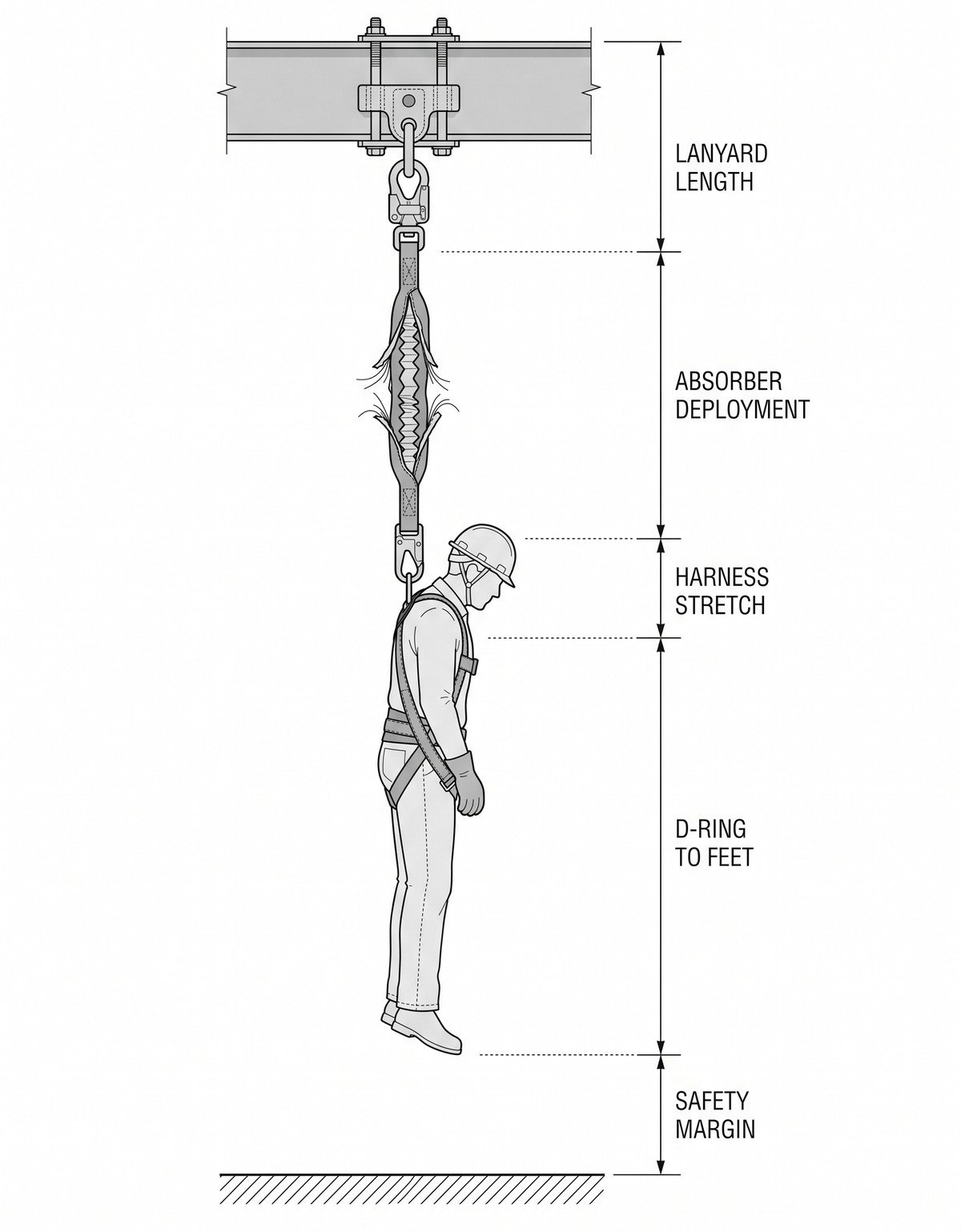
Required clearance is a sum, not a single figure — where it cannot be achieved, a retractable type fall arrester to EN 360 or work restraint is usually the correct selection.
Fit, compatibility and the combinations nobody tested
PPE is certified as individual items and worn in combinations. Common interference problems on site include earmuff cushions broken by the side-arms of spectacles, helmet-mounted visors that prevent a respirator strap sitting correctly on the crown, and a hood or balaclava that crosses a tight-fitting facepiece seal. Directive 89/656/EEC requires that where more than one item of PPE is worn simultaneously, the items must be compatible and remain effective in combination. Practically, that means checking the manufacturer’s instructions for approved combinations (particularly for helmet-mounted hearing protection, which is certified to EN 352-3 only with the specific helmet models listed) and re-checking seal and fit with the full set on.
Sizing is not a comfort issue. A harness whose leg straps are slack allows the body to shift during arrest; a glove one size too large loses grip and dexterity and increases the chance of entanglement; an oversized facepiece leaks. Where PPE is issued for personal use, size should be recorded against the individual rather than assumed.
Inspection, storage and records after issue
Two levels of inspection apply to most PPE, and both need to be defined in writing:
- Pre-use check by the wearer, every time the equipment is donned. For a harness: webbing and stitching for cuts, abrasion, chemical attack, heat damage and UV degradation; buckles and adjusters for deformation and corrosion; D-rings for cracks and distortion; connector gates for correct self-closing and self-locking action; and legible markings. For respiratory protective equipment: seal, valves, straps and filter service life.
- Periodic examination by a competent person. EN 365 requires personal fall protection equipment to be examined at least every 12 months (more frequently where use or conditions warrant), with the examination recorded and the record retained. Any equipment that has arrested a fall is withdrawn from service until assessed by a competent person or the manufacturer.
Storage conditions do measurable damage when they are wrong: textile equipment stored in direct sunlight, in contact with solvents or battery acid, or packed away wet will degrade well before its stated service life. Filtering facepieces and gas filters have shelf lives and, once opened, in-use lives; both are specified in the manufacturer’s instructions and both need to be tracked.
The failure modes worth checking for first
- Cut-resistant gloves selected on the coupe test digit alone where an X is shown and the EN ISO 13997 letter grade is the relevant figure.
- Hearing protection chosen on SNR alone in a low-frequency noise environment where the L value is the limiting figure.
- Tight-fitting respirators issued without fit testing, or worn over facial hair crossing the sealing surface.
- Energy-absorbing lanyards used below the clearance required for full deployment — a retractable type fall arrester to EN 360 or a work restraint system is often the correct answer instead.
- EN 397 helmets used for work at height, where the releasing chinstrap is a design feature rather than a defect.
- Anchor points selected by eye rather than against EN 795 and a documented structural assessment.
- Eye protection with the correct field-of-use code but optical class 2 or 3 issued for all-shift wear.
Takeaway
The useful record is not a signature confirming that PPE was issued. It is a line in the risk assessment that names the hazard, the specific standard and performance level selected against it, the size and fit verification method, the pre-use check, and the periodic examination interval. Where each of those five items is written down and matches what is actually in the store, PPE equipment usage under EN standards becomes auditable rather than assumed. The next practical step for most sites is to take one hazard already listed in the risk assessment, pull the corresponding PPE off the shelf, and read its markings against the standard cited in this article — the gaps tend to appear within the first two or three items.
Frequently asked questions
Why is PPE treated as the last control rather than the first?
ISO 45001 (clause 8.1.2) requires elimination, substitution, engineering controls and administrative controls to be considered before personal protective equipment. The reason is practical: every other control works whether or not an individual worker gets something right at 06:30 on a cold morning, whereas PPE only works when it is the right specification, correctly fitted, correctly worn for the whole exposure, and still in serviceable condition.
What is the difference between Regulation (EU) 2016/425 and Directive 89/656/EEC?
Regulation (EU) 2016/425 covers the product: it replaced Directive 89/686/EEC and sets out the essential health and safety requirements a manufacturer must meet, the conformity assessment route, CE marking rules and the requirement to supply instructions in the official language(s) of the Member State where the PPE is sold. Directive 89/656/EEC (as amended, including by Commission Directive (EU) 2019/1832) covers the use, placing duties on the employer to assess risks, select appropriate PPE, provide it at no cost to the worker, ensure it fits, and provide training and information. Buying certified equipment satisfies only the first strand.
Why should a CE mark without a four-digit number on a harness or respirator be investigated?
Category III PPE — which includes respiratory protective equipment, fall arrest equipment, chemical protection, protection against harmful noise, and thermal and electrical hazards — is subject to ongoing notified body surveillance, so its CE mark is followed by a four-digit notified body number. A CE mark alone on a harness or filtering facepiece is therefore a warning sign worth investigating.
How do EN 397, EN 12492 and EN 50365 differ for head protection?
EN 397 covers industrial safety helmets designed primarily for impact from falling objects, with a chinstrap that releases under a load between 150 N and 250 N so the helmet does not become a strangulation hazard if snagged. EN 12492 (mountaineering helmets) has a retained chinstrap designed not to release, which is why it is specified for work at height and rope access where a helmet coming off during a fall is the greater risk. EN 50365 covers helmets electrically insulating for use on low-voltage installations up to 1000 V a.c., which is a different qualification from the optional 440 V a.c. marking under EN 397.
What do the EN 166 lens and frame markings tell you?
The lens carries the optical class (1, 2 or 3 — only class 1 is suitable for continuous wear), the mechanical strength symbol and any filter scale number. The frame carries the field-of-use code: 3 for liquids and droplets, 4 for coarse dust, 5 for gas and fine dust, 8 for short-circuit electric arc, 9 for molten metal and hot solids. Strength symbols run S (increased robustness), F (low-energy impact, 45 m/s), B (medium energy, 120 m/s) and A (high energy, 190 m/s), with a suffix T indicating impact performance verified at extremes of temperature. Where lens and frame carry different strength symbols, the lower of the two applies to the complete eye protector.
Need this as a document you can issue? The template library gives you the risk assessments, permits and inspection logs in editable form — and employer plans cover a whole team with completion records.