
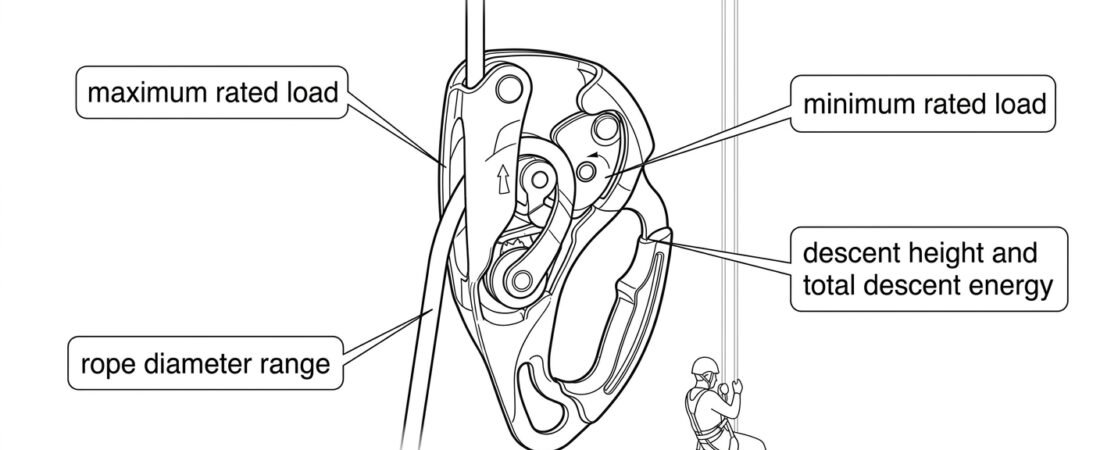
A descender is one of the few pieces of rope-access equipment whose marked numbers change what you are allowed to do on the day. The rated load decides whether one person or two can go down on it. The rope diameter range decides which line it may be threaded on. The descent-energy or descent-height limit decides whether a long shaft or a tall stack is a single lowering or several. Getting these wrong rarely produces a dramatic failure of the device itself — it produces slip, heat, glazed rope sheath, or a device that will not lock reliably. This note explains what each specification on a descender means, how the figures interact, and how to check a device against the task before it leaves the store.
Rated load is not breaking strength
Three different numbers get called “the strength” of a descender, and confusing them is the root of most misunderstanding:
- Maximum rated load — the greatest mass the manufacturer certifies the device to control, in the specific configuration and to the specific standard marked on it. This is the working figure. It is a mass (kg), and it covers the person plus everything hanging on them: harness, tools, bag, rope in hand.
- Static strength — the load at which the device or its attachment hole is tested or fails. It is far above the rated load, and it exists to prove margin, not to license heavier use.
- System strength — whatever is weakest in the chain: rope, anchor, connector, harness attachment point. A descender rated for a heavy two-person load does not upgrade the anchor it is hanging from.
Only the first of these is a permission. The other two are engineering margin and should never be used to justify exceeding the marked rated load.
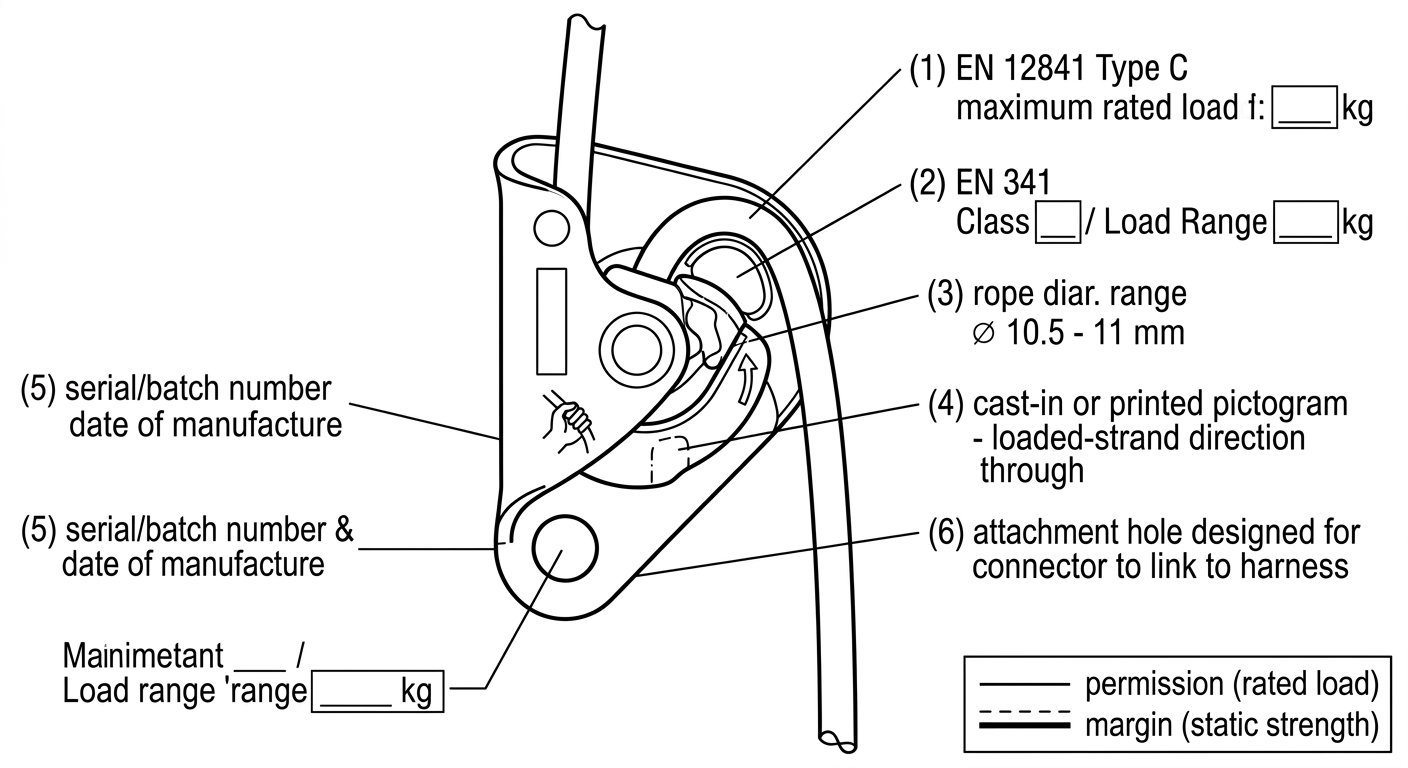
Every limit that governs a descent is marked on the device itself: standards, rated loads, rope diameter range and rope direction.
Where the numbers come from: EN 12841 Type C and EN 341
Most descenders used in industrial rope access carry two certifications, and they mean different things.
EN 12841 Type C — descent on the working line
EN 12841, the standard for rope adjustment devices in rope access systems, classifies a descender as a Type C device: a rope adjustment device for descent on the working line. Certification under Type C assumes the device is one half of a two-rope system — the worker is simultaneously connected to a separate safety line via a Type A backup device. A Type C rating is not a fall-arrest rating, and it does not license single-rope work.
The maximum rated load declared under Type C is typically a single-person figure. Values commonly sit in the 100–150 kg region for general-purpose industrial descenders, but this varies by model and by generation of the same model — read the device, not your memory of the last one.
EN 341 — descent as a rescue or evacuation device
EN 341, which covers descender devices for rescue, treats the same hardware as a lowering or evacuation device. Ratings under EN 341 are usually broader than the Type C rating, because rescue use is expected to involve a rescuer-plus-casualty load, and because the standard is concerned with a different question: how much total energy the device can dissipate before it stops working properly.
Two consequences matter on site:
- An EN 341 rating often carries a minimum load as well as a maximum. A device certified across a wide range is telling you it has been verified at both ends of that range, not that it behaves identically throughout.
- EN 341 classes are distinguished by total descent energy — effectively mass × gravity × descent height × number of descents. A device may be entirely within its mass rating and still be outside its energy rating if you use it for repeated long lowers.
Descent energy: the limit that isn’t a mass
Everything a descender does is conversion of potential energy into heat in the friction elements. That heat has to go somewhere, and on a long descent it goes into the aluminium body, the sheave or bollard, and the rope sheath in contact with them.
This is why a manufacturer’s instructions typically state a maximum descent height per lower and, separately, a maximum total energy or number of descents at a given load. A 15 m descent with one person is trivially inside every limit. A 100 m lower with two people, repeated three times during an evacuation drill, may not be. The practical symptoms of exceeding the thermal envelope are glazing and hardening of the rope sheath, discolouration of the device, and a device too hot to handle at the bottom.
Two field habits follow directly:
- Break very long descents into stages with a rest at an intermediate anchor where the geometry allows it.
- Treat a rope that has taken a hot, heavy descent as suspect until inspected along its full length — the damage sits on the sheath and is easy to feel with a hand run.
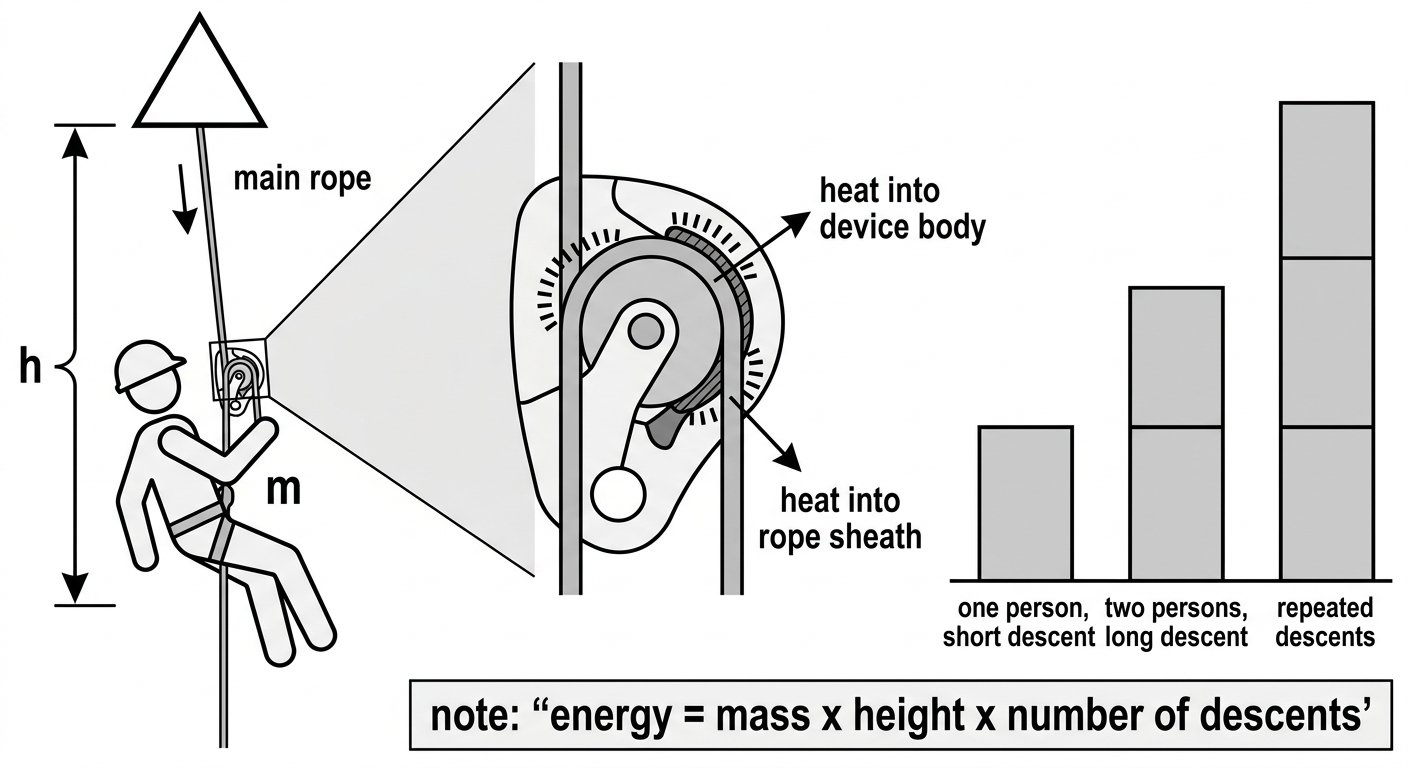
Descent energy, not just mass, sets the limit: heat accumulates in the friction elements and in the rope sheath.
Minimum load: the specification nobody reads
Self-braking descenders need load to work. The camming or clamping mechanism is driven by rope tension, and below a certain mass the device may descend jerkily, fail to lock cleanly when the handle is released, or need the operator to pull rope through by hand.
Low-load problems typically show up in three situations:
- A light worker on a new, stiff, large-diameter rope — the device generates more friction than the load can overcome.
- Lowering a light load or an unmanned load such as a tool bag.
- Partial-weight situations — a worker part-supported by a work-positioning lanyard or standing on structure while still threaded through the descender.
Where a manufacturer publishes a minimum rated load, it is a genuine functional limit, not a formality. Below it, the correct answer is usually a different device or a different rope, not extra force on the handle.
Rope diameter and condition change the effective working load
A descender’s marked rope diameter range and its load rating are not independent specifications — they describe one system. Friction rises with rope diameter and with sheath texture, and falls as a rope wears smooth, becomes contaminated, or gets wet with certain products.
Practically:
- Heavy load on a thin, worn, slick rope is the fast-and-slippery corner of the envelope. Braking hand force goes up, descent control degrades, and the device heats faster.
- Light load on a thick, new, fuzzy rope is the sticky corner. The descent stutters and the worker starts overriding the handle to make progress — which is exactly how uncontrolled descents begin.
This is one of the reasons the marked range on the device is a hard limit rather than a suggestion; see why the marked rope diameter range on a descender matters and, when specifying rope for a site, how to match low-stretch rope diameter to devices, loads and wear. Note also that nominal diameter is a manufacturing figure with tolerance, and that ropes change diameter in service — a rope near the bottom of a device’s range when new may fall below it after heavy use.
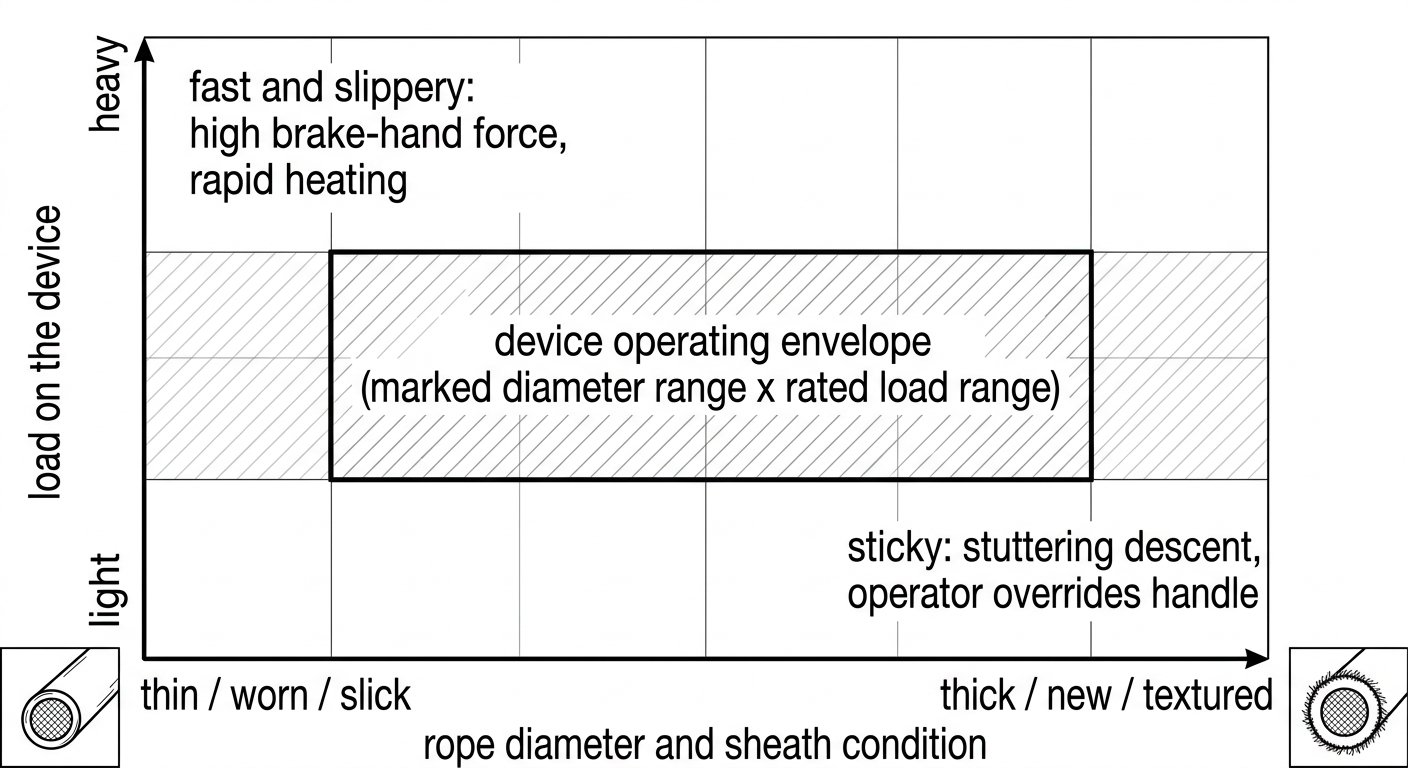
Load rating and rope diameter range describe one envelope: the corners outside it are where control degrades.
Two-person and rescue loads
Descending with a casualty, or lowering two people on one device, roughly doubles every quantity that matters: mass on the device, tension in the rope, load at the anchor, heat generated per metre, and force needed at the brake hand.
Before planning a two-person descent, confirm all of the following, not just the first:
- The device carries a rated load covering the combined mass — and check whether that figure sits under the EN 341 rescue rating rather than the EN 12841 Type C rating, because the permitted configurations may differ.
- The backup device on the safety line is also rated for the combined load. A two-person descender paired with a single-person backup is not a two-person system.
- The anchor, connectors and rope are rated for the increased load, with the anchor also carrying the redirect and braking forces.
- The descent height is inside the device’s per-descent limit at that load, which is often shorter for heavier loads.
Where two-person work is a foreseeable part of the scope, it belongs in the equipment selection at the outset — see selecting a rescue kit for the task.
Anchor and connector loads are not the same as the user’s mass
When a descender is rigged at the harness and running on a fixed rope, the anchor sees the worker’s weight plus whatever friction and redirect loads the rope path adds. When the descender is rigged at the anchor and used to lower, the anchor carries the load and the braking reaction, and any redirect pulley or edge deviation adds its own vector.
The connector between harness and descender is a specific weak point, because it is loaded in a way that invites cross-loading if the shape or locking type is wrong. That selection has its own rules — see choosing a connector for a descender: locking, compatibility and correct loading. The harness attachment point matters too: a descender belongs on a ventral or sternal attachment intended for suspension, not on a rear fall-arrest D-ring, and the attachment points themselves are defined by EN 361 for full body harnesses and the associated work-positioning standards.
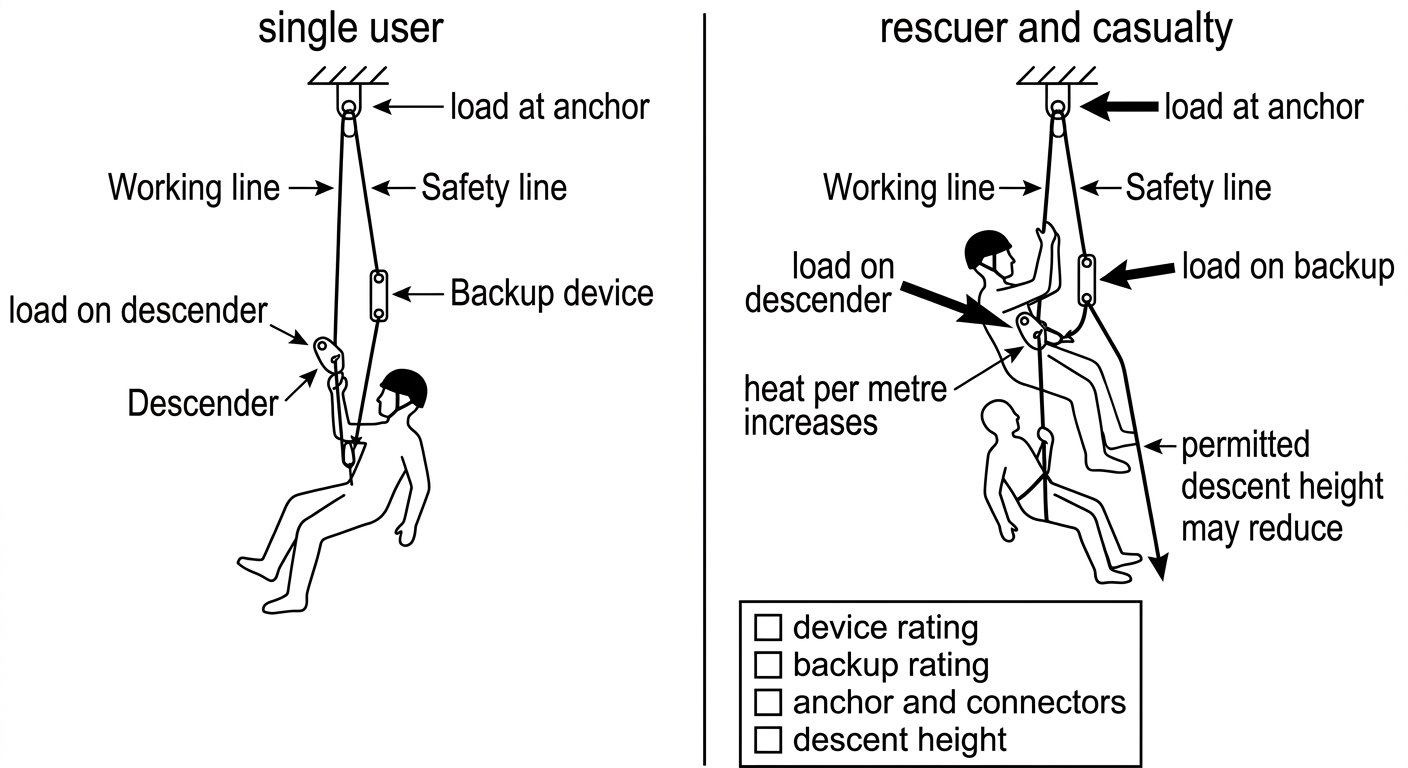
A two-person descent roughly doubles the load on every element, including the backup device on the safety line.
Reading the markings before the job
Everything above is legible on the device and in the instructions supplied with it. A pre-job check takes under a minute:
- Standards marked — EN 12841 with its type letter, EN 341 with its class, and any others. The type letter and class are the configuration permissions.
- Rated load per standard — note that the same device may show different maxima under different standards. Use the one that matches how you are rigging it.
- Minimum load, where declared.
- Rope diameter range and rope type — usually low-stretch kernmantle to a specified standard. A dynamic climbing rope is not a substitute.
- Rope direction — the loaded-strand pictogram cast into the side plate.
- Serial or batch number and date — needed for the equipment register and for traceability at inspection.
If a marking is worn illegible, the device cannot be verified against the task and should go out of service pending the manufacturer’s guidance. The same discipline applies to the rope and the textiles in the system; the criteria for those are covered in service life and retirement criteria for textiles.
Takeaway
A descender has at least four limits, not one: maximum rated load, minimum rated load, rope diameter range, and descent height or total descent energy. A plan can sit comfortably inside the mass rating and still be outside the thermal or diameter envelope. Check all four against the actual task — combined load, actual rope on site, actual drop height, actual number of descents — and check the backup device, connectors and anchor against the same numbers.
For related technique notes on rope, connectors, harnesses and confined-space procedure, see the rope access and confined space technique notes index.
Frequently asked questions
What does the rated load on a descender actually include?
It is the total mass the device is certified to control, not just body weight. That means the worker plus harness, tools, tool bag, radio and any rope or equipment carried on the person. When planning at the upper end of a rating, weigh the full kit rather than estimating.
Why does the same descender show different maximum loads for EN 12841 and EN 341?
The two standards certify different uses. EN 12841 Type C covers descent on the working line of a two-rope rope-access system, usually as a single-person rating, while EN 341 covers the device as a rescue or evacuation descender and often permits a wider load range including rescuer-plus-casualty use. Use the figure that matches the configuration you are actually rigging.
Is there such a thing as too little load on a descender?
Yes. Self-braking descenders rely on rope tension to drive the braking mechanism, so a very light load, especially on a new, stiff or large-diameter rope, can descend jerkily or fail to feed smoothly. Where a manufacturer declares a minimum rated load, it is a real functional limit and the answer is a different device or rope, not extra force on the handle.
Can I exceed the rated load if the device’s breaking strength is much higher?
No. Breaking or static strength is engineering margin proved during testing, not permission to load the device further. The rated load is the only figure that licenses use, and exceeding it also pushes rope, connectors, harness and anchor beyond what the system was planned around.
Does rope wear change how much load a descender can safely control?
It changes how the device behaves at a given load. A worn, contaminated or slick sheath reduces friction, so brake-hand force rises and the device heats faster for the same descent. Ropes can also lose diameter in service and drift below a device’s marked range, at which point the combination is no longer within specification.
How do I know if a long descent exceeds the device’s limits even when the load is fine?
Check the manufacturer’s stated maximum descent height per lower and any limit on total descent energy or number of descents at a given load. Long, heavy or repeated descents put more heat into the device and rope sheath than mass alone suggests. Where the height allows, break the descent into stages at intermediate anchors and inspect the rope afterwards.