
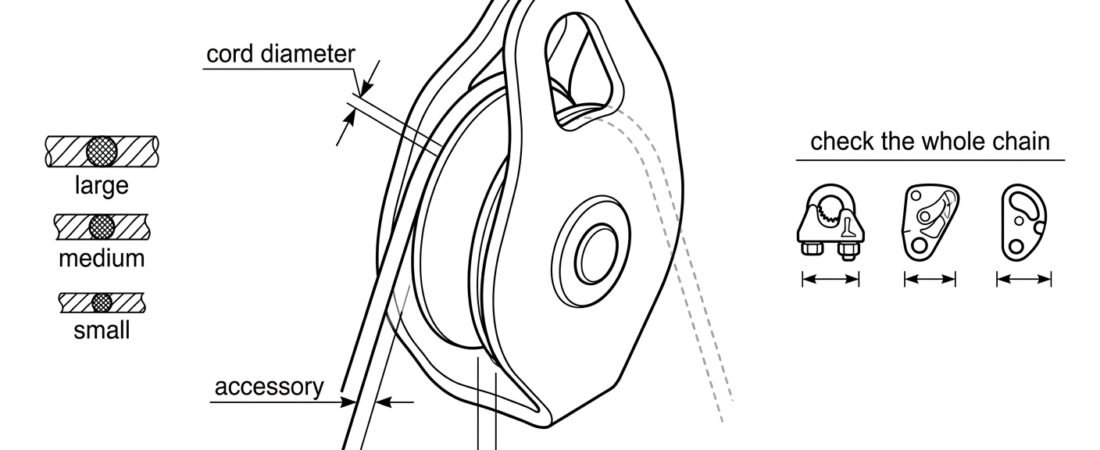
Small cord is convenient. It coils tight, it weighs nothing, and a 100 m spool of 6 mm accessory cord takes up less pack space than 30 m of 11 mm low-stretch rope. That convenience is exactly why it ends up threaded through pulleys that were never designed for it — tool-hoist lines through a rigging pulley, a 6 mm tag line through a swing-side pulley, an 8 mm haul kit reeved through whatever pulleys happened to be in the bag. The pulley usually survives. The cord does not always, and the failure is rarely a clean break: it is a cord that slips off the sheave, wedges between sheave and side plate, jams the system solid under load, and comes out of it with a cut sheath.
Every pulley carries a marked rope diameter range, and the lower end of that range exists for the same reason as the upper end. This note covers what happens when cord sits below it, how to tell whether a given pulley is genuinely built for thin cord, and how to check that the rest of the system — clamps, progress capture, connectors — agrees with the diameter you have chosen.
What the marked diameter range on a pulley actually controls
The upper limit of the marked range is intuitive: a rope too thick will not seat in the groove. It rides high on the flanges, contacts the side plates, loses efficiency and abrades. Most people rig conservatively against that limit because it is visible.
The lower limit is governed by geometry that is much less visible: the clearance between the outer edge of the sheave and the inner face of the side plate. On a pulley designed around 10–13 mm rope, that gap only has to be small relative to a 10 mm rope. Put a 6 mm cord over the same sheave and the gap may be a meaningful fraction of the cord’s diameter — wide enough for the cord to be dragged into it if the strand ever comes off the bottom of the groove.
Two other things change with a thin cord in a wide groove. The cord sits on the groove floor with far less lateral support, so it can slide across the sheave and climb one wall rather than tracking centrally. And because the cord is light and limp, it does not hold its own line when the strand goes slack — it will happily drop off the sheave the moment tension is released, which is when most derailments actually begin.
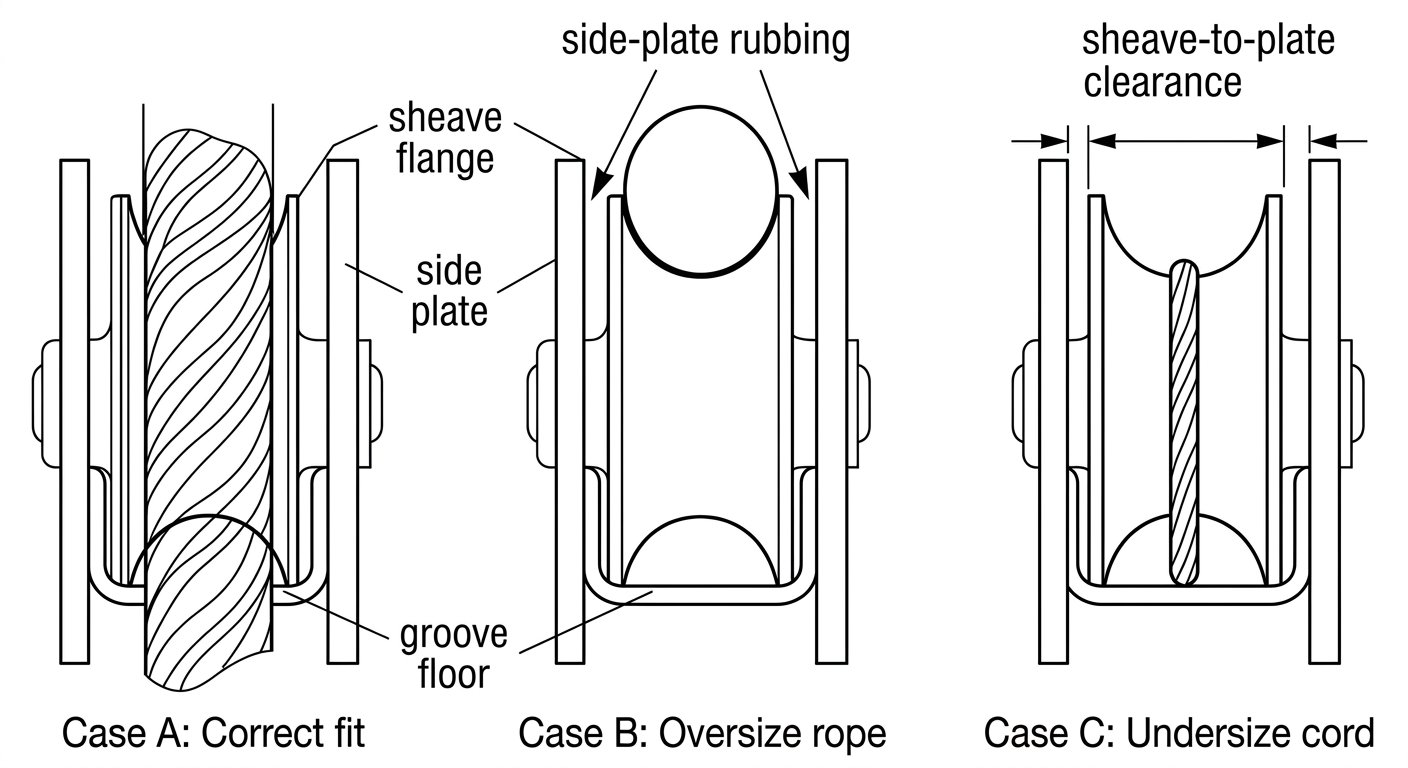
The lower end of a pulley’s marked diameter range is governed by the clearance between sheave and side plate, not by the groove width alone.
The primary failure mode: cord wedged between sheave and side plate
The sequence is consistent enough to be worth memorising:
- The strand goes slack, or the load direction shifts so the cord no longer runs squarely into the groove.
- The cord climbs the groove wall and slips over the sheave flange.
- Tension returns. The cord is now pinched between the rotating sheave and the fixed side plate.
- The sheave stops. The system feels seized. Pulling harder drives the cord further in and shears the sheath against the plate edge.
Three conditions make this far more likely, and they often occur together. A wide change of direction at the pulley — anything approaching a redirect where the two strands run nearly parallel — loads the cord against one groove wall rather than into the floor. Slack–load cycling, typical of hauling a bag that snags and releases, repeatedly presents an unloaded cord to the sheave. And a rotating or unstable pulley body, hanging on a connector that can flip, changes the entry angle mid-haul.
Freeing a jammed cord under load is genuinely awkward: you have to take the load off the pulley to release the pinch, which in a hauling system means having a progress-capture point below the pulley you can transfer to. Rigging so that you always have a way to unweight a pulley is worth more than any amount of care in the initial reeving.
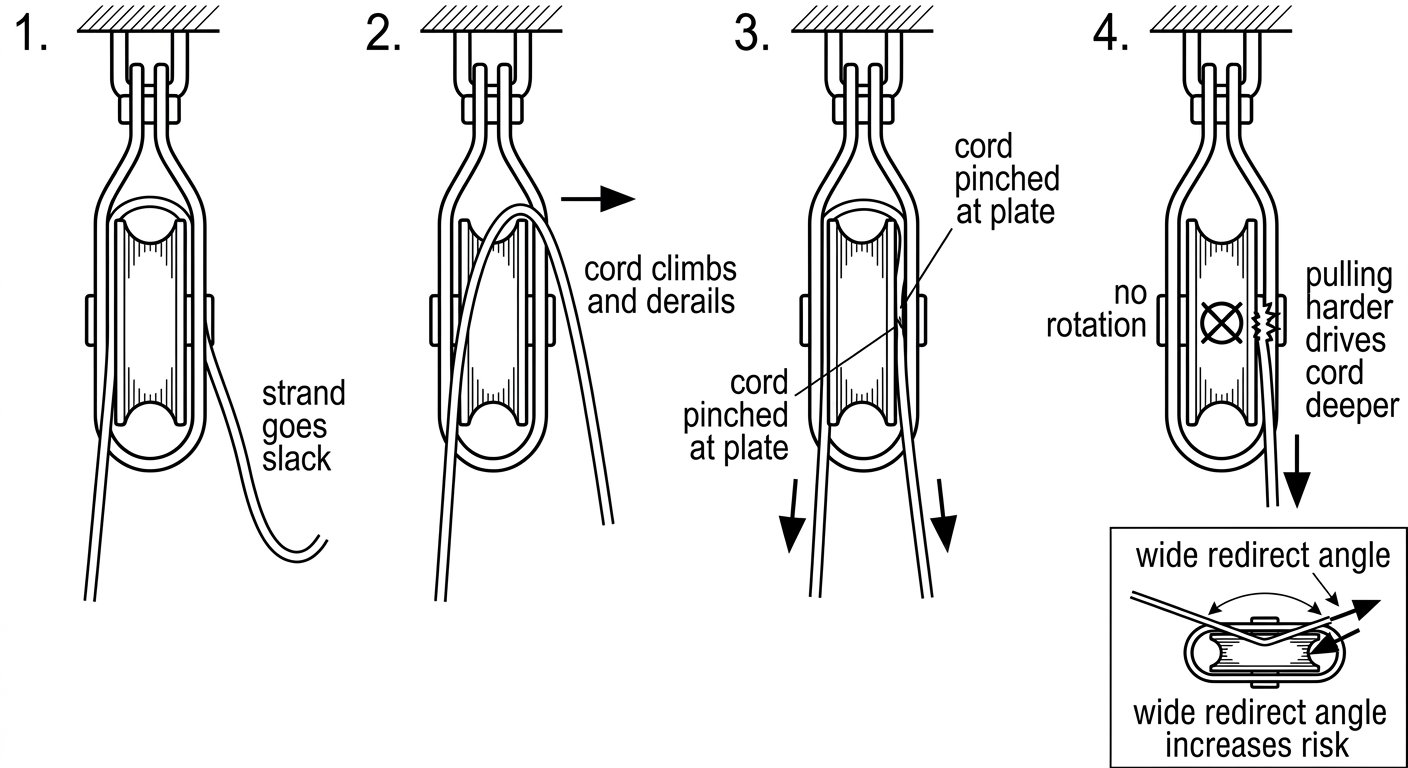
The standard jamming sequence: slack cord derails over the flange, then tension wedges it between sheave and side plate.
Pulleys that are genuinely designed for thin cord
Manufacturers do build pulleys for the small-diameter end of the range, and the differences are visible if you know what to look at. Compare a general-purpose rigging pulley for 10–13 mm rope with a micro or pocket pulley marked for something like 7–11 mm and you will typically see:
- Minimal sheave-to-plate clearance. The side plates come close enough to the sheave that a thin cord physically cannot enter the gap. This is the single most important feature for small cord.
- A narrower, deeper groove profile relative to the sheave diameter, so a thin cord seats with real lateral support instead of resting on a wide flat floor.
- Side plates that close down around the sheave rather than standing off it to accommodate a fat rope.
Conversely, be sceptical of a few common features when thin cord is involved. Prusik-minding pulleys have deliberately broad, flat side plates so a friction hitch is stopped rather than pulled into the sheave — useful, but those plates say nothing about the sheave-to-plate gap, and a prusik tied in cord only marginally thinner than the main line is a poor minding arrangement anyway. Very wide-body pulleys built to take two strands, or knots, or a rope and a rescue line, almost always have generous internal clearance and are the worst candidates for a 6 mm cord.
The practical rule: read the marked range, then confirm it by eye. If you can see daylight between sheave and plate that looks comparable to the cord you are about to reeve, choose a different pulley.
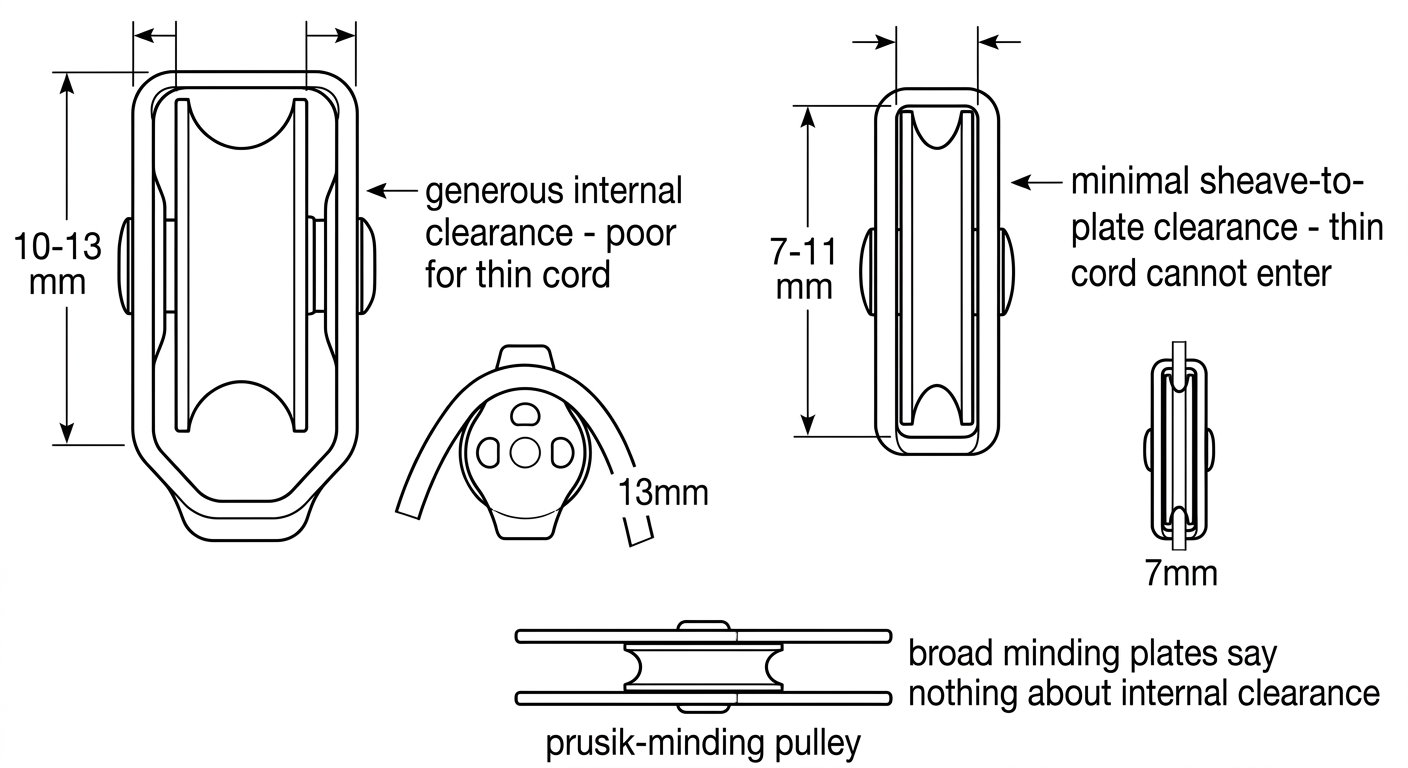
Pulleys built for thin cord close the side plates down onto the sheave; wide-body rigging pulleys leave a gap the cord can enter.
Efficiency: a thin cord on a big sheave is not automatically better
It is tempting to assume thin cord over a large sheave must be efficient, because the bend ratio is generous and the cord does not have to be forced around a tight radius. Bend ratio is genuinely favourable, but it is not the whole story, and it is not what the marked efficiency figure on the pulley refers to.
Efficiency values are measured under defined test conditions with a specific rope, and real-world results vary with rope construction, stiffness, contamination, wetness and load. A stiff aramid or HMPE-cored cord may resist bending more than a supple nylon rope of larger diameter. A thin cord that is not tracking centrally in the groove contributes drag from side-wall contact that does not appear in any published number. If you are calculating what a haul system will actually deliver, treat manufacturer figures as a ceiling rather than a prediction — the reasoning behind those numbers is covered in more detail in pulley efficiency: what the numbers mean.
One effect that does matter with thin cord: it twists. Small-diameter cord has less torsional stiffness and, in a multi-strand reeving, strands tend to wrap around each other far more readily than 11 mm rope does. Twisted strands rub, bind against pulley bodies and quietly destroy mechanical advantage. Keep strands separated, use pulleys that hold their orientation, and expect to spend more time managing lay than you would with full-diameter rope.
The pulley is not the constraint — the rest of the chain is
A pulley is the most tolerant component in a hauling system, because it only has to guide the cord. Everything else in the chain grips it, brakes it or takes its full load, and those components have far tighter diameter limits.
- Toothed rope clamps and ascenders. A cam designed to bite an 11 mm sheath, closing on a 6 mm cord, may not present the cam face squarely at all. Depending on the device it can slip, or it can concentrate the tooth load on a much thinner sheath and cut it. This is not a place for judgement calls — use the marked range.
- Progress-capture devices. The same applies, with the added problem that a capture device is the component you are relying on when everything else is unweighted.
- Descenders and friction devices. These are the least forgiving of all, because friction geometry is diameter-dependent in both directions: too thin and you lose control, too thick and you cannot feed rope. See rope diameter limits on descenders for why that marked range is narrower than people expect.
- Friction hitches. Hitch cord must be meaningfully thinner than the line it grips, which pushes you into very small cord if the main line is already small. Two thin cords in a hitch is a combination that grabs poorly and abrades fast.
- Connectors. The attachment point of the pulley still has to be loaded along its major axis and closed properly; a light cord does not make sloppy clipping acceptable. Choosing connectors for hauling and pulleys covers the shape and loading issues specific to this position.
The workable approach is to build the system around the narrowest compatible diameter across all devices, not around the pulley. If you cannot find a clamp and a capture device that both accept your cord, the cord is the wrong choice — regardless of how well it runs in the sheave. Choosing the working diameter first is easier than retrofitting it; the trade-offs are set out in choosing a low-stretch rope diameter.
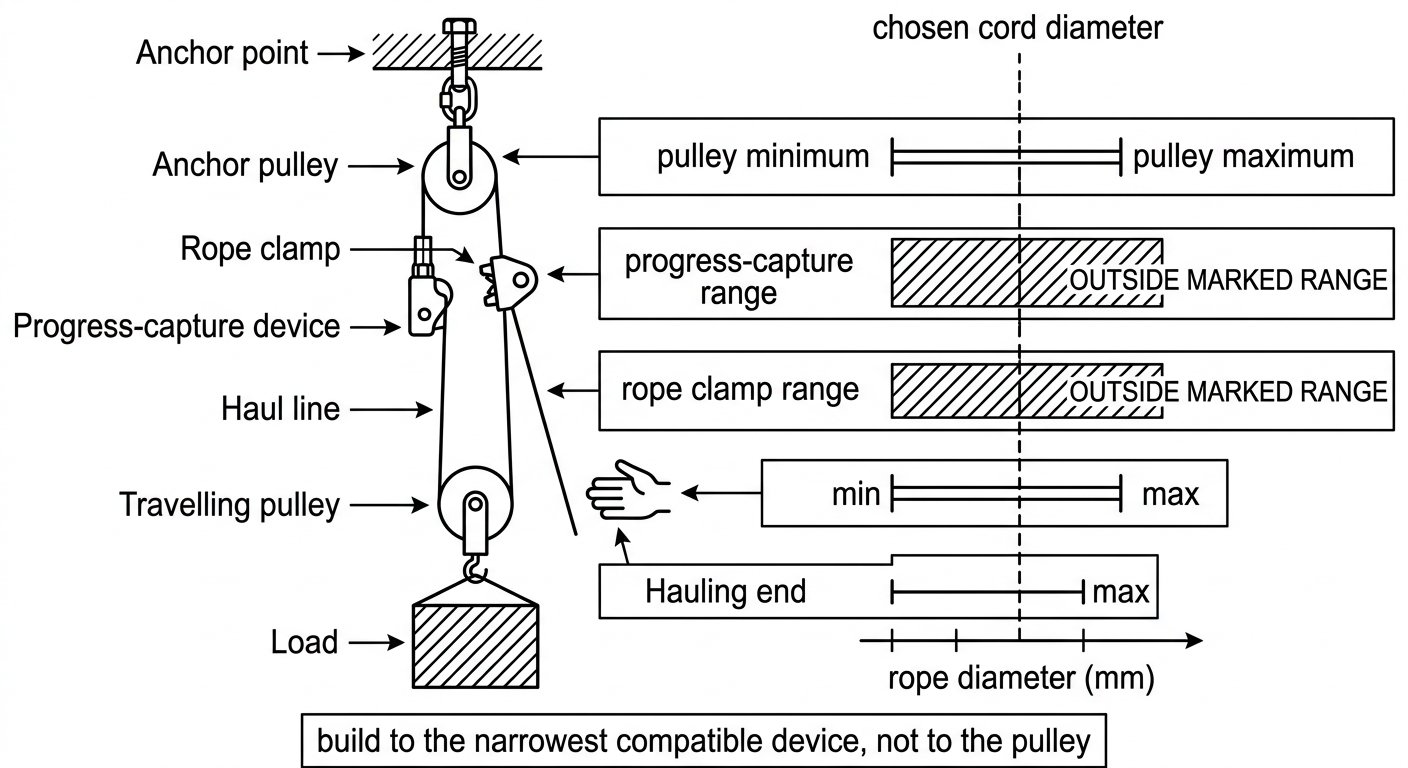
The pulley is the most tolerant component in the chain; clamps, capture devices and descenders set the real diameter limit.
Strength: the cord becomes the weakest element by a wide margin
A pulley’s marked breaking strength and its working load limit are set with full-diameter rope in mind, and in a small-cord system the pulley will typically be several times stronger than the line running through it. That is not a safety margin; it means the cord defines the system.
Two consequences follow. First, the multiplication effect at the pulley is easy to forget: a redirect can load the anchor and the pulley with something approaching twice the line tension, depending on the angle between the strands. Thin cord makes the line tension modest, but it does not change the geometry. Second, knots cost proportionally more in thin cord. Every knot reduces breaking strength, and small-diameter cord is less forgiving of a poorly dressed knot, needs longer tails, and is more prone to knots creeping or capsizing under cyclic load.
The honest conclusion is a use-case boundary rather than a number: reserve small cord for hauling equipment, tools, bags and tag lines, and use full-diameter, device-compatible rope for anything that carries or arrests a person — unless the cord is part of a manufactured system explicitly rated and supplied for that purpose. Some rescue haul kits are built around smaller-diameter rope with matched pulleys, clamps and capture devices, and those are validated as a system. Assembling your own equivalent from a spool of accessory cord is not the same thing.
Cord material changes the rules
“Small cord” covers materials with very different behaviour, and the choice affects how it runs through a pulley.
Nylon and polyester accessory cord behaves predictably: it holds knots reasonably, it is supple enough to seat in a groove, and it wears visibly. It is the default for general hauling.
Aramid and HMPE (Dyneema-type) cords are much stronger for their diameter, which is why they appear in weight-critical kits. They are also stiffer or slicker, hold conventional knots poorly — typically requiring specific high-turn knots such as a triple fisherman’s — and are far less tolerant of heat. HMPE in particular has a low melting point relative to nylon, so it must never be used anywhere friction generates heat, and it should not run over a sheave that is binding. Aramid resists heat but is sensitive to abrasion and to sharp bends over small radii.
For all of these, sheath damage is proportionally more serious than on a thick rope. A nick that would be a cosmetic issue on 11 mm rope can remove a significant share of a 6 mm cord’s cross-section.
Handling and hauling thin cord by hand
Thin cord is hard to grip. Under load it concentrates force into a narrow line across the hand, it slides through a glove more readily than rope, and it is difficult to hold in a controlled lower. Practical consequences on site:
- Wear gloves, and expect to need a hitch, a device or a bollard-style friction wrap rather than hand strength alone for anything but the lightest loads.
- Never take a turn of small cord around a bare hand or wrist to get a better grip. Cord this size cuts.
- Keep the tail bagged or coiled. Loose thin cord tangles into knots that will not pass a sheave, and a knot arriving at a loaded pulley jams it.
- Watch for cord running over edges. Small cord finds the sharp corner of a hatch rim or grating far more readily than rope does, and it has less sheath to lose.
Inspecting small-diameter cord
Inspection intervals and criteria follow the manufacturer’s instructions, but the indicators worth looking for specifically on thin cord are:
- Glazing or hard, shiny patches — a sign of heat, most often from a jammed sheave or a fast lower.
- Flat spots or a change in cross-section when rolled between finger and thumb, indicating core damage that a visual check alone can miss.
- Sheath cuts or fuzzing concentrated at one point, which usually marks the spot that was wedged between sheave and plate, or that ran over an edge.
- Stiffness or contamination from grit, cement dust or chemicals. A thin cord holds proportionally more contaminant per unit of cross-section, and grit inside a small-diameter core does substantial internal abrasion.
Any cord that has jammed hard in a pulley should be inspected along its full length before reuse, not just at the obvious point — a jam under load stretches and works the cord well beyond the pinch.
Field check before you reeve
Four things, in order, before small cord goes into a pulley:
- Read the pulley’s marked diameter range and confirm your cord sits inside it — at the bottom end as well as the top.
- Look at the sheave-to-plate clearance with the cord in hand. If the gap looks comparable to the cord, change the pulley.
- Check every gripping device in the chain — clamps, progress capture, descenders, hitch cord — against the same diameter, and build to the narrowest compatible option.
- Confirm you can unweight each pulley if the cord jams, and that the strand entering the sheave will stay loaded and squarely aligned through the whole haul.
If the answer to any of these is uncertain, the correct move is almost always to use larger rope rather than to rig around the doubt. Further technique notes on rigging, hauling and device compatibility are collected on the rope access and confined space hub.
Frequently asked questions
Why does a pulley have a minimum rope diameter and not just a maximum?
The maximum stops a rope too thick to seat in the groove. The minimum exists because a cord much thinner than the groove has little lateral support and can slip over the sheave flange into the clearance between sheave and side plate, where it jams and can be cut. Pulleys intended for thin cord are built with that clearance reduced to almost nothing.
Is thin cord more efficient over a pulley because the bend radius is more generous?
The bend ratio is favourable, but efficiency also depends on cord stiffness, construction, contamination and whether the cord is tracking centrally in the groove. Stiff aramid or HMPE cords can resist bending more than a supple larger-diameter rope, and side-wall rubbing from a cord that is not seated properly adds drag. Treat published efficiency figures as a ceiling rather than a prediction.
Can I use 6 mm accessory cord in a haul system for lifting a person?
No, unless the cord is supplied and rated as part of a manufactured system for that purpose, with matched pulleys, clamps and capture devices. Small accessory cord has a small fraction of the strength of full-diameter low-stretch rope, loses proportionally more to knots, and generally falls outside the marked range of the gripping devices a rescue system needs. Reserve small cord for tools, bags and tag lines.
What should I do if small cord jams between the sheave and the side plate under load?
The pinch will not release while the pulley is loaded, so you need to transfer the load elsewhere and unweight that pulley before freeing the cord. Pulling harder drives the cord deeper and damages the sheath against the plate edge. Rig so that every pulley in a haul system can be unweighted, and inspect the full length of any cord that has jammed hard before reusing it.
Are prusik-minding pulleys a good choice for small-diameter cord?
Not necessarily. Their broad flat side plates are designed to stop a friction hitch from being pulled into the sheave, which says nothing about the internal sheave-to-plate clearance that matters for thin cord. In addition, a hitch tied in cord only slightly thinner than an already small main line grips poorly and abrades quickly.
Does the material of the cord change how it should run through a pulley?
Yes. Nylon and polyester cord is supple, holds knots reasonably and wears visibly. HMPE and aramid cords are stronger for their diameter but stiffer or slicker, hold conventional knots poorly and are much less tolerant of heat or sharp bends, so they must never run through a binding sheave or anywhere friction is generated.