
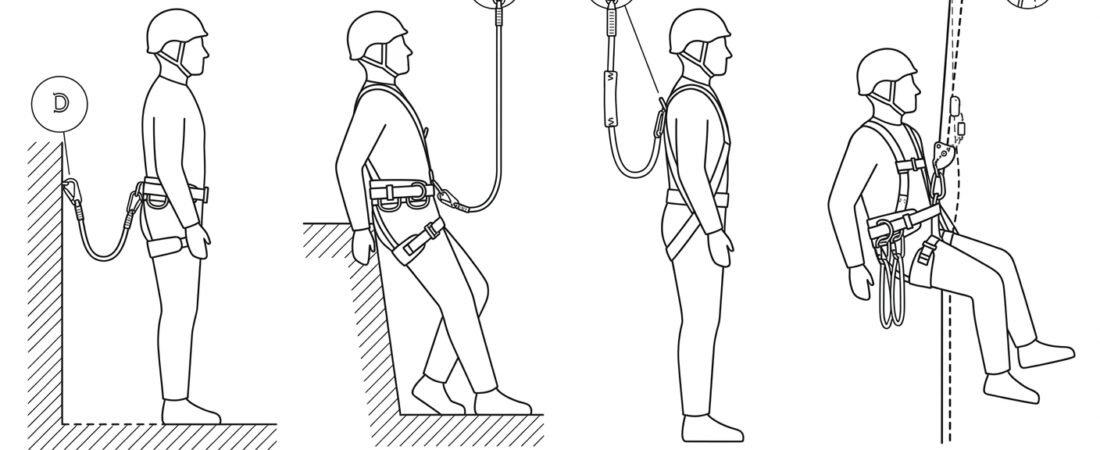
Picking a harness is not a comfort decision made in the stores cupboard — it decides what work the wearer can legally and safely do once they are on site. A harness that is correct for restraint at a roof edge may be useless for a tripod extraction from a manhole; a rope access sit harness on its own is not a fall-arrest harness. The practical question on any job is narrow: what does the task actually require the harness to do — hold a worker back, hold them in position, catch a fall, support them in suspension, or allow them to be lifted out — and does the harness in the bag carry an attachment point certified for that job?
This note works through the harness families in the order a supervisor usually meets them, explains what each attachment point is for, and flags the combinations that cause most of the field errors.
Start with the task, not the catalogue
Five task types cover almost all rope access and confined space work, and each maps to a different harness requirement:
- Restraint — the worker is physically prevented from reaching the fall hazard. No fall is possible, so the system only has to resist a modest pull.
- Work positioning — the worker leans back into the system to work hands-free (pole work, tank walls, formwork). The system is loaded in normal use, but a separate fall-arrest system is still needed as backup.
- Fall arrest — a free fall is possible and the system must stop it and limit the forces on the body.
- Rope access / suspension — the worker hangs on rope for extended periods on a working line with a backup line.
- Rescue and extraction — the worker may need to be lowered, raised or hauled vertically out of a shaft or vessel, possibly unconscious.
Most real jobs are two or three of these at once. That is why so many working harnesses are combination models rather than single-purpose ones.
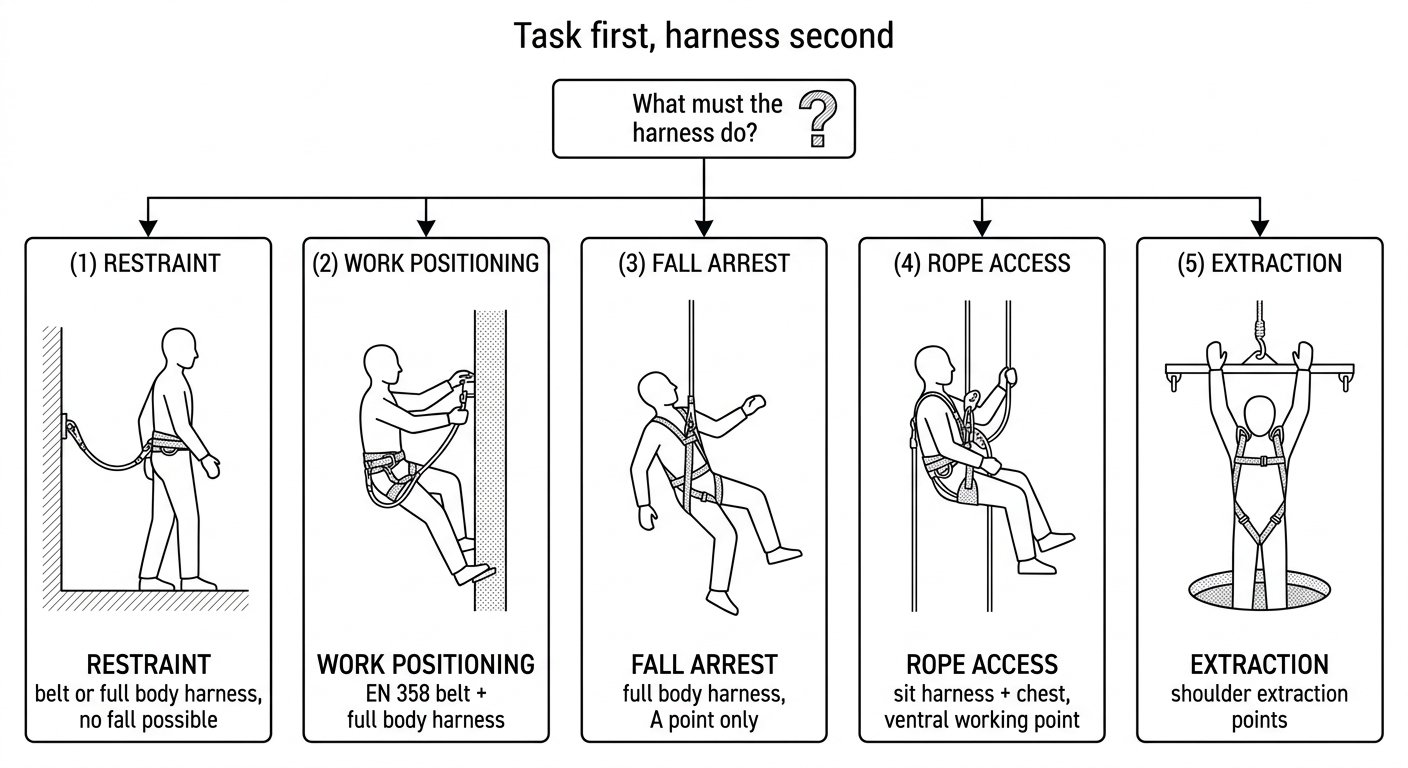
Harness selection starts with naming the task: each of the five task types demands a different certified attachment point.
The attachment points, and what each one is certified for
Harness selection is really attachment-point selection. On a typical combination harness you will find some or all of the following:
- Dorsal (rear) attachment — fall arrest only. The default connection for a lanyard or self-retracting device. It keeps the line out of the worker’s way and tends to leave the body in a reasonably upright, head-up posture after arrest.
- Sternal (chest) attachment — fall arrest, and the usual point for a guided type fall arrester on a vertical ladder line, where the connection must be at the front and short.
- Ventral (low front, waist-level) attachment — suspension and progression: descender, rope clamp, positioning. On a sit harness or rope access harness this is the main working point. It is not a fall-arrest attachment.
- Lateral (hip) attachments — work positioning only, always used as a pair with a positioning lanyard passed around the structure and held taut.
- Shoulder / extraction attachments — a pair of points, usually used with a spreader bar or a Y-connector, intended for lifting and lowering a person, typically in confined space entry and retrieval.
- Rear belt attachment — restraint only. Fine for holding a worker back from an edge, never for arresting a fall.
Fall-arrest points are marked with a capital A. Some harnesses use paired points marked A/2 (for example two textile loops, one on each shoulder or either side of the chest) which are only rated for fall arrest when both halves are connected together into the same connector. Connecting one A/2 loop alone is a defect, not a shortcut — see connecting a fall-arrest lanyard to the harness for how that connection should actually be made.
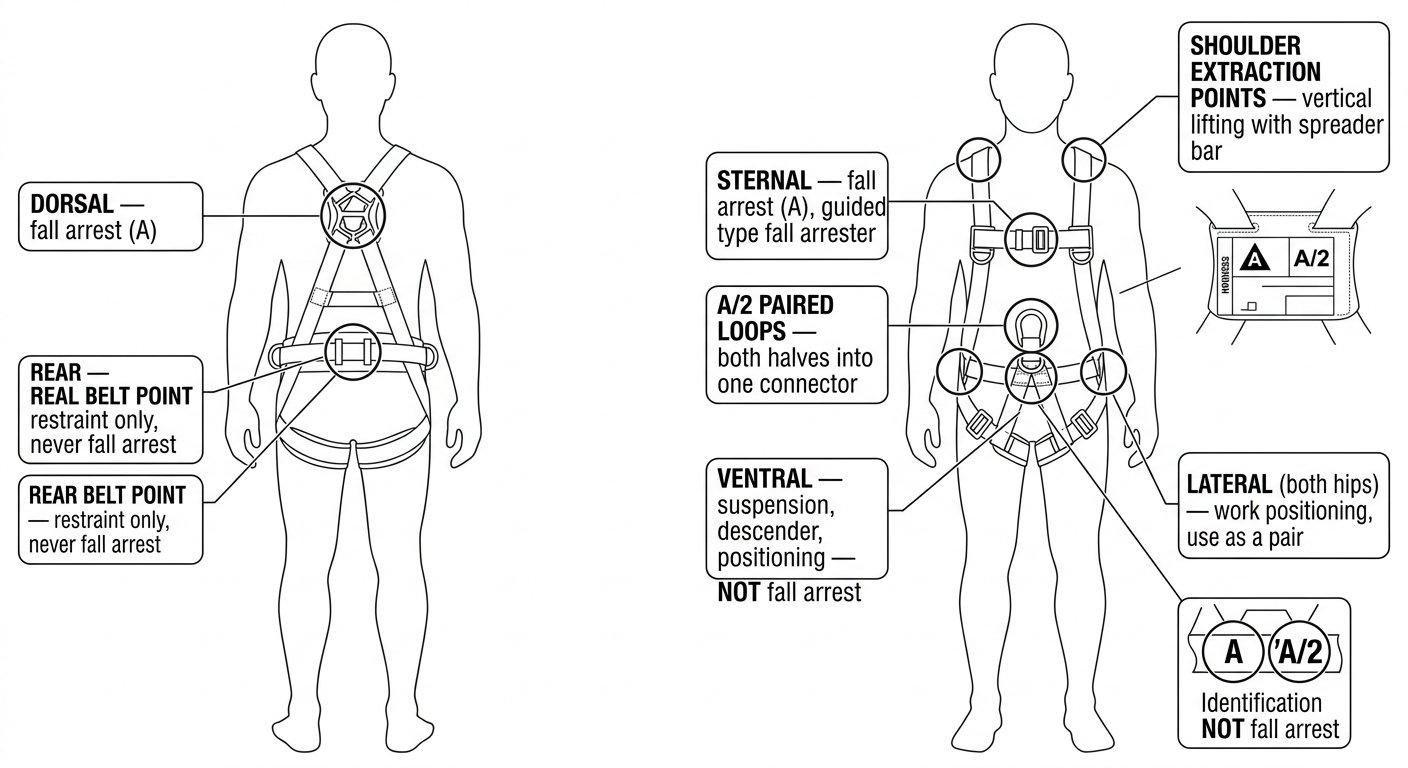
Harness selection is really attachment-point selection — each point on a combination harness is certified for one job only.
Restraint work: a belt is often enough, a harness is rarely wrong
For pure restraint — travel restricted so that the fall hazard cannot be reached — a restraint belt conforming to EN 358 (work positioning and restraint belts) with a fixed-length lanyard is a legitimate choice, and it is lighter and quicker to don than a full harness.
Two cautions make many organisations issue a full body harness anyway. First, restraint only works if the lanyard length and the anchor position genuinely make the edge unreachable in every direction the worker might move — that calculation has to be redone every time the anchor changes. Second, if the task creeps (someone leans out, the edge changes, a hatch opens), a belt gives no fall-arrest capability at all. A full body harness with a restraint lanyard clipped to the rear point costs nothing in safety and covers the change of plan.
Work positioning: belt plus harness, never belt alone
Work positioning means loading the system on purpose so the hands are free. The lateral D-rings on an EN 358 belt take that load, with a positioning lanyard passed around the structure and adjusted short so the worker leans into it rather than standing free.
The rule that matters: a positioning belt is not a fall-arrest device and is not designed to be loaded in a fall. Wherever a fall is conceivable — which on a pole, ladder, tower or tank wall it almost always is — the positioning belt must be part of a harness that also carries EN 361 fall-arrest attachment points, with a separate fall-arrest system connected to a dorsal or sternal A point. In practice this means a combination harness: full body harness with an integrated positioning belt.
Two further details are worth checking before purchase. The belt should be wide and stiff enough at the back to transfer load into the pelvis rather than the lumbar spine, and the lateral D-rings should sit slightly forward of the hips so the wearer can reach both while leaning back. Choice of the anchor-side hook also matters — see choosing and loading the anchor-side hook for work positioning.
Fall arrest: full body harness, and only an A point
If free fall is possible, the harness must be a full body harness with a certified fall-arrest attachment. Nothing else distributes arrest forces across thighs, pelvis, chest and shoulders, and nothing else keeps the wearer in a survivable post-fall posture.
Choosing between dorsal and sternal:
- Dorsal for general work with an energy-absorbing lanyard or self-retracting device, especially where the line would otherwise foul the work. It is also the point that suits rescue by lifting from above in many systems.
- Sternal for guided type fall arresters on a vertical line, for confined vertical ascent, and where a short connection is needed in front of the body. Sternal attachment tends to produce more head-forward posture on arrest and generally requires the connection to be kept short.
Fall clearance is a harness-selection issue too, because attachment height differs: a dorsal attachment sits higher on the body than a ventral or sternal one, and the arrest geometry changes with it. Whatever point is used, the harness has to be adjusted correctly for the arrest forces to go where the designer intended — loose leg loops and a low-riding dorsal ring undo most of the design. The fit checks are covered in adjusting a full body harness correctly.
Rope access: sit harness plus chest, with a ventral working point
Rope access work is suspension work, and suspension comfort is a safety issue: a harness that numbs the legs after twenty minutes drives people to rush or to improvise. The rope access harness is built around a wide, padded waist belt, supportive leg loops and a strong ventral attachment that keeps the descender close to the body’s centre of mass.
A typical rope access setup uses:
- a sit harness (EN 813-type) providing the ventral point, for the descender or main rope clamp on the working line;
- an integrated or attachable chest harness giving the sternal point, holding the chest ascender in place and providing the fall-arrest attachment;
- optionally a positioning belt with lateral points for hands-free work at a face or a structure.
The devices themselves are governed separately: rope adjustment devices used on working and safety lines are covered by EN 12841 (rope access adjustment devices), which distinguishes backup devices on the safety line from ascent and descent devices on the working line. The harness must have a point suitable for each: ventral for the working-line device, and a point suitable for the backup device according to its instructions — commonly ventral or sternal depending on the system. Connector choice at these points is not incidental either; see choosing a connector for a descender.
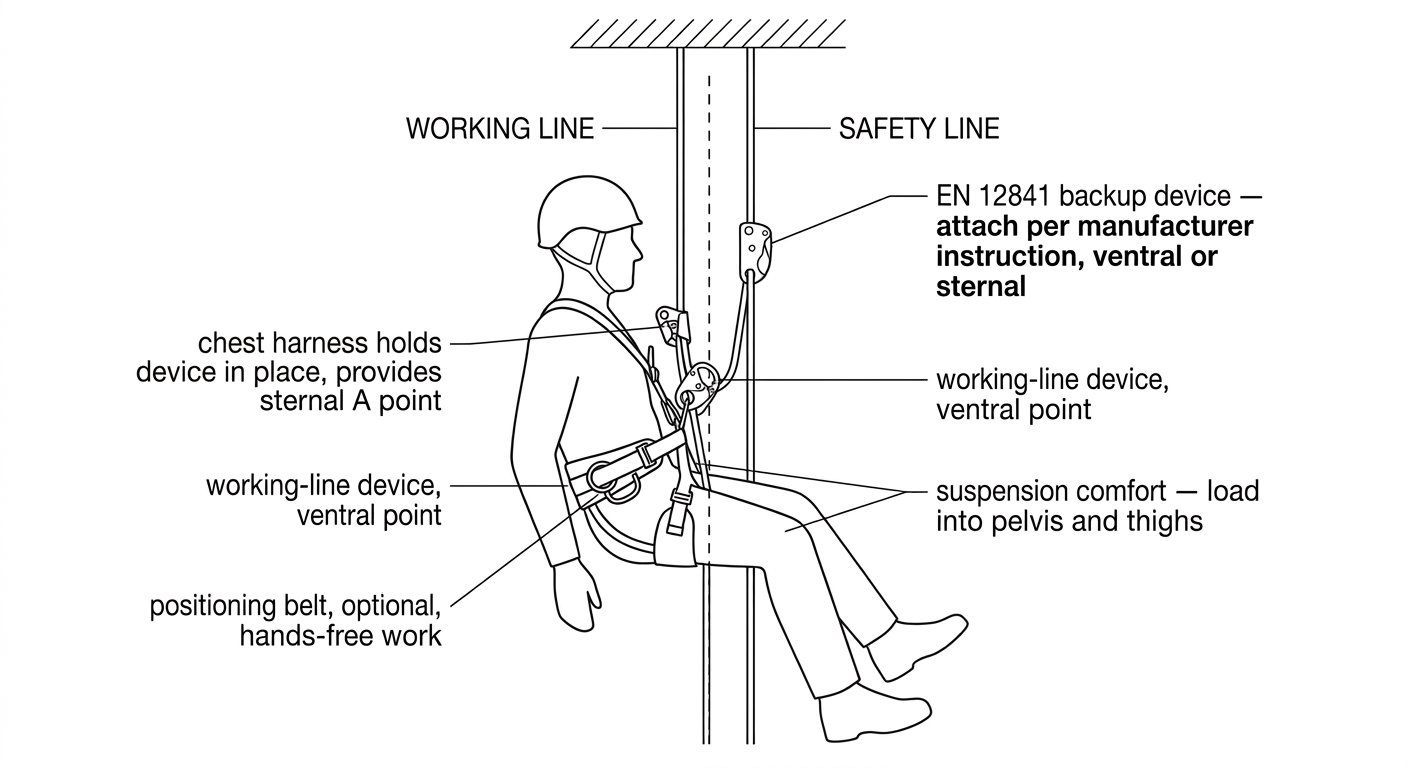
The rope access harness is built around a low ventral working point that keeps the descender near the body’s centre of mass.
Confined space entry: think about how the person comes back out
Confined space harness selection is driven by retrieval, not by the descent. If the plan is vertical extraction through a manhole with a tripod or davit and a rescue winch, the harness needs shoulder extraction attachments: a pair of points, used with a spreader bar or Y-lanyard, that lift the wearer in a near-vertical, arms-up posture so the body passes through a narrow opening. A dorsal ring alone tends to lift the wearer with the torso folded and the shoulders wide — workable in a large opening, awkward in a small one.
Where a harness is intended to support and lift a casualty, it should carry an attachment certified for that purpose under EN 1497 (rescue harnesses). Many combination harnesses are certified to more than one standard at once — a full body harness with rescue attachments and a positioning belt — and the labels inside the harness are the only reliable way to confirm which points carry which certification. Read the label, not the product name.
In the entry system as a whole, the harness usually has three jobs at once: fall arrest on the way in and out (dorsal or sternal), suspension or positioning while working (ventral or lateral), and extraction if things go wrong (shoulder points). Confirming those roles is part of preparing the entry, alongside the checks described in the confined space entry permit sequence.
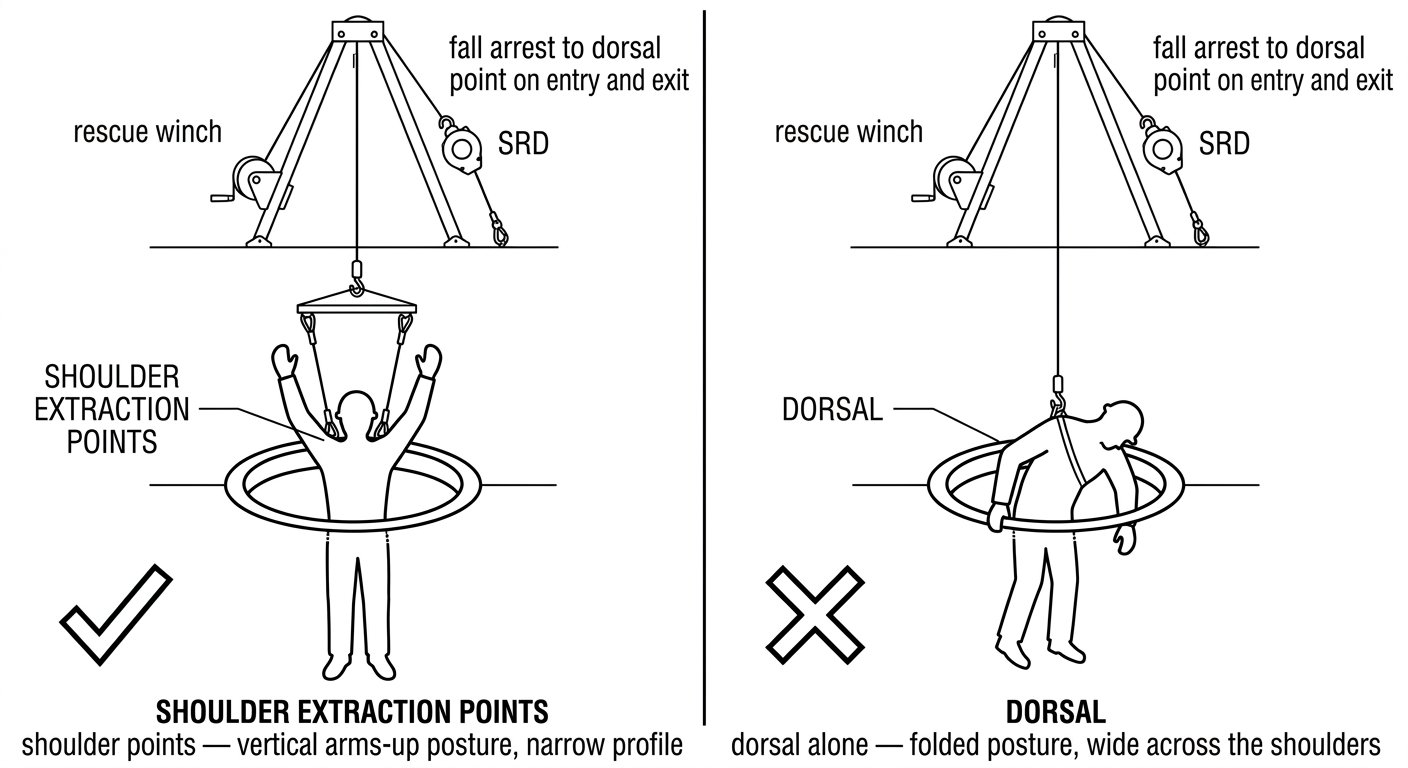
Confined space harness choice is driven by retrieval geometry: shoulder extraction points give the narrow, arms-up profile a small opening needs.
Secondary selection factors that still change the answer
- Size and adjustment range. A harness that cannot be adjusted to fit is the wrong harness, regardless of certification. Check that the wearer’s size sits mid-range rather than at the end of the webbing, and that adjustment is still possible over the actual work clothing.
- Donning method. Quick-connect buckles speed up donning for frequent short entries; pass-through buckles are simpler and cheaper for a harness that is fitted once at the start of a shift.
- Environment. Hot work, arc-flash risk and chemical exposure all affect webbing and hardware choice; harnesses intended for these environments use specific webbing and may restrict exposed metal. Where protective clothing is worn over or under the harness, check that it does not block access to attachment points or buckles.
- Load rating and total system mass. Manufacturers state a rated user mass that includes tools and equipment. A worker carrying a heavy tool bag can exceed it more easily than expected.
- Suspension time. For long suspension work, padded leg loops, a supportive waist belt and — in some systems — suspension relief straps make a measurable difference to how long the wearer can work safely.
- Compatibility with connectors and devices. Attachment points differ in shape, width and stiffness, and not every connector loads them correctly. Before committing, run the check described in checking connector compatibility before you clip in.
Common selection errors
- Using a positioning belt where fall arrest is required. The lateral points are for tension between two anchors under body weight, not for arresting a fall.
- Clipping a lanyard to the ventral point of a sit harness. The ventral point is a suspension point. Fall arrest goes to an A-marked point on a full body harness.
- Using one half of an A/2 pair. Both halves must go into the same connector for the point to be rated.
- Using a shoulder extraction point as a fall-arrest attachment unless it is explicitly marked and certified as such by the manufacturer.
- Selecting a harness with no extraction capability for a vertical confined space entry, then discovering the problem during the rescue rather than during planning.
- Assuming certification transfers between points. A harness certified to several standards is certified at specific points, not everywhere on the webbing.
The short version
Name the task first: restraint, positioning, fall arrest, suspension, extraction — or the combination the job actually involves. Then check the harness label for a certified attachment point for each of those functions, confirm the point is reachable and correctly shaped for the connector you intend to use, and confirm the harness can be adjusted to fit the specific wearer over their working clothing. A harness that satisfies all four checks is the right harness; a harness that satisfies three of them is a hazard waiting for the day the task changes.
For related selection notes on lanyards, connectors and confined space procedure, see the full set of rope access and confined space technique notes.
Frequently asked questions
Can a work positioning belt be used for fall arrest?
No. The lateral D-rings on a positioning belt are designed to be loaded in tension between two anchor legs while the wearer leans back, not to arrest a fall. Wherever a fall is possible, the belt must be part of a combination harness that also provides certified fall-arrest attachment points, with a separate fall-arrest system connected to a dorsal or sternal A point.
What is the difference between the dorsal and sternal fall-arrest attachments?
Both are fall-arrest points. The dorsal point is the usual choice for general work with a lanyard or self-retracting device, because it keeps the line clear of the worker and tends to leave the body upright after arrest. The sternal point is used where a short front connection is needed, typically with a guided type fall arrester on a vertical line; connections to it are generally kept short and the post-arrest posture is more head-forward.
Is a rope access sit harness enough on its own?
Not for fall arrest. A sit harness provides the ventral suspension point for a descender or rope clamp, but it has no certified fall-arrest attachment. Rope access work normally combines the sit harness with a chest harness so that the wearer also has a sternal attachment and the correct point for the backup device on the safety line.
What does the A/2 marking on a harness mean?
A/2 marks one half of a paired fall-arrest attachment. The point is only rated for fall arrest when both marked halves are connected together into the same connector. Clipping into a single A/2 loop leaves the connection unrated and is a defect in the setup, not an acceptable shortcut.
Do I need shoulder extraction points for every confined space entry?
Not for every entry, but for any entry where the rescue plan involves vertical extraction through a restricted opening using a tripod, davit or rescue winch. Shoulder points used with a spreader bar lift the wearer in a near-vertical, arms-up posture that passes through a small opening; lifting from a dorsal ring alone tends to fold the torso and widen the shoulders. Decide this during entry planning, not during the rescue.
How do I confirm which standards a specific harness is certified to?
Read the identification label sewn into the harness and the manufacturer’s instructions supplied with it. Certification applies to specific attachment points, not to the harness as a whole, so a model may be certified for fall arrest at some points, positioning at others and rescue lifting at others again. The product name is not a reliable guide.