
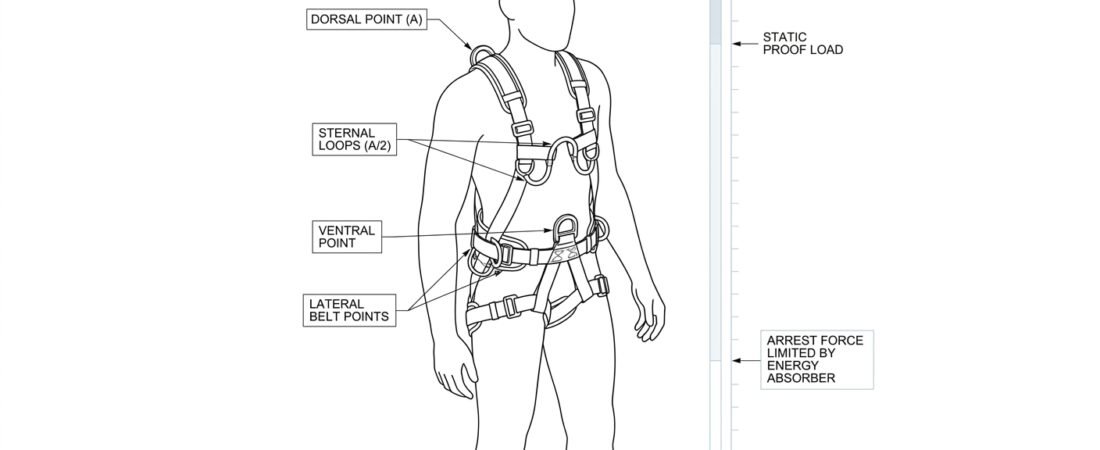
A harness attachment point is not simply a metal ring with a number stamped near it. It is a rated load path — webbing, stitching, adjusters and the ring or textile loop itself — that has been tested as an assembly. Understanding what those ratings mean, and where they stop applying, is the difference between clipping into something that will hold an arrested fall and clipping into something that was only ever designed to carry a bolt bag.
This note covers what the strength figures behind harness attachment points represent, how test values differ from working loads, why direction of loading matters as much as magnitude, and how to tell a rated point from an unrated one on the harness in front of you.
The rating belongs to the load path, not the ring
When a harness is certified, the attachment point is not tested as an isolated component. The test load is applied through the point and into the harness structure, usually via a torso dummy or a rigid form, so the result reflects the weakest element anywhere along that path. That path typically includes:
- The D-ring, textile loop or bridge the connector clips into.
- The bar-tack stitching that secures it to the webbing.
- The shoulder, leg and waist webbing that distributes the load into the body.
- Any buckle or adjuster sitting between the point and the load-bearing webbing.
This is why a frayed shoulder strap or a scorched bar-tack matters as much as a deformed D-ring: it degrades the same rated assembly. It is also why an attachment point cannot be repaired, substituted or re-rigged in the field. The rating is a property of the harness as manufactured.
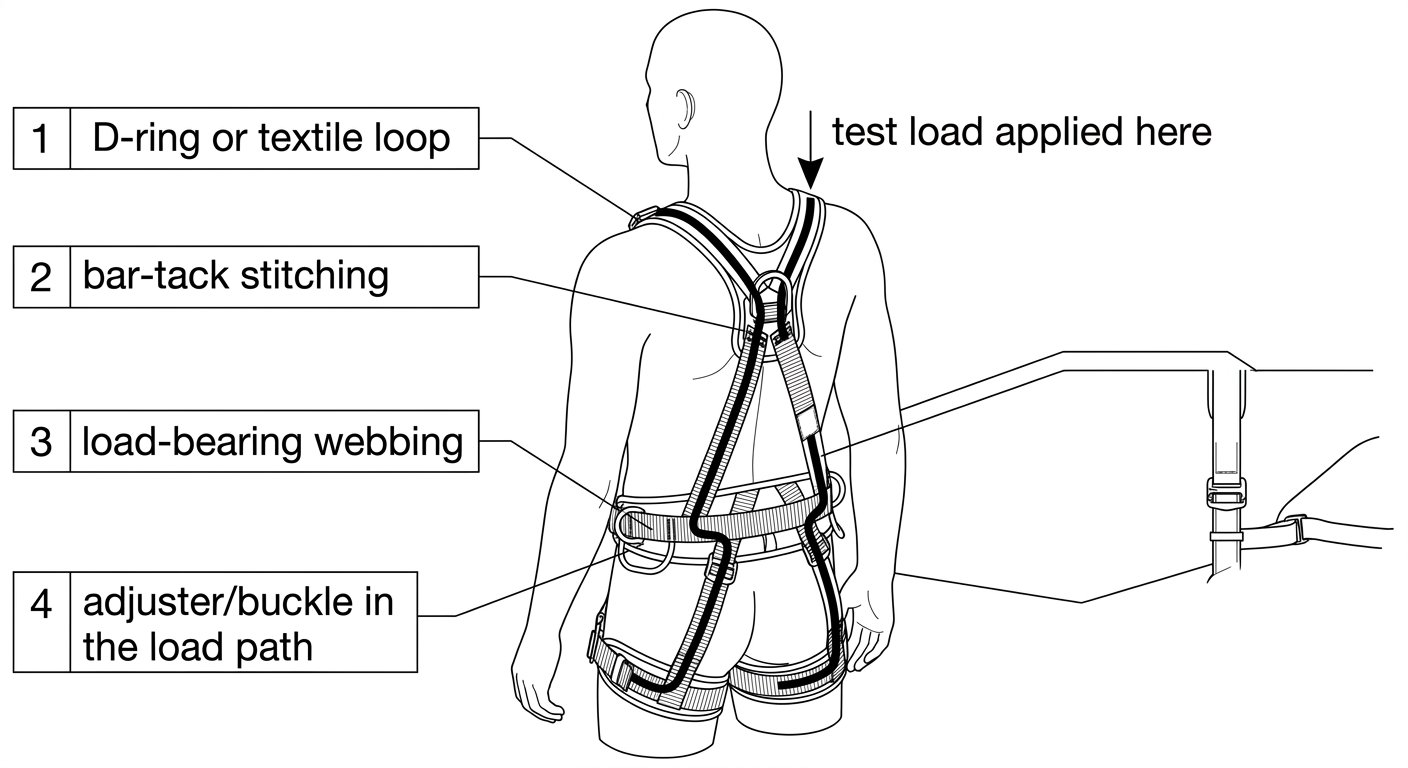
The strength rating covers the whole tested load path — ring, stitching, webbing and adjusters — not the D-ring alone.
The numbers behind the letters
European harness standards specify static strength tests, and for fall-arrest and rescue points, dynamic performance tests as well. The static values are pass/fail proof loads held for a defined period — commonly three minutes — not breaking strengths and not working load limits.
| Point type | Governing standard | Typical static test load | Permitted use |
|---|---|---|---|
| Dorsal and sternal fall-arrest points | EN 361 (full body harnesses) | Typically 15 kN for textile attachment elements and 10 kN for metallic ones, plus a dynamic drop test | Fall arrest |
| Lateral and rear belt points | EN 358 (work positioning and restraint belts) | Typically 15 kN static | Work positioning and restraint only — never fall arrest |
| Ventral point on a sit harness | EN 813 | Typically 15 kN static, with a marked maximum rated load | Suspension, rope access, work positioning |
| Rescue attachment points | EN 1497 (rescue harnesses) | Typically 15 kN static, plus a dynamic test | Raising, lowering and rescue of a person |
North American practice expresses the same idea in different units. OSHA’s fall protection requirements for construction (29 CFR 1926.502(d)(4)) state that D-rings and snaphooks shall have a minimum tensile strength of 5,000 pounds — 22.2 kN. ANSI/ASSP Z359.11 sets its own static and dynamic requirements for full body harness attachment elements. If you work to both regimes, check the harness markings rather than assuming one certification implies the other.
Why a 15 kN test value is not a 15 kN working load
Two things follow from the way these tests are constructed, and both are routinely misread:
- The figure is a minimum, not a rupture point. A harness that passes at 15 kN has not been shown to fail at 15.1 kN. Real breaking loads are usually higher, but the manufacturer does not publish them as a usable margin, and you should not treat them as one.
- The figure is not a load you may apply. The rating exists to give headroom above the forces a fall protection system is designed to generate — not to define an allowable suspended load. The human body is the limiting factor long before the hardware is: EN 355 energy absorbers are designed to keep arrest force on the worker at or below 6 kN, and OSHA limits maximum arresting force on a body harness to 1,800 lb (8 kN). The gap between roughly 6 kN of arrest force and a 15 kN proof load is the safety margin, and it is there to absorb the things you cannot control — a slightly off-axis load, an aged sling, a worker at the upper end of the rated mass carrying tools.
“A” and “A/2”: reading the marking correctly
Fall-arrest attachment points under EN 361 are marked with a capital A. Where a manufacturer splits a fall-arrest point into two halves that must be joined together — commonly two textile loops at the sternum that a single connector passes through — each half is marked A/2. The marking is an instruction, not a label:
- A point marked A may be used alone for fall arrest.
- Points marked A/2 must always be used together, with one connector capturing both. Clipping into a single A/2 loop is not a reduced-strength option; it is an out-of-certification configuration, and the load path through a single half was never tested.
Belt attachment points carry no A marking, and this is deliberate. Lateral points on a positioning belt are strength-rated but are certified only for work positioning and restraint. The same applies to a ventral point on a sit harness: it will hold a suspended worker comfortably, but it is not a certified fall-arrest element and using it as one places the load on the abdomen in a way the standard never tested.
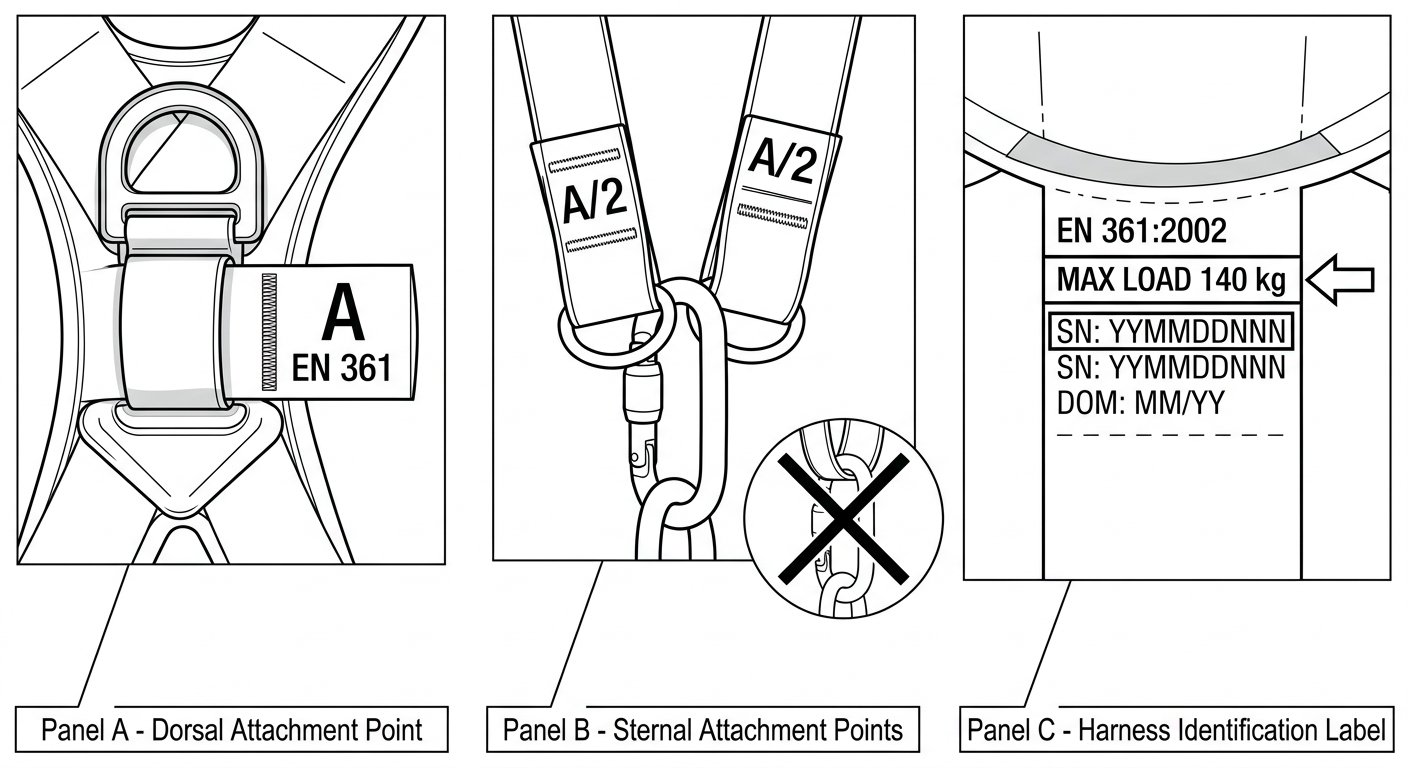
Markings are instructions: A may be used alone, A/2 loops must always be joined by a single connector.
Direction of loading is part of the rating
Every attachment point is rated in the direction it was tested. Load it another way and you are outside the certification, even if the magnitude is modest.
- Dorsal (rear) point: rated for an essentially axial pull along the line of the spine. It positions the worker head-up after arrest and keeps the connector away from the face and hands. It is the default fall-arrest point for most work at height.
- Sternal (chest) point: rated for a frontal pull, generally where the anchor is above and the fall distance is short — ladder climbing systems, guided type fall arresters, some rope access setups. Selection between sternal and dorsal for a moving rope grab is a decision in its own right; see the note on choosing a harness attachment point for a rope grab.
- Ventral (low front) point: rated for suspension in the seated position. Loads run downward from the point; it is not intended to take a shock load from above through an unabsorbed lanyard.
- Lateral belt points: rated as a pair, loaded roughly horizontally, with a positioning lanyard passing from one to the other around the structure. A single lateral point loaded alone puts a torsion into the belt that its test never reproduced.
- Rear belt (restraint) point: rated only to hold a worker back from an edge. There is no fall to arrest, and if there is, the point is the wrong one.
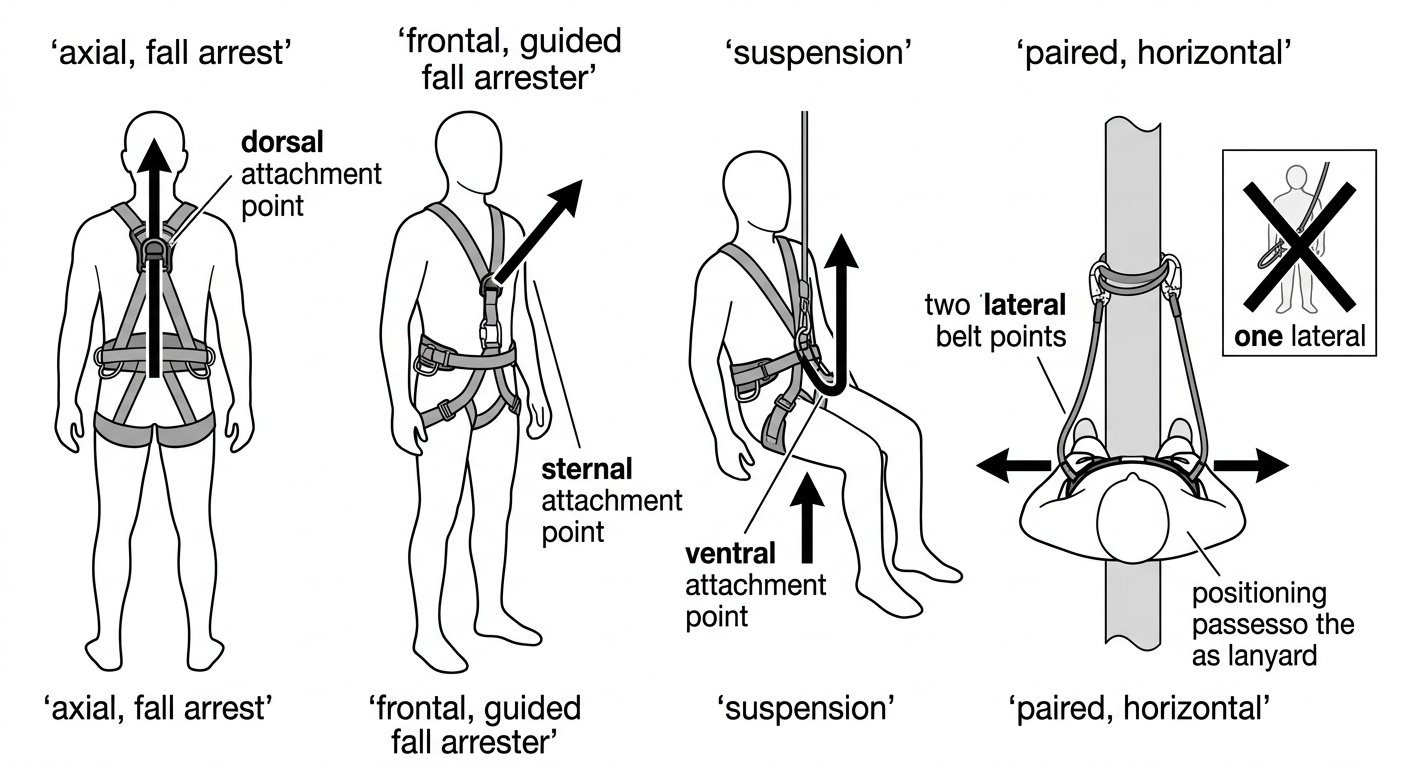
Each point is certified in the direction it was tested; lateral belt points are rated only as a loaded pair.
The maximum rated load: the person plus everything on them
Older harness certification testing was built around a 100 kg reference mass. Many current harnesses are marked with a higher maximum rated load — often somewhere between 100 and 150 kg depending on the model — and that figure is the total system mass: the worker, clothing, boots, harness, tools, rescue kit and anything carried on the back or in a bag hung from the harness.
This matters most in rope access and confined space work, where a technician may be carrying a descender, a backup device, a rope bag, a drill and a rescue kit. Check the marked maximum rated load on the harness label and on the energy absorber, since the two may differ; the lower of the two governs. Where a rescue plan involves a rescuer descending with a casualty, the combined mass frequently exceeds the rating of equipment chosen for single-person use.
Rated points versus everything else on the harness
Modern harnesses carry a lot of hardware that is not load-bearing. The commonest serious error in this topic is clipping a lifeline into something that was never intended to hold a person.
- Gear loops are for carrying equipment. They are typically marked with a maximum load of a few kilograms and are usually made of plastic or light webbing that will fail well below any fall load.
- Tool holders and retractor attachment tabs are similarly rated for tool mass only.
- Haul loops on the rear of some harnesses are intended for hauling a rope or bag up to the worker, not for attaching to an anchor or a lanyard. Some are rated, but for a stated equipment load only.
- Shoulder strap adjusters, webbing keepers and elastic retainers are structural to fit, not to load.
The reliable rule: if the point is not stamped, labelled or identified in the manufacturer’s instructions as an attachment point with a stated standard, it is not one. Colour coding helps on many harnesses — load-bearing points are often marked in a contrasting colour — but colour is a convenience, not a certification. Read the marking.
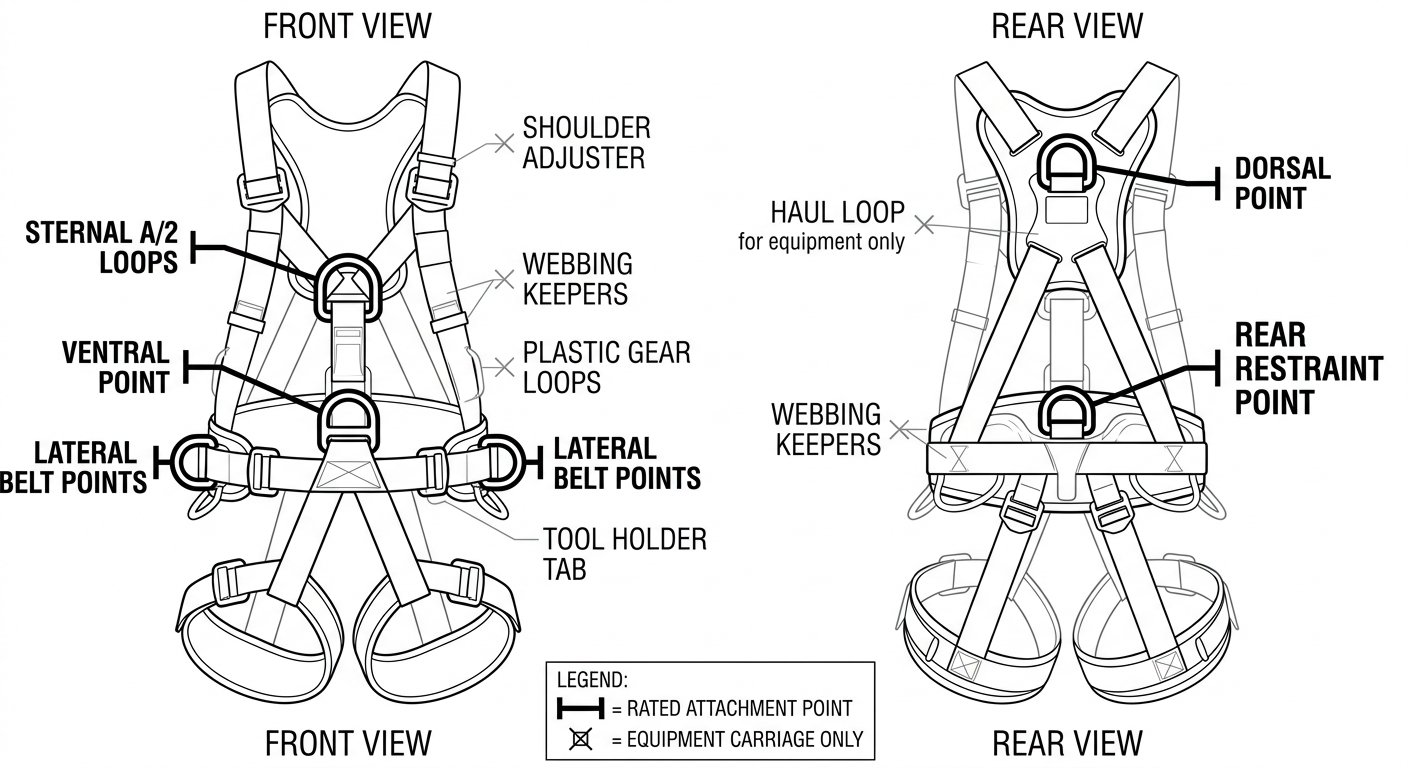
Gear loops, tool tabs and haul loops carry equipment mass only and are never attachment points.
The connector completes the chain
An attachment point rated to 15 kN gives you nothing if the connector clipped into it is loaded across its minor axis or held with the gate open. Connectors certified to EN 362 (connectors for fall protection) carry markings for their major-axis, minor-axis and gate-open strengths, and the minor-axis and gate-open figures are typically a fraction of the major-axis value. Two practical consequences:
- Check the geometry of the fit. A connector that cannot sit straight in the attachment point — because the D-ring is too wide, the textile loop too bulky, or the point is captured on the wrong axis — will be loaded off-axis under fall load. Where a harness point is a soft textile loop, a connector with a captive bar or a shape that keeps the loop at the spine of the connector is usually the correct choice.
- Do not stack connectors. A connector clipped into a connector clipped into the attachment point creates unpredictable loading angles and levering across gates. Use one connector per point unless the manufacturer’s instructions describe otherwise.
Ratings apply to undamaged equipment
Every figure discussed above describes a harness in as-new condition. In service, the rated load path is degraded by cuts and abrasion in the webbing, broken or pulled stitching at bar-tacks, deformation, scoring or corrosion of metal rings, chemical contamination, heat damage and UV exposure. None of these has a published strength reduction you can calculate against, which is why the response is binary: a fall-arrest point whose load path is damaged is withdrawn from service, not derated.
Practical inspection points specific to attachment strength:
- Flex each attachment loop and the webbing immediately either side of it, checking for internal fibre damage and for stiffness that suggests heat or chemical exposure.
- Look at every bar-tack around the attachment element for pulled, cut or abraded thread.
- Check metal D-rings for a flat face, free rotation where designed to rotate, and no scoring at the point where the connector bears.
- Confirm the markings are still legible. An attachment point whose A or A/2 marking has worn away cannot be verified as the point you think it is.
Field summary
- The rating is a tested load path — ring, stitching and webbing together — not a component figure.
- Static test values such as 15 kN are proof loads with a built-in margin above realistic arrest forces, not working load limits.
- Only points marked A (or a joined pair marked A/2) are certified for fall arrest.
- Belt and ventral points are rated, but for positioning and suspension only.
- Load each point in the direction it was tested; lateral belt points work only as a pair.
- The maximum rated load includes tools, kit and everything else on the worker.
- Gear loops, tool holders and haul loops are not attachment points.
- Damage to the load path removes the rating entirely.
For related technique notes on harness selection, fit and connector loading, see the full set of rope access and confined space technique notes, and confirm any specific figure against the manufacturer’s instructions supplied with your harness.
Frequently asked questions
Does a 15 kN static test value mean I can hang 15 kN on the attachment point?
No. The static test value is a pass/fail proof load applied under laboratory conditions, not a working load limit and not a breaking strength. It exists to provide margin above the forces a properly configured fall protection system can generate — energy absorbers to EN 355 are designed to keep arrest force on the worker at or below 6 kN. The human body, not the hardware, is the limiting factor.
What is the difference between an attachment point marked A and one marked A/2?
A point marked A is a complete fall-arrest attachment element and may be used on its own. Points marked A/2 are two halves of a single fall-arrest point and must always be used together, with one connector passing through both. Using a single A/2 loop is outside the harness certification because that load path was never tested in isolation.
Can I use the lateral D-rings on my positioning belt for fall arrest?
No. Lateral belt attachment points certified under EN 358 are strength-rated but are approved only for work positioning and restraint, where the worker is supported and no free fall is possible. They are designed to be loaded as a pair, roughly horizontally, with a positioning lanyard passing around the structure. Fall arrest requires a point marked A on a harness certified to EN 361.
Is a ventral attachment point on a sit harness strong enough for fall arrest?
Strength is not the issue — the certification and the loading of the body are. A ventral point under EN 813 is designed for suspension and work positioning in the seated position, not for arresting a fall, and using it that way loads the abdomen in a manner the standard does not test. Fall arrest should be taken on a sternal or dorsal point marked A.
What does the maximum rated load on a harness label include?
It is the total mass of the worker plus everything carried: clothing, boots, the harness itself, hardware, tools, rope bags and any rescue kit. Check the figure marked on the harness and on any energy absorber in the system, since they may differ — the lower of the two governs. Combined rescuer-and-casualty loads frequently exceed ratings chosen for single-person use.
Can a damaged attachment point still be used at a reduced load?
No. There is no published derating for cut webbing, pulled bar-tack stitching, chemical or heat damage, or a scored or deformed D-ring, because the residual strength of a damaged load path cannot be estimated in the field. The response is binary: withdraw the harness from service. An attachment point whose A or A/2 marking has worn away illegible also cannot be verified and should be treated the same way.