
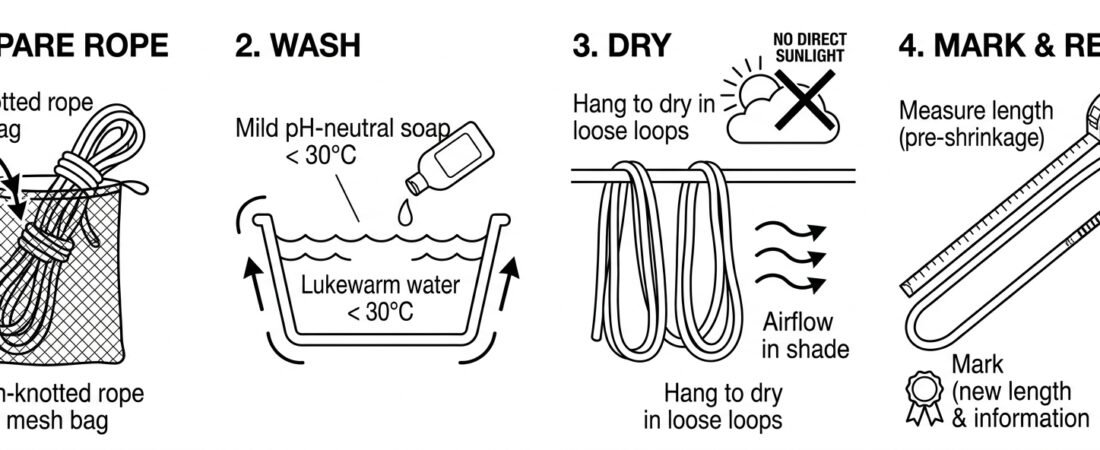
A new low-stretch (semi-static) kernmantle rope does not arrive in the state it will spend the rest of its working life in. It carries residual processing lubricants and fibre dust from spinning and braiding, its sheath is slick, and its length is not yet stable: the first thorough wetting shrinks it. Washing the rope before it goes into service deals with all three at once, and — critically — it means the rope gets measured, cut and marked at the length it will actually hold, not the length it happened to have on the reel.
This note covers why a first wash is worth doing, how to do it without damaging the rope, and what has to be re-checked and re-recorded afterwards. As always, the rope manufacturer’s own instructions for use take precedence over any general procedure; some notices specify a maximum wash temperature, a permitted detergent type, or explicitly address shrinkage figures for that product.
Why wash a rope that has never been used
- It removes manufacturing residues. Fibre dust and processing oils left on and in the sheath make a new rope feel slippery and can affect how much friction it generates in a descender or how positively a toothed cam bites. Washing removes the loose surface material.
- It stabilises the length. Polyamide sheath and core shrink when first soaked and dried. The rope that comes off the reel at a nominal length will be measurably shorter after its first wetting — whether that wetting happens in a wash tub or unplanned, in rain, halfway down a shaft.
- It gives the rope a known starting point. A pre-washed, dried, measured and end-marked rope enters the equipment log with a real length and a real first-inspection record, rather than a figure copied off the packaging.
- It normalises device behaviour. New rope typically runs faster through a descender and can allow more slip in a rope grab than the same rope will after a few sessions of use. Washing moves the rope closer to its settled condition. This is the same set of effects covered in more detail in our note on the performance of new versus used ropes: slip, stretch, diameter and friction.
Washing is not a substitute for anything. It does not repair a damaged rope, does not remove chemical contamination that has already attacked the fibres, and does not extend a rope’s service life beyond what the manufacturer states.
Preparing the rope: chain it before it goes anywhere near water
A loose 100 m or 200 m rope in a wash tub or drum turns into a single knotted mass. Two preparation steps prevent that:
- Chain-knot (daisy-chain) the full length. Starting from one end, form a series of interlocking loops so the rope becomes a short, compact, self-contained chain that can be pulled apart in seconds afterwards. This keeps the length from tangling and keeps water and detergent circulating through it.
- Put the chained rope in a mesh laundry bag if a machine is being used. The bag protects the sheath from the drum and from any exposed metal, and stops the chain from working loose.
Wash the rope on its own. Nothing else goes in the load — no work clothing, no harnesses, no grit-carrying kit that could grind abrasive particles into the sheath.
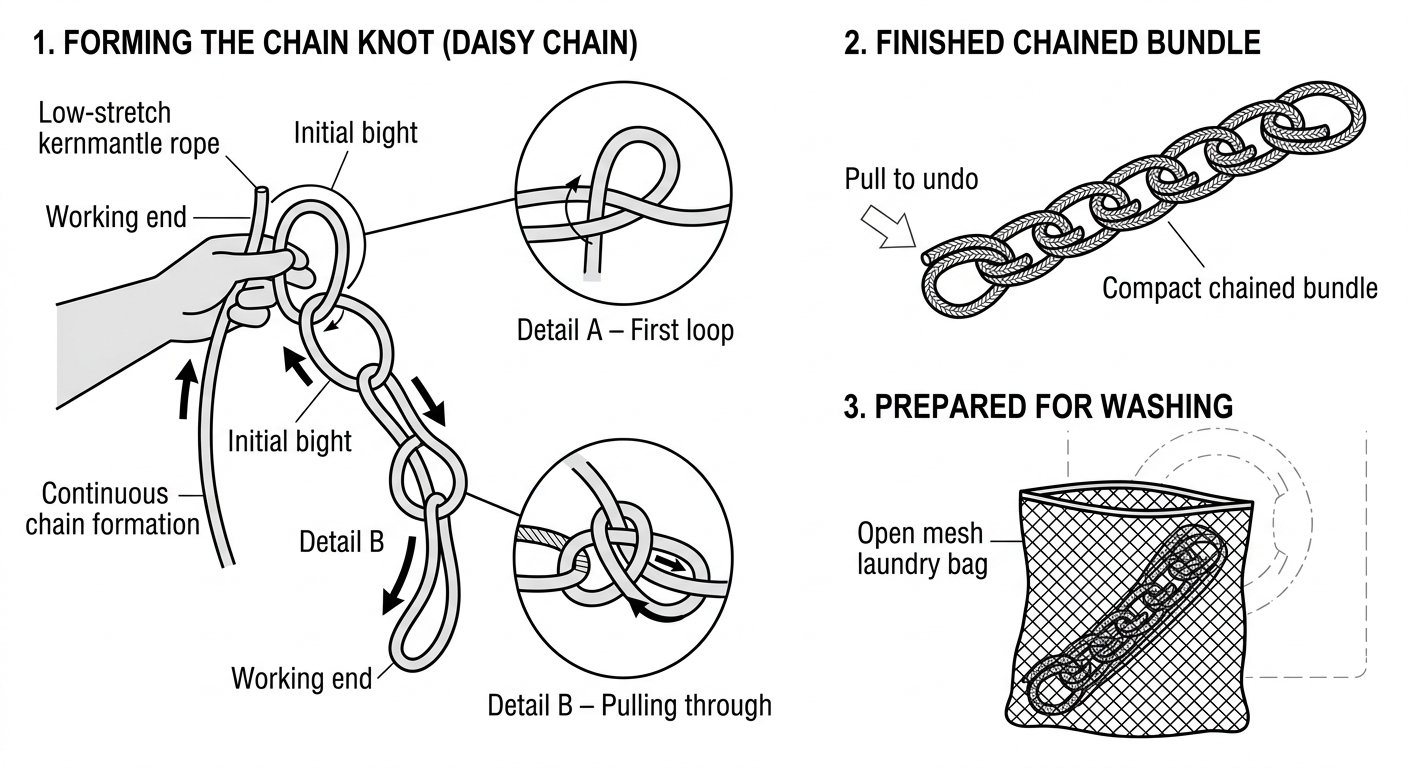
Chain-knotting the full length and bagging it keeps the rope from tangling while still letting water and detergent circulate.
Water, temperature and detergent
Use clean, lukewarm water. Most manufacturers of low-stretch rope specify a modest maximum wash temperature — commonly in the region of 30 °C — and the specific figure is printed in the product notice; treat that as the ceiling rather than a target. Hot water offers no benefit here and risks affecting the fibres and any sheath treatment.
Detergent choice is simple:
- Use a mild, pH-neutral soap, or a detergent specifically sold for washing ropes and technical textiles. Use it sparingly.
- Do not use bleach or any chlorine-based product, solvents, degreasers, acids, or strong household cleaners. Polyamide is vulnerable to acids and to oxidising agents, and the damage is not always visible in the sheath.
- Do not use fabric softener or any conditioning additive. Softeners leave a residue on the sheath that is exactly the opposite of what a first wash is meant to achieve.
- Do not pressure-wash the rope and do not scrub it with a stiff wire brush. A soft brush on localised dirty patches is fine; driving grit into the sheath is not.
Hand washing in a clean tub is entirely adequate: soak, agitate the chained rope by hand, then rinse. If a machine is used, choose a front-loading machine with no central agitator, a gentle or delicate programme, and the lowest available spin — or no spin at all.
Rinse thoroughly. Detergent left in the rope keeps working on the fibres and can leave the rope feeling waxy or stiff. Rinse in clean water until the water runs clear and no foam appears when the rope is squeezed.
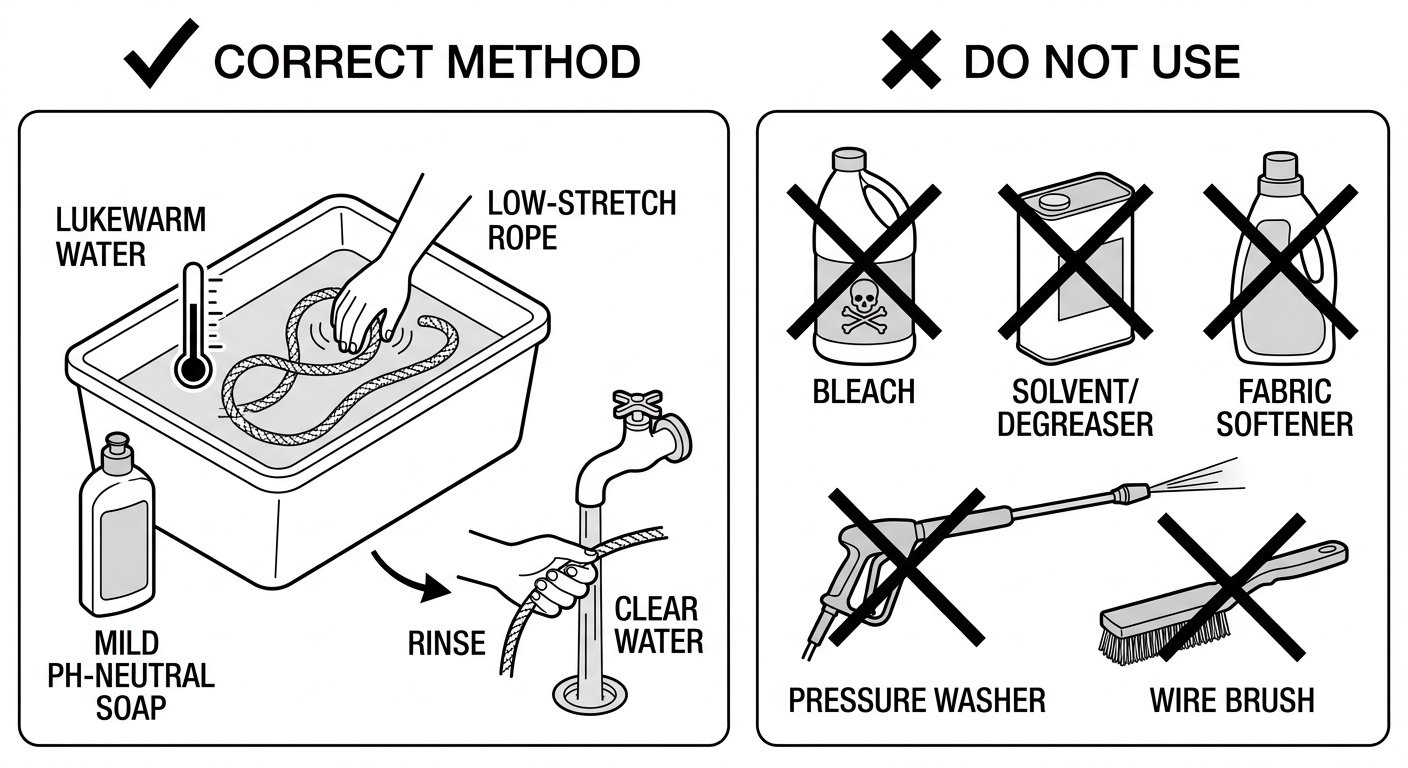
Lukewarm water and a mild pH-neutral soap, thoroughly rinsed; bleach, solvents, softeners and pressure washing all damage or contaminate the rope.
Drying
Drying is where ropes are most often damaged after a perfectly good wash. The rules are short:
- Dry in a shaded, ventilated space, out of direct sunlight. UV degrades polyamide.
- Keep the rope away from any heat source: no radiators, no hot-air blowers, no drying rooms running above ambient, no tumble dryers, no vehicle engine bays.
- Hang the rope in large, loose loops over a clean, smooth, wide support, or lay it out in loose loops on a clean surface. Avoid tight loops and avoid resting the rope over thin edges, which concentrate load on damp fibres.
- Turn or re-hang the rope during drying so the inner loops dry as well as the outer ones.
- Allow days, not hours. A large-diameter rope holds a lot of water in the core, and a rope that feels dry to the hand can still be damp inside.
Do not load or use the rope while it is wet or damp. Wet polyamide is temporarily weaker and behaves differently under load — it stretches more and runs differently through devices — and it recovers as it dries. A rope stored damp also risks mould on the sheath and, in freezing conditions, becomes stiff and unusable.
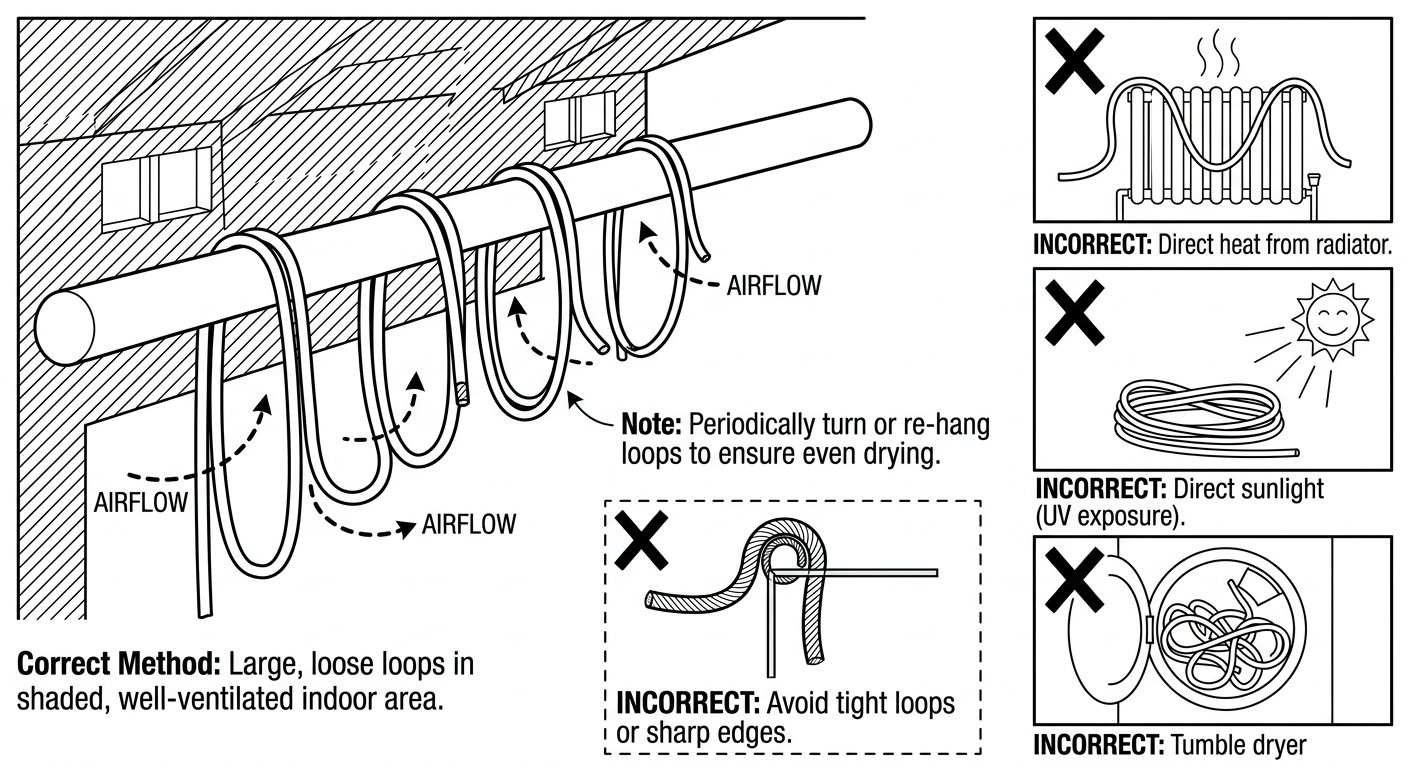
Dry in large loose loops, shaded and ventilated; heat sources, direct sun and tumble dryers all damage polyamide.
After drying: measure, mark, inspect, record
This is the part that makes the whole exercise worthwhile.
- Measure the actual length. Run the dried rope out and measure it properly. Expect it to be shorter than its nominal length — first-wash shrinkage is generally on the order of a few percent, and it varies by construction and manufacturer. On a long rope, that difference is metres, not centimetres, and “the rope is 5 m shorter than I planned” is not a discovery to make at the bottom of a rope-access drop.
- Cut to working length now, not before. If a rope is being cut into working lengths from a reel, cut after washing and drying. Seal the cut ends by the method the manufacturer specifies or accepts.
- Re-mark the ends. Apply or update end markings with the identification and length the rope now actually has, using only marking products the manufacturer permits. Do not overwrite or obscure the manufacturer’s own marking.
- Carry out and record the first inspection. Pass the whole rope hand-over-hand, feeling for flat spots, core inconsistencies, sheath damage from the wash process, and any glazing. A pre-service rope should be uniform end to end; this pass establishes the baseline the rope will be compared against later.
- Enter it in the equipment log with date of first wash, measured length, identification, and date placed into service.
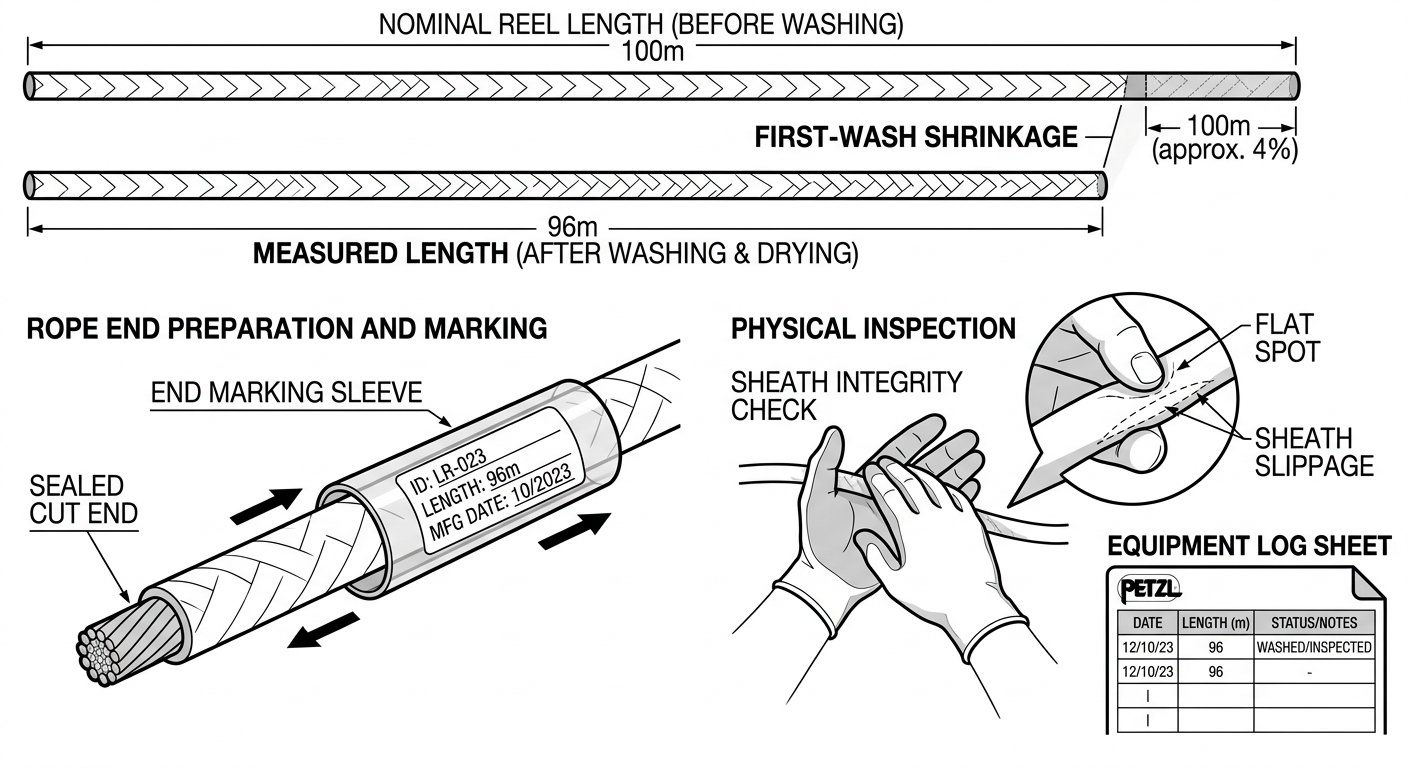
Measure, cut, mark and inspect after drying, then log the rope with the length it actually has.
Check device compatibility once, with the washed rope
Because washing and drying change how the rope feels and can slightly change its measured diameter and its friction characteristics, function checks are worth repeating on the washed rope rather than relying on impressions formed with it new. Confirm that the rope still sits comfortably within the marked diameter range of every device it will be used with — this is exactly the issue discussed in rope diameter limits on descenders — and run a short, backed-up function test of the descender and of each rope adjustment device.
Rope adjustment devices covered by EN 12841 are certified against stated rope types and diameter ranges, and their grip and travel behaviour depend on the condition of the sheath they are working on. If the plan involves a specific rope choice for particular devices and wear conditions, the reasoning is set out in our note on choosing a low-stretch rope diameter.
Practical takeaway
Wash a new low-stretch rope, on its own, chain-knotted, in lukewarm water with a mild pH-neutral soap and no additives; rinse it until the water is clear; dry it slowly in loose loops in the shade away from any heat source; then measure it, cut and mark it, inspect it hand-over-hand, and log it. The rope that goes into service afterwards has a known length, a stable diameter, a clean sheath and a documented starting condition — which is the whole point.
Related technique notes in this series are collected on the rope access and confined space hub.
Frequently asked questions
Is washing a new low-stretch rope actually necessary?
It is not universally required, and manufacturers differ on how strongly they recommend it. It is, however, useful: it removes manufacturing residues and fibre dust, brings the rope closer to its settled handling and friction characteristics, and stabilises its length before the rope is cut, marked and logged. Check the product notice for the manufacturer’s own position and wash instructions.
How much does a low-stretch rope shrink after its first wash?
Shrinkage is generally on the order of a few percent and varies with construction and manufacturer, so the only reliable figure is the one you measure. On a long rope that can amount to several metres. Measure the dried rope and cut, mark and record it at that measured length rather than the nominal length on the packaging.
Can a rope be washed in a domestic washing machine?
Yes, if it is done carefully: chain-knot the rope, place it in a mesh bag, wash it alone in a front-loading machine with no central agitator, use a gentle programme at a low temperature within the manufacturer’s stated limit, use only a mild pH-neutral soap, and select the lowest spin or none. Never add bleach or fabric softener.
What should never be used to clean a rope?
Avoid bleach and other chlorine-based products, solvents, degreasers, acids, strong household cleaners and fabric softeners. Polyamide is vulnerable to acids and oxidising agents, and the resulting damage is not always visible on the sheath. High-pressure washing and stiff wire brushing also drive grit into the sheath and abrade the fibres.
How long does a washed rope take to dry, and can it be used damp?
Allow days rather than hours, especially for long or larger-diameter ropes, since the core holds water even when the sheath feels dry. Do not load a wet or damp rope: wet polyamide is temporarily weaker, stretches more and runs differently through devices, recovering as it dries. Storing a damp rope also risks mould on the sheath.
Does washing change how the rope works in descenders and rope grabs?
It can. Removing surface residues typically makes a new rope less slippery, and washing and drying can slightly change measured diameter and sheath feel. Confirm the washed rope is still within the marked diameter range of every device it will be used with, and repeat short, backed-up function checks on the descender and each rope adjustment device.