
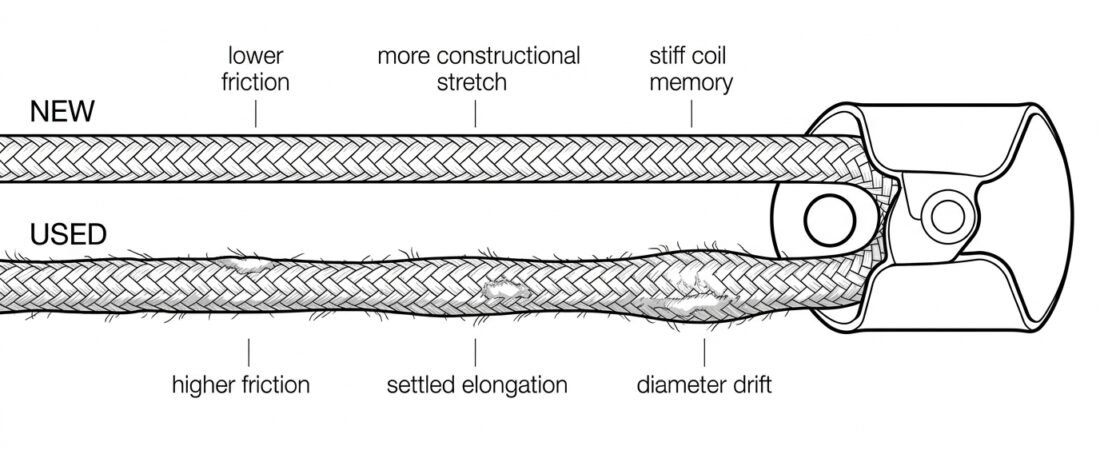
A rope that has been in service for a season does not behave like the one that came out of the bag last week, and the difference shows up in the places that matter most: how fast a descender runs, how far the rope stretches before the load is taken, whether a rope grab bites cleanly, and whether the diameter still sits inside the range marked on the device. None of this is a defect. Low-stretch kernmantle rope changes predictably with use, and a rope access technician who knows which way each property drifts can set friction, choose devices and plan clearances accordingly instead of being surprised on the first descent.
This note covers what actually changes between a new and a used low-stretch rope (typically EN 1891 Type A rope in rope access and confined space work), how each change affects device behaviour, and what to do about it on site.
Three things change with use, and they do not change together
It helps to separate the properties, because they drift in different directions and on different timescales:
- Surface condition. A new sheath is smooth, tightly woven and often still carries residual manufacturing lubricant and sizing. With use it becomes fuzzy, and locally it can become glazed and hardened from heat.
- Geometry. Diameter is not fixed. Fuzz and sheath fibre bloom can make a rope measure slightly larger; repeated loading and cyclic tensioning compact the core and can make it measure slightly smaller. Both happen on the same rope, in different places.
- Mechanical behaviour. Constructional stretch is used up early in a rope’s life. Residual strength decreases gradually with abrasion, sustained and repeated loading, contamination and UV exposure — usually well before any of it is visible from the outside.
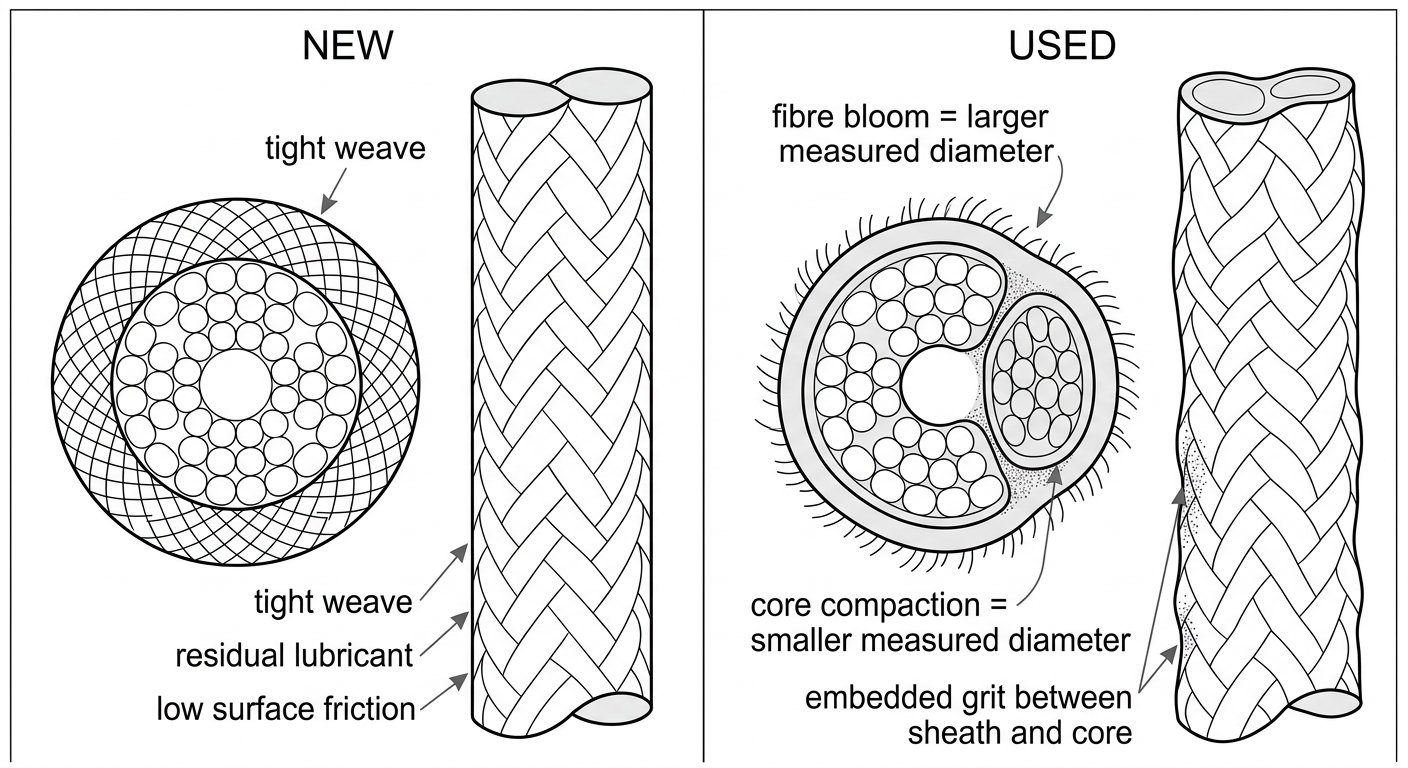
New and used low-stretch rope in cross-section: sheath weave, core compaction and embedded grit all change the rope’s effective diameter and friction.
Why a new rope descends faster
The most common field surprise is a descender that runs noticeably faster and grips less on a brand-new rope. The cause is straightforward: a new sheath has a lower coefficient of friction. The weave is tight and regular, the fibres lie flat, and any manufacturing lubricant left on the rope reduces friction further at the rope–device interface. Descent control devices dissipate energy through friction between rope and metal, so a slicker rope means less braking for the same hand force and the same device setting.
The practical consequences:
- Add friction before you need it, not after. Use the device’s high-friction configuration, an additional friction carabiner or a redirect where the device design provides for it — set up as the manufacturer specifies for the device in question.
- Test the rope before committing to a long descent. Load the system in a position where you can still stand, take your weight on the descender, and feel the braking response over a short, controlled slip. That test tells you more about this rope on this device than any general rule.
- Expect the difference to be largest on the first few uses, and largest for light users on smaller-diameter ropes. It shrinks as the sheath breaks in.
The same slickness works against rope grabs and rope adjustment devices as well: cam-based devices bite on a compliant, textured sheath, and a hard, slick, new sheath gives a device less to work with. Devices certified as rope adjustment devices under EN 12841 are type-tested with specified ropes, which is another reason the manufacturer’s stated compatible rope types are not a suggestion.
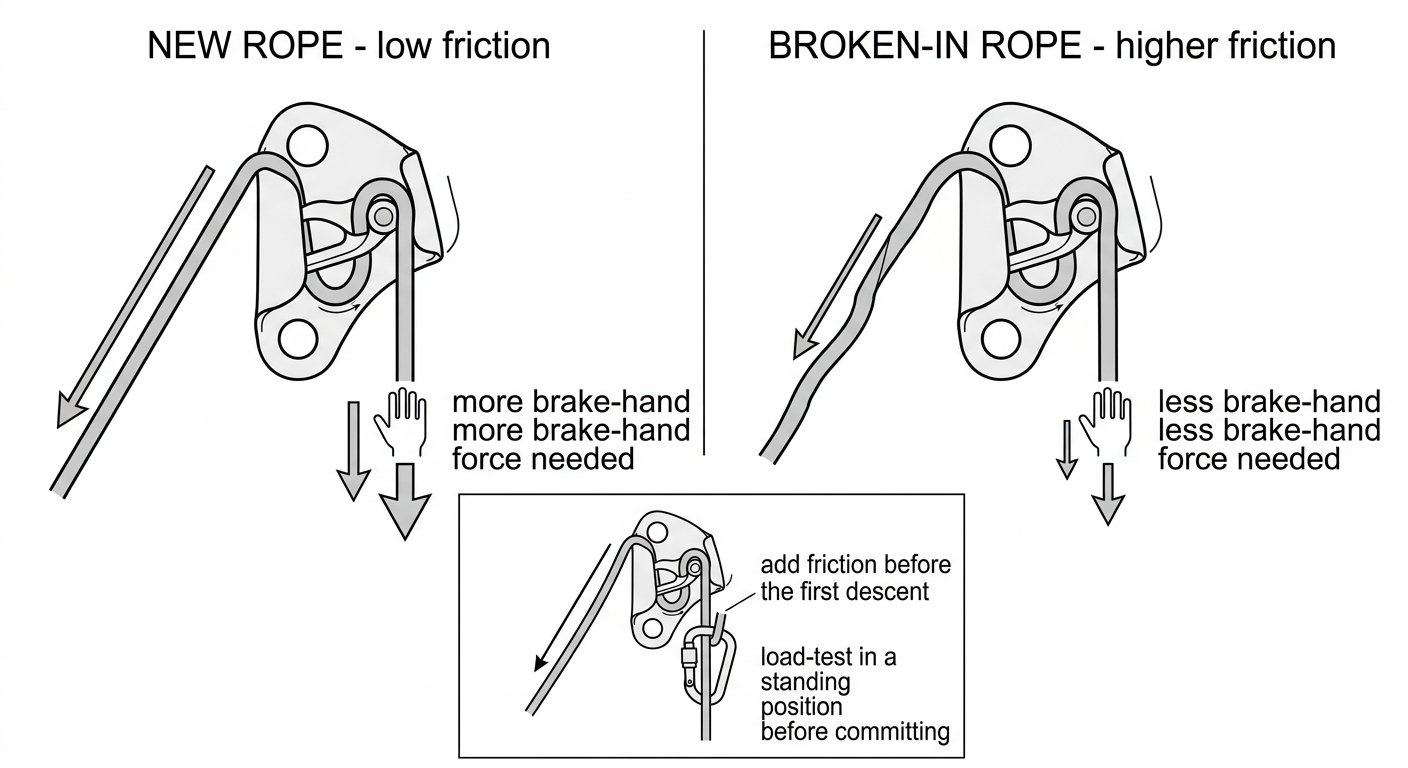
A new sheath gives a descender less friction to work with; set the device in its higher-friction configuration and test before committing to the descent.
Constructional stretch: the elongation a new rope gives away once
New kernmantle rope contains a certain amount of constructional stretch — elongation that comes from the braid and core bundles bedding down under load rather than from the fibres themselves stretching. It is largely a one-time effect. A new rope, first loaded, will settle more than the same rope after a dozen working days.
What that means in practice:
- Standing height and rope stretch at the anchor. On a long working line, a new rope may let you settle further than expected before the system takes your full weight. Allow for that when rigging near a floor, a landing or an obstruction.
- Rope lengths change. A new rope typically shortens slightly in overall relaxed length after break-in as it recovers and the sheath stabilises, while under load it settles further than a used one. Re-check working lengths on a new rope rather than trusting the label metres.
- Knots tighten differently. Terminations in new, stiff, slick rope need to be dressed and set deliberately; they will bed in further under the first real load.
Low-stretch rope standards set limits on static elongation between defined test loads, which is what keeps this behaviour within a narrow band rather than leaving it to chance — but the limit is an upper bound, not a promise that two ropes will feel the same.
Diameter drift and the marked range on the device
Every descender and rope grab has a marked rope diameter range, and it applies to the rope as it is, not as it was when new. Used ropes drift in both directions:
- Larger effective diameter where the sheath has bloomed, fuzzed or swollen — often in the sections that ran through devices or over edges most.
- Smaller effective diameter where core and sheath have compacted under repeated loading, or where the rope has been held under sustained tension.
- Local hard spots and flat spots at points that saw heat, edge loading or a fall arrest event.
A rope that measures slightly over range feeds stiffly and can jam in a device; a rope that measures under range slips more and gives less braking. Both matter — see the discussion of rope diameter limits on descenders and why the marked range matters, and the broader trade-offs in choosing a low-stretch rope diameter. The same principle extends to pulleys, where sheave fit and rope condition determine whether the rope tracks or binds.
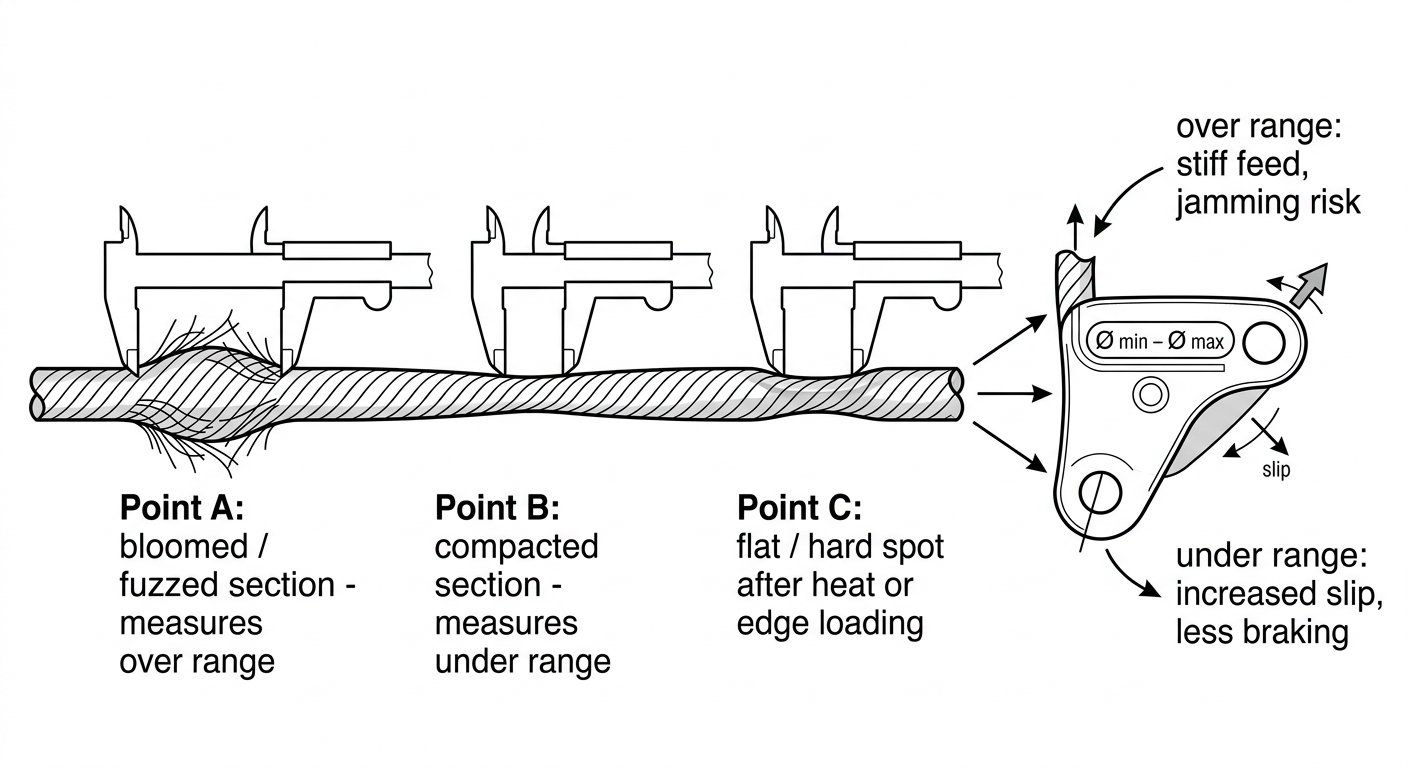
Diameter drifts in both directions along a used rope; check it against the marked range on every device in the system.
Surface condition: fuzz, glazing and embedded grit
Not all wear is equal, and the difference is worth being able to read by hand and eye.
General fuzz — a soft, even nap over long sections — is normal service wear. It usually increases friction (more braking, stiffer feed) without indicating that the sheath has lost integrity. A rope that has settled into an evenly fuzzed state is often the most predictable rope in the bag.
Glazing — a shiny, hard, slightly melted-looking patch, sometimes with a stiff feel — is heat damage from a fast descent or a slipping device. It is localised and it matters: glazed fibre has been degraded, and the patch changes both diameter and friction abruptly as it passes through a device.
Embedded grit is the quiet one. Sand, concrete dust and metal swarf work into the sheath and abrade the rope from inside every time it flexes or runs through a device. This is why a rope used in a dusty confined space ages faster than its visible condition suggests, and why washing rope in clean water (following the manufacturer’s instructions, then drying out of direct sunlight, away from heat sources) is maintenance rather than cosmetics.
Sheath slippage and core damage are inspection findings, not performance quirks. If the sheath moves relative to the core, if you can feel a soft spot, void, lump or step change when the rope is flexed through your hands, or if the core is visible, the rope comes out of service.
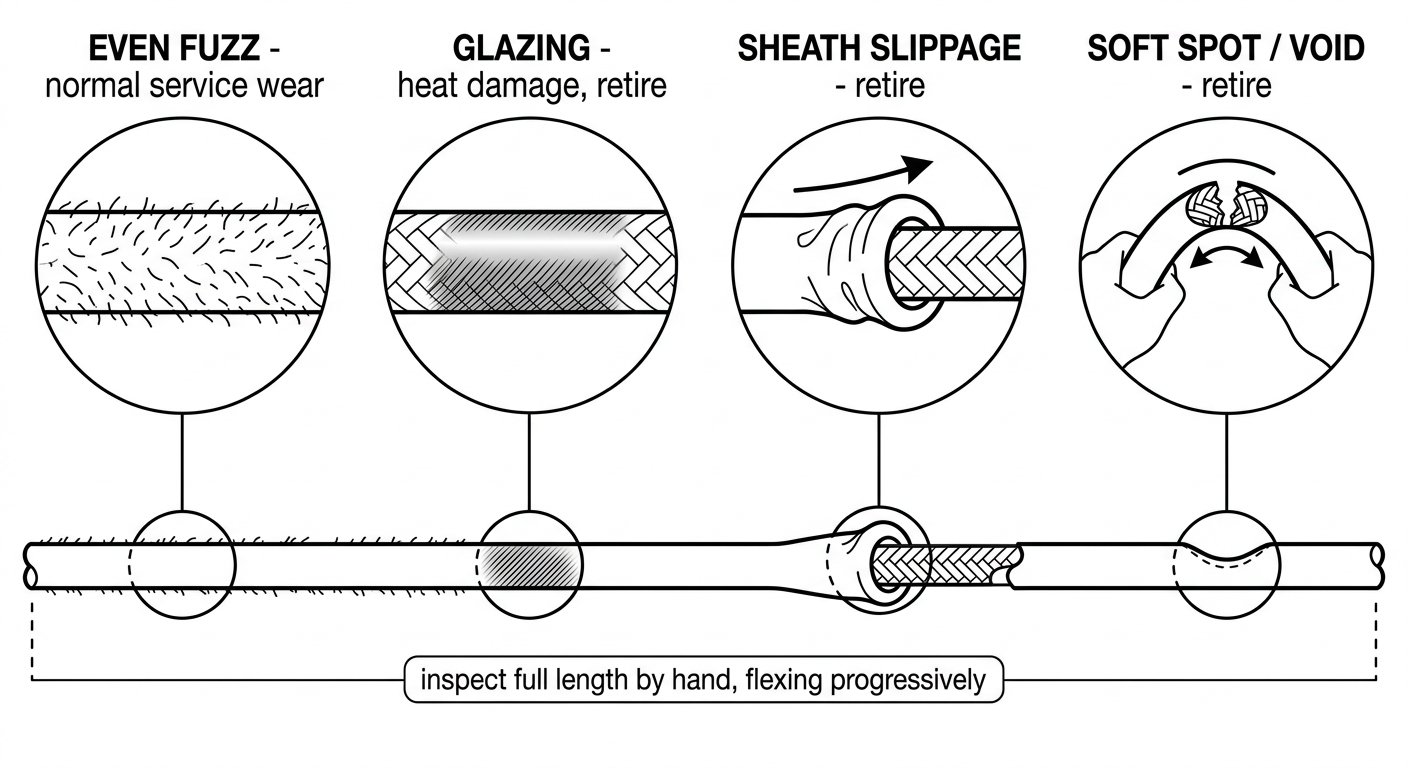
Reading surface condition by hand: even fuzz is service wear, while glazing, sheath slippage and soft spots are retirement findings.
Where a used rope performs better than a new one
Used rope is not simply degraded rope. Within its service life, a broken-in rope offers real advantages:
- More predictable descender friction, because the sheath has stabilised and the lubricant is gone.
- Better cam bite for rope grabs and adjustment devices on a slightly textured sheath.
- Less settling under load, so working positions hold where you set them.
- Better handling — it is more supple, knots dress more easily and it feeds through bags and edge protection without the coil memory of a new rope.
The corresponding trade-off is reduced residual strength, less remaining energy absorption and less tolerance for a shock event. That is a reason to keep older ropes for the applications where loads and consequences are best controlled, and to reserve the freshest rope for the work that could see the highest dynamic loading.
Mixing new and used rope in the same system
Rope access typically runs a working line and a backup line. If one is new and one is well used, they do not stretch by the same amount under the same load. Practical implications:
- On a two-rope descent, the backup device may sit at a different height relative to the harness than expected, and slack may distribute unevenly as you move.
- In any arrangement intended to share load between two lines, unequal stretch means unequal sharing — the stiffer, more used rope takes load first.
- Descender and backup device feel will differ between the two lines. Know which is which before you go over the edge, and set friction for the rope actually in the descender.
Pairing ropes of similar age and service history in a single system removes a variable, which is the general principle behind matching components across the rest of the chain as well — from harness attachment points through to the connector chosen for the descender.
Handling a rope on its first working day
A short, deliberate routine converts “new rope surprises” into known quantities:
- Uncoil and flake the rope fully before rigging, so twist and coil memory come out rather than showing up mid-descent.
- Mark and log the rope: identification, date of first use, length. Performance history is meaningless without a rope that can be identified.
- Measure the diameter and check it against the marked range on the descender, backup device and any rope grab in use.
- Set the descender in its higher-friction configuration for the first descents, and load-test in a safe position before committing.
- Note the length under load on the first rigging, and adjust working lengths on the basis of what the rope actually does.
When the performance change becomes a retirement decision
Rope is retired on inspection findings and service history, following the manufacturer’s instructions and the recorded results of periodic examination — not on gut feel about how it descends. The findings that end a rope’s service life are the familiar ones: core visible, sheath slippage, soft or hard spots on flexing, glazing or melting, chemical contamination, severe or localised abrasion, exposure to a significant fall or shock load, exceeding the manufacturer’s stated service or storage life, or any doubt about the rope’s history.
What performance change does give you is early warning. A rope that suddenly feels faster, stiffer, lumpier or noisier through a device than it did last week has changed for a reason, and that reason deserves a hands-on inspection over its full length before the next use.
Takeaway
Treat a new rope as slick and stretchy, a broken-in rope as predictable, and a heavily used rope as a rope with a shorter margin. Measure diameter against the devices you are actually using, add friction before the first descent on new rope, avoid mixing very new and very used lines in the same two-rope system, and keep a rope log so that “how does this rope perform” has an answer other than a guess. For related technique notes on matching rope, devices and connectors, see the rope access and confined space technique notes.
Frequently asked questions
Why does my descender run faster on a brand-new rope?
A new sheath is tightly woven, smooth and often still carries residual manufacturing lubricant, so there is less friction between rope and device. Less friction means less braking for the same device setting and hand force. Use the descender’s higher-friction configuration, add friction as the manufacturer allows, and load-test the system in a safe standing position before starting the descent.
Is a fuzzy rope worn out?
Not necessarily. An even, soft nap over long sections is normal service wear and often makes descender behaviour more predictable. What ends a rope’s service life is localised damage: glazing or melting, sheath slippage, visible core, soft or hard spots felt when flexing the rope, chemical contamination or severe local abrasion. Inspect the full length by hand and follow the manufacturer’s retirement criteria.
Does a used rope still fit inside my descender’s marked diameter range?
It has to be checked, because diameter drifts with use in both directions. Sheath bloom and fuzz can make sections measure larger, while repeated loading and core compaction can make other sections measure smaller. Over-range rope feeds stiffly and can jam; under-range rope slips more and brakes less, so measure the rope you are actually using against the range marked on each device.
Can I use a new working line with an old backup line?
It is better to pair ropes of similar age and service history. A new rope contains more constructional stretch than a broken-in one, so under the same load the two lines settle by different amounts, slack distributes unevenly and any load sharing between them is unequal. Device feel will also differ between the two ropes, so at minimum know which line is in which device and set friction accordingly.
Does washing a rope improve its performance?
Removing embedded grit is genuinely useful, because sand, concrete dust and metal particles abrade the rope from inside every time it flexes or runs through a device. Wash in clean water following the manufacturer’s instructions, then dry away from direct sunlight and heat sources. Washing does not restore lost strength or reverse wear — it slows further degradation.
Should a rope be retired based on how it feels through a device?
Retirement decisions are made on inspection findings, service history and the manufacturer’s instructions, not on feel alone. However, a sudden change in how a rope runs — faster, stiffer, lumpier or noisier than last time — is a useful early warning. Treat it as a trigger for a full hands-on inspection along the whole length before the rope is used again.