
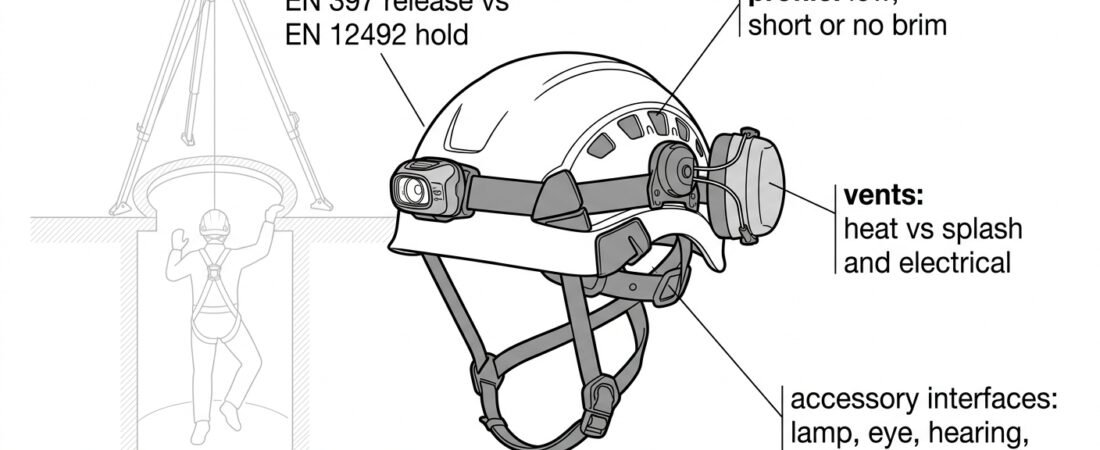
In a confined space, the head is exposed in ways it is not on an open work platform. The hazards are close and constant: fixed structure at head height, valve stems and flanges, a shaft above the worker down which tools and debris can fall, and — during vertical entry or work on rope — the possibility of a fall or a suspended body coming into contact with the wall. On top of that, the helmet has to share the head with a lamp, eye protection, hearing protection and often a respirator, and it has to still be on the head when a rescue team pulls the worker out. Selecting a helmet for confined space work is therefore less about the shell alone and more about three decisions: which retention performance the job needs, what shell profile fits the access route, and what the helmet has to be compatible with.
What the helmet is actually protecting against
Three distinct hazard patterns matter here, and they pull towards different helmet types:
- Impact from above. Dropped tools, falling debris, material dislodged from the shaft wall during entry and exit. This is the classic industrial case: energy arriving on the crown.
- Impact from the side, front and rear. Walking or crawling into structure, standing up under a beam, a pendulum swing against a wall, a slip on a wet ladder. In tight vessels and culverts this is by far the most frequent contact.
- Loss of the helmet at the wrong moment. A helmet that comes off during a vertical entry becomes a falling object for whoever is below, and leaves the worker unprotected for the rest of the job — including extraction.
Standard industrial head protection is designed principally around the first pattern. Confined space work usually involves all three.
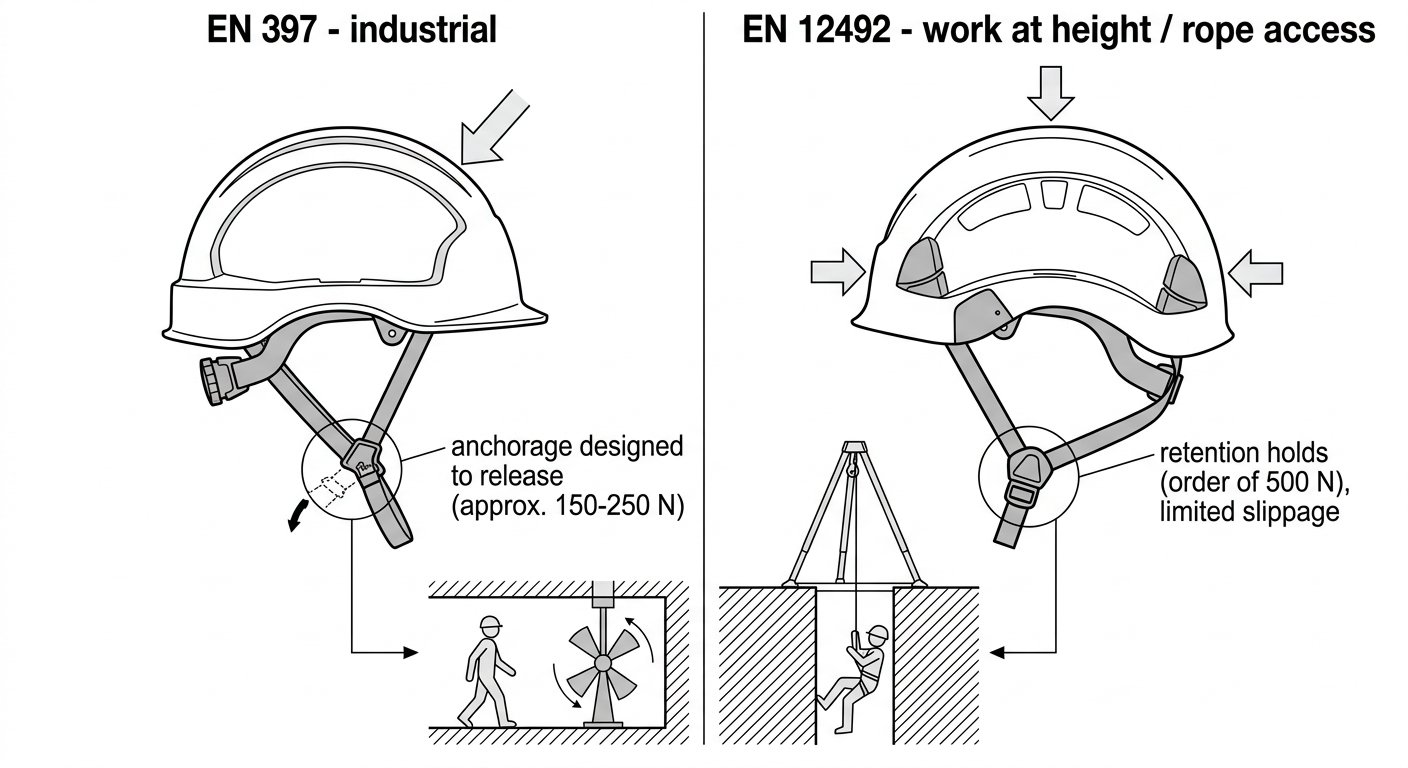
The chinstrap is the decisive difference: EN 397 anchorage is designed to release under load, EN 12492 retention is designed to hold.
EN 397 and EN 12492: the retention difference that drives the choice
Most helmets offered for this work are certified to EN 397 (industrial safety helmets), EN 12492 (helmets for mountaineers, widely used as the reference for work at height and rope access), or both. The shells often look similar. The important difference is in the chinstrap.
Under EN 397, where a chinstrap is fitted, its anchorage is required to release under load — the release force falls in a band in the region of 150–250 N. That behaviour is deliberate: in a plant environment, a helmet caught in machinery or on a fixed obstruction should let go rather than take the wearer’s neck with it.
Under EN 12492, the retention system is required to hold: it must resist a load on the order of 500 N without releasing, with limited slippage. That behaviour is also deliberate: a helmet that leaves the head at the start of a fall protects nothing during the fall or afterwards.
EN 12492 also places more emphasis on impact from directions other than the crown, and on penetration resistance, which is why it is the usual reference for rope access. EN 397, in turn, offers a set of industrial options that EN 12492 does not address at all.
Neither standard is automatically “better” for a confined space. The question is which failure mode is more credible on the specific job:
- Entry on foot into a large chamber with rotating equipment, agitators or conveyors running nearby, no fall potential: the releasing chinstrap of EN 397 is a genuine safety feature.
- Vertical entry through a manhole on a tripod or davit, descent on rope, work in suspension, or any task where a fall or a pendulum is credible: retention to EN 12492 is what keeps the helmet on the head through the event and through the rescue.
This mirrors the way equipment is selected elsewhere in the system — the same logic applied in choosing which harness suits which use applies to the helmet: define the access method first, then select the certification that matches it.
Dual-certified and switchable-retention helmets
Because many confined space jobs contain both situations, several manufacturers certify a single helmet to both standards. Two approaches are common. Some models pass both sets of requirements as supplied. Others provide a switchable chinstrap: an internal lever or buckle setting that selects either the releasing behaviour required by EN 397 or the high-strength retention required by EN 12492.
If you buy a switchable helmet, the switch position becomes part of the pre-entry check. A helmet set to the releasing mode and then used for a vertical rope entry is, in practice, a helmet that may not stay on. Decide the mode at the permit stage, not at the hatch, and record it with the rest of the entry preparation — the same discipline described in the confined space entry permit sequence.
Shell profile, brim and upward vision
Shell geometry matters more in a confined space than almost anywhere else, and it is routinely overlooked.
Brim. A full peak or a full brim is useful outdoors and under light rain, but in a shaft it blocks the view upward. A worker on a ladder or in a tripod system needs to see the hatch, the anchor, the standby person and the rope above them. A short-brim or brimless (“peakless”) shell recovers that field of view. A brim also fouls the upper strap of a full-face respirator and the top of many welding shields.
Overall profile. Every millimetre of shell adds to the effective width and height of the worker’s head. Low-profile, close-fitting shells pass through tight manholes and side entries with less snagging and less need to tilt the head. In very tight spaces the helmet is what contacts the structure first — a smooth shell with recessed accessory slots snags less than one with protruding clips.
Ventilation. Vents help enormously in hot, humid vessels. They are unacceptable where there is a risk of splash from chemicals or molten metal, or where the helmet is relied upon for electrical insulation. Vented and non-vented versions of the same model are commonly available; choose per the atmosphere, not per comfort alone.
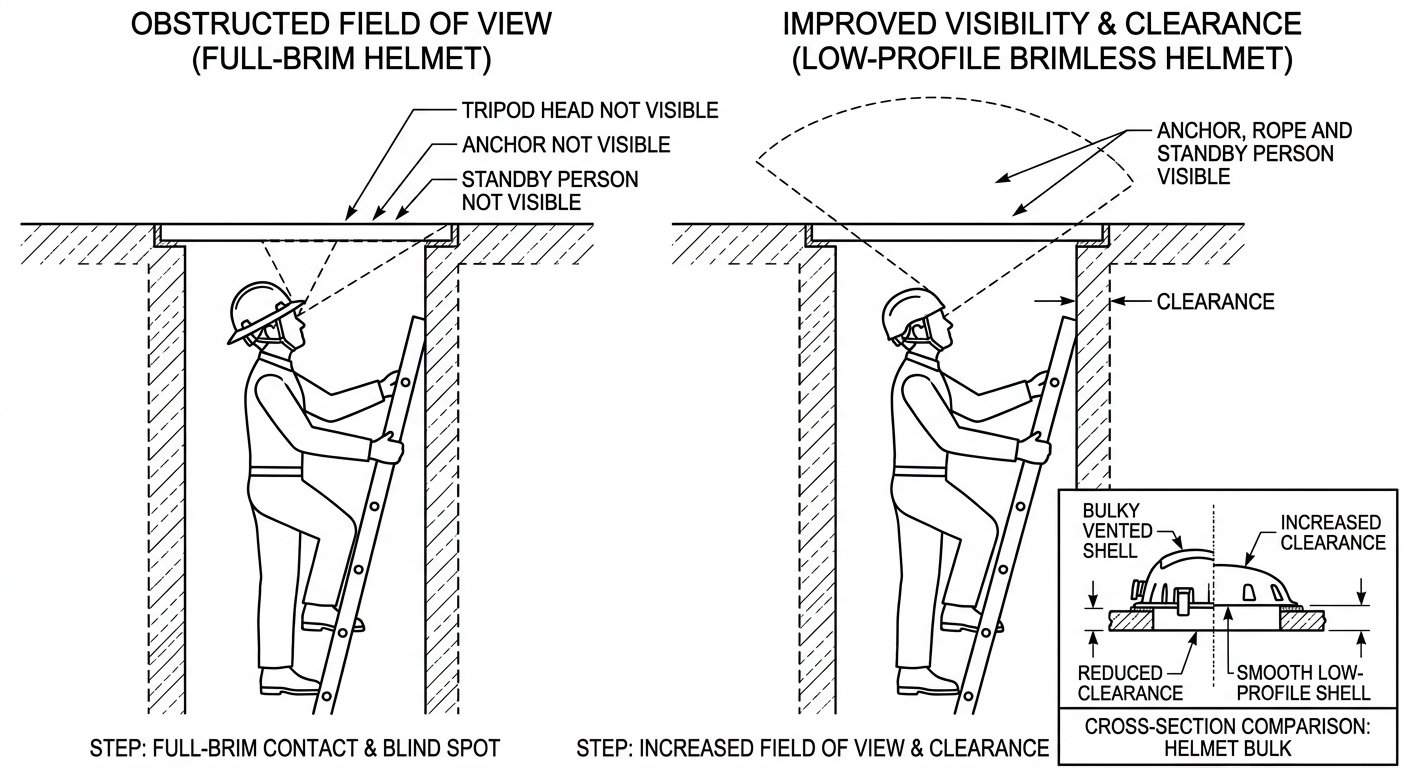
In a shaft, brim and shell profile decide whether the worker can see the anchor, the rope and the standby person above them.
Optional performance markings worth specifying
EN 397 defines a set of optional requirements which, when met, are marked on the helmet. Those most relevant to confined space and vessel work are:
- Low temperature (typically marked −20 °C or −30 °C) — cold-weather entries, refrigerated plant, cryogenic areas.
- Very high temperature (+150 °C) — hot work environments, furnace and boiler internals.
- 440 V a.c. — limited electrical insulation of the shell.
- MM (molten metal splash) — foundry and smelter work.
- LD (lateral deformation) — resistance to crushing loads from the side, relevant wherever the head can be trapped between structure or where a partial collapse is credible.
Where work is carried out near live low-voltage installations, EN 50365 covers helmets electrically insulating for use on low-voltage systems; helmets to that standard are non-vented by design. Note that any electrical marking applies to the helmet as supplied — drilling the shell, or fitting an unapproved accessory into it, voids it.
Specify only the options the job genuinely requires. Each one tends to add weight or remove ventilation, and an uncomfortable helmet gets loosened or removed.
Mounting a lamp
Confined space work is almost always dark, and both hands are usually occupied, so the primary work light generally lives on the helmet. Two practical points:
- Use the helmet’s designed lamp interface — moulded slots, integrated clips or a manufacturer-supplied adapter. Do not drill the shell. Do not run an elastic headband over a helmet where it can be knocked off; where a band is used, thread it under the designed retaining features.
- Check the atmosphere rating. In spaces where a flammable atmosphere is possible, the lamp — not just the helmet — has to be suitable for the classified zone. A general-purpose headlamp is not made acceptable by being mounted on a good helmet.
A secondary light source carried on the person is normal practice; the helmet lamp is the one that gets knocked or splashed first.
Sharing the head with other PPE
Confined space entries stack protective equipment on a single head, and the interfaces are where problems appear. Test the full combination on the actual wearer before the job, not in isolation.
- Respiratory protection. With a full-face mask or a supplied-air/escape hood, the mask harness or hood generally goes on first and the helmet over it. A brim, a deep shell or a bulky rear adjuster can lift the mask off the face or displace the head harness. Any interference that disturbs the face seal is disqualifying: seal integrity takes priority over the helmet, so change the helmet.
- Hearing protection. Helmet-mounted cups (certified as helmet-mounted attenuators) keep the head tidy, but attenuation depends on the specific helmet–cup combination, and mounted cups can be pushed out of position by structure in a tight space. Banded or in-ear protection may perform better where the helmet is constantly in contact with the wall. Selection logic for the protector itself is covered under EN 458, hearing protector selection.
- Eye protection. Integrated visors or helmet-mounted eye shields avoid the temple-arm conflict that spectacles create under a chinstrap, and are less likely to be dislodged in a crawl. Where separate spectacles or goggles are worn, confirm the strap route does not sit under the helmet’s rear adjuster.
- Harness and rescue. During extraction on a tripod, the casualty’s head is close to the shaft wall and the helmet is loaded against it. That is the moment the retention performance from EN 12492 matters — and the moment a well-fitted harness matters too, as covered in adjusting a full body harness correctly.
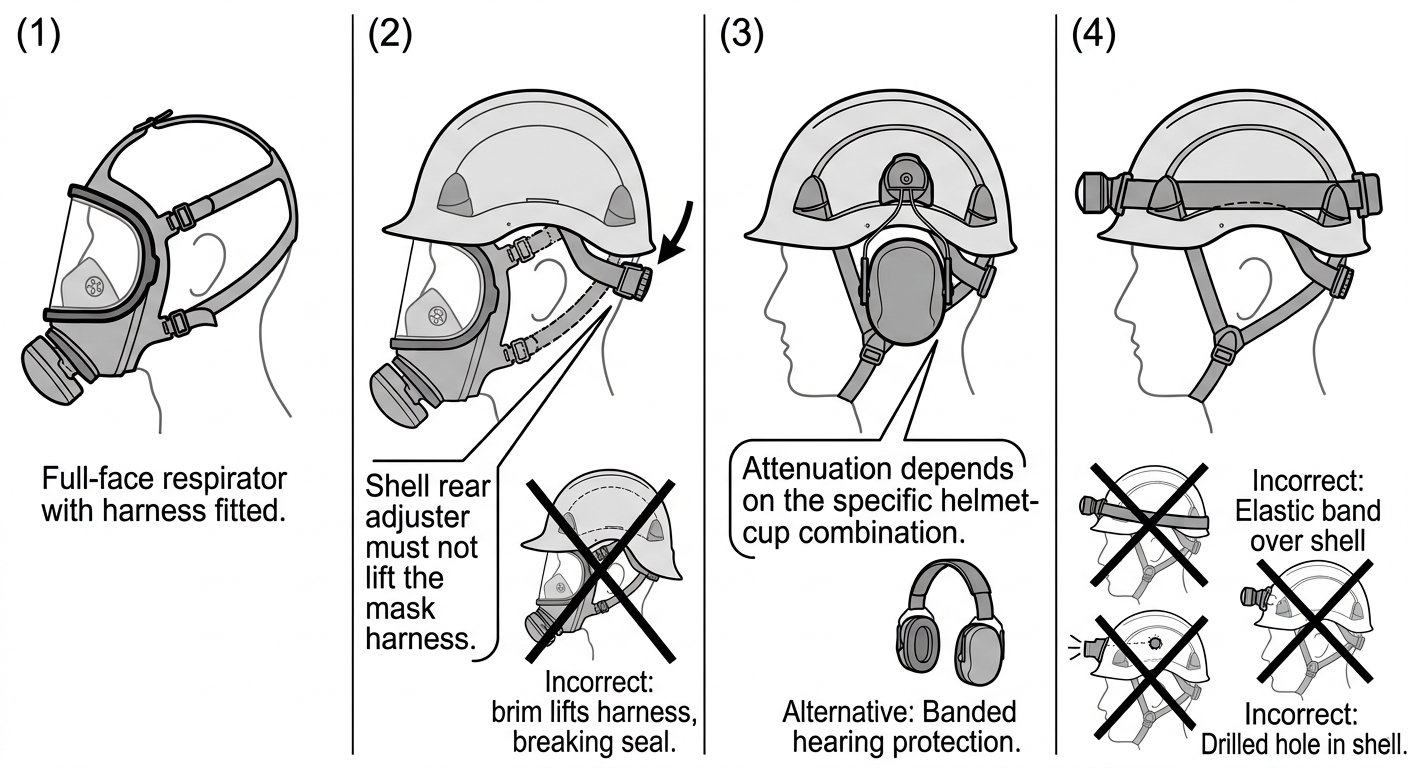
Trial the whole head assembly on the actual wearer: the interfaces between mask, helmet, hearing protection and lamp are where problems appear.
Fit and adjustment
A helmet that is not adjusted does not perform as tested. On issue, and again before each entry:
- Set the headband circumference so the helmet is firm without pressure points; the shell should not rock forward and back when the head is shaken.
- Set the headband height so the shell sits level and low enough to cover the forehead, without pushing the eyes into the front rim or blocking upward view.
- Fasten and tension the chinstrap. A four-point (Y-shaped) strap resists forward and rearward rotation better than a simple two-point strap — worth having wherever the wearer may end up inverted, which in a confined space is more often than people expect.
- Bend forward and look up. The helmet should stay in place with no need for a hand.
Long hair should be tied back and contained; loose hair under a headband displaces the fit and is a snag hazard around rotating equipment.
Markings, inspection and retirement
The information moulded or printed inside the shell tells you what you have: the applicable standard(s), the shell material, the size range, the manufacturer, and the date of manufacture. Keep it legible — do not paint over it, and do not apply solvent-based stickers or markers to a shell without confirming compatibility, since some solvents and adhesives attack thermoplastics and can produce cracking that only shows up under impact.
Before each entry, check the shell for cracks, deep scoring, gouges, deformation, chalky or crazed surfaces and colour change from UV exposure; check the harness webbing and stitching, the headband, the adjuster and the chinstrap buckle; and confirm all accessory mounts and the lamp are secure. On a switchable helmet, confirm the chinstrap mode.
Withdraw the helmet from service after any significant impact, even if no damage is visible — energy-absorbing structures are designed to be used once. Follow the manufacturer’s stated service life and storage guidance; heat, UV and chemical exposure all shorten it, and a helmet stored on a vehicle dashboard ages far faster than one kept in a bag.
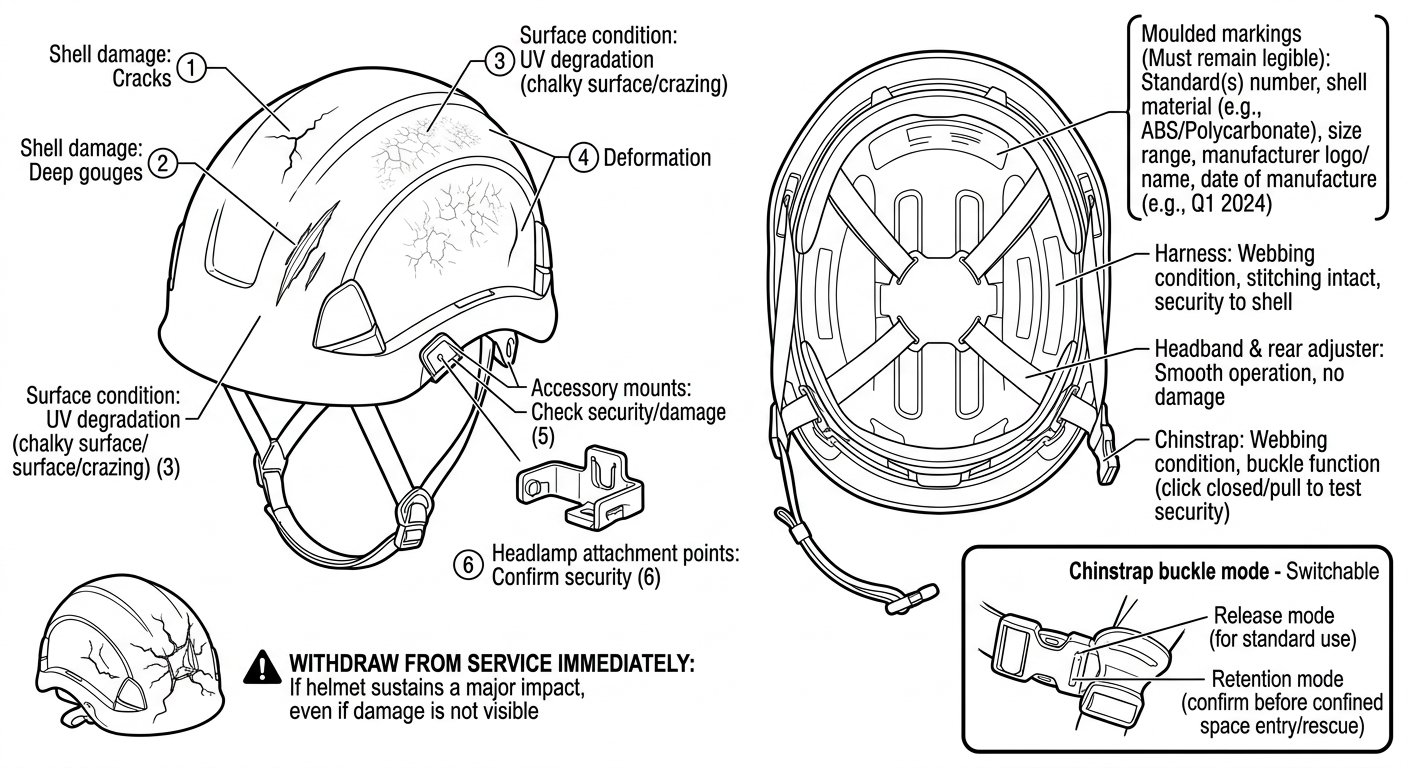
Pre-entry check: shell condition, harness and chinstrap, legible internal markings, and — on switchable helmets — the chinstrap mode.
Selection summary
- Define the access method first. Vertical entry, rope work or any credible fall or pendulum points to retention performance to EN 12492 (or a dual-certified helmet set to that mode). Walk-in entry near running machinery points to the releasing chinstrap of EN 397.
- Choose a low-profile, short-brim or brimless shell so the worker can see the hatch, the anchor and the standby person above them.
- Take vents for heat, refuse vents where there is splash, molten metal or an electrical insulation requirement.
- Specify only the EN 397 options the job needs — low temperature, high temperature, 440 V a.c., MM, LD — plus EN 50365 where electrical insulation is required.
- Use the designed lamp interface, with a lamp suitable for the classified zone.
- Trial the complete head assembly — helmet, lamp, eye, hearing and respiratory protection — on the actual wearer before the entry.
- Adjust it, check it, and retire it after impact.
For the other selection notes in this series — harnesses, connectors, lanyards and descent equipment — see the rope access and confined space technique notes.
Frequently asked questions
Can a standard industrial hard hat be used for confined space entry?
For a walk-in entry with no fall potential, a helmet to EN 397 with a fitted chinstrap can be appropriate, and its releasing anchorage is a genuine advantage near rotating machinery. For vertical entry, rope work or anywhere a fall or pendulum swing is credible, a helmet with retention to EN 12492 is the better choice because it is designed to stay on the head through the event and the rescue. A brimmed hard hat with no chinstrap is not suitable for confined space work.
Why does EN 397 require the chinstrap to release while EN 12492 requires it to hold?
The two standards address different dominant hazards. EN 397 assumes an industrial plant where a helmet snagged in machinery or on fixed structure could injure the wearer’s neck, so the anchorage is designed to let go under a defined load. EN 12492 assumes work at height, where losing the helmet at the start of a fall leaves the head unprotected for the impact and everything that follows, so the retention system is required to hold a much higher load.
Are dual-certified EN 397 and EN 12492 helmets a good option?
Yes, and they are common for mixed confined space work. Some models meet both standards as supplied; others use a switchable chinstrap with a releasing setting and a high-retention setting. If the helmet is switchable, the mode becomes a pre-entry check item — decide it when planning the entry and confirm it before the worker goes through the hatch.
Should a confined space helmet have ventilation holes?
It depends on the atmosphere. Vents help considerably in hot, humid vessels, but they are unsuitable where there is a risk of chemical or molten metal splash, and helmets relied upon for electrical insulation are non-vented by design. Many models are offered in both vented and non-vented versions, so the decision should follow the hazard rather than comfort alone.
How do you fit a helmet over a full-face respirator?
The respirator and its head harness normally go on first and the helmet over it. Then check that the helmet’s brim, rear adjuster or headband does not lift the mask or displace the harness, because anything that disturbs the face seal is unacceptable. If there is interference, change the helmet — typically to a lower-profile, shorter-brim model — rather than compromising the respirator fit.
When should a confined space helmet be replaced?
Withdraw it after any significant impact, even with no visible damage, since energy-absorbing structures are intended for single use. Replace it if the shell shows cracks, deep gouges, deformation, or a chalky and crazed surface, or if the harness, headband, adjuster or chinstrap buckle is damaged. Otherwise follow the manufacturer’s stated service life, remembering that heat, UV and chemical exposure shorten it.