
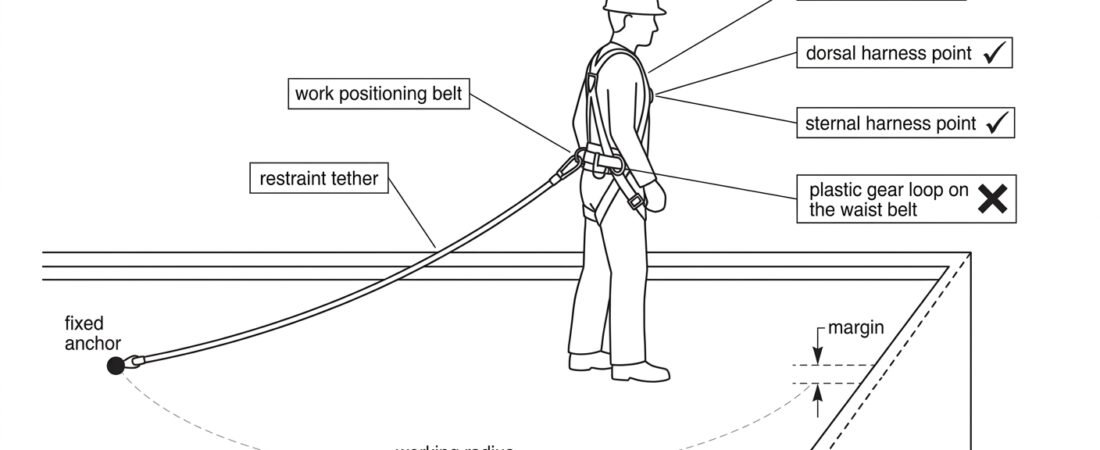
Restraint work looks simple on paper: connect to an anchor with a tether short enough that the worker cannot physically reach the fall hazard. Because a fall is designed out of the system rather than arrested, the attachment point on the body does not have to absorb a fall load — which is exactly why the choice gets treated carelessly. The practical questions on site are which points on the belt or harness are actually intended for this, which one keeps the tether out from under the worker’s feet, and which loops on the equipment are not attachment points at all. Getting that wrong either creates a trip hazard, loads a textile loop that was never designed for it, or leaves a system that fails the moment the risk assessment shifts from restraint to fall arrest.
Restraint is defined by the whole system, not by the point
In a correctly designed restraint system, the attachment point carries no load during normal work. It only sees load when the worker walks or leans out to the limit of the tether and comes up against it — a static pull, roughly body weight or less, applied slowly and horizontally. That is a mild duty compared with fall arrest or work positioning.
Two consequences follow. First, several different points on typical equipment are technically adequate. Second, the decision should be driven by geometry and by what happens if the assessment changes, not by load capacity alone.
The candidate attachment points
On the equipment most crews already own, there are usually four or five places a restraint tether could legitimately go.
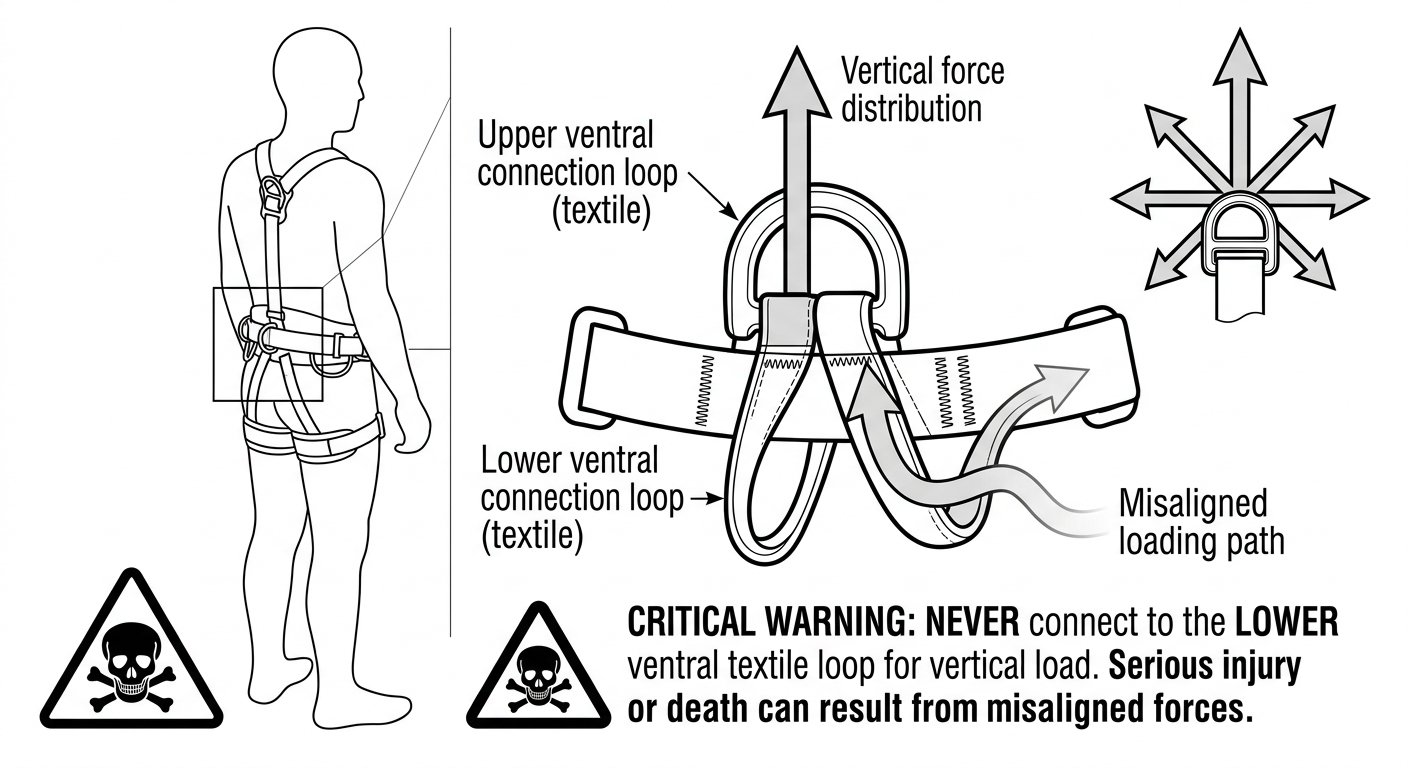
The legitimate candidates for a restraint tether: rear and lateral belt points, and the sternal, dorsal or ventral harness attachments.
- Rear (dorsal) point on a work positioning belt. Many belts built to EN 358 (work positioning and restraint belts) carry a single rear attachment point specifically intended for restraint. It sits behind the worker, in the direction the tether naturally runs when the worker faces the work and the anchor is behind them.
- Lateral (side) points on a belt. Also EN 358 points. These are designed to be used as a pair for work positioning, with a lanyard passing through both. For restraint, a single lateral point is generally acceptable, but check the manufacturer’s instructions — some explicitly permit single-point restraint use, others do not.
- Dorsal point on a full body harness. The fall-arrest attachment on a harness certified to EN 361 (full body harnesses). Perfectly usable for restraint, and the most future-proof choice on a surface where the hazard picture might change.
- Sternal point on a full body harness. Also an EN 361 fall-arrest point, also usable for restraint. Useful when the anchor is ahead of the worker and the tether needs to stay in view.
- Ventral point on a sit or rope-access harness. A load-bearing attachment intended for suspension and work positioning. Most manufacturers permit restraint use, but this is a point where instructions vary, so read them rather than assume.
Rear point first, for one practical reason: tether routing
The usual restraint geometry on a flat roof or a platform is that the anchor is behind the worker and the hazard is in front. A tether leaving from the rear of the belt or harness runs straight back along the ground, clear of the feet, and comes tight against the back of the body when the worker reaches the limit. That is a comfortable, predictable stop.
A tether leaving from a lateral point on the same job runs diagonally across the body or under one leg. It snags on boots, gets stood on, and pulls the worker sideways at the limit rather than straight back. On a sternal point the tether hangs down the front, into the work.
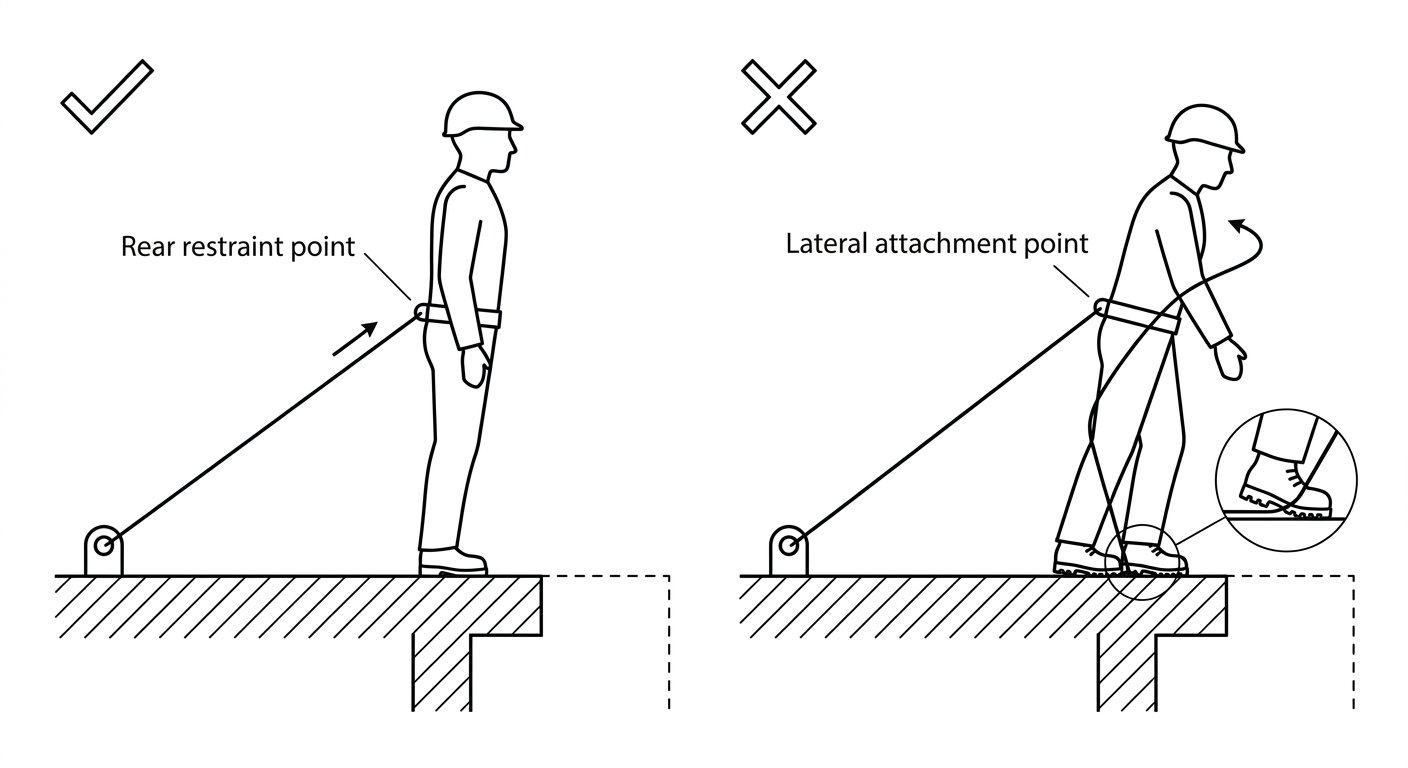
With the anchor behind the worker, a rear point keeps the tether clear of the feet; a lateral point routes it across the body.
None of that makes lateral or sternal points wrong — it makes them the second choice on that particular layout. Where the anchor is ahead of the worker, or where a rear tether would drag through wet debris, sealant or hot work, a sternal or lateral point may be the better answer. Choose the point that keeps the tether out of the work and out from under the feet, not the one that is habitual.
When to use the EN 361 harness points instead of the belt
Restraint depends on an assumption: the surface is stable and level enough that the worker cannot fall from where they are standing. That assumption fails more often than people expect — a section of fragile roof light appears inside the working arc, a temporary opening is uncovered, the surface turns out to slope more than it looked from the ground, or the tether has to be extended to reach part of the task.
If the system might have to become a fall-arrest system mid-shift, connect at the harness dorsal or sternal point from the start. Those points will accept a fall-arrest lanyard or a rope grab; a belt attachment point never will. This is the same logic set out in the selection note on which harness to choose for fall arrest, positioning, rope access and confined space: pick the equipment for the worst credible case on that job, not the mildest.
Stated plainly: an EN 358 belt attachment point must never be used for fall arrest. Belt-only restraint is defensible only where a fall genuinely cannot occur anywhere within the tether’s reach, and where that has been checked on the surface rather than assumed from a drawing.
What is not an attachment point
Every harness and belt carries loops that are not for connecting to an anchor. Under a restraint load they may hold, may tear, or may hold long enough to be trusted next time.
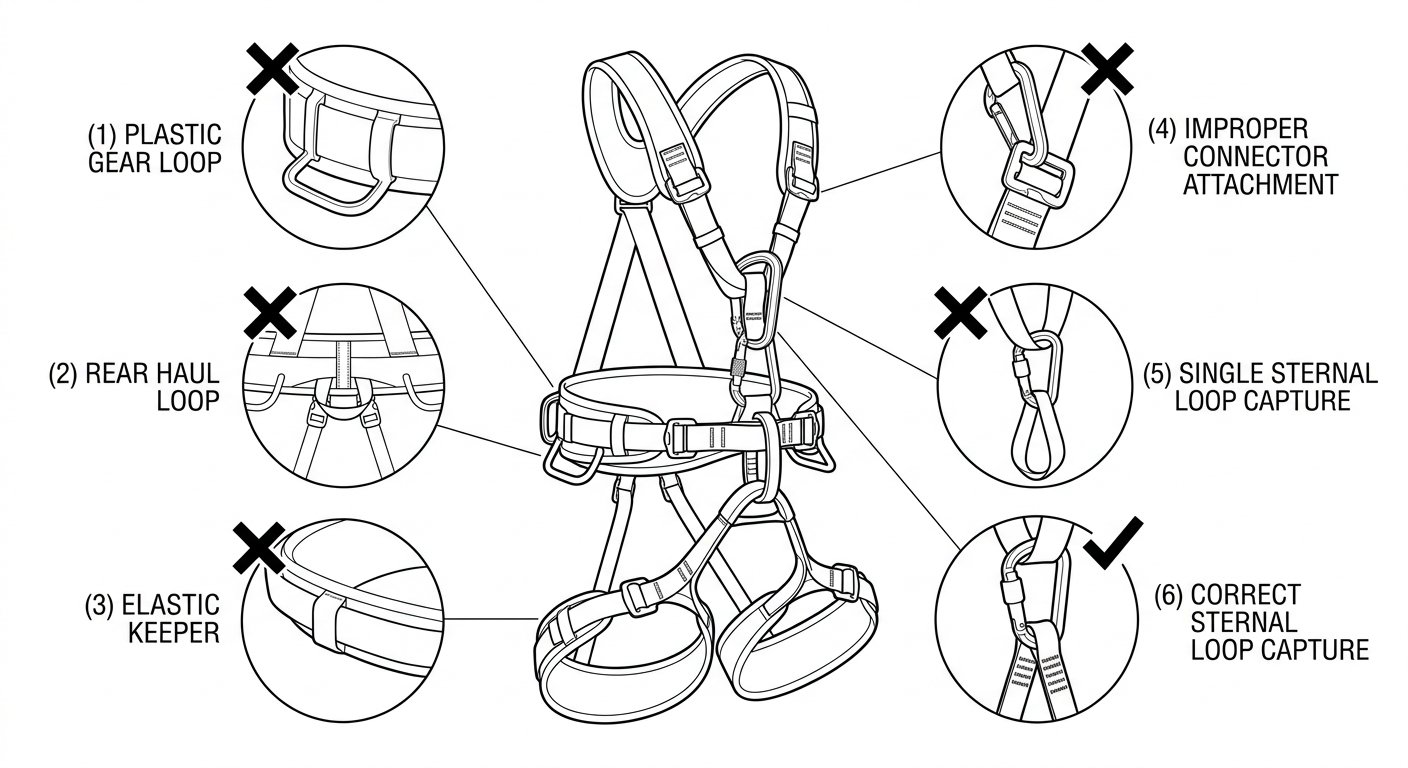
Loops that are not attachment points: gear and haul loops, keepers, adjusters, and half of a paired sternal attachment.
- Gear and tool loops. Typically plastic or light webbing, rated for equipment only, often with no rating at all. Never a tether point.
- Rear haul or trailing loops. On some rope-access harnesses a small rear loop is provided for carrying a rope tail. It is not a body attachment point and is easily mistaken for the dorsal point.
- Elastic keepers, strap retainers and label pockets. Housekeeping hardware, nothing more.
- Structural webbing, buckles or adjusters. Clipping around a shoulder strap or through an adjuster loads the harness in a direction it was never designed for and can slip the adjustment.
- One half of a paired attachment. Where a sternal or lateral attachment is formed by two textile loops or two rings intended to be captured together, the connector must take both. Half of a paired point is not a point.
The same confusion arises when choosing where a rope grab goes, and the reasoning is worth reading across: see the note on sternal, dorsal and what not to clip into for a rope grab.
The point is only half the decision — length and arc are the other half
A correctly chosen attachment point on an over-long tether is still a fall hazard. Restraint length has to be set against the full arc the worker can sweep from the anchor, and that arc has to stay clear of every edge, opening and fragile panel within reach.
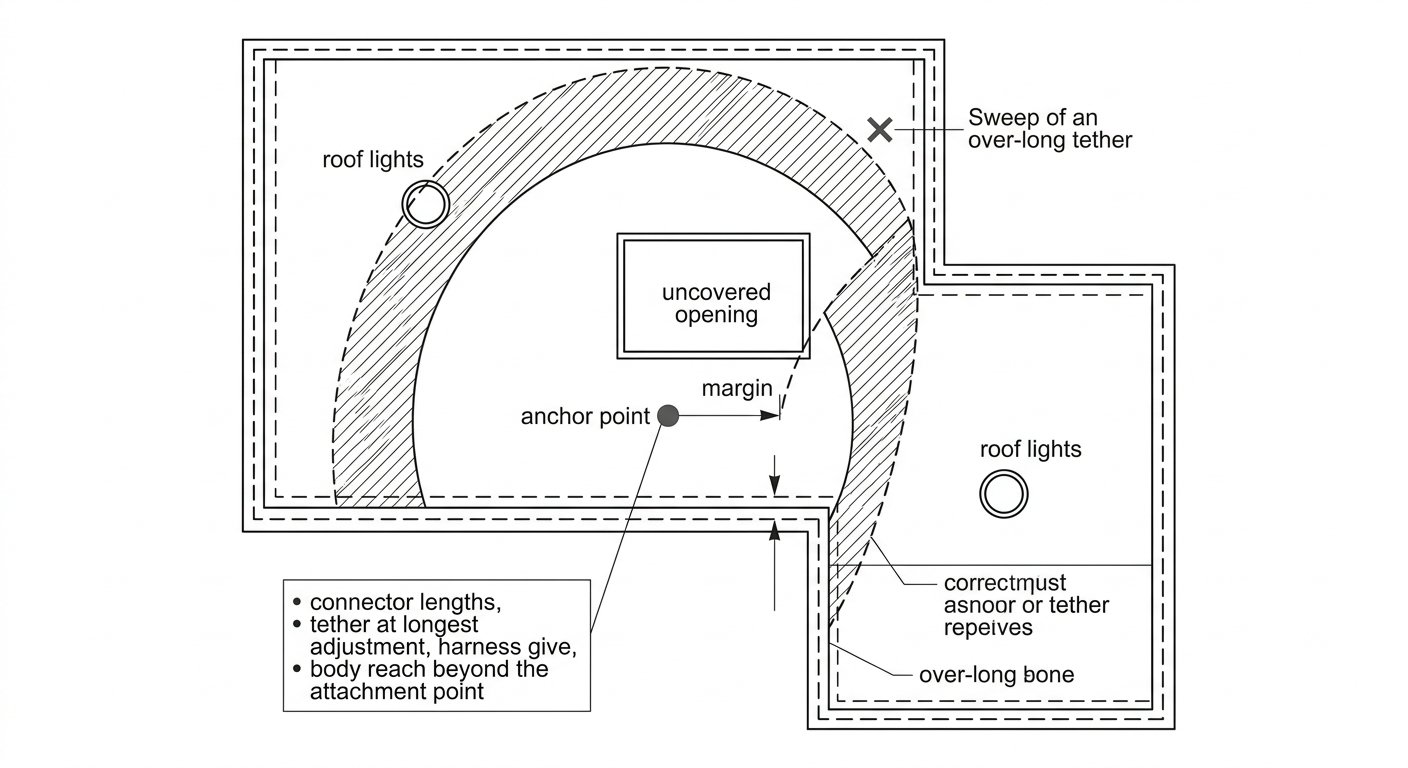
Restraint length is set against the full arc the worker can sweep, including corners, openings and roof lights, not just the nearest edge.
Practical points when setting the length:
- Measure to the hazard, not to the nearest edge. Corners, re-entrant edges, roof lights and uncovered penetrations all sit inside the arc even when the obvious edge does not.
- Account for everything in the chain: connector lengths, tether length at its longest adjustment, harness give under load, and the reach of the body beyond the attachment point when a worker leans out.
- Leave margin. A tether set so the worker’s toes reach exactly to the edge is not restraint.
- With an adjustable tether, set it and lock the adjuster deliberately, then verify by walking the limit of the arc before starting work. Anyone who can lengthen it during the shift can defeat the system.
- On a horizontal flexible anchor line, the line’s deflection under load adds to the effective radius. Include it.
The connector at the harness end
Restraint loads are low, but the failure modes of a badly matched connector are not load-dependent. A connector to EN 362 (connectors for fall protection) should sit in the attachment point so that it loads along its major axis, cannot ride onto the gate, and cannot lever against a rigid ring or a stiff textile loop. Wide steel D-rings and small alloy karabiners are a common mismatch: the karabiner rotates and cross-loads. Where a restraint tether is clipped and unclipped repeatedly, prefer a connector whose locking action does not depend on the user remembering to screw it shut.
Field summary
- Default: rear restraint point on an EN 358 belt, or the dorsal point on an EN 361 harness, with the anchor behind the worker.
- Anchor ahead of the worker, or tether must stay in view: sternal EN 361 point, or a lateral belt point if the manufacturer permits single-point use.
- Any chance the job turns into fall arrest: use the harness EN 361 points, not the belt.
- Never: gear loops, haul loops, keepers, adjusters, structural webbing, or one half of a paired attachment.
- Always: confirm the tether length against the full working arc, including corners and openings, before the first task of the shift.
For related technique notes on harnesses, connectors, tethers and confined-space procedure, see the full set of rope access and confined space technique notes.
Frequently asked questions
Can I use a work positioning belt on its own for restraint?
Only where a fall genuinely cannot occur anywhere within the tether’s reach, and where that has been verified on the surface rather than assumed. Belt attachment points to EN 358 are intended for restraint and work positioning, never for fall arrest. If there is any prospect of the system having to arrest a fall, use a full body harness and its EN 361 attachment points.
Should a restraint tether go on the rear point or a side point?
It depends on where the anchor sits. With the anchor behind the worker, a rear point runs the tether straight back, clear of the feet, and stops the worker squarely; a lateral point routes it diagonally across the body where it can be stood on. Where the anchor is ahead of the worker, a sternal or lateral point may route better.
Is it acceptable to use a single side D-ring rather than both?
Lateral belt points are designed to be used as a pair for work positioning, where the lanyard passes through both. For restraint, many manufacturers permit a single lateral point because the loads are low and horizontal, but practice varies between products. Check the instructions for use for that specific belt or harness before relying on one side alone.
Can I use the dorsal fall-arrest point for restraint?
Yes. A dorsal EN 361 attachment is fully suitable for a restraint tether, and it is the more robust choice where the hazard picture might change during the shift. It will accept a fall-arrest lanyard or rope grab later; a belt point never will.
Does restraint work on a sloping roof?
Generally no. Restraint relies on the worker being unable to fall from where they are standing, and a slope introduces the possibility of sliding even without reaching an edge. Sloping, slippery or otherwise unstable surfaces normally call for a fall-arrest or work-positioning system rather than restraint.
How do I set the tether length correctly?
Measure to the hazard rather than the nearest edge, and include every contribution to reach: connector lengths, the tether at its longest adjustment, harness give under load, and how far the body extends beyond the attachment point when leaning out. Leave a deliberate margin, lock any adjuster, and walk the limit of the arc to confirm it before starting work.